
生理学_神经系统
上篇:Overview
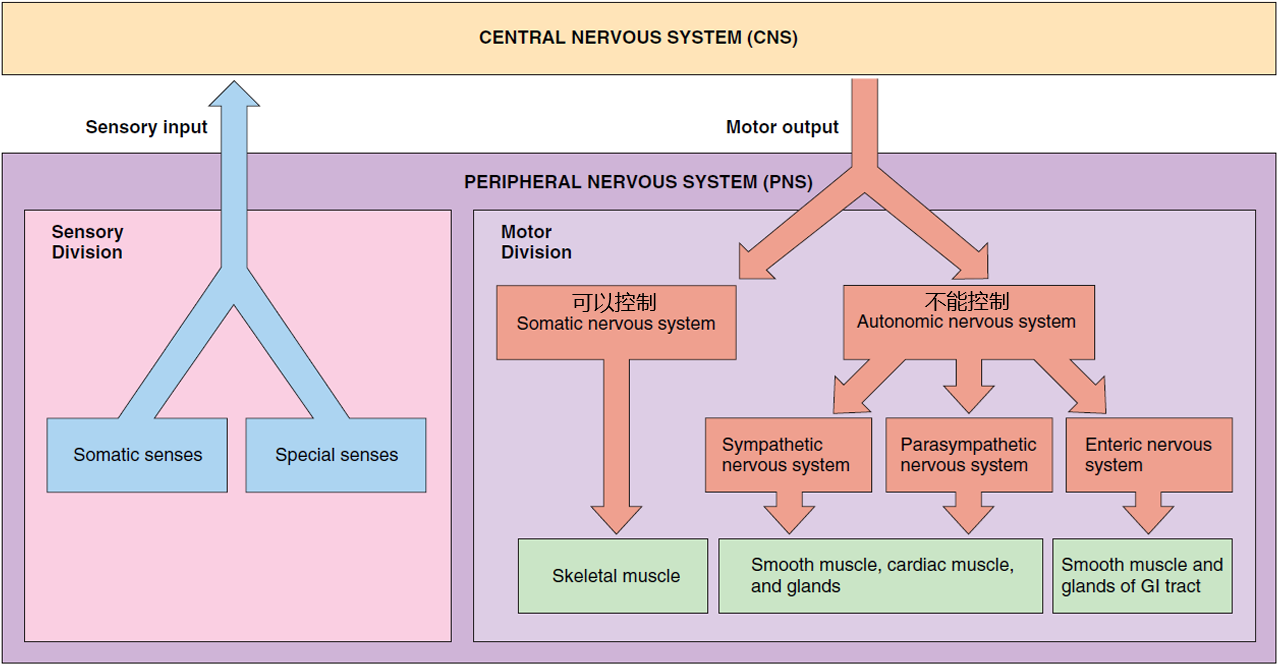
- Organization of the nervous system
- central nervous system
- brain
- cerebrum
- cerebellum
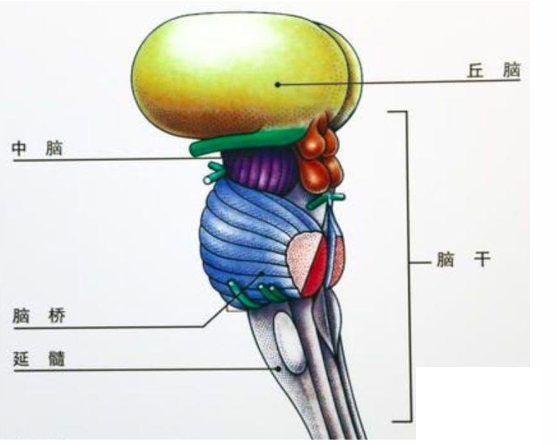
- brainstem
- Brainstem (脑干) = midbrain (中脑) + pons (脑桥) + medulla (延髓)
- Brainstem (脑干) = midbrain (中脑) + pons (脑桥) + medulla (延髓)
- spinal cord
- brain
- peripheral nervous system
- 12 pairs of cranial颅 nerves
- 31 pairs of spinal脊髓 nerves
- ENS enteric肠 nervous system
叫system表示可以独立工作,有反射弧 - sensory receptors
- functions→sensory (input),integrative (process),motor (output
- central nervous system
- Histology of nervous tissue
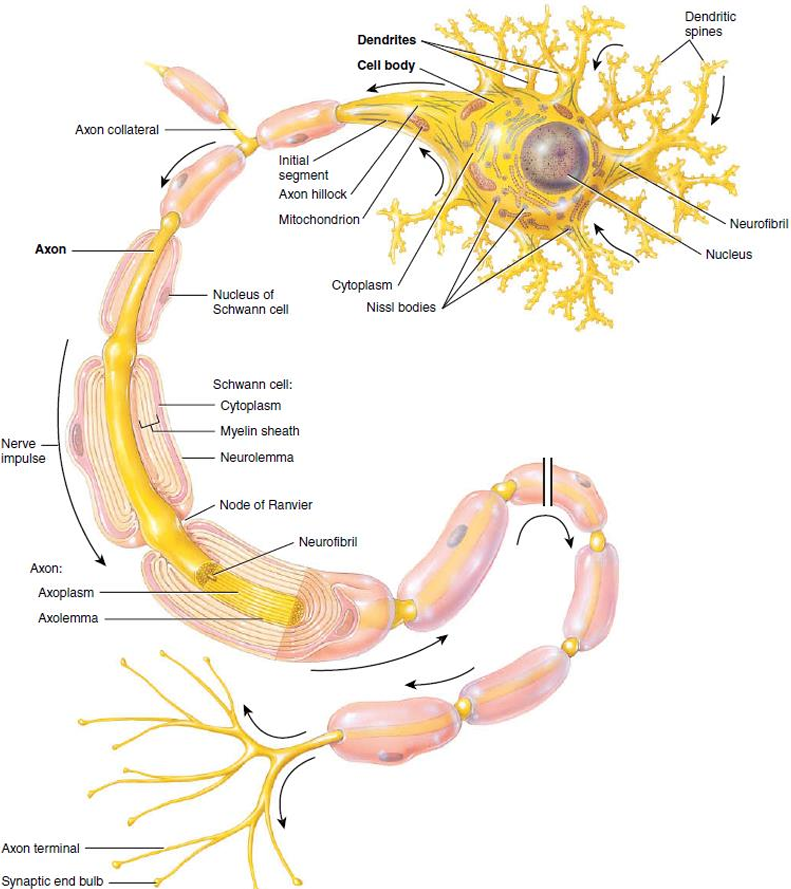
- neurons
- 结构
- cell body (胞体)
- inside the CNS, nucleus (核)
在中枢神经系统中叫神经核 - outside the PNS, ganglion (节)
在外周神经系统中叫神经节
- inside the CNS, nucleus (核)
- dendrites (树突)
- axon (轴突)
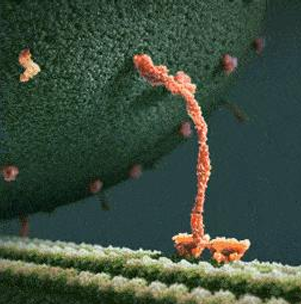
- axonal transport
- anterograde (顺向)
- retrograde (逆向)
- motor proteins 在microtubules上面走
- axonal transport
- myelinated nerve fiber (有髓神经纤维)
- unmyelinated nerve fiber (无髓神经纤维)
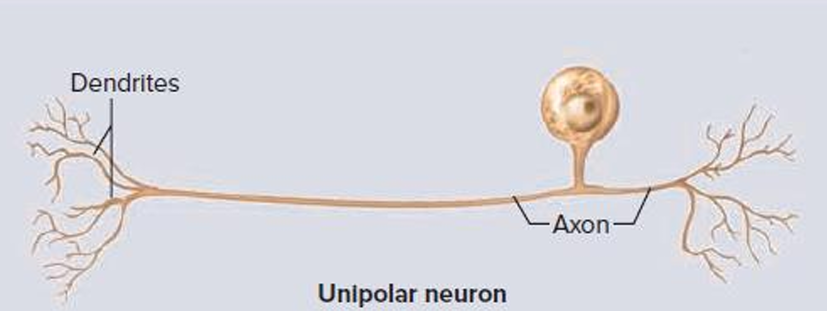
- 不同形状
- A multipolar neuron has many processes extending from the cell body
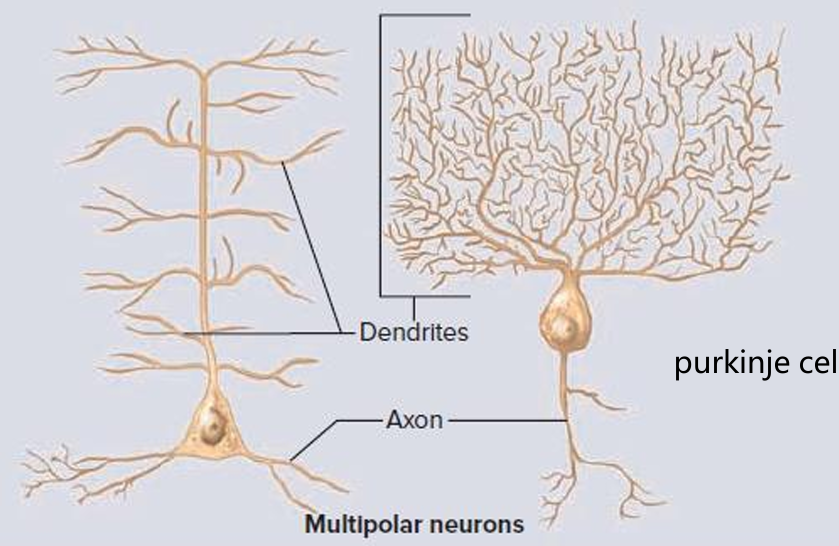
eg.浦肯野细胞
- A bipolar neuron has two
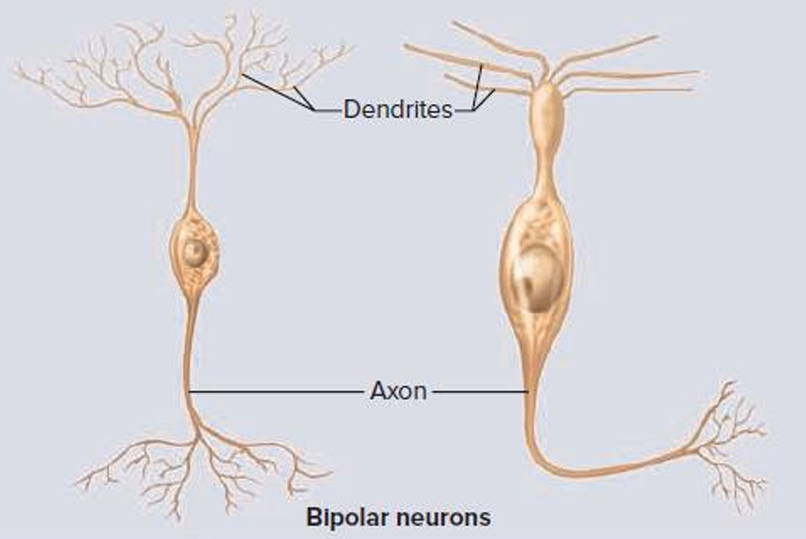
eg.pyramidal cell 锥形细胞
- A unipolar neuron has one
- A multipolar neuron has many processes extending from the cell body
- 结构
- neuroglia
- neuroglia of the CNS
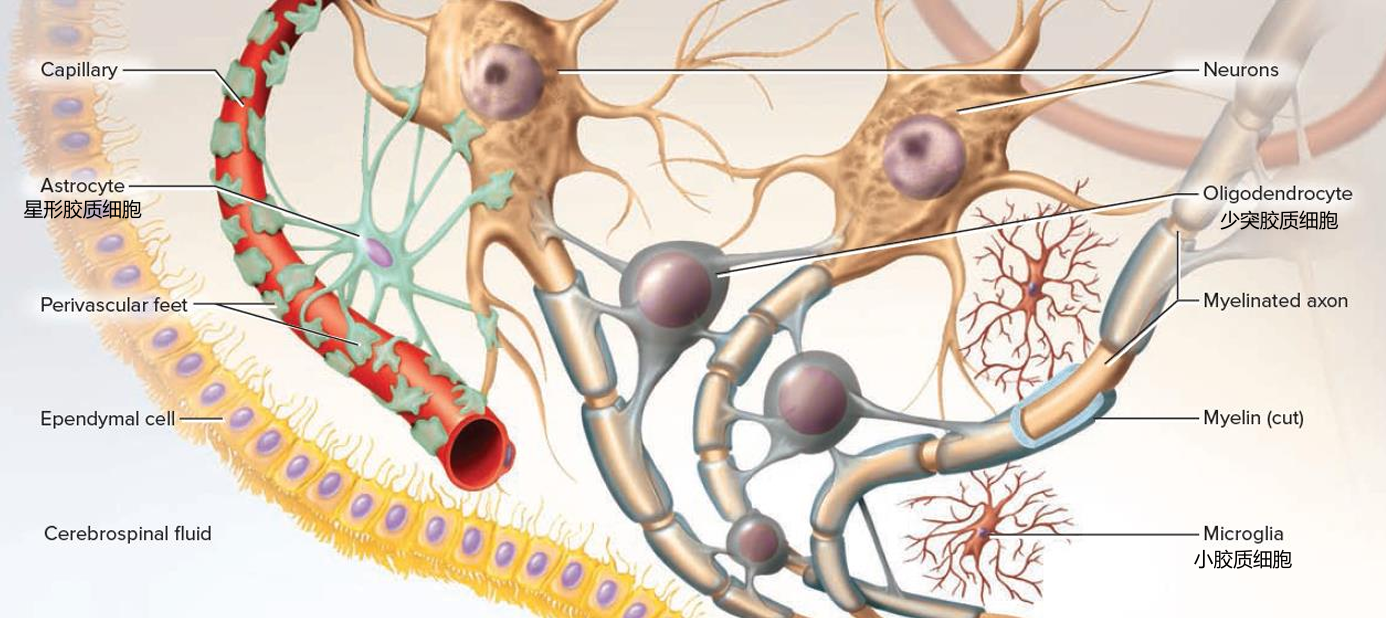
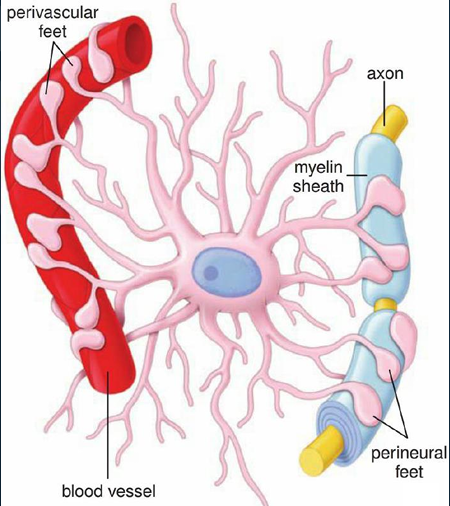
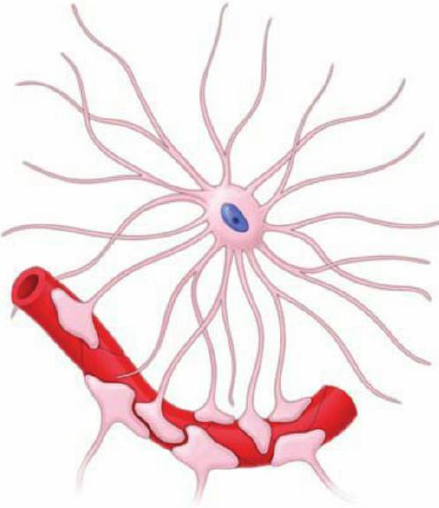
- Astrocytes 星形胶质细胞
- are the most abundant glia cells in the CNS
- They form a supportive framework
- supply with nourishment营养
- regulate nerve development and functons
- create the blood-brain barrier
- 灰质是cell body聚集的地方,protoplasmic astrocyte in the gray matter of the brain
- 白质是Axon聚集的地方, fibrous astrocyte in the white matter of the brain
- 灰质是cell body聚集的地方,protoplasmic astrocyte in the gray matter of the brain
- Oligodendrocytes 少突胶质细胞
- contain fewer processes
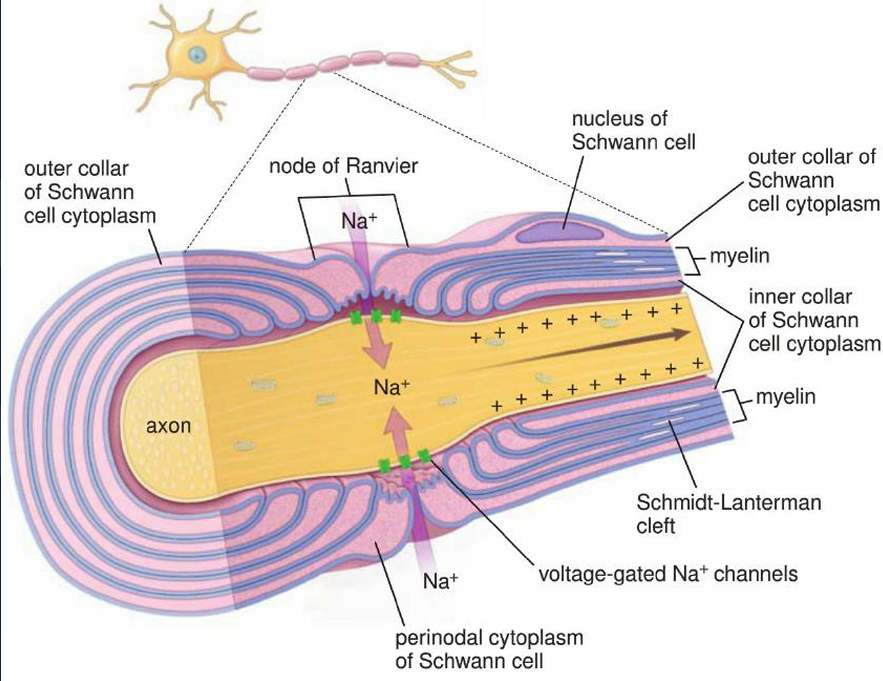
- They form the myelin sheath髓鞘 around CNS axons.
- Microglia 小胶质细胞
- develop from monocytes and have slender纤细的 processes凸起.
- They functions as macrophages and remove cellular debris and microbes in the CNS.
- neuroglia of the PNS
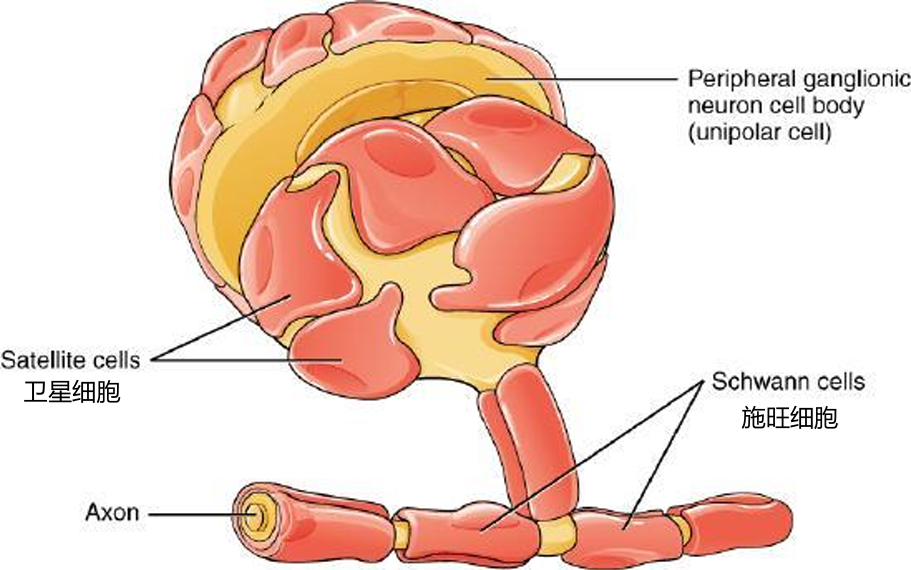
- Schwann cells
- form the myelin sheath around axons in the PNS
- participate in axon regeneration
- Satellite cells
- provide structural support and regulate the exchange of materials
- neuroglia of the CNS
- Myelin sheath
- node of Ranvier (郎飞结),只有朗飞结的地方有Na+通道
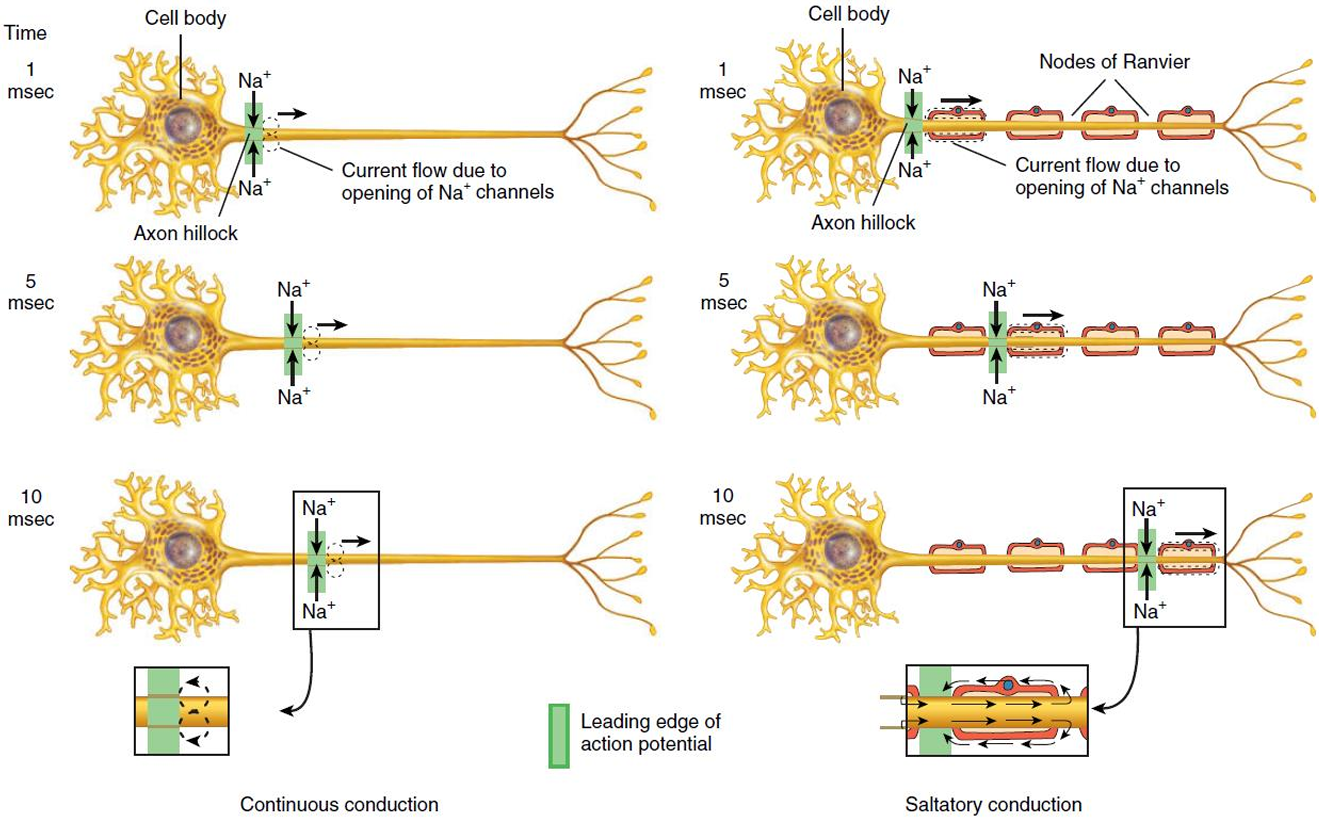
- continuous & saltatory conduction
- signal start at Axon hillock,这里有很多voltage gate Na+同搭配,high excitbility
- 髓鞘会导致电流回路更大,传导速度更快
- node of Ranvier (郎飞结),只有朗飞结的地方有Na+通道
- Neuroglia vs. neurons
- Both have processes, but can’t distinguish dendrites from axons in glia.
- Glia have gap junctions but not chemical synapses.
communicate - Glia does not generate action potentials.
- Glia can regenerate while neurons can not.
- Electrical signals in neurons
- Properties of AP conduction in nerve fibers
- integrity (完整性)
- insulation (绝缘性)
好几个并排的神经之间不会互相影响,有细胞外液隔着不导电 - bidirection/unidirection (双向性/单向性)
- indefatigability (不疲劳性)
- Factors affecting the velocity of conduction
- myelin sheath
- axon diameter ↑,velocity ↑
- temperature ↑,velocity ↑
- Properties of AP conduction in nerve fibers
- neurons
- Synapses
- A synapse ( 突触) is a region where communication occurs between two neurons or between a neuron and an effector cell.
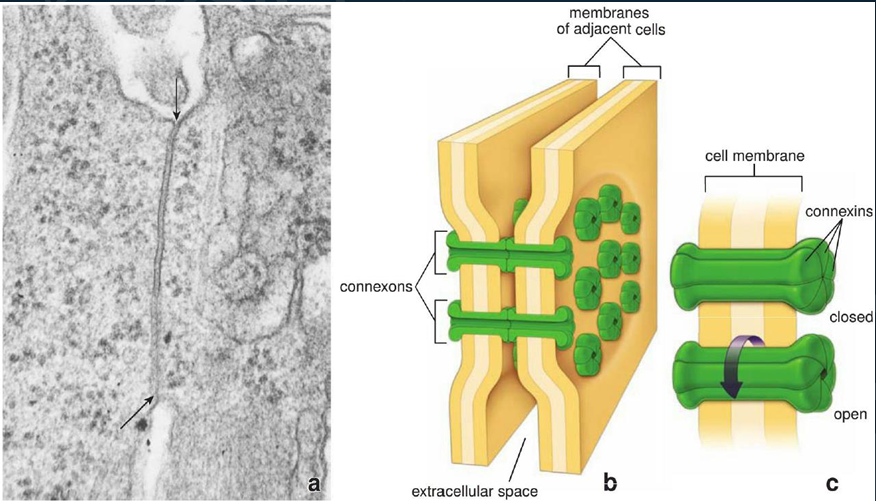
neuron muscular junction 也是突触 - Electrical synapses (电突触)
- 电突触 = gap junction = 闰盘 intercalated disc
- fast communication & synchronization
- 是一种没有选择性的 ion channel
- 电突触 = gap junction = 闰盘 intercalated disc
- Chemical synapses (化学突触)
- 结构
- presynaptic membrane 突触前膜
- synaptic cleft 突触间隙
- postsynaptic membrane 突触后膜
- 分类
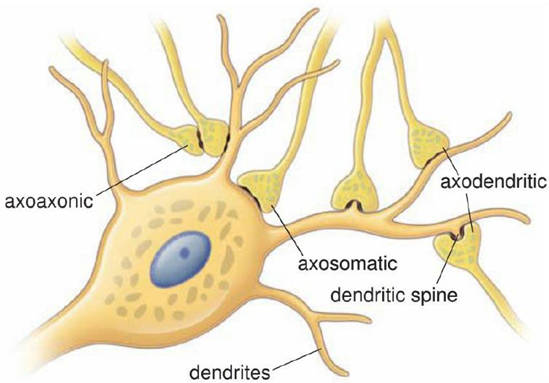
- directed synapses 定向突触
- 图
- axodendritic synapses (轴-树突触)
- axosomatic synapses (轴-体突触)
- axoaxonic synapses (轴-轴突触)
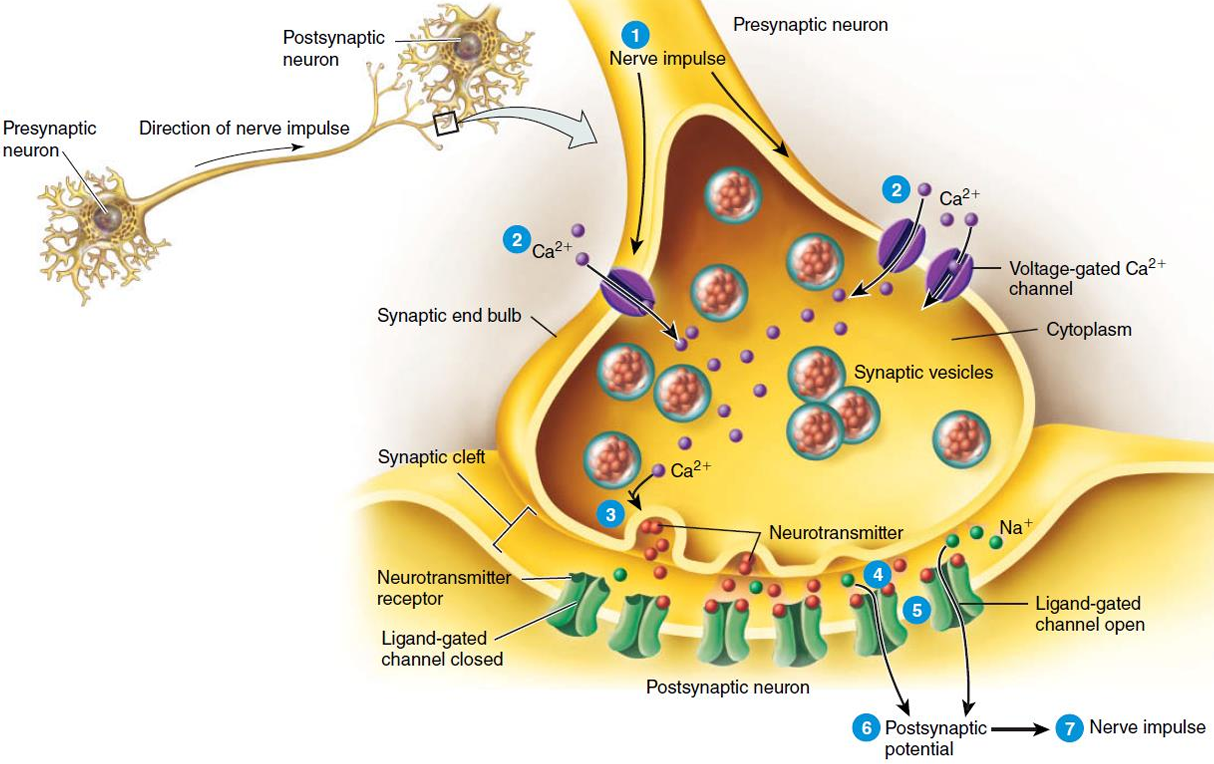
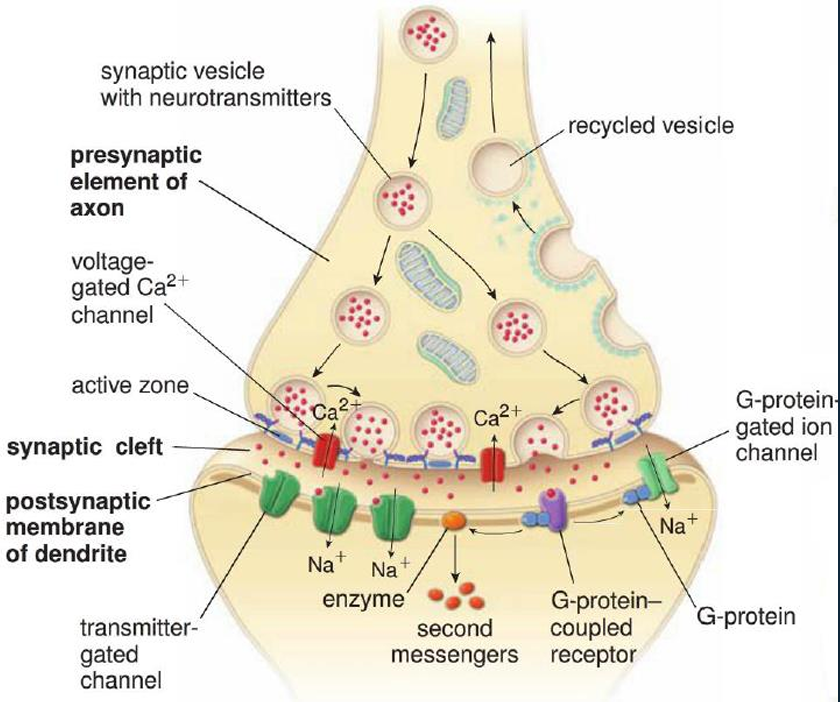
- signal transmission at a directed chemical synapse
- 图
- ① nerve impulse come
- ② voltage gate Ca2+ open,Ca2+ float in
- ③ Ca2+ direct vesicle fuse with membrane,neurotransmitter release
- ④ neurotransmitter bind to neurotransmitter receptor,ligand gated Na+ channel open
- ⑤ Na+ float in cause depolarization
- ⑥ postsynaptic potential rise
- ⑦ nerve impulse generate
- 图
- 图
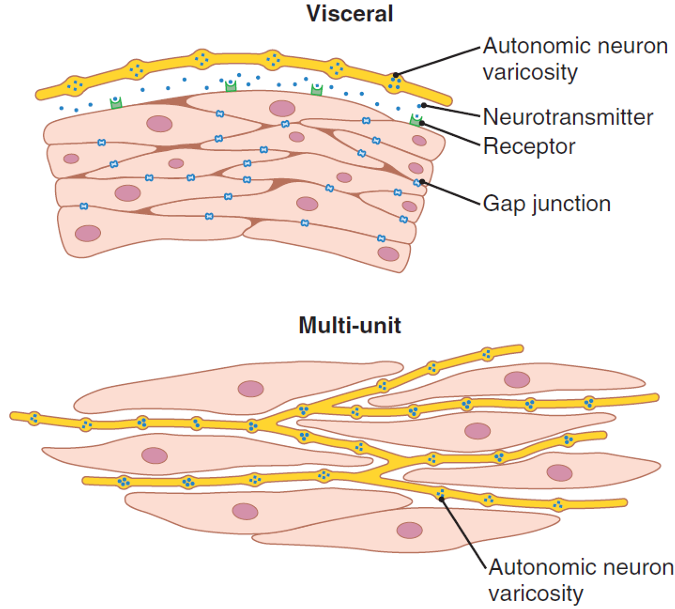
- undirected synapses 不定向突触
- Autonomic motor neurons usually form varicosities (曲张体) instead of neuromuscular junctions to innervate muscle fibers
- 不定向突出释放神经递质是一对多的
- directed synapses 定向突触
- 结构
- A synapse ( 突触) is a region where communication occurs between two neurons or between a neuron and an effector cell.
- Synaptic transmission
- Factors
- release of neurotransmitters
- Ca2+, action potential
- clearance of neurotransmitters
- reuptake, hydrolysis
- receptors
- affinity, expression
- release of neurotransmitters
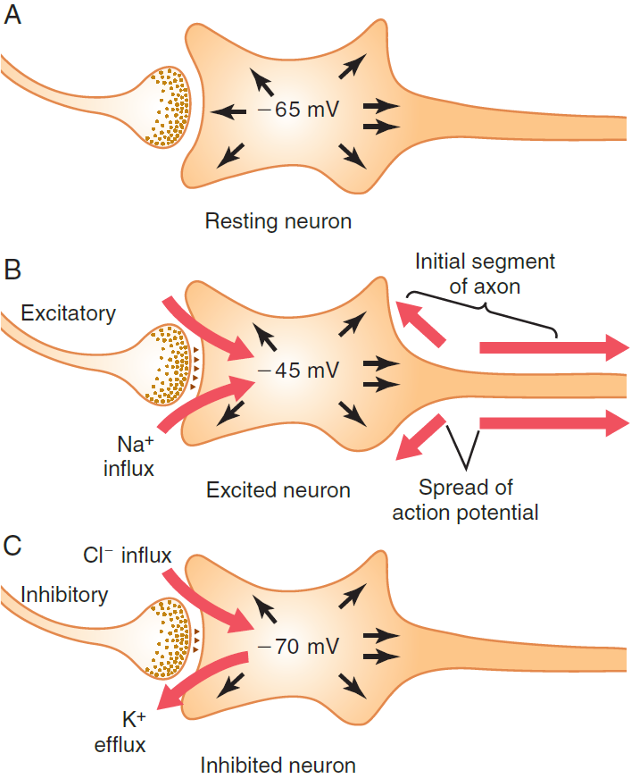
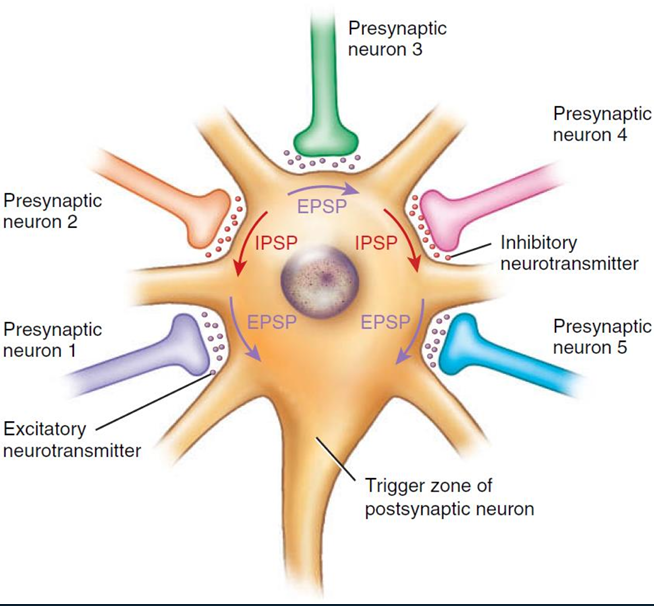
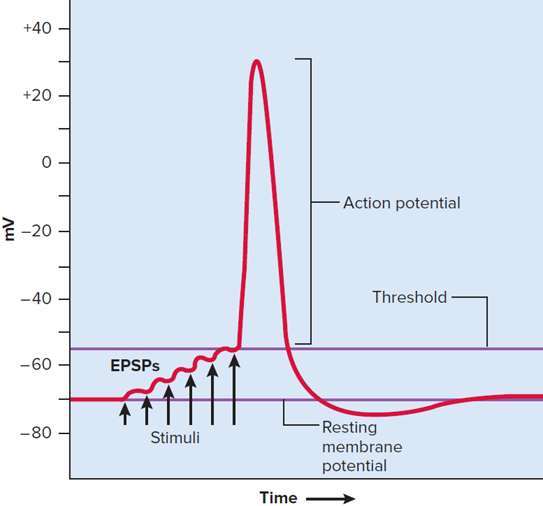
- EPSP&IPSP
- 图
- EPSP
- An excitatory postsynaptic potential (兴奋性突触后电位 ) is a depolarizing potential caused by Na+ or Ca2+ entry
- IPSP
- An inhibitory postsynaptic potential (抑制性突触后电位) is a hyperpolarizing potential caused by K+ exit or Cl- entry
- Postsynaptic potentials are local/graded potentials
- These potentials are summated by the cell body
- When the summation reaches the threshold, the action potential occurs
- Action potentials occurs at the initial segment, because there are more voltage-gated Na+ channels,excitability最高
- 局部电位积累达到阈值后触发动作电位
- 图
- Synaptic plasticity
- Synapses can be added, taken away, or modified to make transmission easier or harder.
- The ability of synapses to change (structurally and functionally) is called synaptic plasticity.
- Synaptic plasticity is highly associated with memory
- Factors
- Neurotransmitters 介绍
- 曾经的分类//现在都叫神经递质
- Neurotransmitters ( 神经递质 )
- bind to ionotropic receptors
- Neuromodulators ( 神经调质)
- bind to metabotropic receptors (G protein-coupled receptors)
- Neurotransmitters ( 神经递质 )
- 特点
- synthesized by neurons
- stored in vesicles and released by the effects of action potentials
- bind to their specific receptors
- can be hydrolyzed and recycled
- there are agonists and antagonists of their receptors
自然界中都有兴奋剂和拮抗剂
- 一个神经元可以释放一种或多种神经递质
- XX-ergic neurons, for example, cholinergic neurons and adrenergic neurons
XX能神经元,释放一种神经递质 - Coexistence of neurotransmitter,a neuron can release more than one transmitter
- XX-ergic neurons, for example, cholinergic neurons and adrenergic neurons
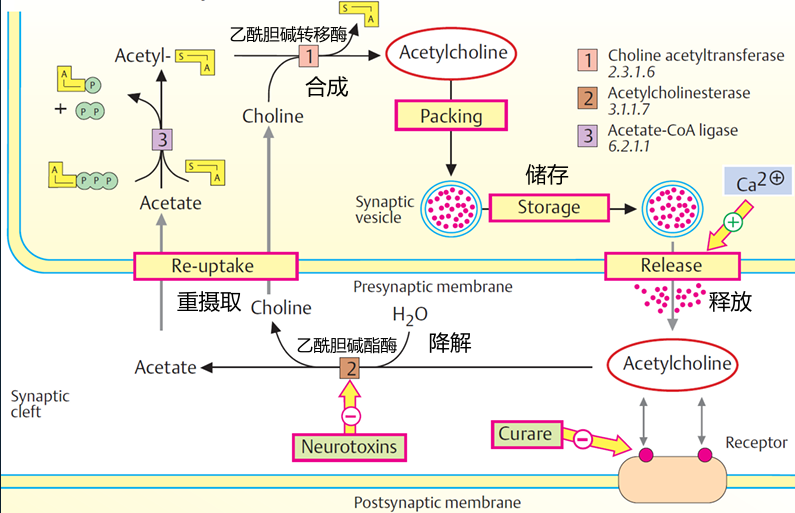
- metabolism of acetylcholine
- 图
- 图
- 曾经的分类//现在都叫神经递质
- recepotors 介绍
- can be classified as XX-ergic receptors according to the ligands
- can be divided into presynaptic receptors and postsynaptic receptors according to the location
- can be divided into ionotropic receptors and metabotropic receptors (GPCR) according to the cellular mechanism
- presynaptic active zones (突触前膜活性区) & postsynaptic density (突触后膜致密区)
- 实际上并不是整个前膜都释放神经递质,只有活性区才会释放,对应的后膜致密区才有受体
- 实际上并不是整个前膜都释放神经递质,只有活性区才会释放,对应的后膜致密区才有受体
- 调节
- The number of receptors can be modified by
- endocytosis (胞吞)
- exocytosis (胞吐)
- The affinity of receptors can be modified by
- phosphorylation (磷酸化)
通过kinase - dephosphorylation (去磷酸化)
通过磷酸酶 phosphatase
- phosphorylation (磷酸化)
- The number of receptors can be modified by
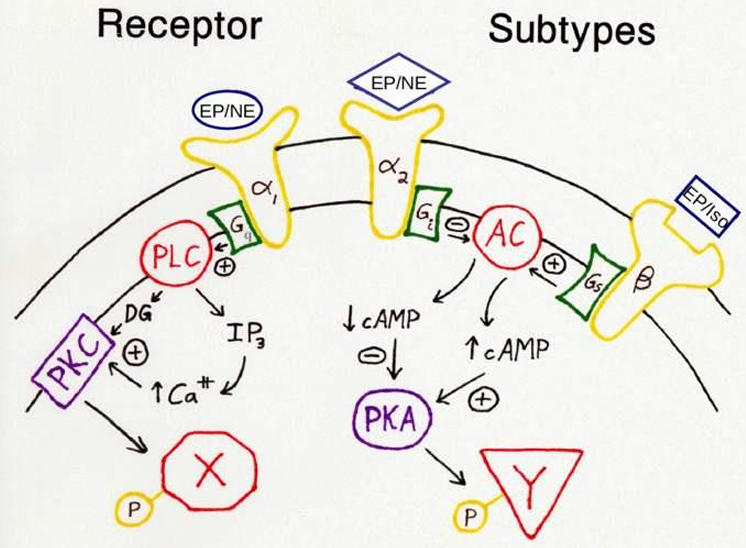
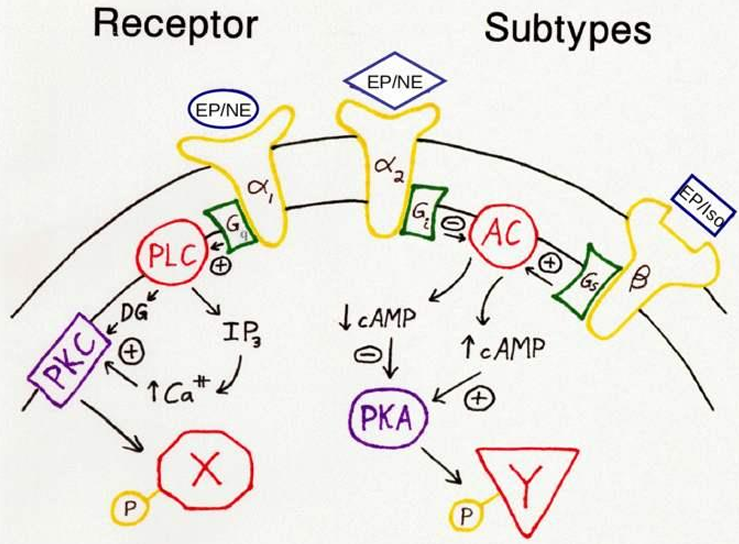
- GPCR复习
- 图
- Gq
- Gq激活PLC
- PLC水解PIP₂生成IP₃和DAG
- IP3→Ca2+↑
- DAG→PKC↑
- EPSP,促进动作电位
- Gi
- Gi抑制AC,cAMP↓,PKA↓
- PKA↓ → IK↑ → ICa↓ → IPSP
- IPSP,抑制动作电位
- Gs
- Gs促进AC,cAMP↑,PKA↑
- EPSP,促进动作电位
- PKA
- PKA会关闭K+通道,打开Ca2+通道
- 图
- neurotransmitter & receptors 详细
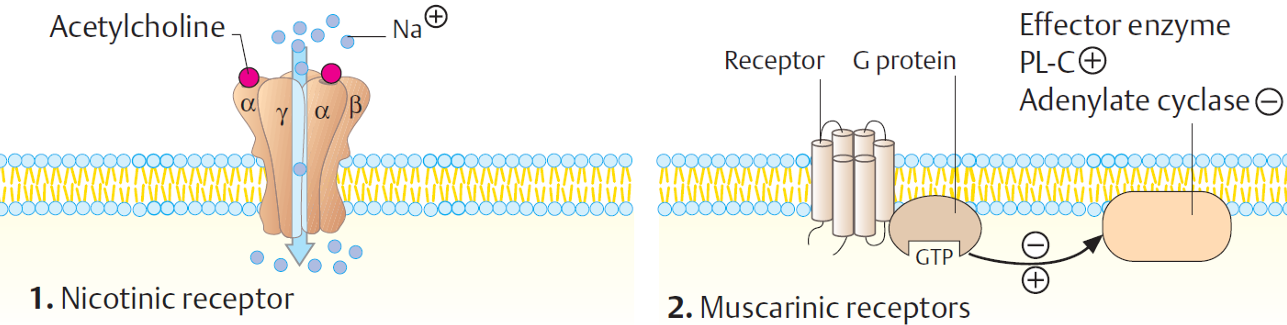
- ACHs 乙酰胆碱 & Cholinergic receptors 胆碱能受体
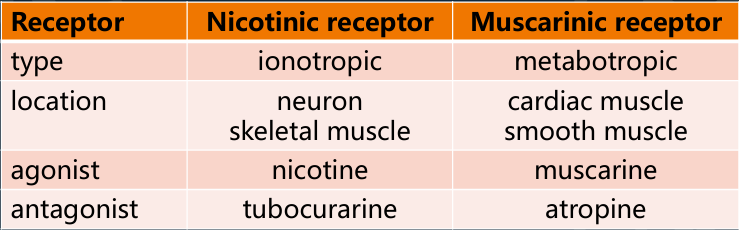
- 分为nicotinic receptor和muscarinic receptors
- 图
- tubocurarine 筒箭毒,muscarine 毒蕈碱,atropine 阿托品,用于散瞳
- muscarinic receptor 是GPCR,在cardiac muscle 中是M2,Gi coupled,在smooth muscle 中是M3,Gq coupled,在神经元中也有,负责认知
- 分为nicotinic receptor和muscarinic receptors
- Monoamines单胺 & their receptors
- Catecholamines (儿茶酚胺)
- include norepinephrine, epinephrine and dopamine, but not 5-HT or histamine
前两个作用于心脏,多巴胺作用域大脑 - 急救时候经常扎这个
- include norepinephrine, epinephrine and dopamine, but not 5-HT or histamine
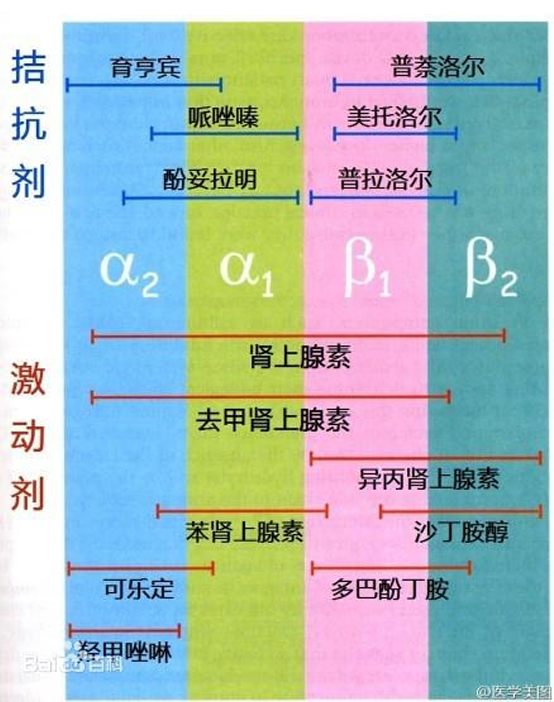
- norepinephrine去甲肾上腺素, epinephrine肾上腺素 & adrenergic receptors肾上腺素能受体
- α1在血管smooth muscle上,β1在cardiac muscle上
- 作用机理
- α1在血管smooth muscle上,β1在cardiac muscle上
- dopamine多巴胺 & its receptors
- Dopamine mainly exists in the CNS.
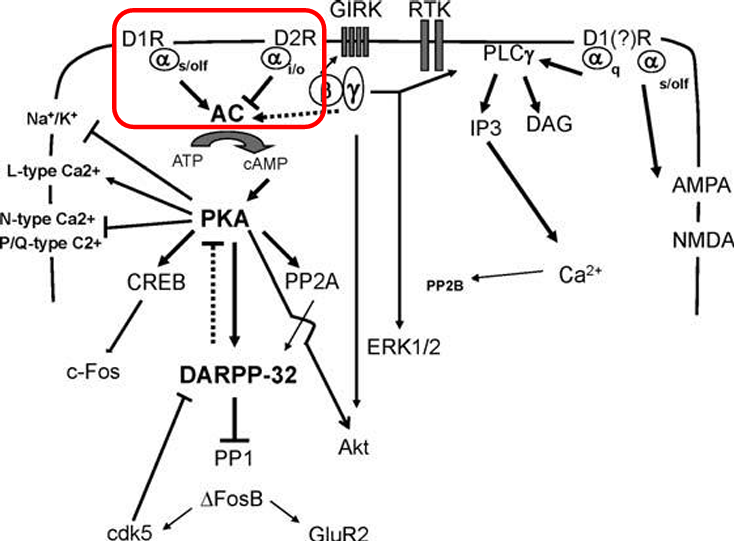
- Its receptors are divided into D1-like and D2-like group.
- D1-like group includes D1 and D5 receptors that activate AC.
EPSP - D2-like group includes D2, D3 and D4 receptors that inhibit AC.
IPSP - Dopamine receptors are involved in pleasurable experiences, addictive behaviors and Parkinson’s disease.
- 5-hydroxytryptamine 5-羟色胺(serotonin血清素) & its receptors
- 7 of 5-HT receptors are metabotropic, only 5-HT3 is ionotropic
- They are mainly involved in pleasurable mood, sense of pain, appetite, temperature regulation and sleep.
- histamine & its receptors
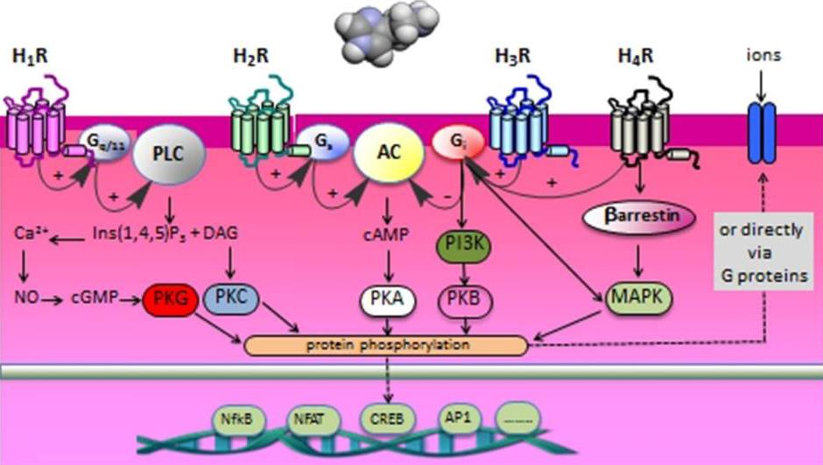
- Histamine receptors are involved in sense of pain and itch蚊子咬了痒, awaken, regulation of blood pressure and gland secretion鼻涕
- 作用机理
- Catecholamines (儿茶酚胺)
- Amino acids & their receptors
- 介绍
- Glutamate and aspartate generate EPSP, thus they are excitatory neurotransmitters.
- Glutamate accounts for 75% of all excitatory synaptic transmission in the brain.
- GABA and glycine generate IPSP, thus they are inhibitory neurotransmitters.
- Glutamate receptors
- 分类
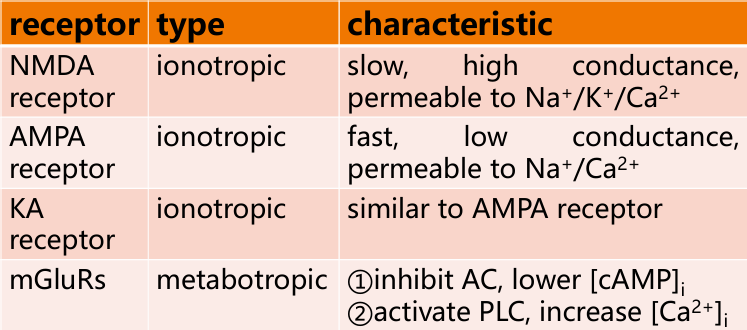
最后的GPCR有两种功能,许多种类型
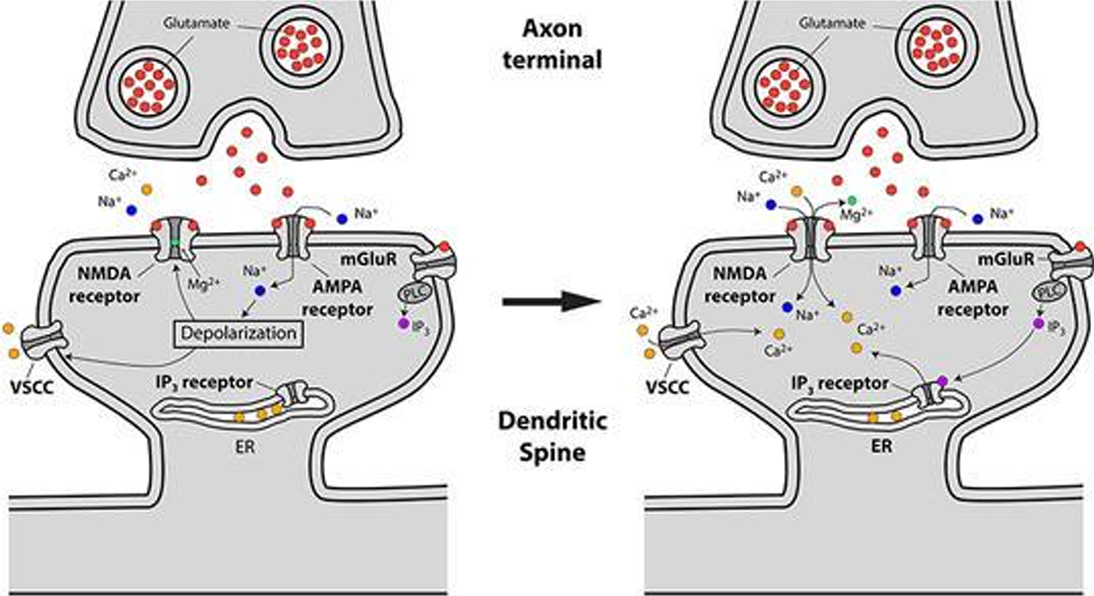
- cooperation of glutamate receptors in pyramidal cells
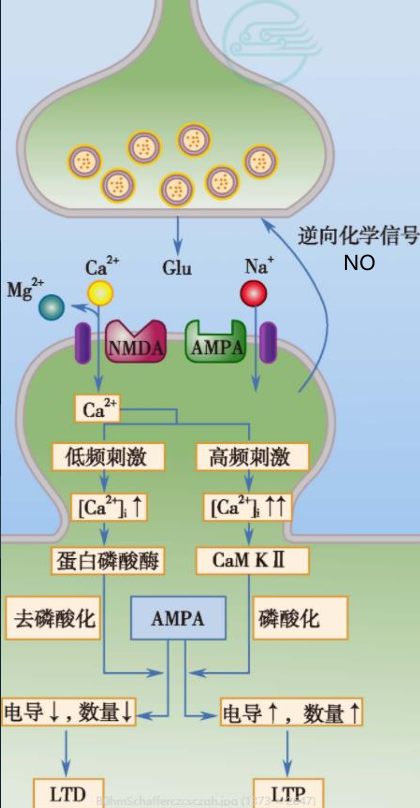
- Both Long-term potentiation (长时程增强) and long-term depression (长时程压抑)are associated with learning and memory.
- mechanisms of LTP & LTD
- 高频刺激是一个正反馈过程,calmodulin kinase Ⅱ会导致包含AMPA的囊泡与细胞膜fuse,并且会磷酸化AMPA,使AMPA可以产生更强的电位
- mechanisms of LTP & LTD
- 分类
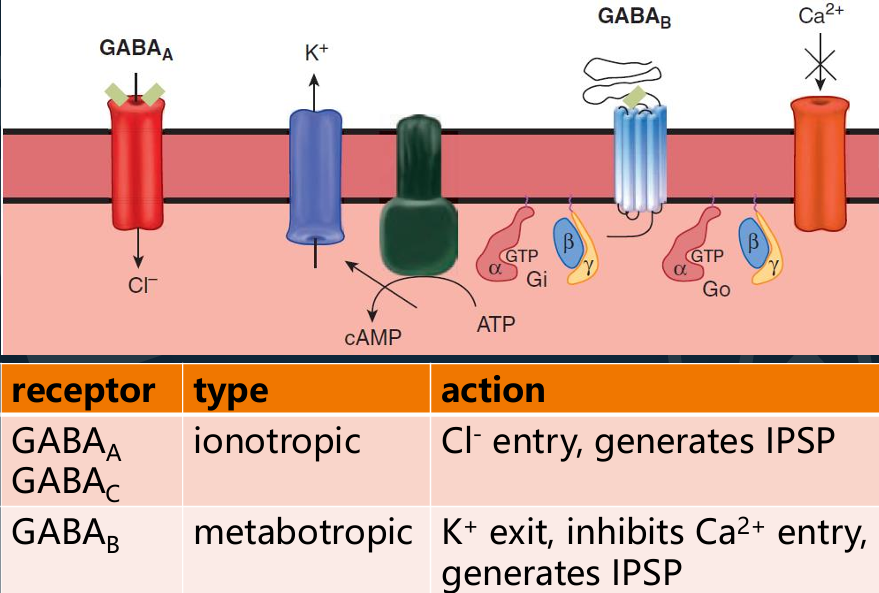
- GABA receptors
- 分类
- PKA↓ → IK↑ → ICa↓ → IPSP
- 分类
- Glycine receptors
- ionotropic
- Cl- channel
- When activated, the receptor allows Cl entry and generates IPSP.
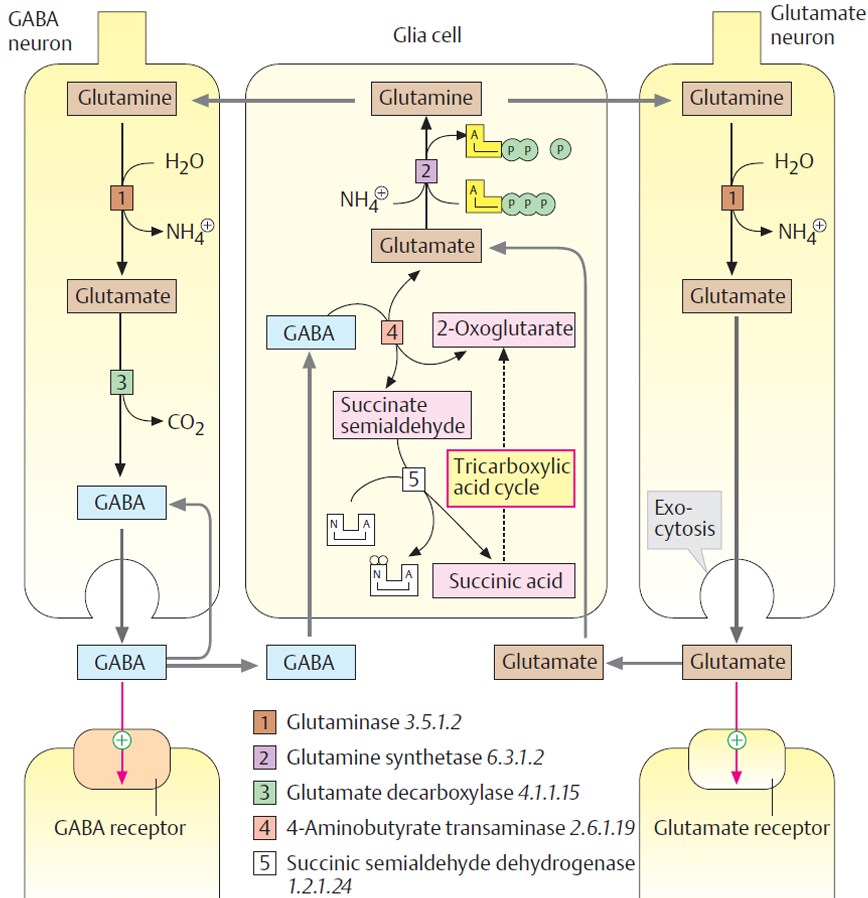
- The relationship between glutamate and GABA
- 前体都是Glia cell中的Glutamine,且都会在作用后被Glia cell回收
- 前体都是Glia cell中的Glutamine,且都会在作用后被Glia cell回收
- 介绍
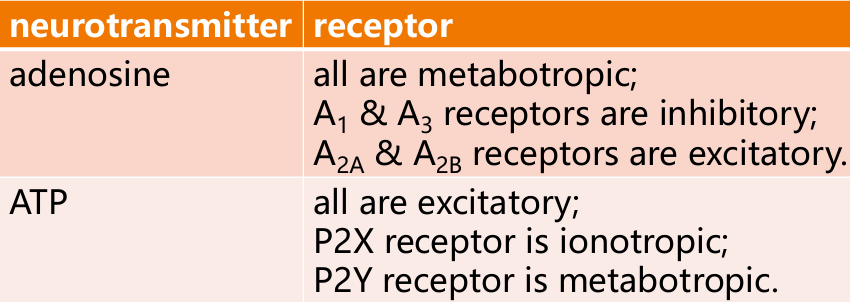
- Purines & their receptors
- 总览
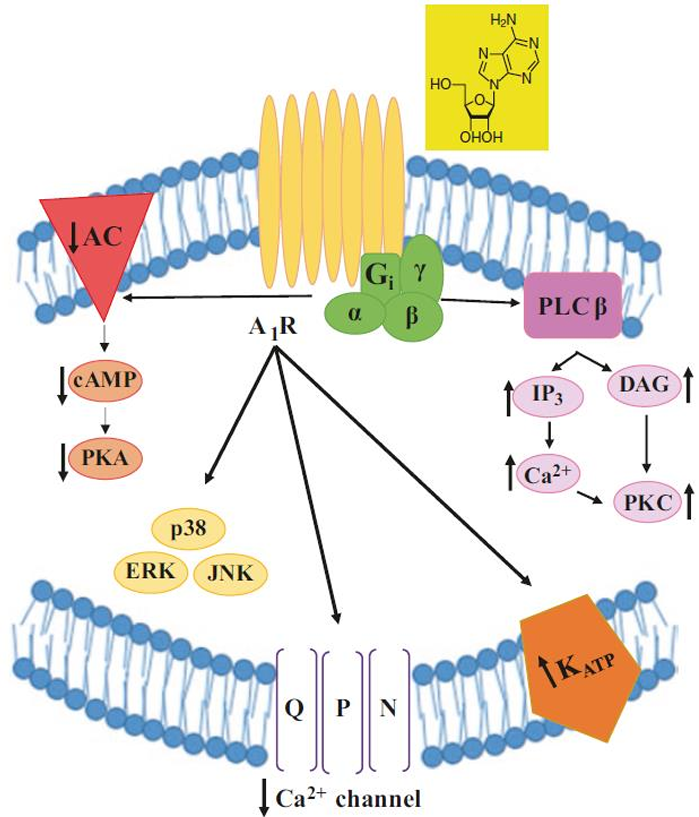
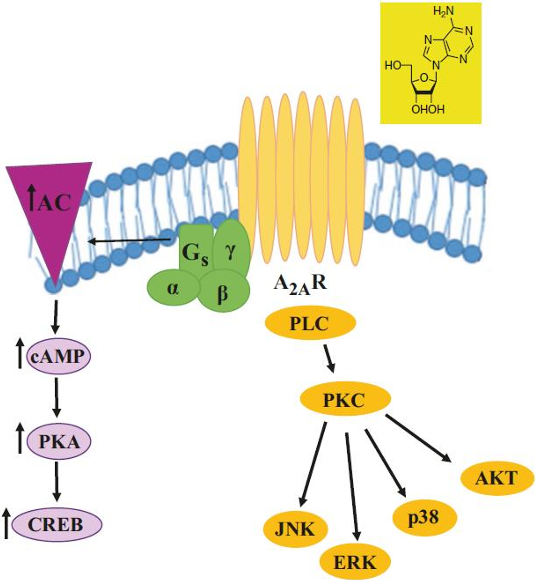
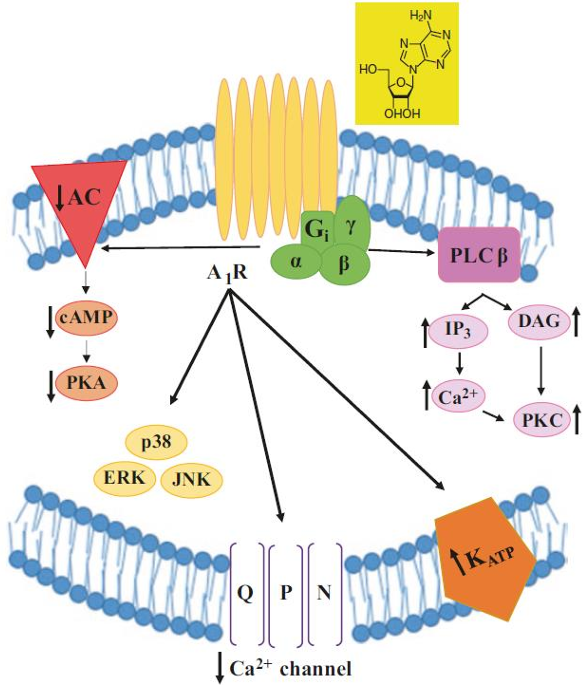
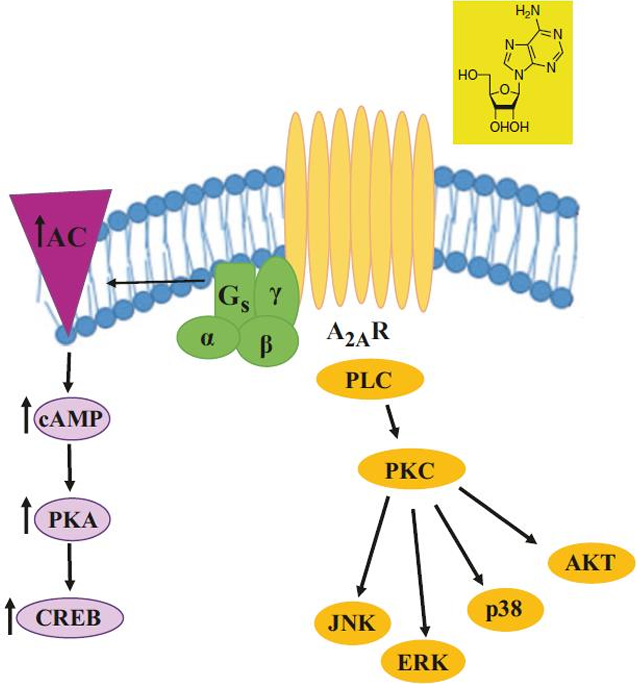
- Adenosine腺苷 receptors GPCR
- A1 receptor inhibits AC, reduces [cAMP]i and Ca2+ entry, enhances K+ exit. IPSP
- A2A receptor activates AC, increases [cAMP]i EPSP
- A1 receptor inhibits AC, reduces [cAMP]i and Ca2+ entry, enhances K+ exit. IPSP
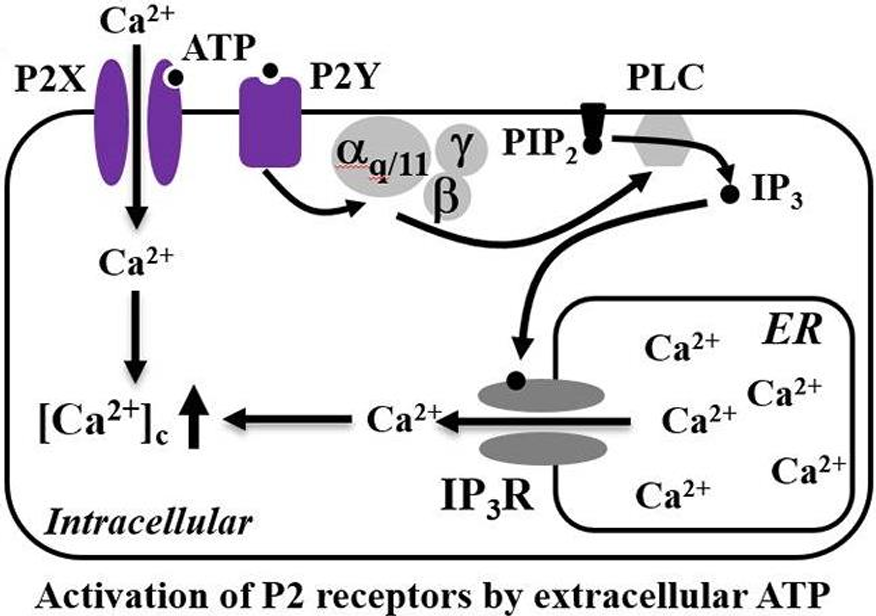
- ATP receptors EPSP
- Gq激活PLC,最终导致Ca2+↑
- Gq激活PLC,最终导致Ca2+↑
- 总览
- Gaseous neurotransmitters
- NO
- Gaseous vs. classic neurotransmitters
- Gaseous neurotransmitters are not stored in synaptic vesicles
- They are released by simple diffusion
- They do not bind to specific receptors
- They activate soluble GC鸟苷酸环化酶 to produce cGMP → PKG进一步激活蛋白激酶G
- NOregulates neurotransmitter release in LTP & LTD
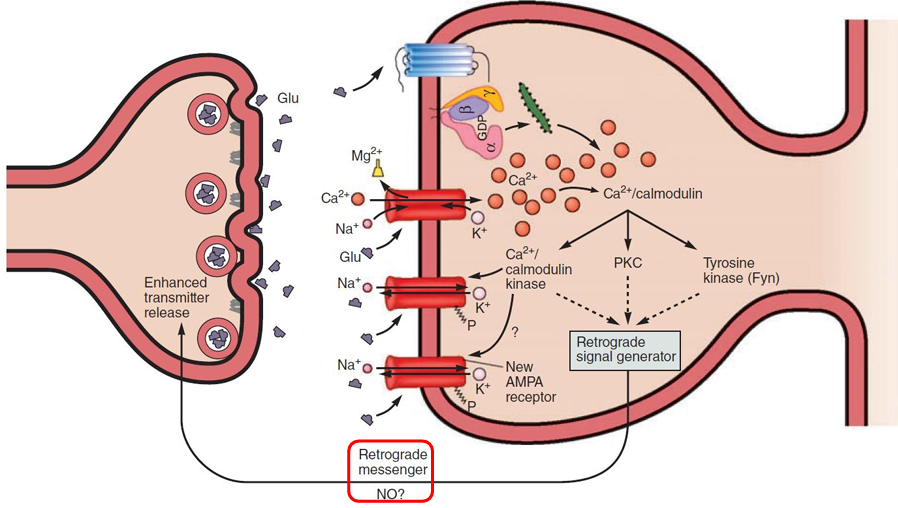
与Glu受体共存
- Neuropeptides
- 特点
- large molecules
- numerous classes
- slow synthesis
- little secretion
- efficient
- durable
- P substance & NK1 receptor
- NK1 receptors are distributed throughtout the body
- P substance and its receptor are associated with slow pain
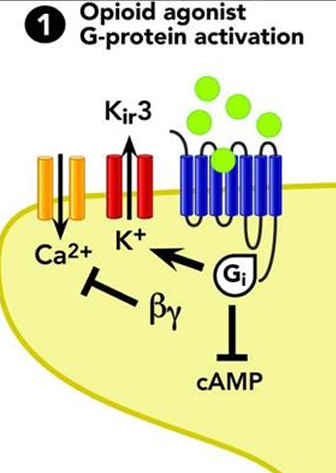
- Opioid peptides阿片肽 and opioid receptors
- Opioid peptides (阿片肽) include endorphin (内啡肽), enkephalin ( 脑啡肽) and dynorphin (强啡肽).
- Opioid receptors include μ, κ and δ receptors.
- μ receptor enhances K+ exit, while κ and δ receptors close Ca2+ channels,都是激活Gi,PKA↓,IPSP
- analgesia (镇痛),天然agonist是鸦片
- 特点
- ACHs 乙酰胆碱 & Cholinergic receptors 胆碱能受体
- reflex
- Reflexes can be divided into unconditioned reflex and conditioned reflex
- Unconditioned reflex
- innate, limited number, fixed, cerebral cortex does not participate
- Conditioned reflex
- acquired, unlimited number, extinguishable, cerebral cortex participates.
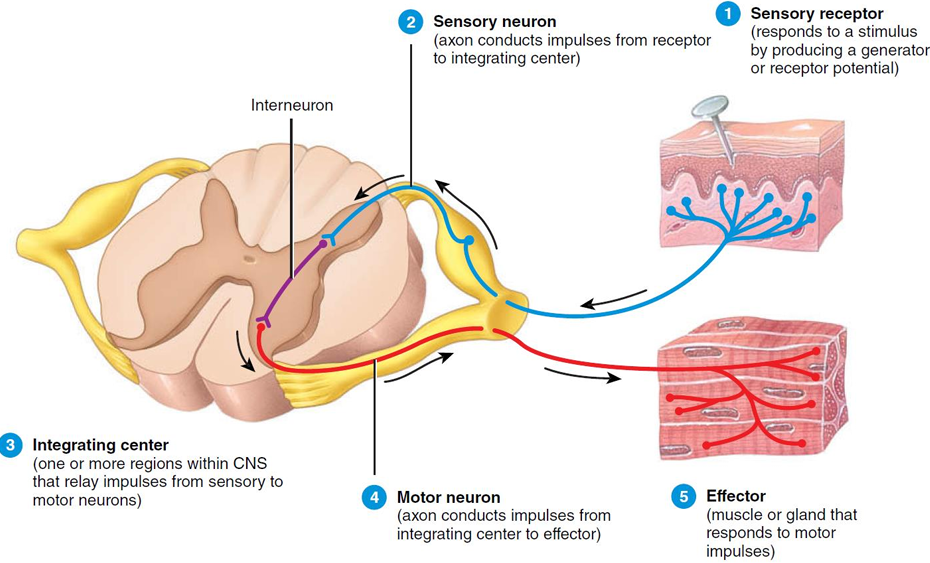
- Reflex arc
- sensory receptor → sensory neuron → integrating center → motor neuron → effector
- A monosynaptic reflex arc (单突触反射弧) has only one synapse in the CNS.
- A polysynaptic reflex arc (多突触反射弧) has more than one CNS synapse.
- Neural circuits
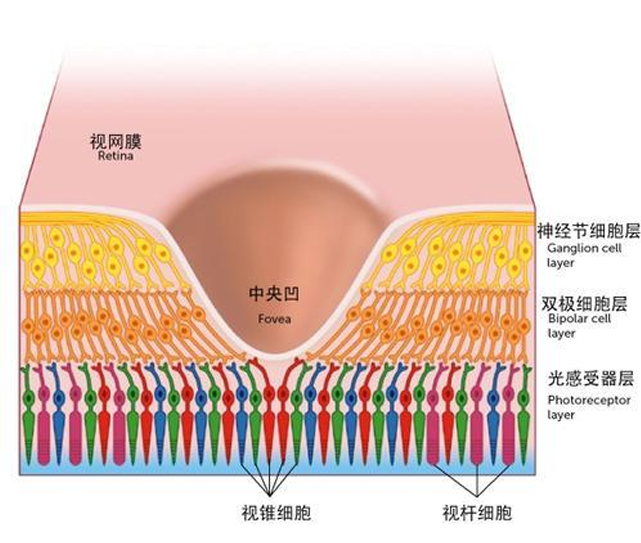
- single line circuit
- In the fovea centralis (黄斑中央凹), a cone cell, a bipolar cell and a ganglion cell form a single line circuit
- In the fovea centralis (黄斑中央凹), a cone cell, a bipolar cell and a ganglion cell form a single line circuit
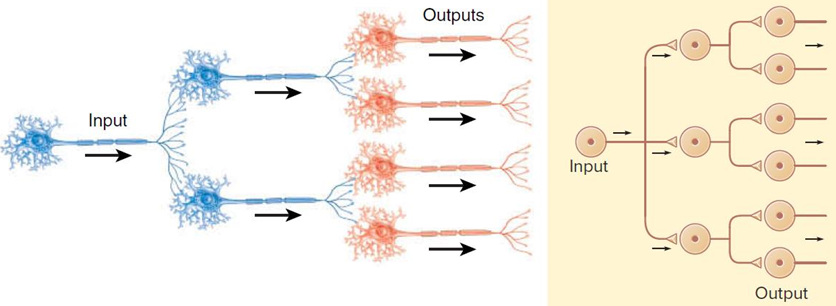
- diverging circuit
- For example, a small number of neurons in the brain that govern a particular body movement stimulate a much larger number of neurons in the spinal cord
- For example, a small number of neurons in the brain that govern a particular body movement stimulate a much larger number of neurons in the spinal cord
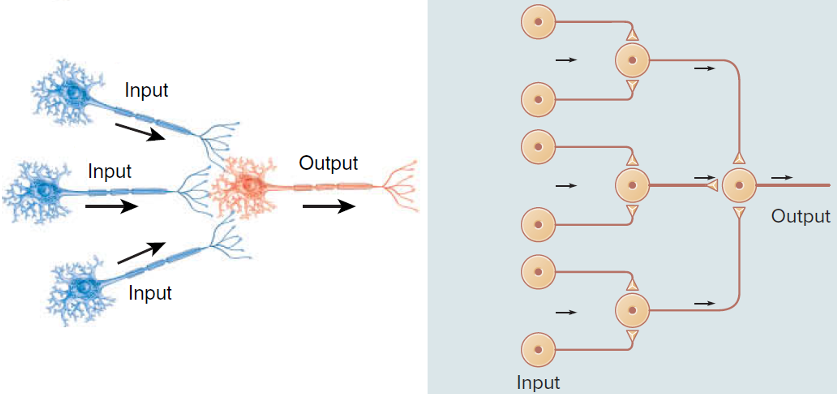
- converging circuit
- The respiratory center receives information from other parts of the brain, blood chemistry sensors in arteries and stretch receptors in the lungs.
- It then produce an output that takes all of these factors into account and sets an appropriate pattern of breathing.
- The respiratory center receives information from other parts of the brain, blood chemistry sensors in arteries and stretch receptors in the lungs.
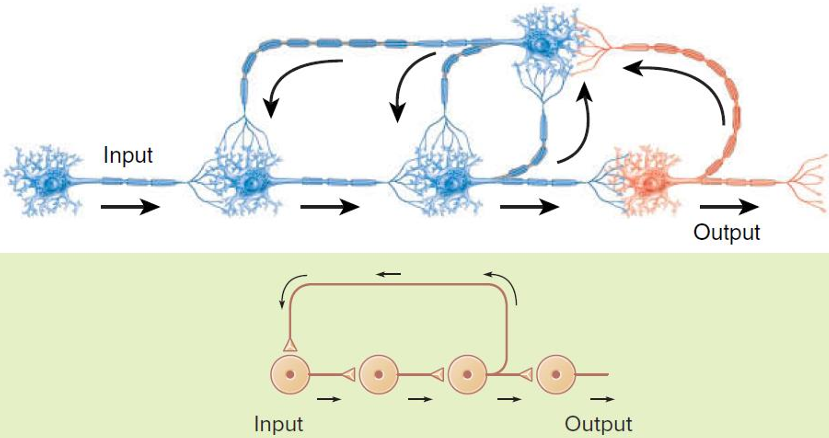
- reverberating回响 circuit
- A reverberating circuit sends repetitious signals to the diaphragm and intercostal muscles to ensure that the respiratory muscles contract for 2s
- A reverberating circuit sends repetitious signals to the diaphragm and intercostal muscles to ensure that the respiratory muscles contract for 2s
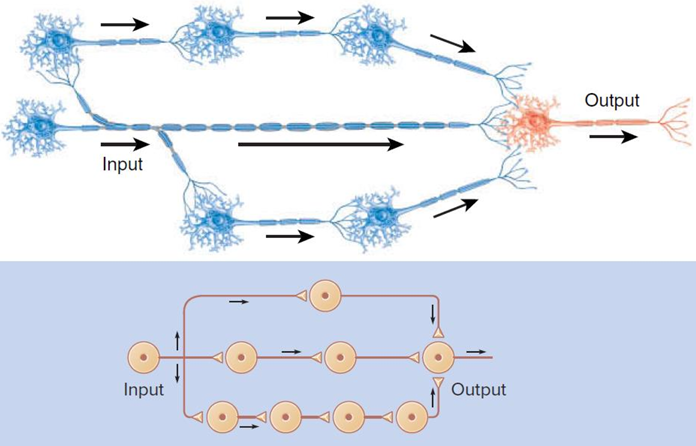
- parallel after-discharge circuit
- A brief pain produces a longer-lasting output to the limb muscles
- A brief pain produces a longer-lasting output to the limb muscles
- single line circuit
- Propagation传播 of excitation in the reflex
- one-way conduction – presynaptic → postsynaptic
- central delay (中枢延搁) – time spent on chemical synaptic transmission
- summation – EPSP+IPSP spatially and temporally
- change in excitation rhythm – change of impulse frequency in different neurons
- after discharge 神经元或神经网络在受到刺激后,即使刺激已经停止,仍然持续一段时间的异常电活动
- sensitive & fatigable – neurotransmitters can be affected by numerous factors and easily exhausted 跑步累了就是神经递质exhausted
- Facilitation & inhibition
- Facilitation is a process in which one neuron enhances the effect of another.
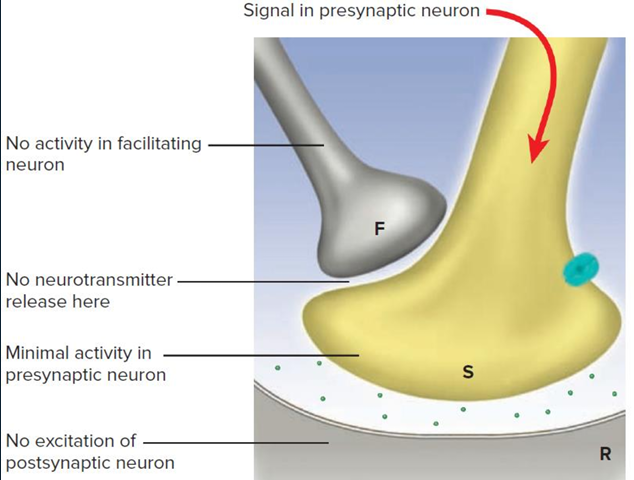
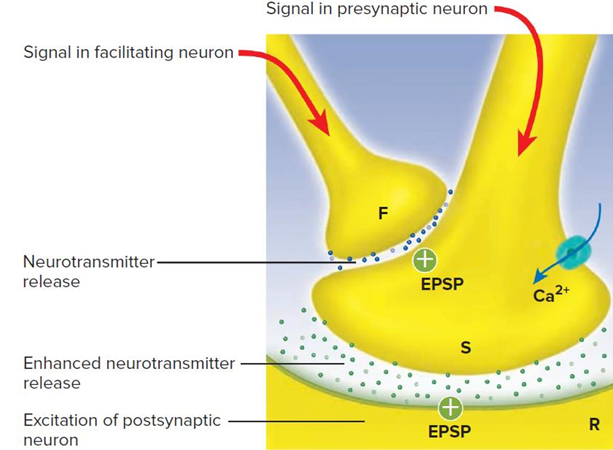
- presynaptic facilitation
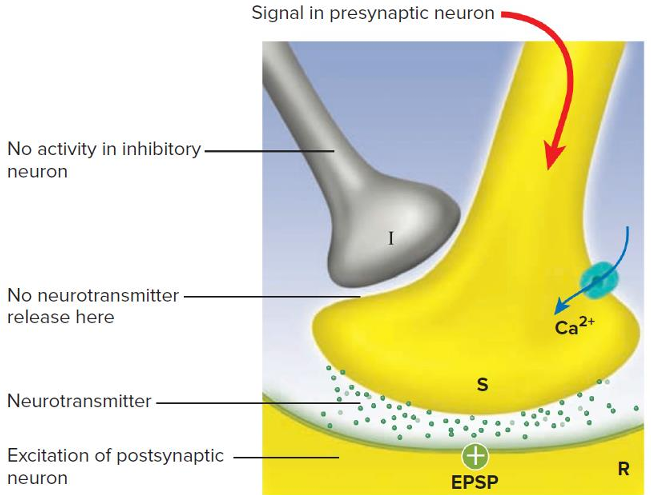
- In the absence of stimulation neuron F, neuron S releases too little neurotransmitter to excite neuron R
- In presynaptic facilitation, neuron F secretes a neurotransmitter that excites neuron S, which in turn now excites neuron R. Thus, neuron F has facilitated signal transmission at synapse S-R
- In the absence of stimulation neuron F, neuron S releases too little neurotransmitter to excite neuron R
- postsynaptic facilitation
- If each EPSP arrives at the postsynaptic trigger zone faster than they fade, they can build on each other to bring the neuron to threshold and action potential is more easily to trigger
- If each EPSP arrives at the postsynaptic trigger zone faster than they fade, they can build on each other to bring the neuron to threshold and action potential is more easily to trigger
- presynaptic facilitation
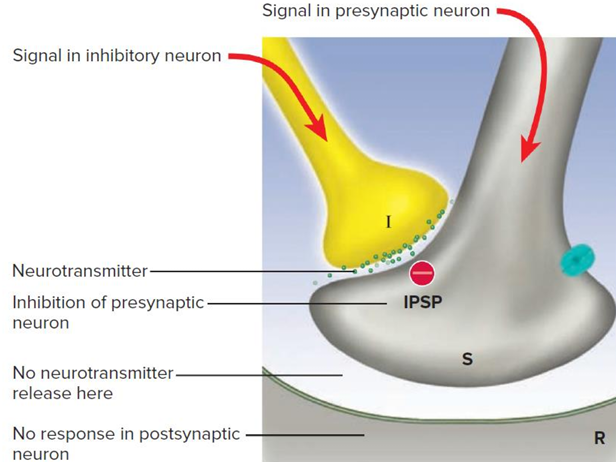
- Inhibition is the opposite of facilitation, a process in which one neuron suppresses another one
- presynaptic inhibition
- In the absence of inhibition, neuron S releases neurotransmitter and stimulates neuron S
- In presynaptic inhibition, neuron I suppresses the release of neurotransmitter by S, and S cannot stimulate R
- In the absence of inhibition, neuron S releases neurotransmitter and stimulates neuron S
- postsynaptic inhibition
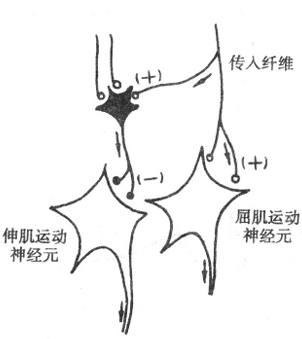
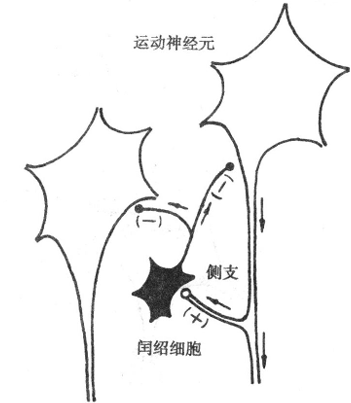
- afferent collateral inhibition传入侧支性抑制
- recurrent inhibition回返性抑制
- afferent collateral inhibition传入侧支性抑制
- presynaptic inhibition
- Facilitation is a process in which one neuron enhances the effect of another.
中篇:Sensory
- 总体介绍
- Sensory receptors & sense organs
- A sensory receptor is either a specialized cell or dendrites of a sensory neuron to detect stimuli
- 机械感受器 mechanoreceptors
- 化学感受器 chemoreceptors
- 温度感受器 thermoreceptors
- 疼痛感受器 nociceptors
- 电磁感受器 elecromagnetic receptors
- A sense organ is a structure that sensory receptors combine with other accessory tissues
- A sensory receptor is either a specialized cell or dendrites of a sensory neuron to detect stimuli
- Adequate stimulus
- A given sensory receptor responds vigorously活泼的 to one particular kind of stimulus.
- This type of stimulus is the adequate stimulus (最适刺激) of the sensory receptor.
- The sensory receptor responds only weakly or not at all to other stimuli.
- factors
- Stimulus strength
- Stimulus frequency
- Stimulus duration
- Stimulus area
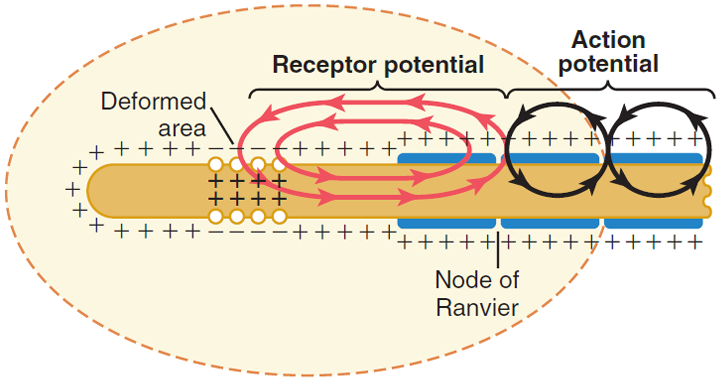
- Receptor potential
- A sensory receptor is a transducer (换能器), which turns stimuli into electrical signals
- stimulus → receptor (local) potential → action potential
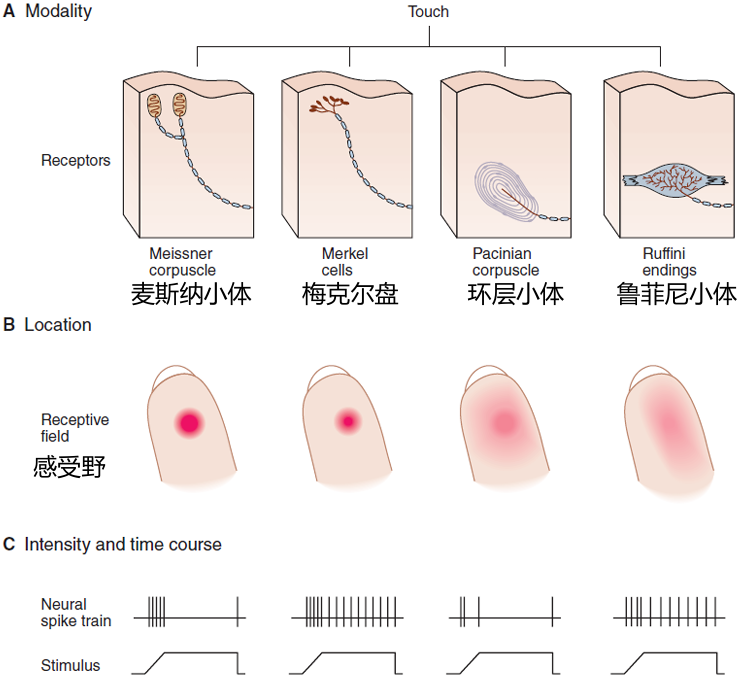
- Sensory coding
- Sensory receptors encode
- modality
- location
- intensity
- duration
- 可以编码形态,感受野,强度,持续时间
- Coding in sensory pathways
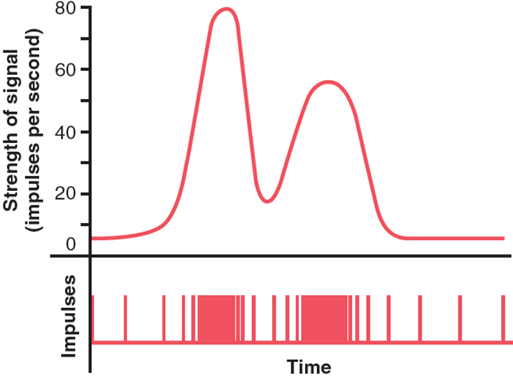
- Increasing signal strength is transmitted by increasing the frequency of nerve impulse.
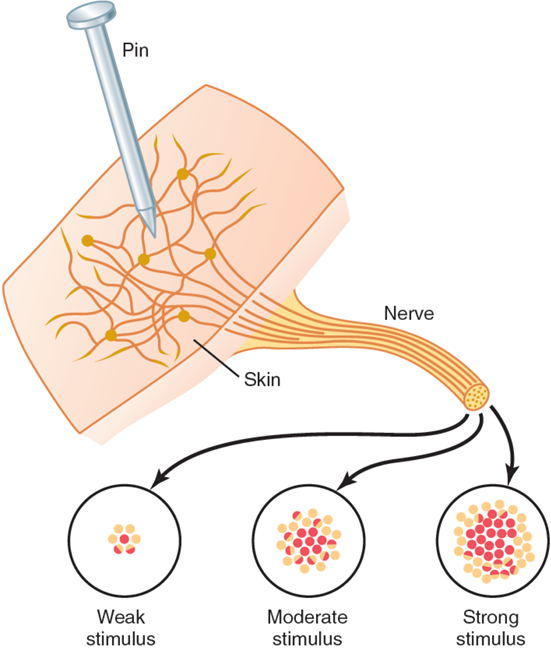
- Increasing signal strength is transmitted by using greater numbers of fibers.
- Increasing signal strength is transmitted by increasing the frequency of nerve impulse.
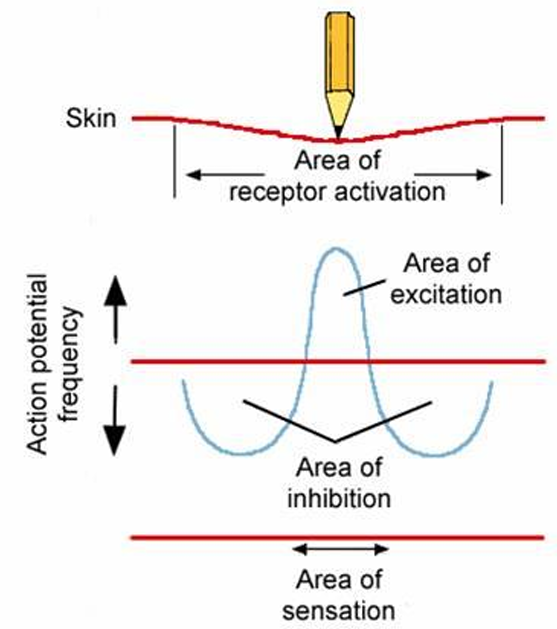
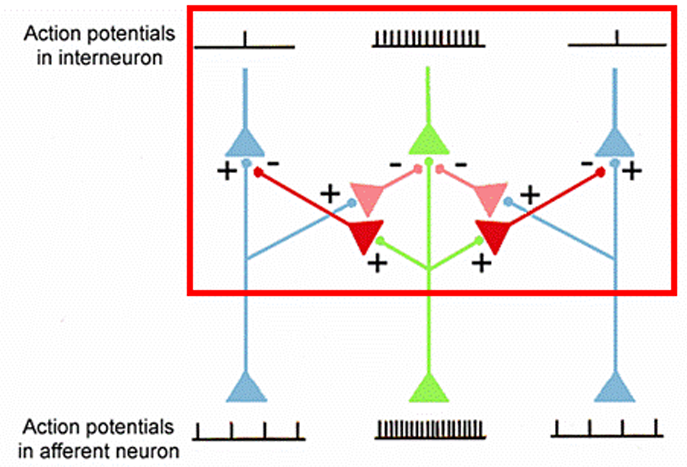
- Lateral inhibition
- 神经抑制隔壁的神经,可以更准确的知道感受的地点
- 神经抑制隔壁的神经,可以更准确的知道感受的地点
- Sensory receptors encode
- Somatosensory projection躯体感觉投射
- pathways
- A first-order neuron conducts a pain signal to the posterior horn of the spinal cord脊髓
- A second-order neuron conducts it to the thalamus丘脑
- A third-order neuron conducts it to the cerebral cortex大脑皮层
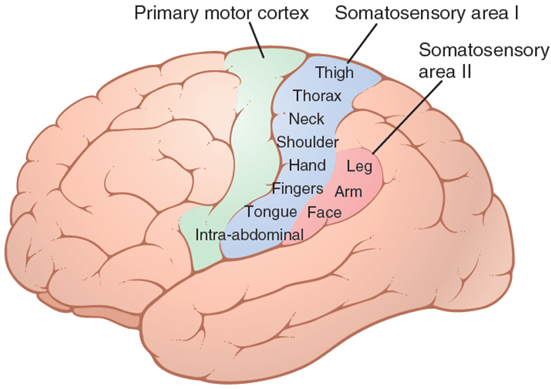
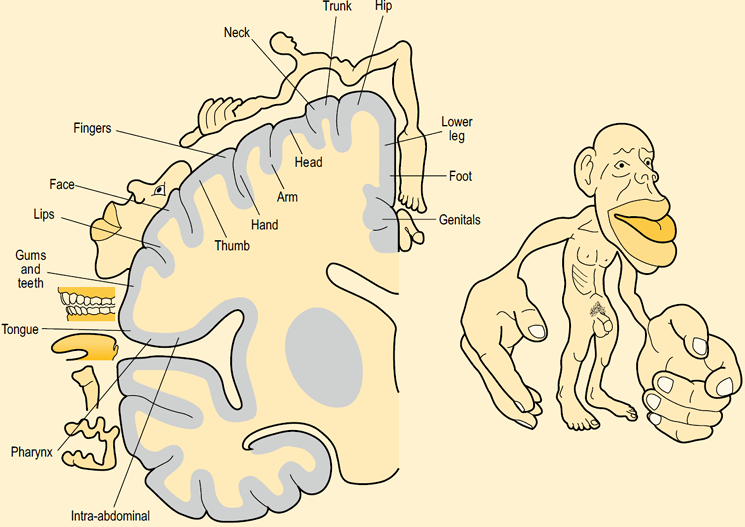
- The primary somatosensory area (初级躯体感觉区) occupies the postcentral gyri (中央后回) of the parietal lobes (顶叶) of the cerebral cortex
- somatosensory areas
- sensory homunculus感官侏儒,手这样的越精密的对应的区域越大
- somatosensory areas
- pathways
- Sensory receptors & sense organs
- Somatic sensations 躯体感觉 & visceral sensations 内脏感觉
- Somatic sensations
- tactile sensations (触觉)
- activated by mechanoreceptors
- tactile sensation threshold (触觉阈)
- 在触点上引起触觉的最小压陷深度
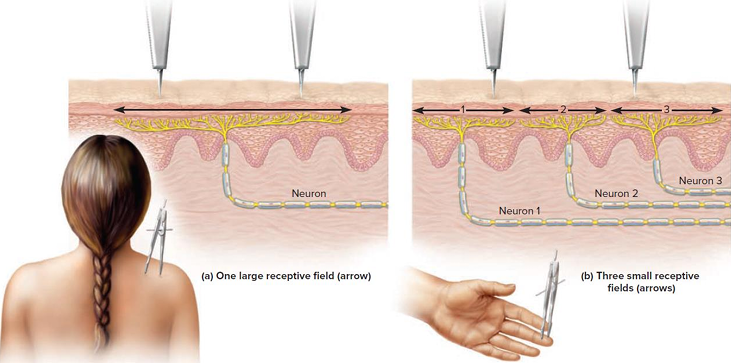
- threshold of two-point discrimination (两点辨别阈)
- 人体能分辨出两个刺激点的最小距离
- 人体能分辨出两个刺激点的最小距离
- thermal sensations
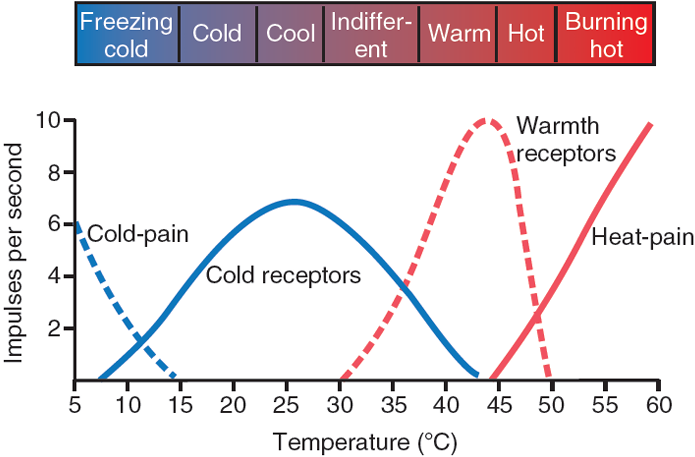
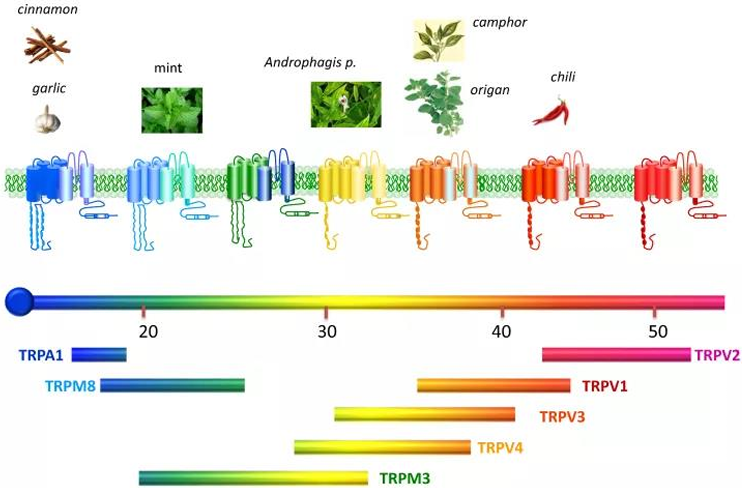
- Thermal sensations are mediated by TRP channels, a kind of non-selective cation channels.
- The sensations are transmitted by myelinated Aδ fibers有髓鞘纤维 and unmyelinated C fibers无髓鞘纤维
- TRP可以感觉温热觉,冷觉和伤害性温度痛觉
- pain sensations
- Nociceptors痛觉感受器/伤害性感受器 are free nerve endings found in every tissue of the body except the brain.
- 痛觉感受器不易发生适应
- Pain is transmitted by myelinated Aδ fibers (fast pain) and unmyelinated C fibers (slow pain).
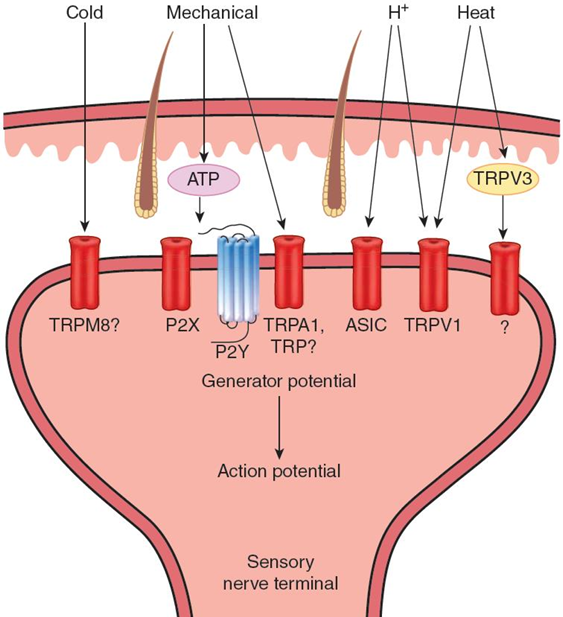
可以看出温度感受器与疼痛感受器使用相同的神经纤维
- proprioceptive sensations (本体感)
- 来自肌肉,肌腱,关节等对躯体的空间位置、姿势、运动状态和运动方向的感觉
- Proprioception includes topesthesia位置感 and kinesthesia运动觉
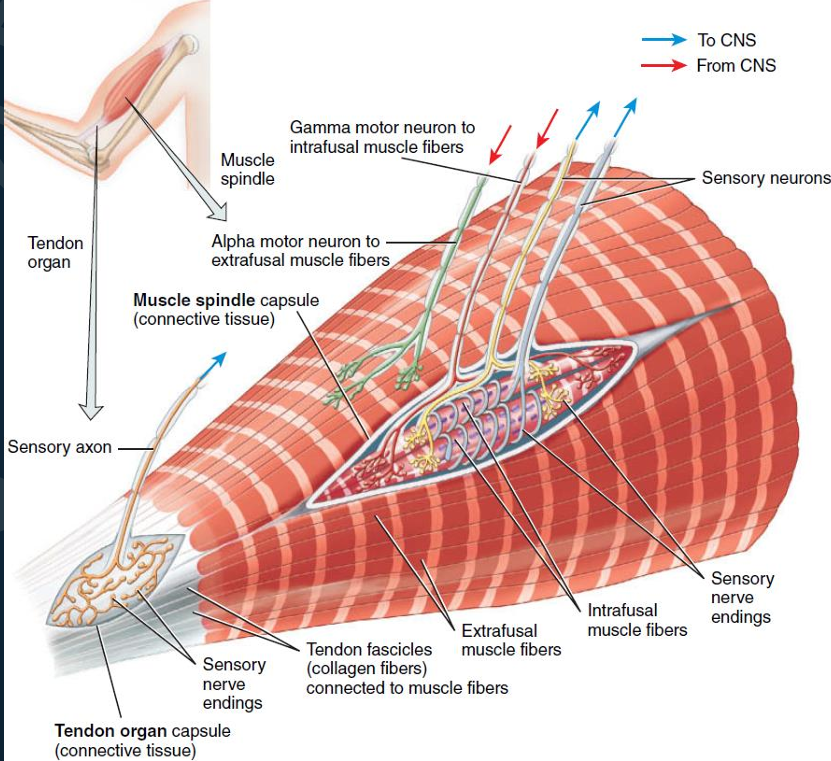
- Muscle spindles and tendon organs are proprioceptors本体感受器
- tactile sensations (触觉)
- Visceral sensations are mainly pain sensations
- Visceral pain is often slow and poorly localized.
- Referred pain牵涉痛 results from the convergence of neural pathways in the CNS.
- For example, spinal cord segments T1-T5 receive input from the heart as well as from the chest and arm.
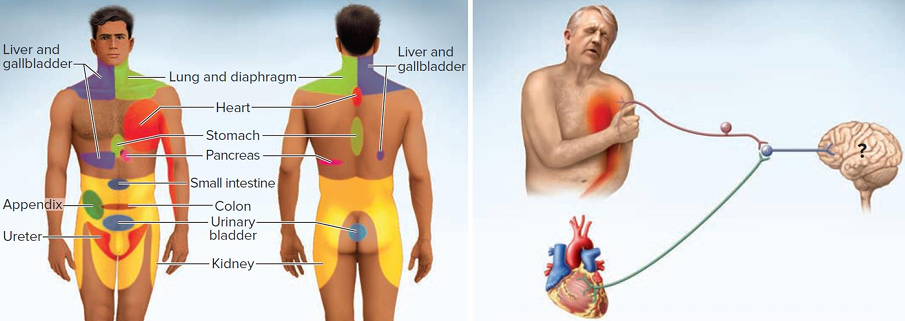
比如心脏疼会牵涉到左胳膊
- Somatic sensations
- eye
- anatomy
- 图
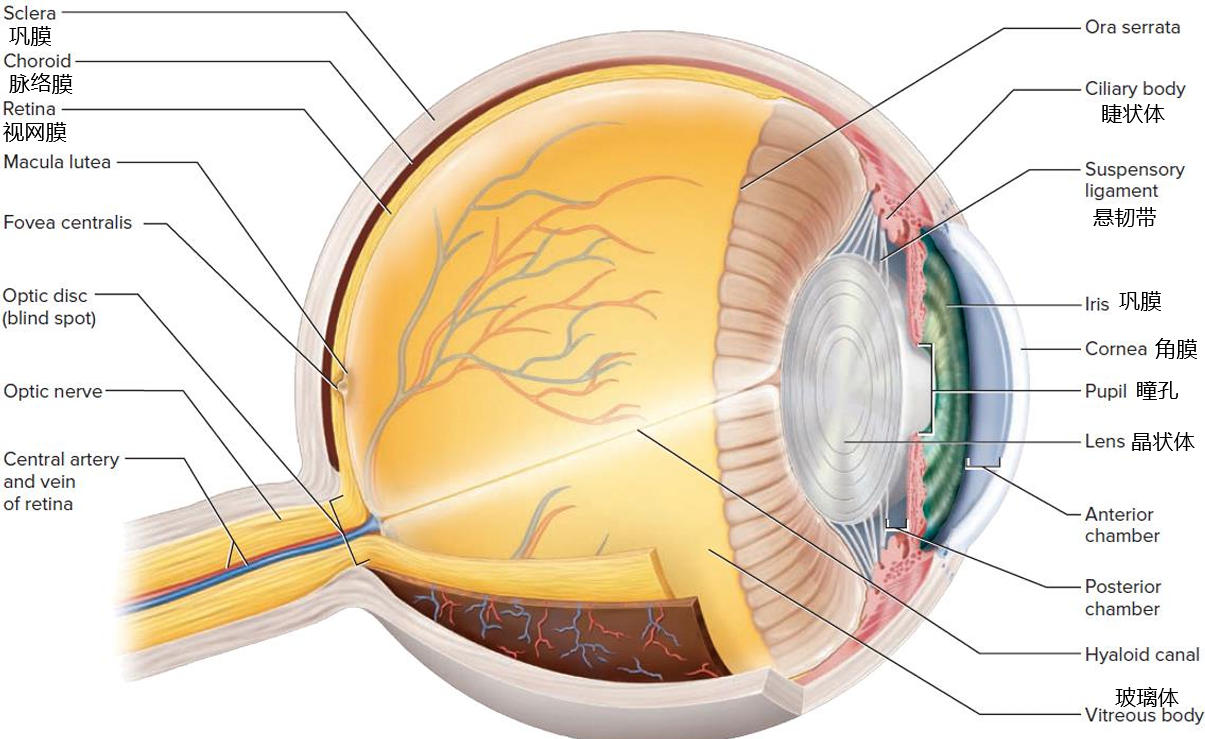
- 眼球壁 eyeball wall
- 纤维膜 fibrous tunic of eyeball
- 角膜 cornea
- 巩膜 sclera 白眼
- 血管膜 vascular membrane
- 虹膜 iris
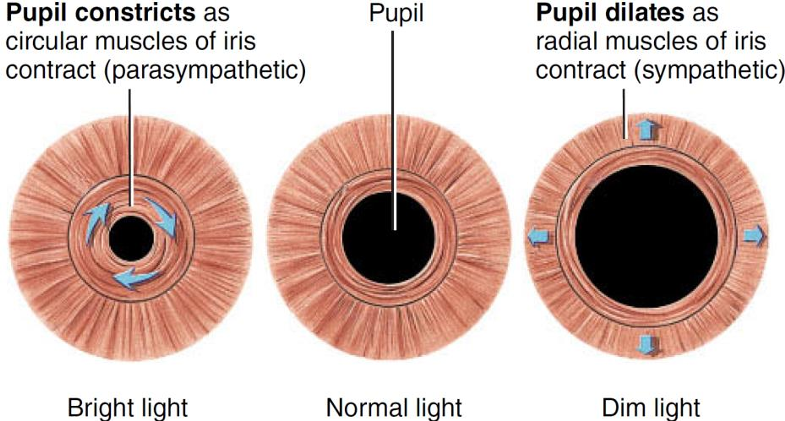
颜色取决于色素细胞多少- 瞳孔括约肌 sphincter pupillae
副交感神经控制,使瞳孔缩小 - 瞳孔开大肌 dilatator pupillae
交感神经控制,使瞳孔变大
- 瞳孔括约肌 sphincter pupillae
- 睫状体 ciliary body
与晶状体lens相连,调节晶状体曲度,产生房水 - 脉络膜 choroid
营养,吸收分散光线
- 虹膜 iris
- 视网膜 retina
- 纤维膜 fibrous tunic of eyeball
- 眼球内容物
- 图
- refraction
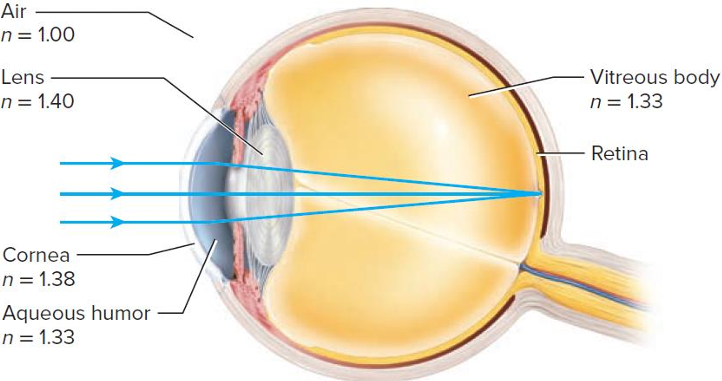
- 大部分折射发生在 air to cornea
- 大部分折射发生在 air to cornea
- accommodation
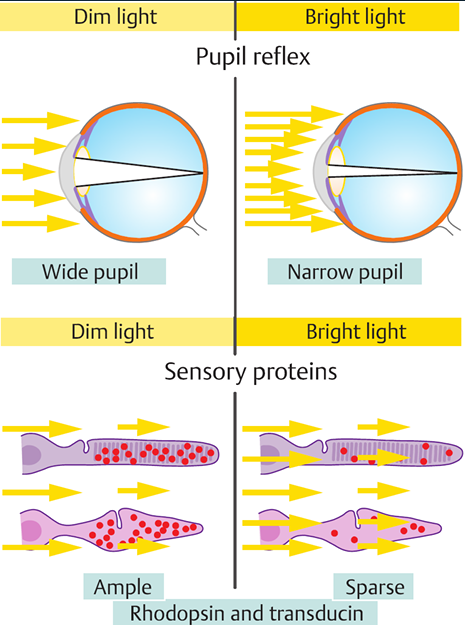
- 明暗
- circular括约肌-副交感-缩小,radial放大肌-交感-放大
- Pupillary light reflex is consensual 双侧同感
捂住一只眼看灯,瞳孔都会变小
- circular括约肌-副交感-缩小,radial放大肌-交感-放大
- 远近
- In the emmetropic eye, the ciliary muscle is relaxed. It puts tension on the suspensory ligament and flattens the lens
看远处(6米外),ciliary muscle放松,lens thins - In accommodation, the ciliary muscle contracts. This reduces tension on the suspensory ligament and allows the lens to relax into a more convex shape
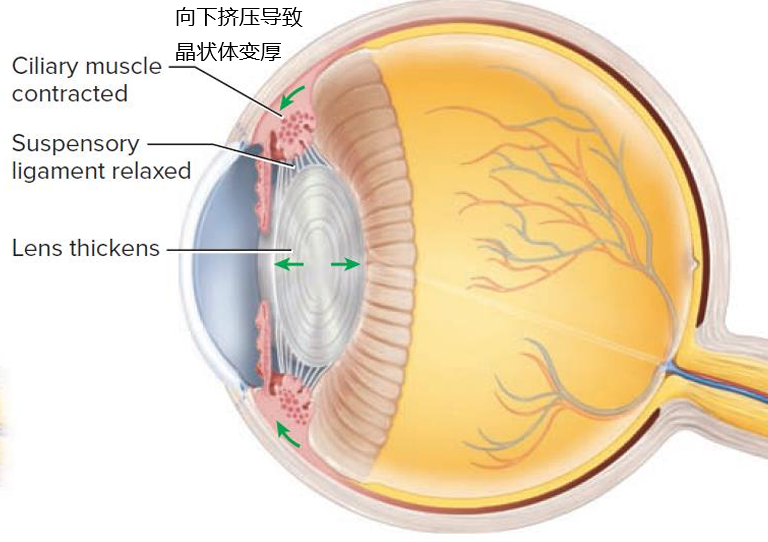
看近处,ciliary muscle收缩,lens thickens
- In the emmetropic eye, the ciliary muscle is relaxed. It puts tension on the suspensory ligament and flattens the lens
- 明暗
- 疾病
- refraction abnormalities
- myopia 近视
- hyperopia远视
- 老花眼,ciliary muscle weak
- astigmatism 散光
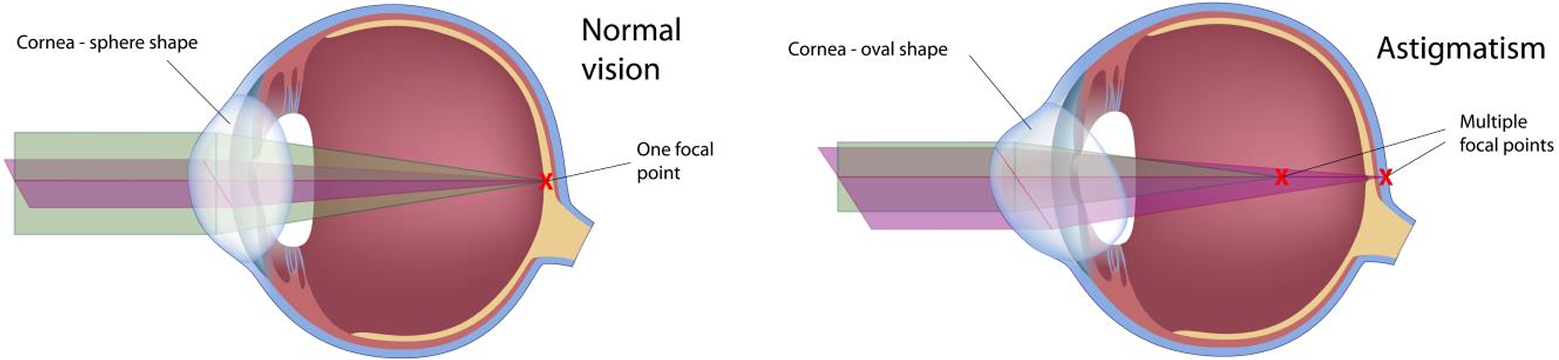
irregular shape of cornea
- Glaucoma 青光眼
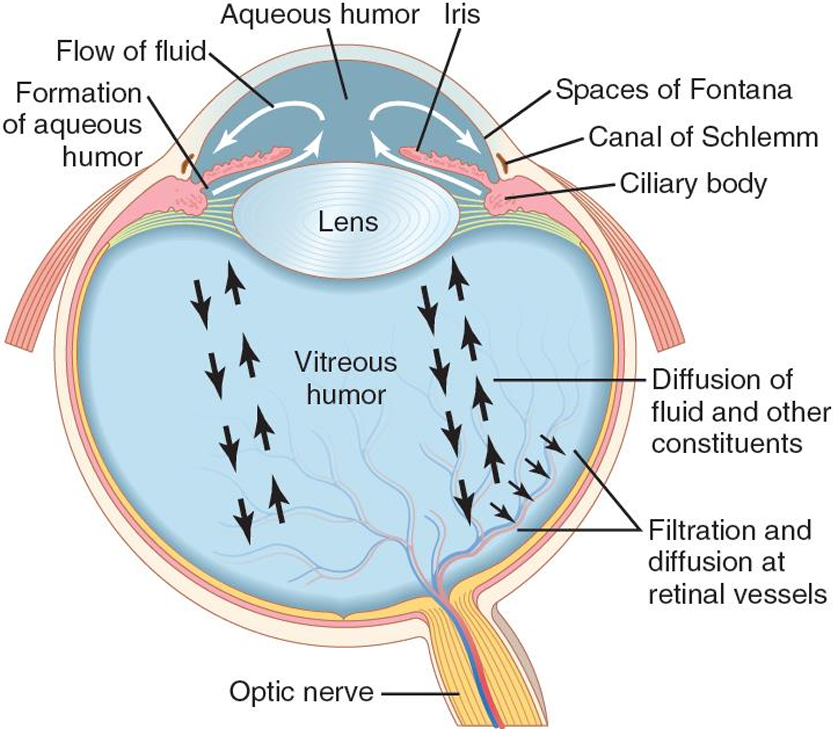
- Aqueous humor (房水) is formed by the ciliary processes (睫状突) at an average rate of 2-3μl per min.
- Aqueous humor first flows through posterior chamber (后房) and the pupil into the anterior chamber (前房), eventually enters the canal of Schlemm (巩膜静脉窦)and empties into extraocular veins
- Glaucoma (青光眼) results from increased resistance to fluid outflow into the canal of Schlemm
- Cataract 白内障
- 晶状体蛋白受强紫外线(太阳光)变性,导致不透明
- 治疗时抽走晶状体,换成人造的
- refraction abnormalities
- retina 视网膜
- histology of the retina
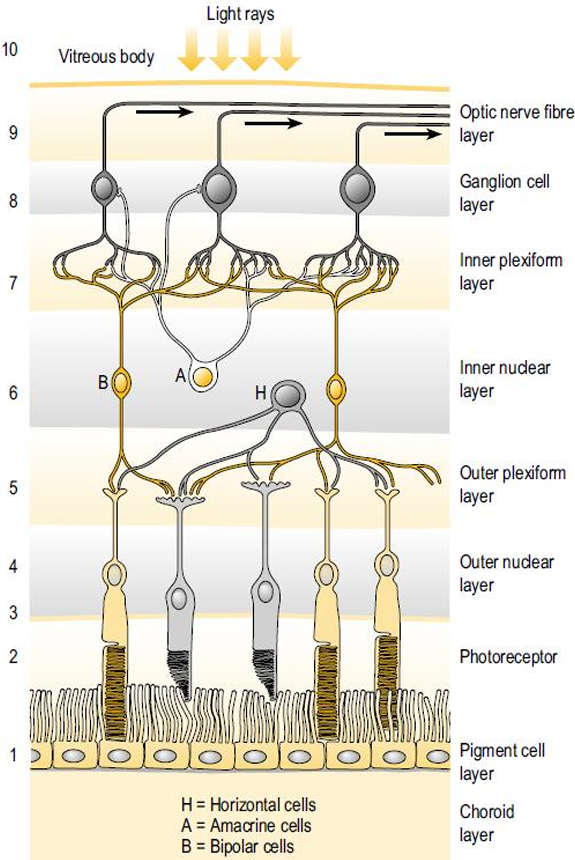
- 光先穿过一堆神经细胞再到达感光细胞
- photoreceptors → bipolar cells → ganglion cells
- Horizontal cells水平细胞 and amacrine cells无长突细胞 form horizontal links
adjust signal intensity
- 光先穿过一堆神经细胞再到达感光细胞
- retina pigment epithelium cell 功能
视网膜色素上皮细胞,连着视锥视杆细胞的- It absorbs light passing through the retina to prevent reflection
防止光在眼里乱跑 - It covers part of the outer segment of photoreceptors to protect them from overexposure
- It supplies with vitamin A to synthesize photopigments 感光色素
- It phagocytoses old membranous discs from photoreceptors
- It absorbs light passing through the retina to prevent reflection
- photoreceptors
- 图
- 2种
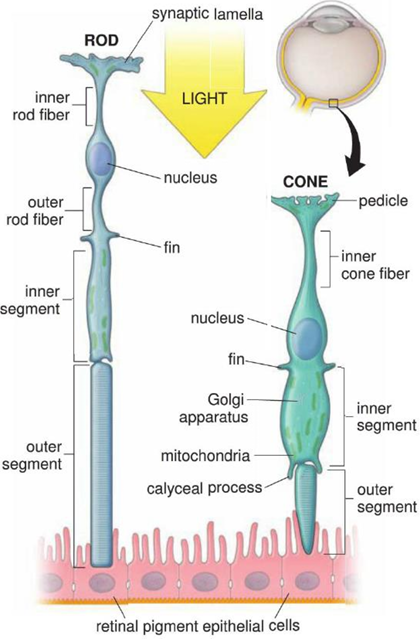
- rods视杆细胞 (dim light)
photopigments 感光色素-rhodopsin 视紫红质 - cones视锥细胞 (bright light)
photopigments 感光色素-iodopsin 视紫蓝质
- rods视杆细胞 (dim light)
- Each photoreceptor has an outer segment, inner segment and synaptic terminal.
- The membranous discs contain photopigments
- distribution of rods/cones
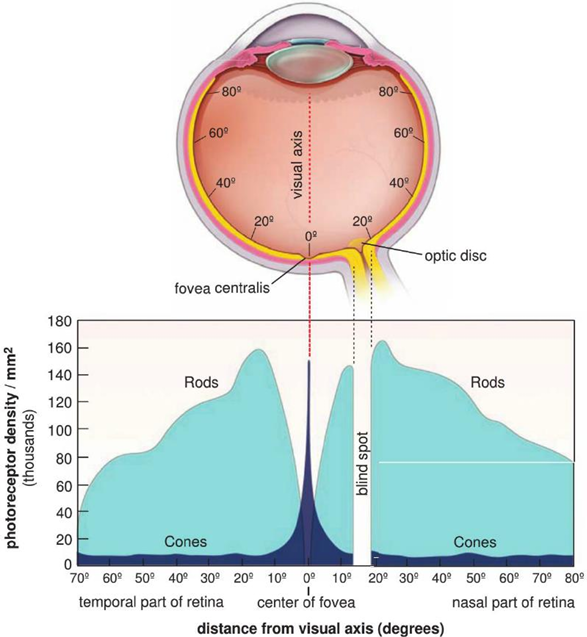
- 半夜用余光看的清楚,rods主要发挥作用
- 盲点两眼可以互补
- 半夜用余光看的清楚,rods主要发挥作用
- 图
- phototransduction 感光
光 → 化学的过程- rod 感受亮暗
- A rhodopsin视紫红质 consists of a opsin (视蛋白) and a vitamin A derivative called retinene (视黄醛).
- When light strikes, retinene changes comformation and breaks away from opsin.
- Opsin is a G protein-coupled receptor. It is activated when separated from retinene.
激活Gt,Gt激活PDE,PDE会断开cGMP的环 - The breaking down and forming up of rhodopsin continually occurs in the light/dark
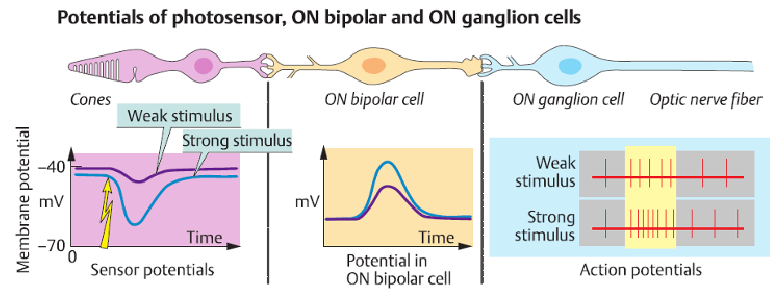
- 黑暗时-40mV,光亮时-70mV
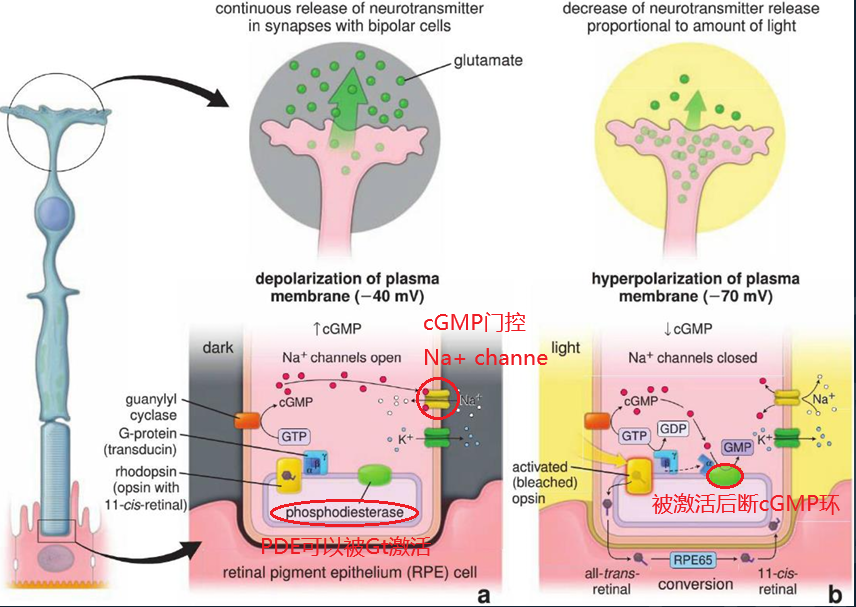
光亮时会导致Na+ channel关闭,超极化
- cone 感受颜色
- The opsin moieties of iodopsin have different amino acid sequence that determines which wavelengths of light the pigment absorbs.
- 亮一点才能看到颜色
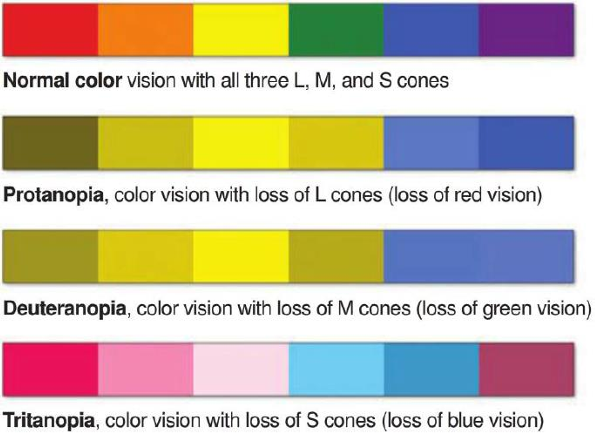
- There are three kinds of cones, blue, green and red
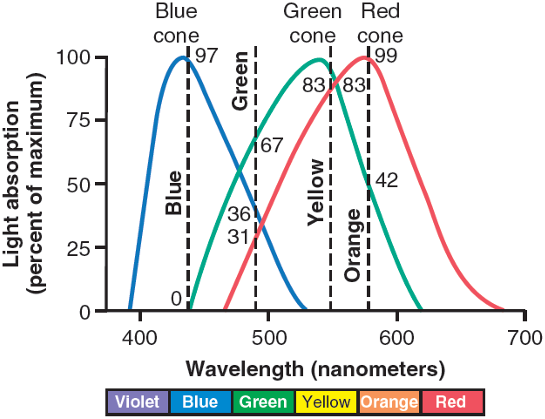
tricolor mechanism
- 正常人都是蓝敏cones少,红/绿敏cones多,红绿的比例因人而异
- Protanopia and deuteranopia are X chromosome-linked, while tritanopia is an autosomal defect
- rod 感受亮暗
- bipolar cells
- 基础
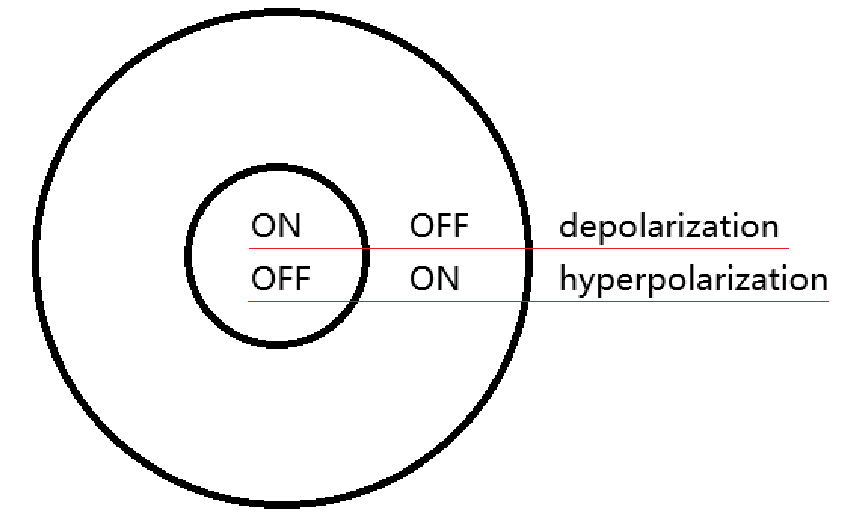
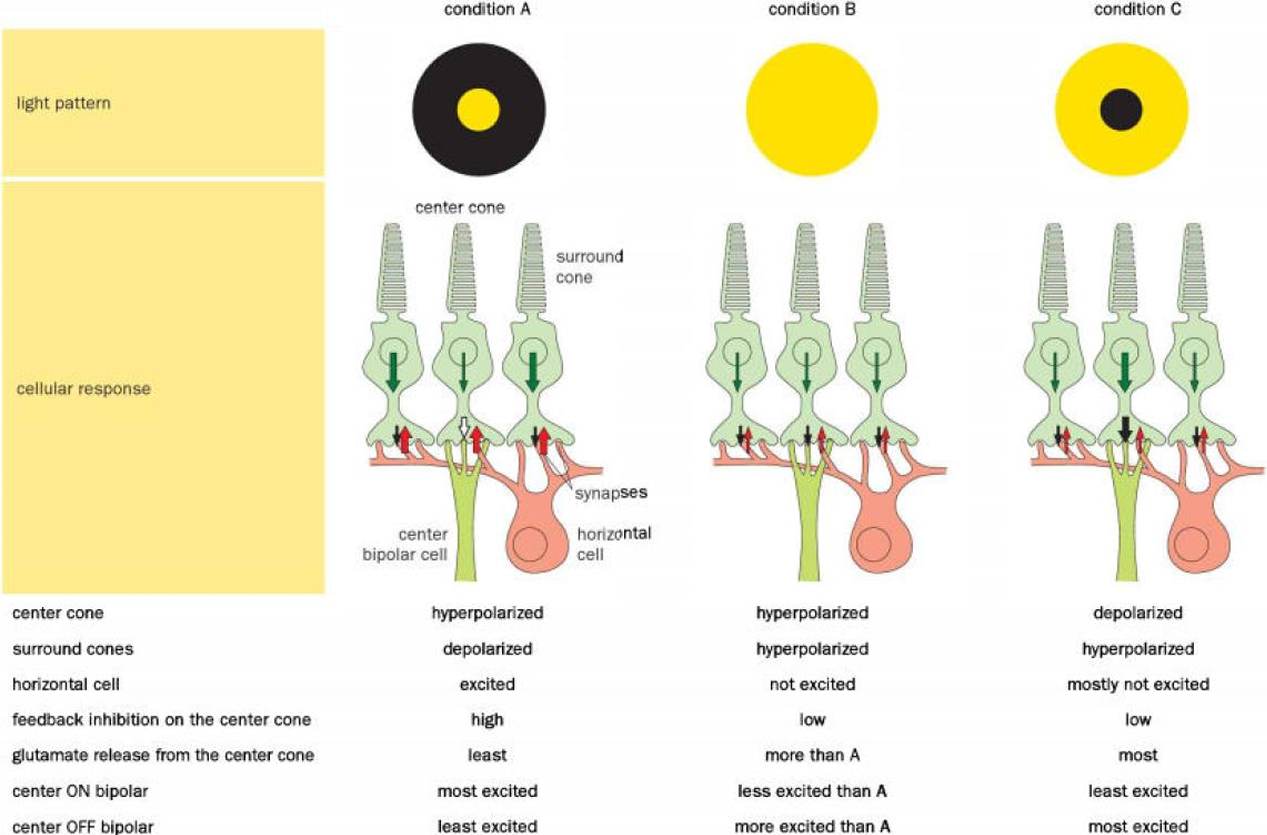
- The receptive field of bipolar cells is two concentric circles.
- The response of the center circle is opposite to the surround area.
- The center area is directly connected to photoreceptors
- the surround area is indirectly connected to photoreceptors by horizontal cells.
- ON bipolar cells
- light on the center causes depolarization while light on the surround causes hyperpolarization.
- OFF bipolar cells
- light on the center causes hyperpolarization while light on the surround ON/OFF bipolar cells with projection to different layers causes depolarization
- The receptive field of bipolar cells is two concentric circles.
- 在小圈里的
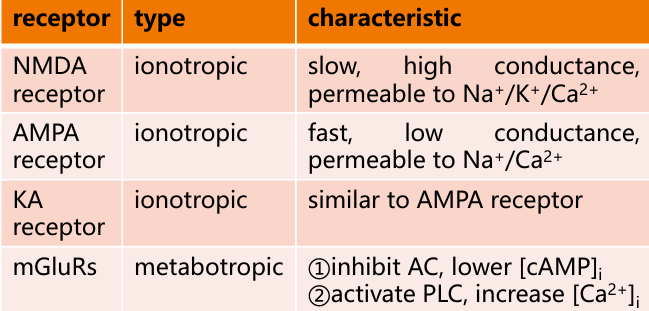
- ON bipolar cells express metabotropic glutamate receptor. It closes cation channels and causes depolarization
光 → cones ↓ → GPCR ↓ → +channel ↑ → depolarization - OFF bipolar cells express ionotropic glutamate receptor. It opens cation channels and causes hyperpolarization
光 → cones ↓ → iontropic receptor ↓ → +channel ↓ → hyperpolarization - 都是glutamate receptors
- ON bipolar cells express metabotropic glutamate receptor. It closes cation channels and causes depolarization
- 在小圈到大圈的
- Horizontal cells are inhibitory interneurons that receive glutamate from photoreceptors and releases GABA to act on photoreceptors
- recurrent inhibition & lateral inhibition
- Amacrine cells (无长突细胞) are similar to horizontal cells
- 小圈到大圈的感光细胞不直接连着双极细胞,而是通过horizontal cell影响小圈里的双极细胞
- 基础
- ganglion cells
- Ganglion cells connect to bipolar cells and inherit继承 their receptive field
- The axons of ganglion cells forms the optic nerve视神经
- Ganglion cells can fire action potentials
- ON/OFF跟双极一样,双极ON连着ganglion ON
- 图
- histology of the retina
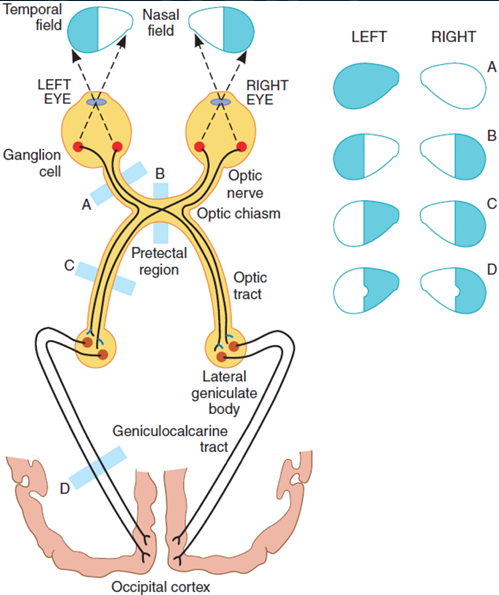
- visual pathway
- optic nerve 视神经
- optic chiasm 视交叉
- optic tract 视束
- lateral geniculate body 外侧膝状体
- geniculocalcarine tract 膝距束
- visual cortex 视皮层
在occipital cortex枕叶 - 图
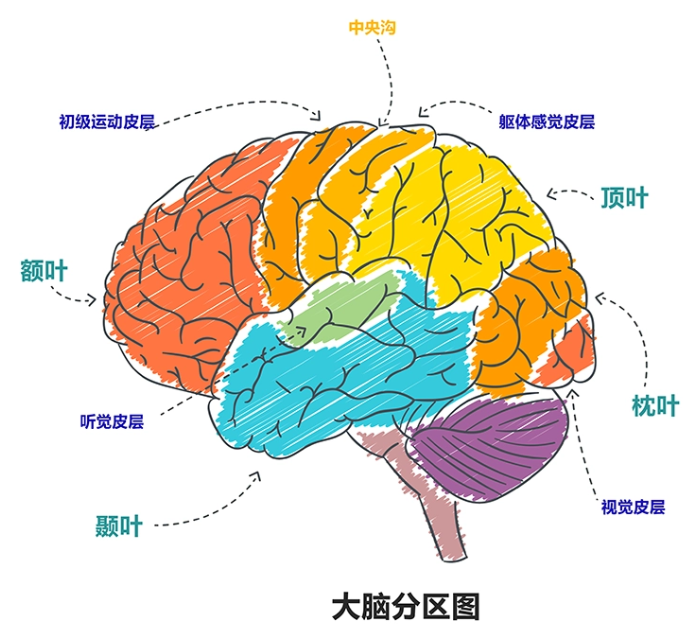
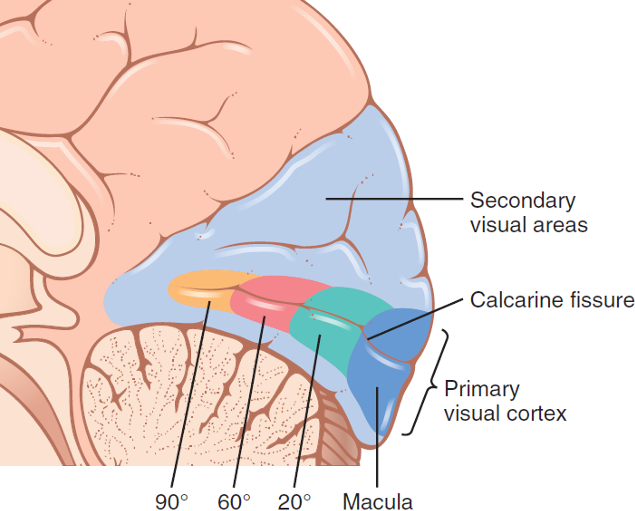
- visual cortex
- 枕叶在后脑勺那
- 可以看出眼中间位置占的皮层最大
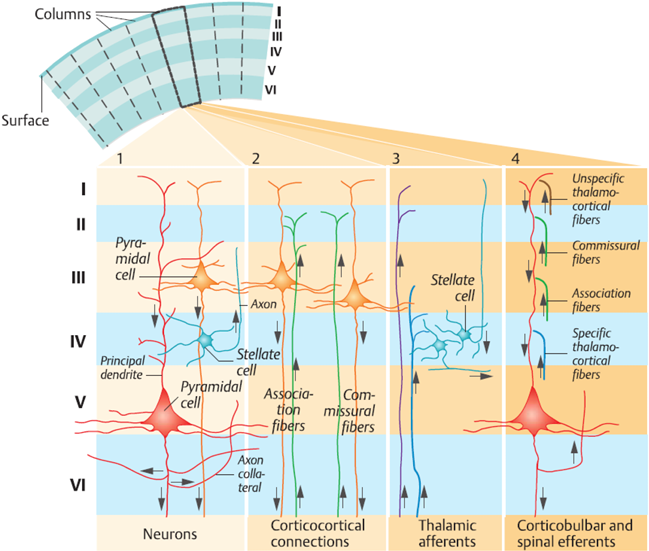
- six layers of the cortex
- orientation columns of the visual cortex
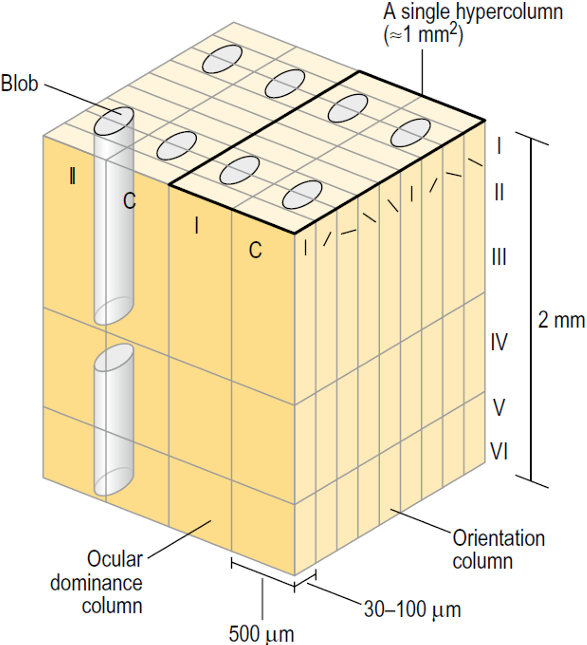
每个column可以分成更小的columm,每个column对应一个方向,对物体运动方向敏感
- 枕叶在后脑勺那
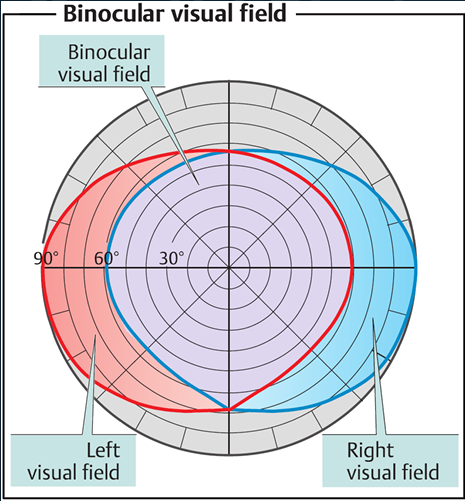
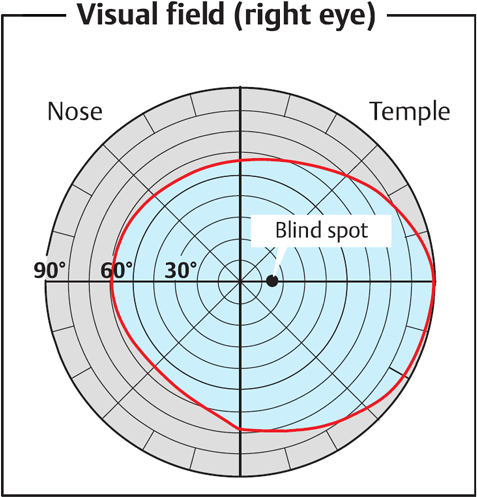
- visual field & stereoscopic vision
- 立体视野,两个眼加一块就行
- 单个眼有盲点
- 立体视野,两个眼加一块就行
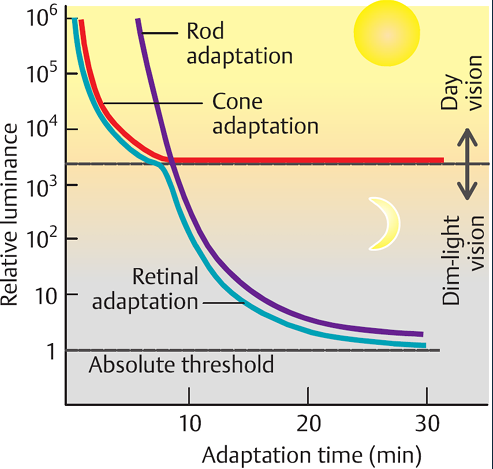
- light & dark adaptation, afterimage
- 暗光时候视色素会积累,导致突然看到光会很亮,反之亦然
- 暗光时候视色素会积累,导致突然看到光会很亮,反之亦然
- anatomy
- ear
- anatomy
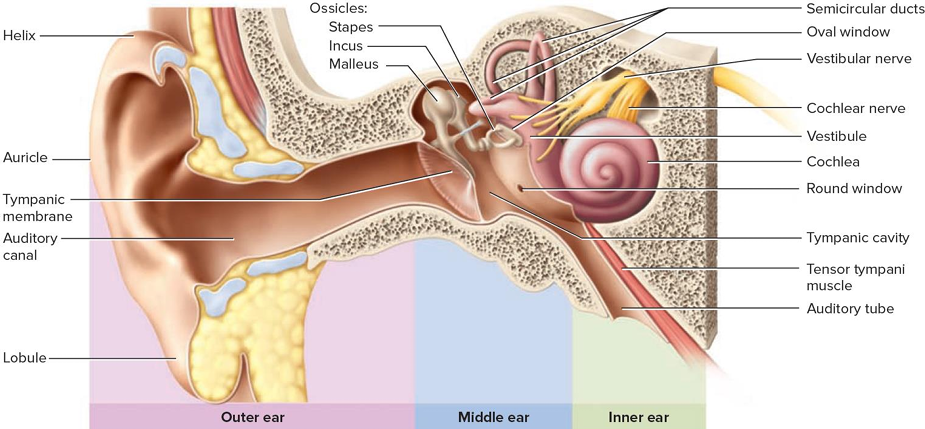
- 外耳,中耳,内耳
- tympanic membrane 鼓膜
分隔外耳与中耳- The eardrum is suspended in a ringshaped groove and vibrates in response to sound
鼓膜悬浮于环形凹槽中,随声音振动 - It is innervated by sensory branches of the vagus and trigeminal nerves and is highly sensitive to pain
它受迷走神经和三叉神经的感觉分支支配,对疼痛极为敏感
- The eardrum is suspended in a ringshaped groove and vibrates in response to sound
- auditory ossicles 听小骨
- malleus 锤骨
- incus 砧骨
- stapes 镫骨
人体最小的骨头 - The auditory ossicles form a lever杠杆 to increase pressure
- eardrum → malleus → incus → staples → oval window (卵圆窗)
- eardrum : oval window = 55:3.2 = 17.2:1
鼓膜与卵圆窗的面积比,会使压强增大17.2倍 - malleus : incus = 1.3:1
锤骨与砧骨形成杠杆,使压强增大1.3倍 - magnification = 22.4
压强总共增大22.4倍
- inner ear
- The inner ear is also called the labyrinth (迷路).
- The bony labyrinth (骨迷路) is a maze of temporal bone passages that form the cochlea and the vestibule
- The membranous labyrinth (膜迷路) is a series of epithelial sacs and tubes inside the bony labyrinth.
- The cochlea (耳蜗) resembles a snail’s shell that converts mechanical vibrations to action potentials in the auditory nerve fibers
- The vestibule (前庭) is responsible for equilibrium.
- cochlea
- 结构
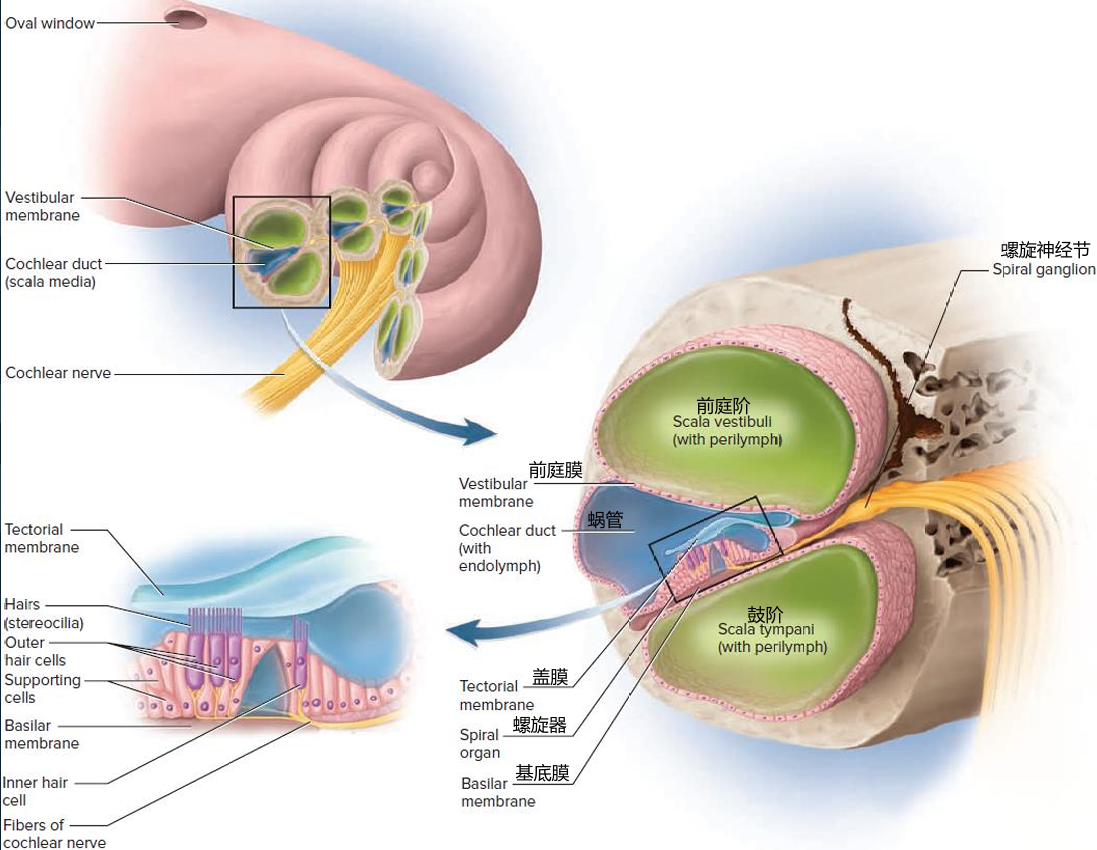
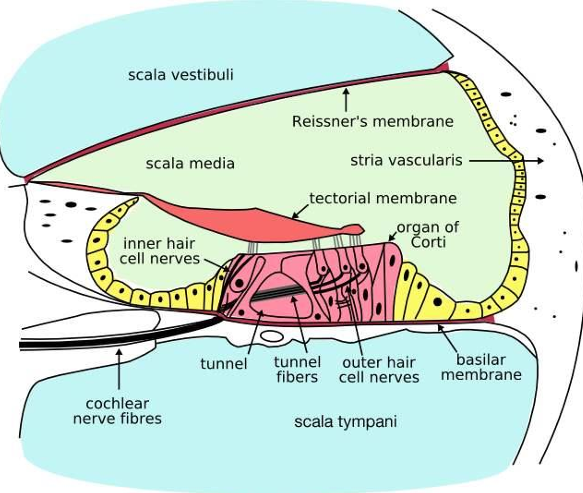
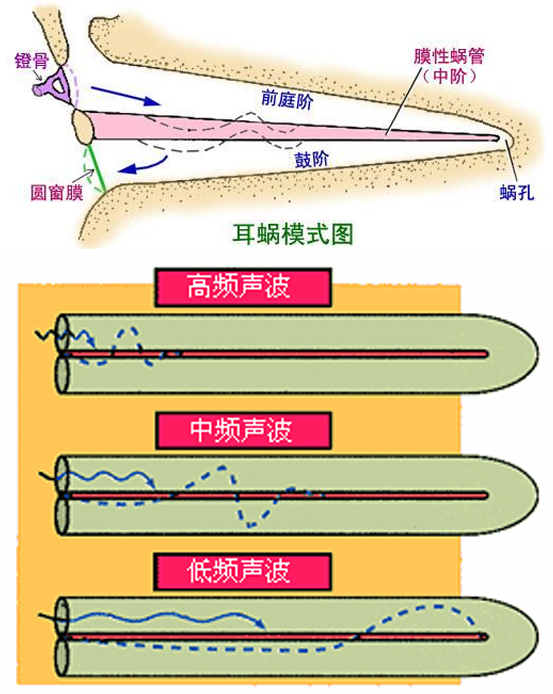
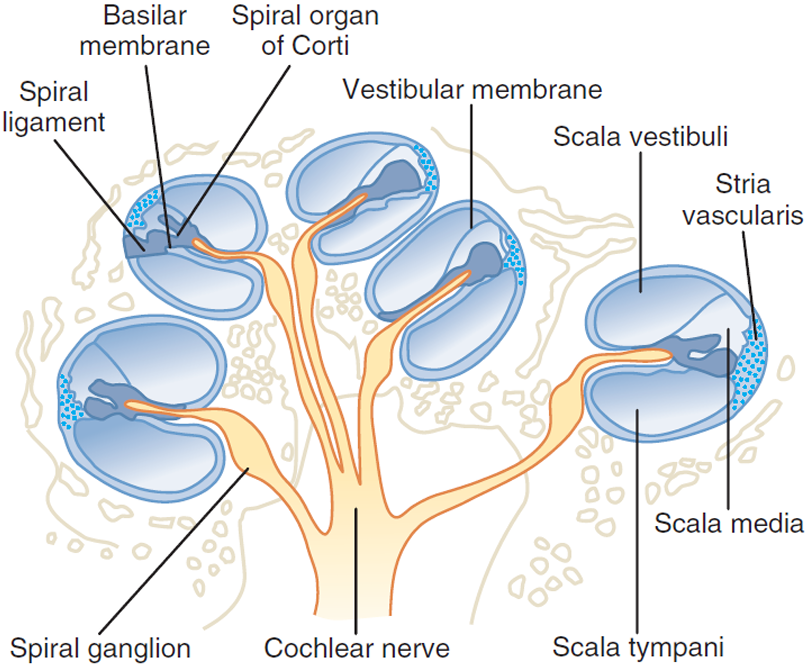
- scala vestibuli 前庭阶,scala tympani 鼓阶里面是perilymph外淋巴液,cochlear duct 蜗管里面是endolymph内淋巴液
- 蜗管有两个膜,tectorial membrane 盖膜,basilar membrane 基底膜
盖膜受到传导自vestibular membrane 前庭膜的振动,使hair cell倾斜 - 分为outer hair cell与inner hair cell
- 结构
- 外耳,中耳,内耳
- hearing
- travelling wave theory
- https://www.bilibili.com/video/BV1aa4y1Y7F2/
- The higher the frequency a sound has, the shorter the distance it transmits
- the lower the frequency a sound has, the longer the distance it transmits
- The auditory nerve fibers connect to different parts of the basilar membrane
- They convert sounds of different frequencies to action potentials transmit them to different parts of the auditory cortex, thus we can distinguish the pitches of and sounds
- 不同的地方可以感受到不同的频率,圆窗膜可以平衡压力
- auditory transduction
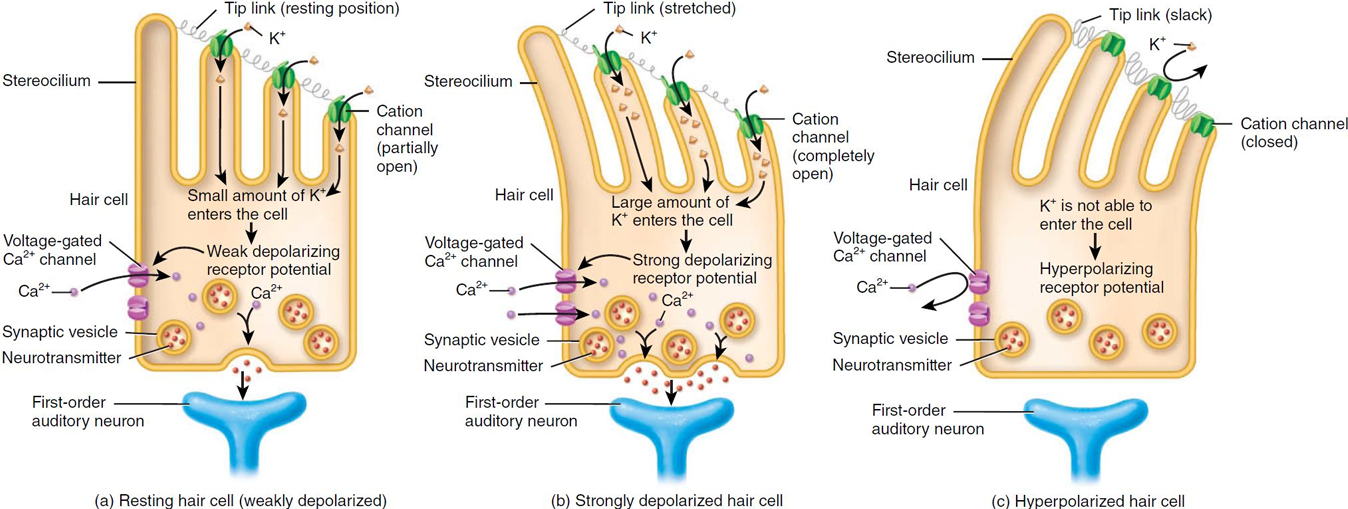
- As the basilar membrane vibrates, the stereocilia纤毛 bend back and forth.
- Inner hair cells release glutamate to excite the nerve fiber
- Outer hair cells shorten to amplify the sound by 40dB
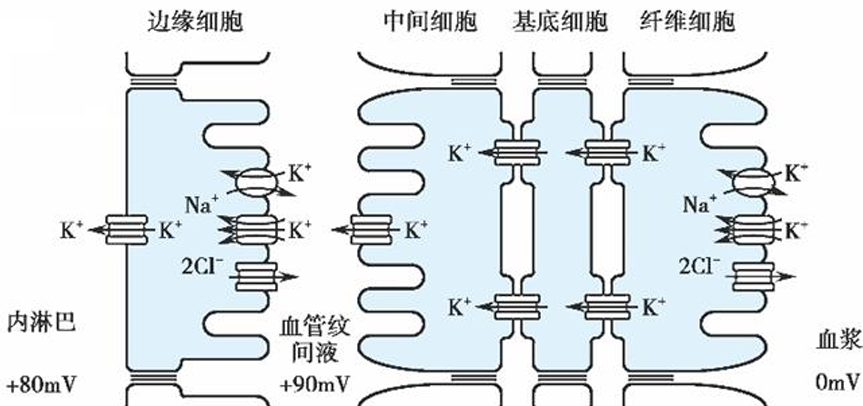
- endolymph 内淋巴液
- K+浓度高,所以纤毛上的通道在打开时能快速进入
- mechanism of high K+ in endolymph
- cochlear nerve
- The cochlear nerve is a trunk神经干 formed by many fibers.
- The amplitude of compound action potential is determined by the intensity of sound, numbers of excited fibers and synchronization of discharges.
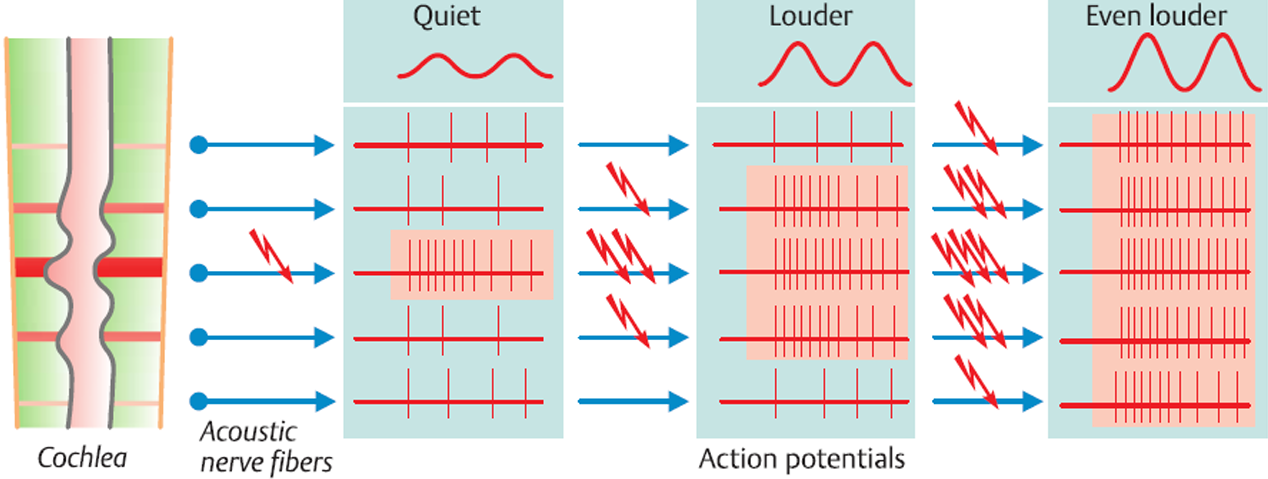
正常的action potential强度是一定的,但是compound action potential是好几个神经合起来的,大小可变
- The cochlear nerve is a trunk神经干 formed by many fibers.
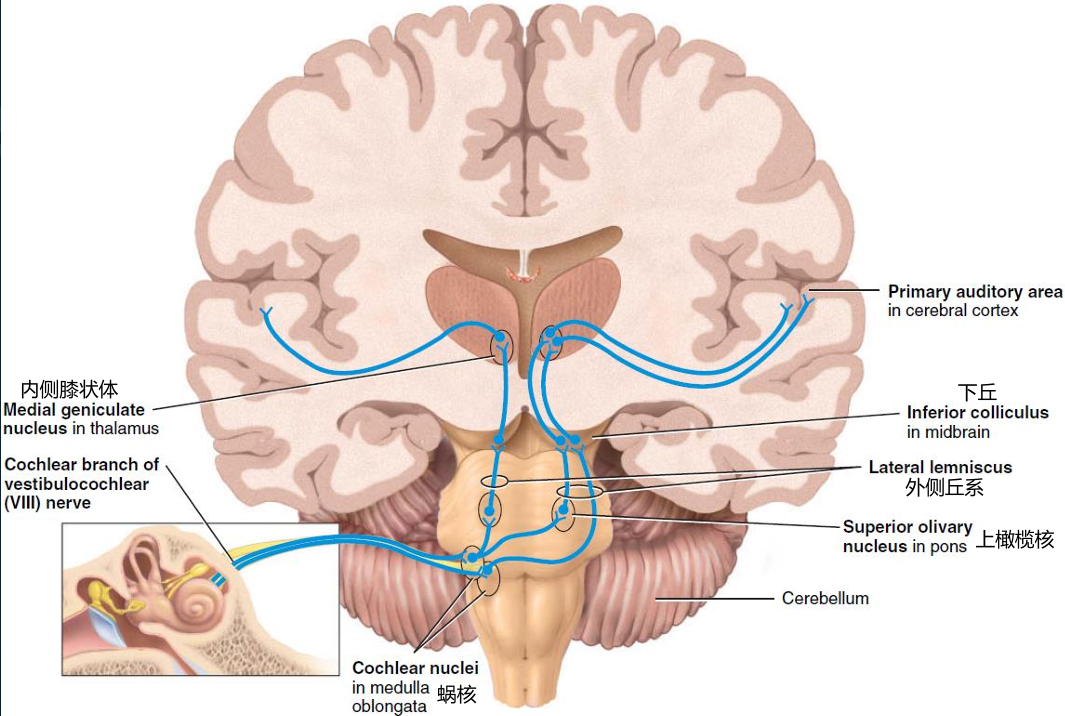
- auditory pathway
- 图
- Cochlear branch of vestibulocochlear(VIII) nerve
前庭蜗神经的耳蜗神经分支 - Cochlear nuclei 蜗核
in medulla oblongata延髓 - Superior olivary 上橄榄核
nucleus in pons - Medial geniculate 内侧膝状体
nucleus in thalamus丘脑 - Primary auditory area
in cerebral cortex
- 图
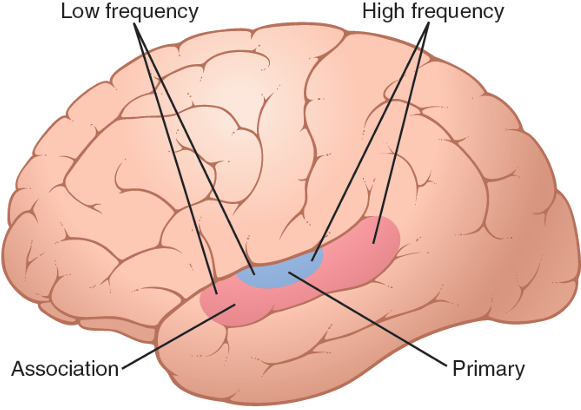
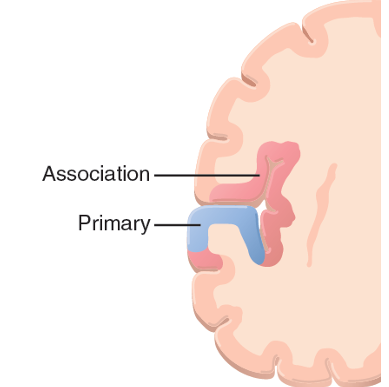
- auditory cortex
- The auditory cortex lies on the superior temporal gyrus (颞上回) and the transverse temporal gyrus (颞横回).
- High-frequency sounds excite neurons located posteriorly, while low-frequency sounds excite neurons located anteriorly.
- Besides frequency, the auditory cortex can distinguishes the direction and duration of sounds
- travelling wave theory
- Equilibrium
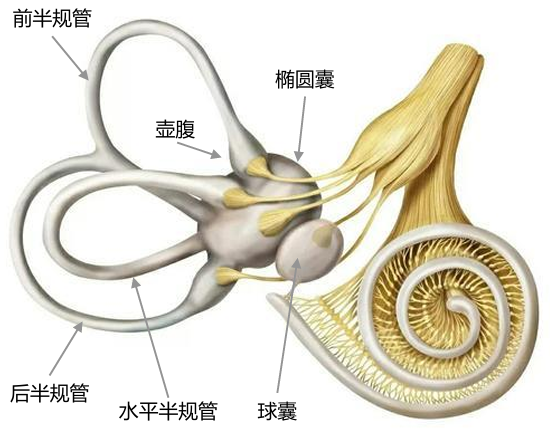
- vestibular apparatus前庭器官
- vestibular apparatus = utricle (椭圆囊) + saccule ( 球囊) + 3 semicircular ducts (半规管)
- Equilibrium: gesture, body movement and head position
只负责头部平衡感觉 - The vestibulocochlear (Ⅷ) nerve consists of the vestibular nerve and the cochlear nerve.
- vestibular apparatus = utricle (椭圆囊) + saccule ( 球囊) + 3 semicircular ducts (半规管)
- https://www.bilibili.com/video/BV1xt411T7Rg/
- transduction
- 原理跟听觉一样
- 原理跟听觉一样
- semicircular ducts
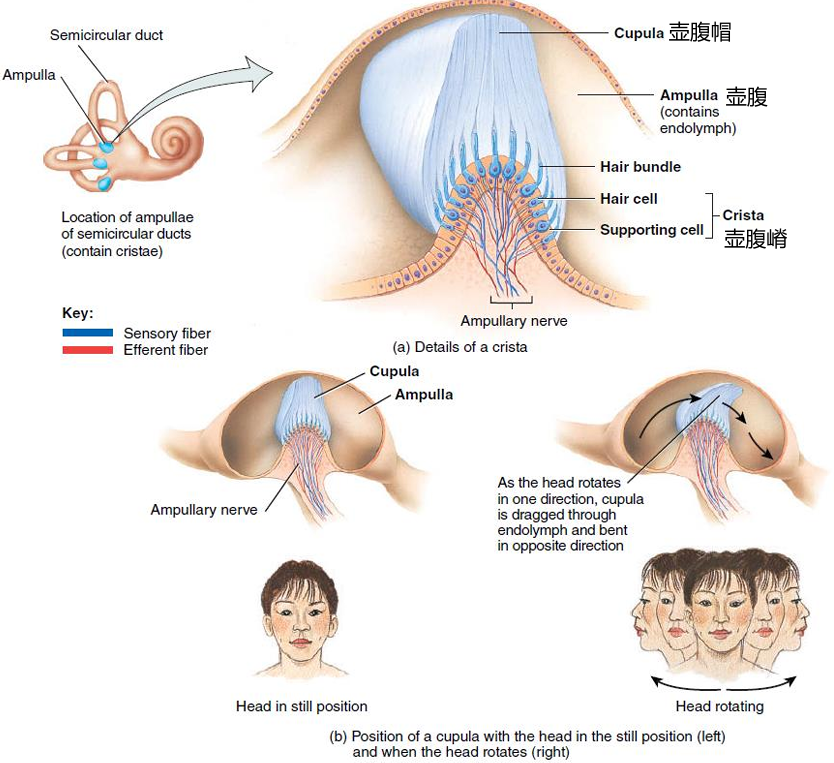
- The three semicircular ducts are responsible for detecting rotation of different direction.
- lateral semicircular duct: horizontal
- anterior semicircular duct: front to back
- posterior semicircular duct: left to right
- threshold: 1~3°/s²
感受角速度
- The three semicircular ducts are responsible for detecting rotation of different direction.
- saccule球囊 & utricle椭圆囊
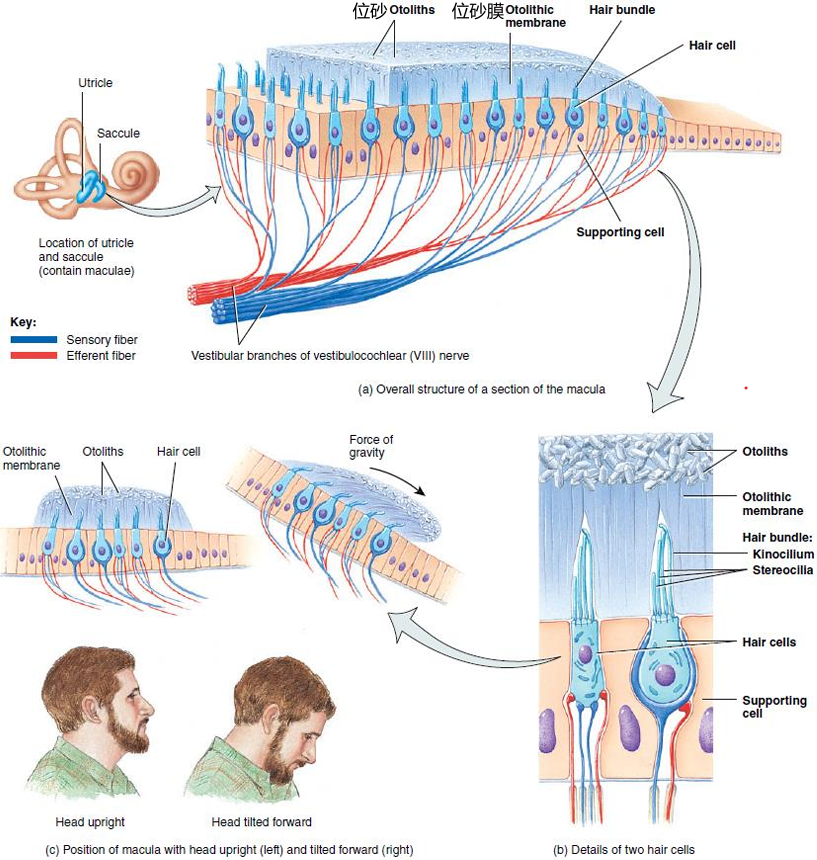
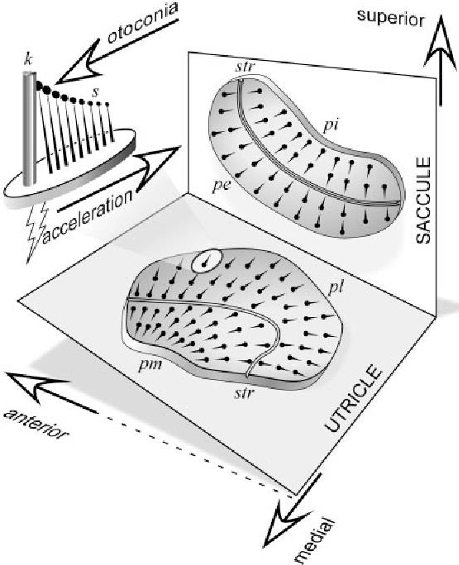
- The saccule and utricle are responsible detecting for linear acceleration.
- Hair cells lie in the macula (囊斑) and their hair is imbedded in the otolithic membrane (位砂膜)
- saccule感受垂直加速度,utricle感受水平加速度
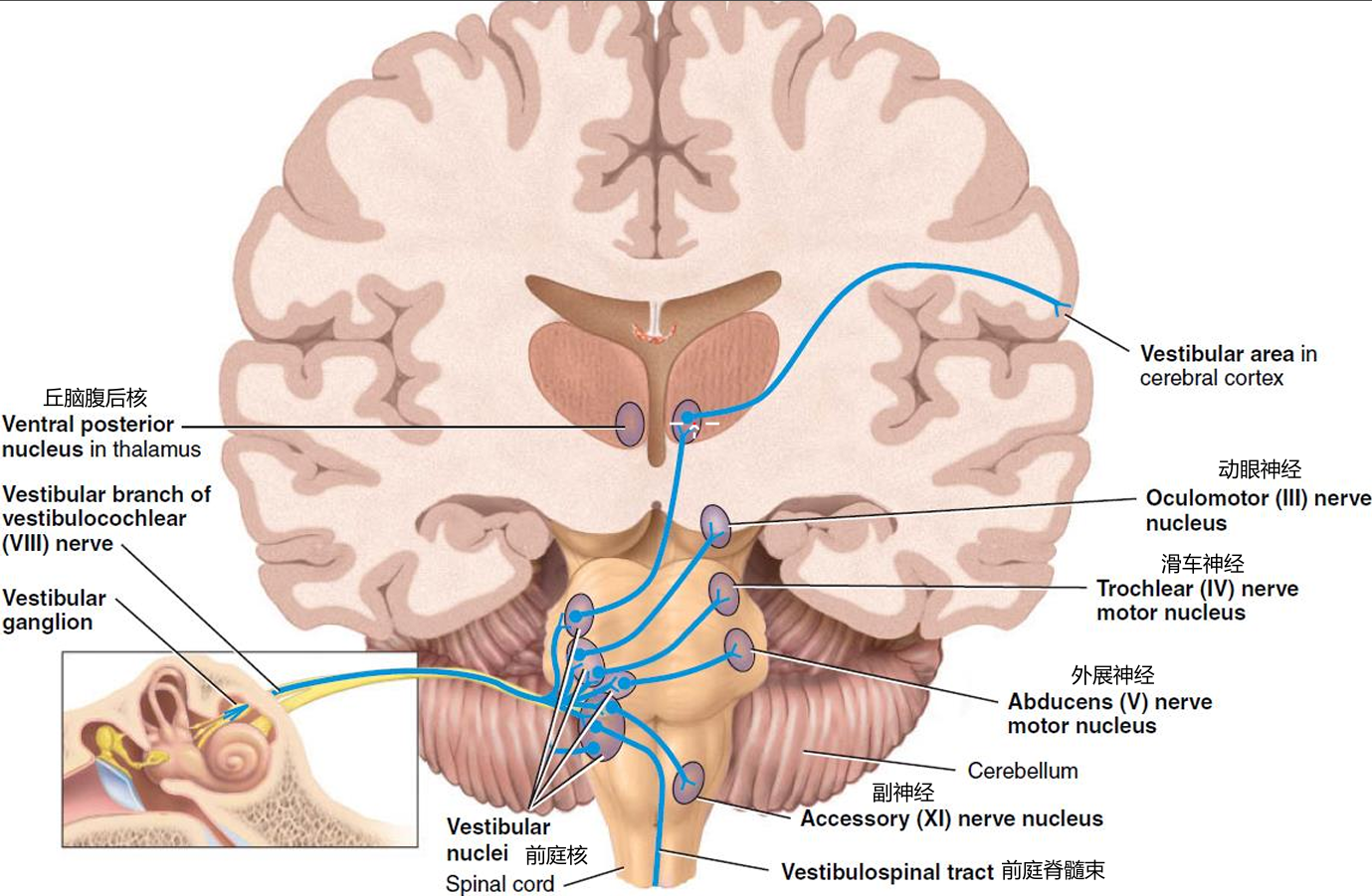
- equilibrium pathway
- 图
- 图
- vestibular apparatus前庭器官
- anatomy
- nose
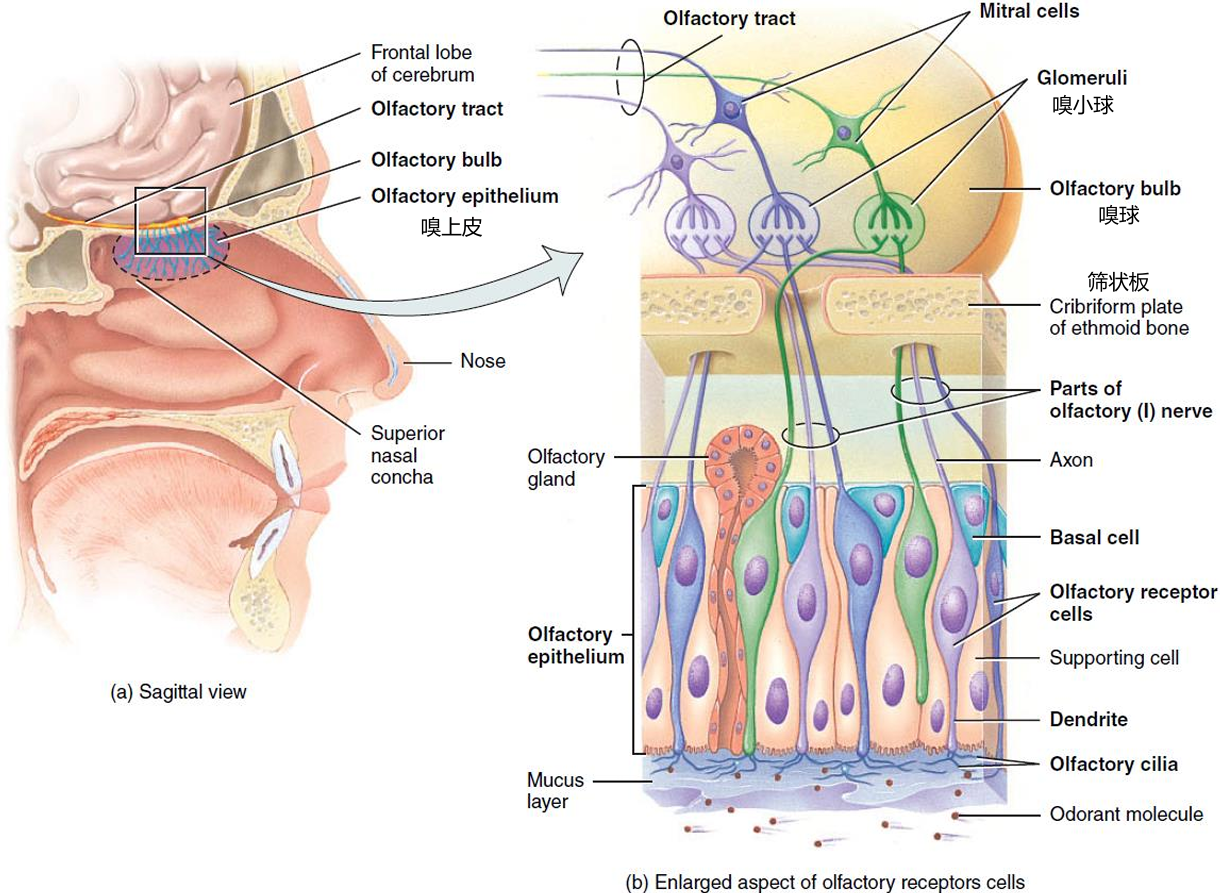
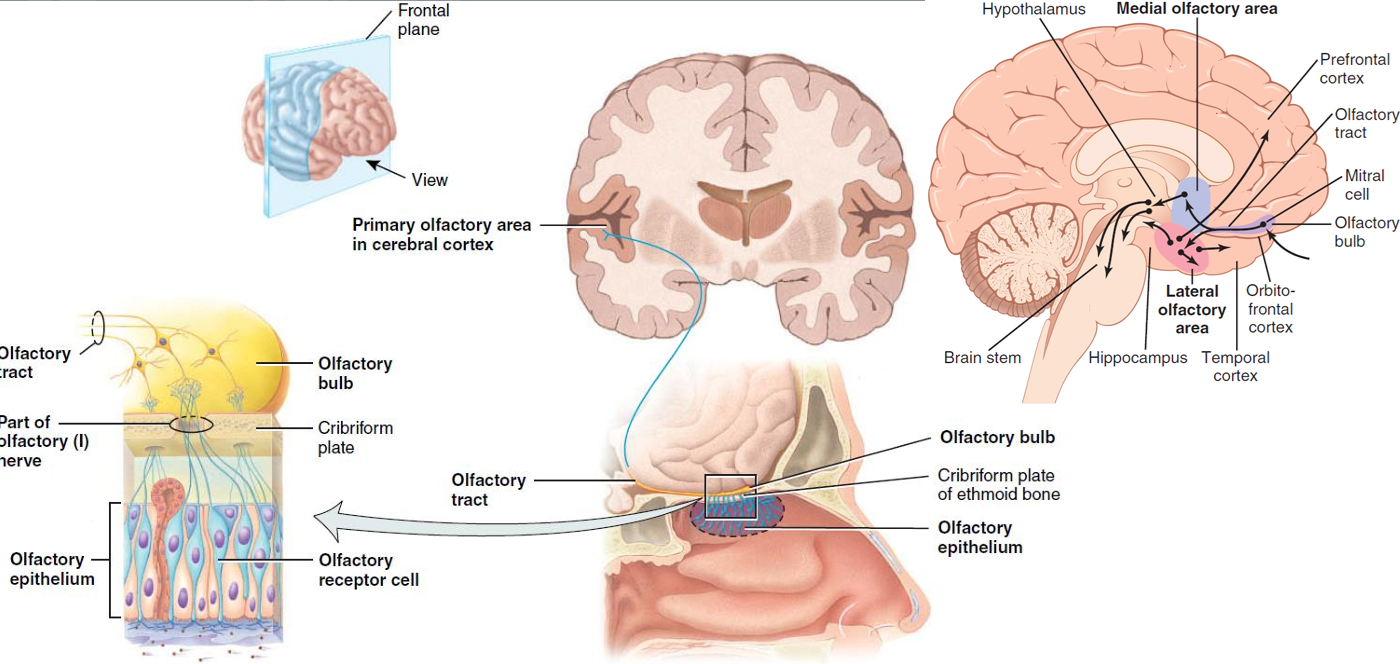
Olfaction 嗅觉- olfactory epithelium
- 嗅上皮就在脑子底下
- 嗅上皮就在脑子底下
- olfactory receptors
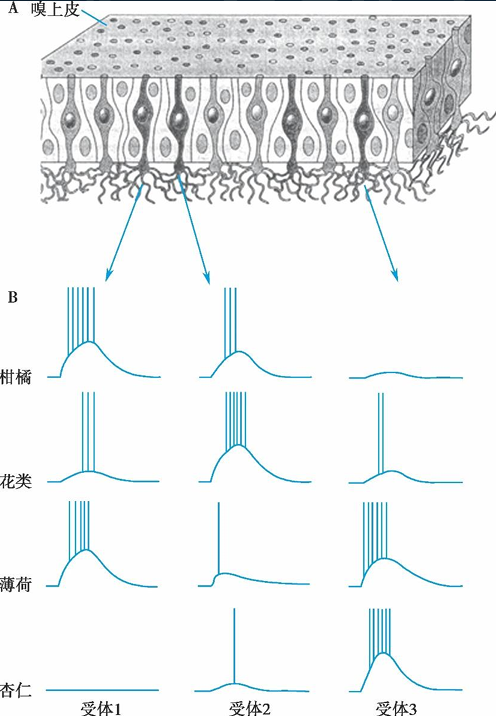
- Each olfactory cell usually expresses only one type of olfactory receptors.
但是一个受体对许多种气味有反应 - There are 1200 olfactory receptor types, humans, but in most of the olfactory genes have mutated to become pseudogenes.
- Only about 350 kinds of receptors are functional.
- We can distinguish up to 10000 odors by population coding (群体编码)
- Each olfactory cell usually expresses only one type of olfactory receptors.
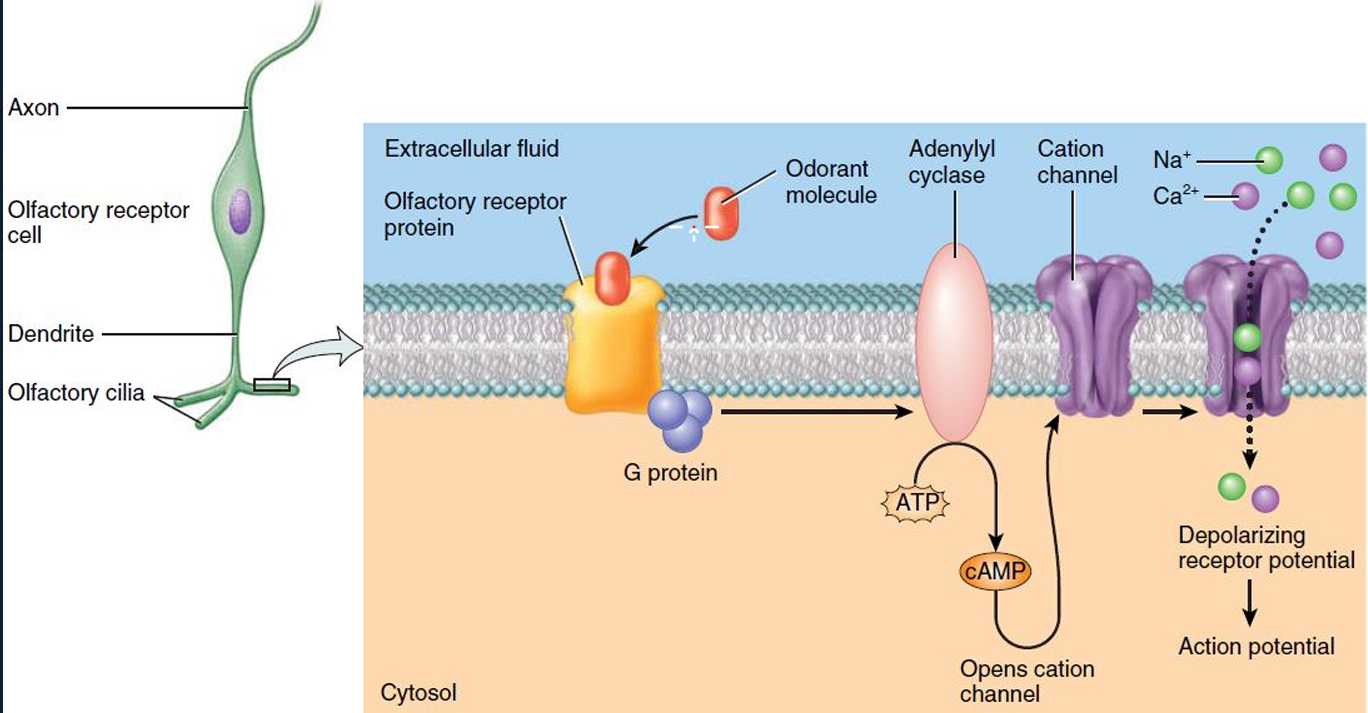
- olfactory transduction
- Gs
- Gs
- olfactory pathway
- 图
- 图
- olfactory epithelium
- tongue
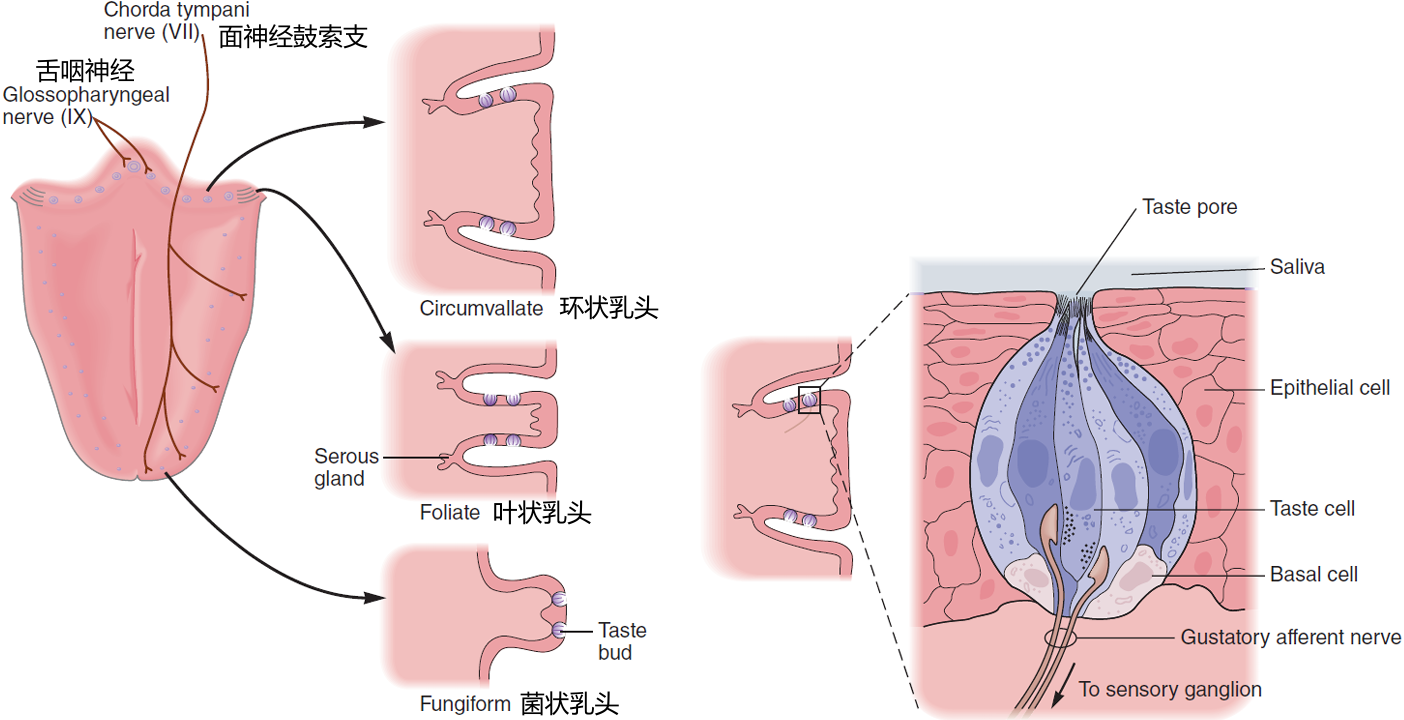
Gustation- taste buds 味蕾
- taste buds in papillae of the tongue
- taste buds in papillae of the tongue
- 味道
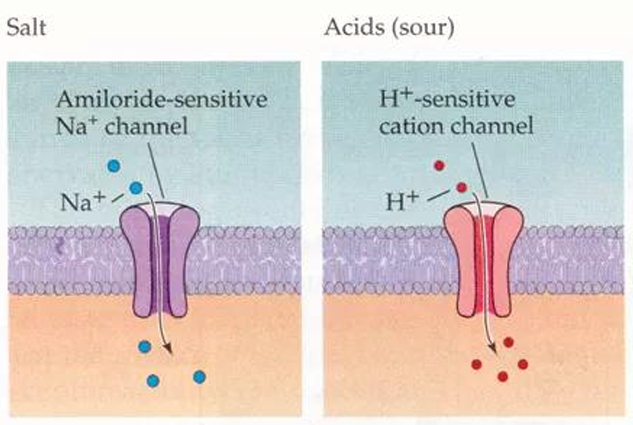
- salty & sour
- Cation entry causes depolarization, release of neurotransmitters and eventually action potentials on the nerve fibers
- Cation entry causes depolarization, release of neurotransmitters and eventually action potentials on the nerve fibers
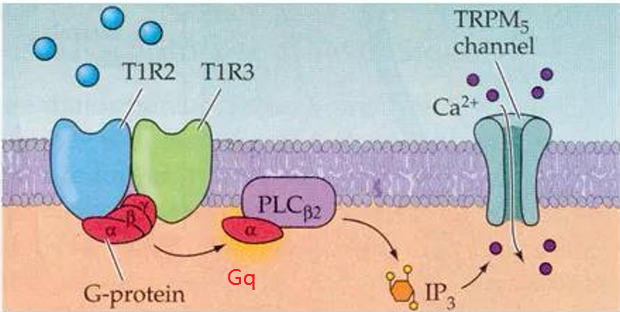
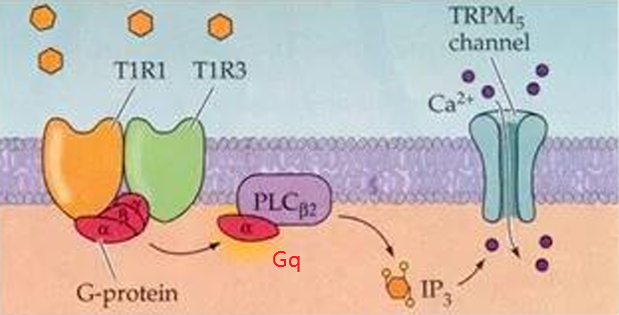
- sweet
- Natural sweet tastants bind to their receptor (T1R2/T1R3) and open TRPM5 channel.
- Man-made sweet tastants transmit the signal by cAMP-dependent pathway.
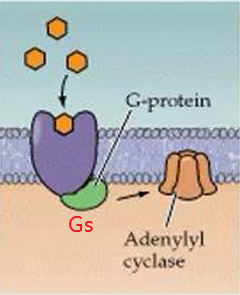
cAMP → PKA → action
- Natural sweet tastants bind to their receptor (T1R2/T1R3) and open TRPM5 channel.
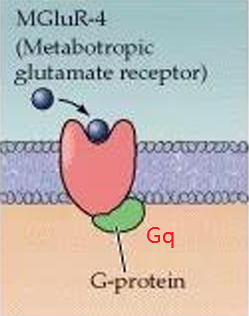
- umami 鲜味
这个词来源于小日子喜欢吃生鱼片- Umami tastants bind to their receptor (T1R1/T1R3) and open TRPM5 channel.
- Umami tastants can also bind to metabotropic glutamate receptor
- Umami tastants bind to their receptor (T1R1/T1R3) and open TRPM5 channel.
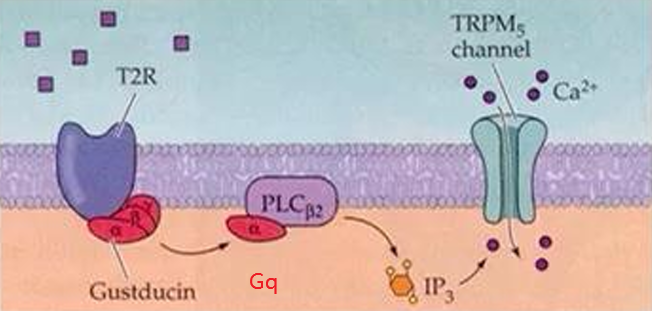
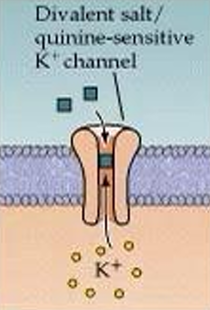
- bitter
- Bitter tastants bind to their receptor (T2R) and open TRPM5 channel.
- Bitter tastants can block K+ channel that is sensitive to quinine (奎宁) to cause depolarization
- Bitter tastants bind to their receptor (T2R) and open TRPM5 channel.
- spiciness
- Spicy signals are transmitted via nerve fibers that transmit pain and temperature
- Spicy signals are transmitted via nerve fibers that transmit pain and temperature
- salty & sour
- gustatory pathway
- Facial/glossopharyngeal nerve (tongue) and vagus nerve (pharynx)
- gustatory nucleus in the medulla oblongate
- ventral posterior medial nucleus (腹后内侧核) of thalamus
- gustatory cortex
- 图
- taste buds 味蕾
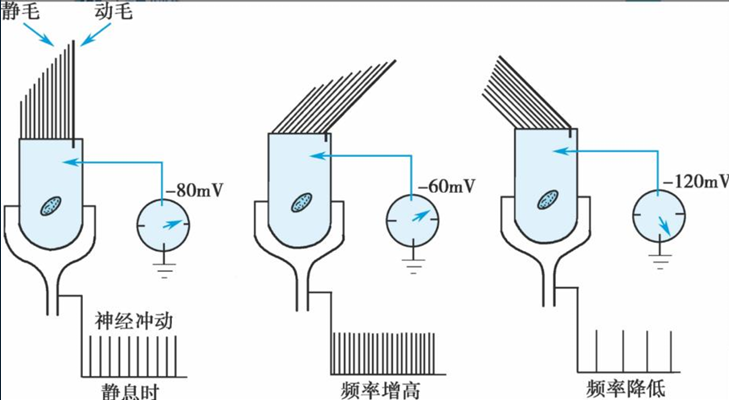
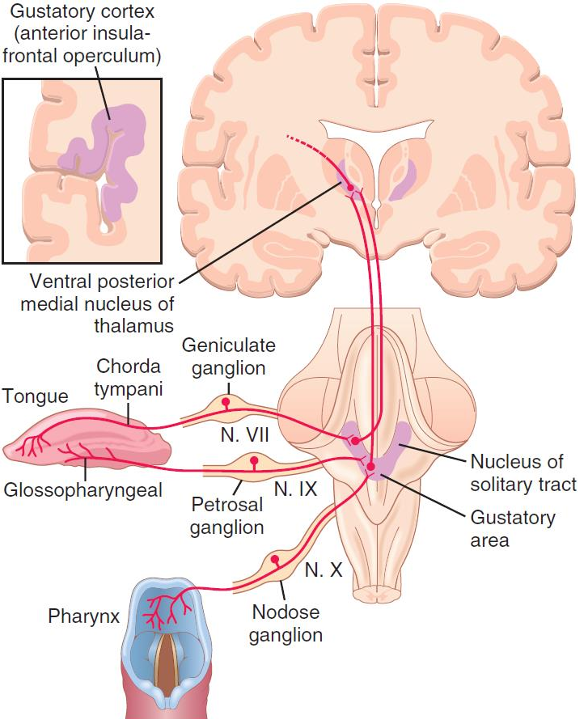
下篇
- Motor Functions of the Nervous System
- Classification of body movement
- reflex movement
- voluntary movement
- rhythmic movement
比如呼吸,但是心跳不算,不是skeleton muscle
- Motor regulation
- Plan
- association area of the cortex (大脑皮层联络区)
- basal ganglia (基底神经节)
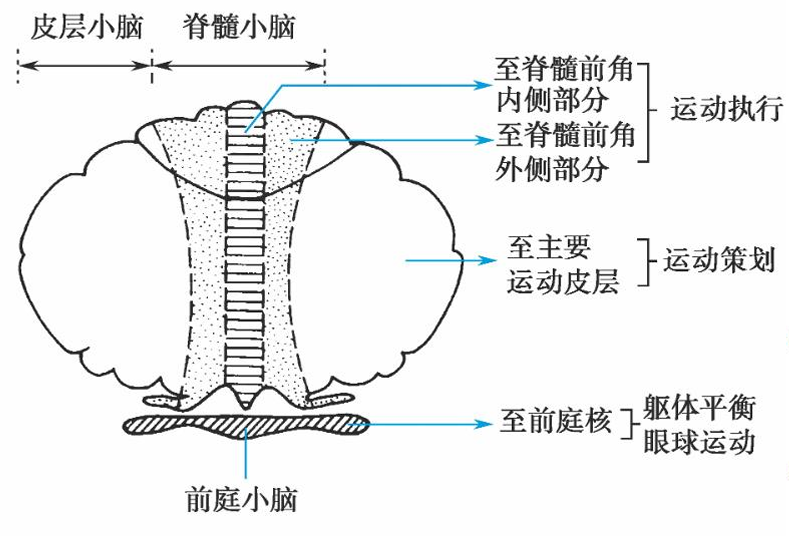
- cerebrocerebellum (皮层小脑)
- Coordinate
- motor cortex
- spinocerebellum (脊髓小脑)
- Execute
- brainstem
- spinal cord
- 图
- Plan
- spinal cord
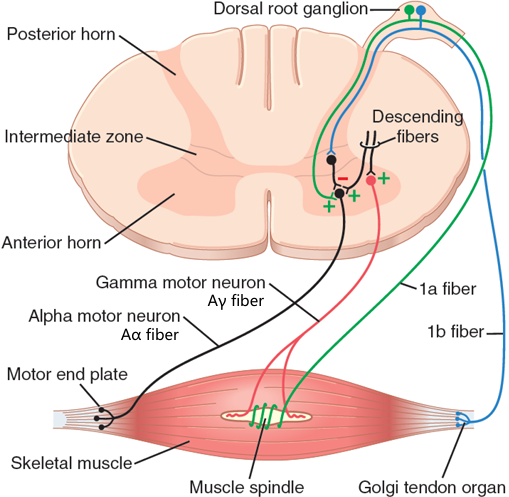
- There are 3 kinds of motor neurons in the anterior horn of spinal cord.
- α motor neurons innervate the extrafusal肌梭外的 fibers. A single α motor neuron and all the muscle fibers it excites are collectively called the motor unit.
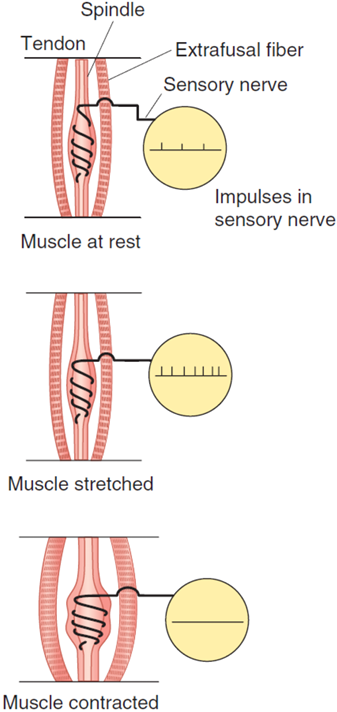
- γ motor neurons innervate the intrafusal fibers梭内肌纤维 and maintain the sensitivity of the muscle.
- The function of β motor neurons is unknown
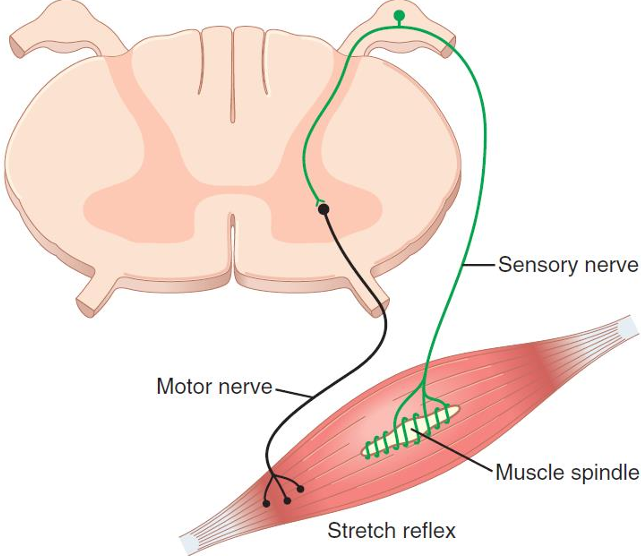
- sensory fibers and anterior motor neurons innervating skeletal muscle
- 上一张图绿色的感受肌肉位置,本体感
- 脊髓负责unconditional reflex
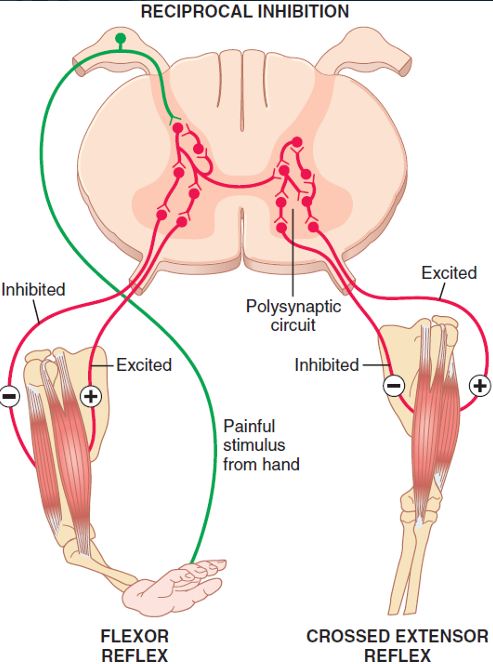
flexor reflex & crossed extensor reflex,捅一边手,会导致整个身体产生反应
- Stretch reflex(牵张反射) include tendon reflex (腱反射) and muscle tone (肌紧张)
- There are 3 kinds of motor neurons in the anterior horn of spinal cord.
- brainstem
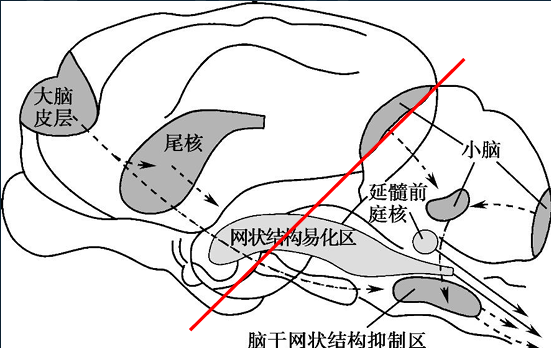
- The facilitatory area in the reticular formation (网状结构) increases muscle tone, while the inhibitory area reduces it
- 深灰色抑制,浅灰色促进
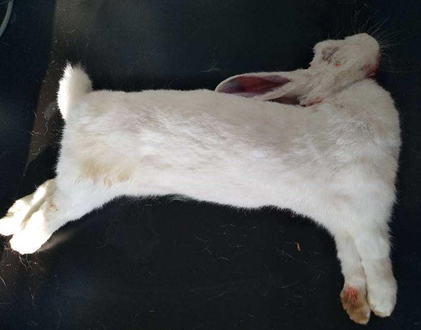
- 沿着上图红线切一刀,就会全身肌肉收缩, decerebrate rigidity
- Cerebellum
- The cerebellum has no direct ability to cause muscle contraction, but it coordinates motor activities by continuously monitoring and making corrective adjustments.
- 中间部分是vermis,往两边是spinocerebellum和cerebrocerebellum
- The vermis regulates rough movements
游泳,跑步等 - The rest of the spinocerebellum regulates precise movements
精细工作
- Basal ganglia 基底神经节
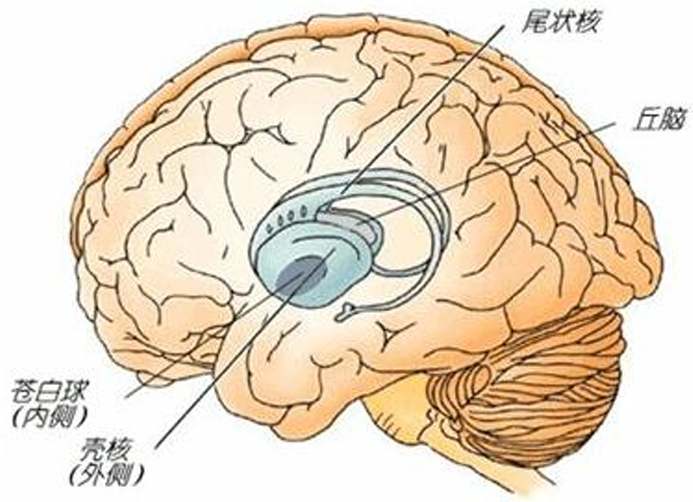
大脑皮层下面- Basal ganglia are nuclei deep within each cerebral hemisphere.
- corpus striatum (纹状体)
- globus pallidus (苍白球)
- putamen (壳核)
- caudate nucleus (尾核)
- 图
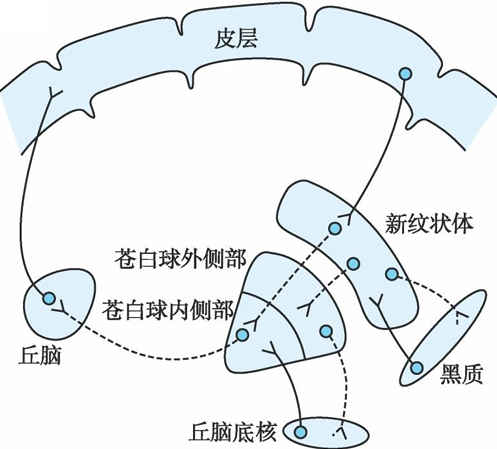
- The substantia nigra (中脑黑质) and the subthalamic nuclei (丘脑底核) are functionally linked to the corpus striatum
- pathways
- direct pathway
- neostriatum (新纹状体) → internal segment of globus pallidus
- neostriatum = putamen + caudate nucleus
- indirect pathway
- neustriatum → external segment of globus pallidus → subthalamic nuclei → internal segment of globus pallidus
- nigrostriatal projection
- the substantia nigra releases dopamine to excite the neostriatum
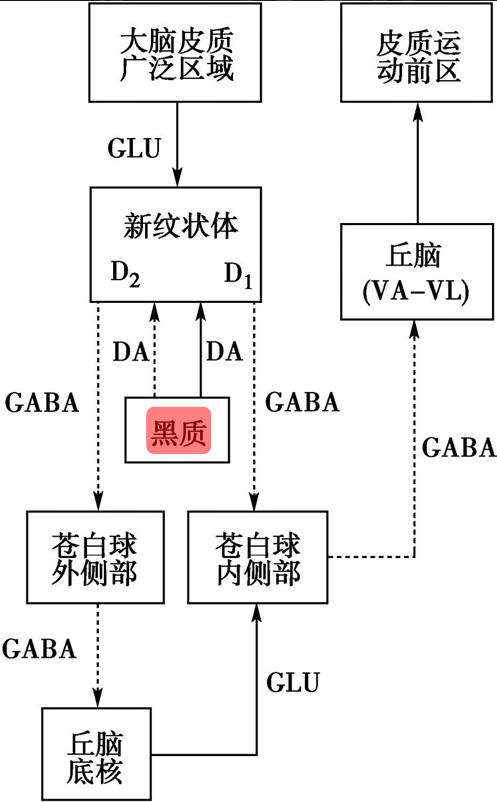
- 释放dopamine(DA)可以↑皮质运动前区
- 原理图
- neostriatum D1受体路径
- DA → D1↑ → GABA↑ → internal globus pallidus↓ → GABA↓ → thalamus↑ → cortex↑
- neostriatum D2受体路径
- DA → D2↓ → GABA↓ → external globus pallidus↑ → GABA↑ → subthalamic nuclei↓ → GLU↓ → internal globus pallidus↓ → GABA↓ → thalamus↑ → cortex↑
- 原理图
- 疾病
- Parkinson’s disease 帕金森
- Degeneration of dopaminergic neurons of the substantia nigra causes paralysis agitans (震颤性麻痹).
- It is treated with L-dopa. 这是一种多巴胺前体
- Huntington’s disease 亨廷顿病
- Degeneration of GABAergic neurons of the neostriatum causes rapid involuntary body movements
- Parkinson’s disease 帕金森
- direct pathway
- Cerebral cortex
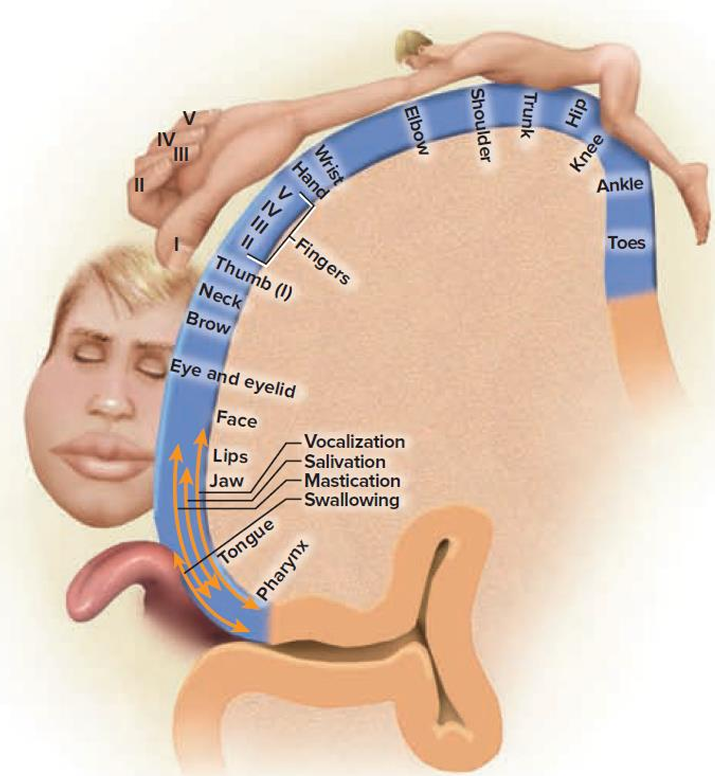
- The primary motor cortex is close to the primary somatosensory cortex. Both of them are upside-down.
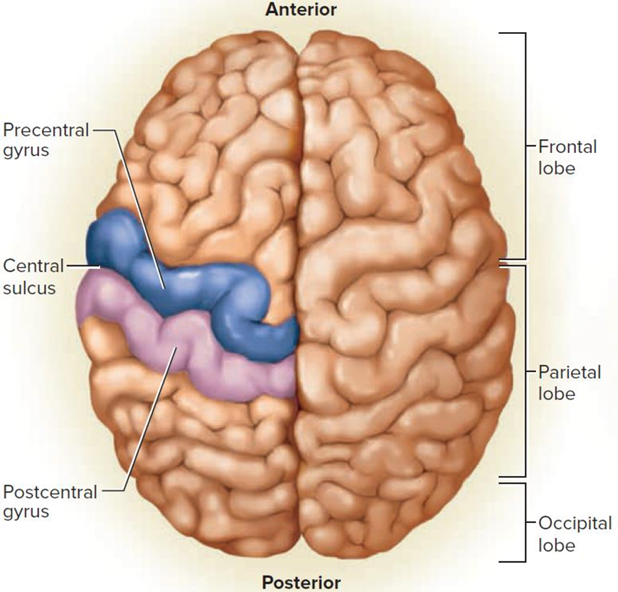
中央前回和中央后回
- Above the tongue is bilateral innervation, below is contralateral innervation.
- The more complex the movement is, the larger area it represents
- The primary motor cortex is close to the primary somatosensory cortex. Both of them are upside-down.
- pathways
- Corticospinal pathway 皮质脊髓
- 四肢
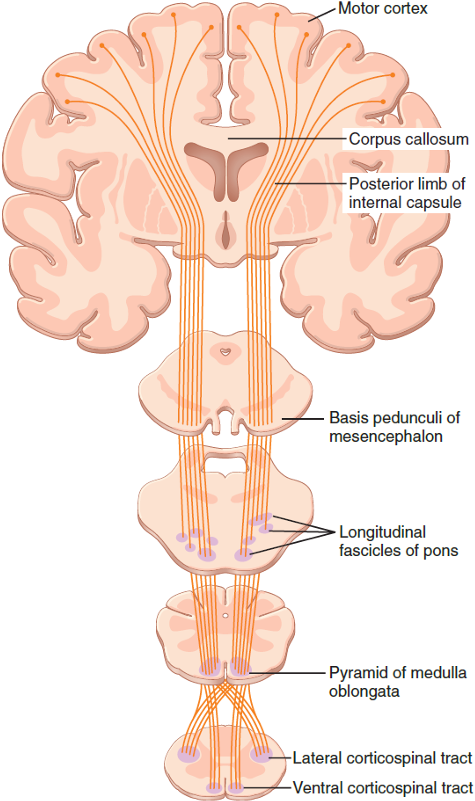
- The corticospinal tract (皮层脊髓束) leaves the cortex, passes through the internal capsule and then downward through the brainstem
皮层脊髓束(Corticospinal tract)起源于大脑皮层,穿过内囊(internal capsule),然后下行至脑干 - The majority (80%) of fibers cross in the medulla to the opposite side and descend into the lateral corticospinal tract (皮层脊髓侧束) which control precise movements
大部分神经(80%)在延髓(medulla)交叉至对侧,形成皮层脊髓侧束(lateral corticospinal tract),控制精细运动 - The remaining fibers pass ipsilaterally down in the ventral corticospinal tract ( 皮层脊髓前束) which control rough movements.
剩余纤维在同侧下行,形成皮层脊髓前束(ventral corticospinal tract),主要调控粗略运动 - 图
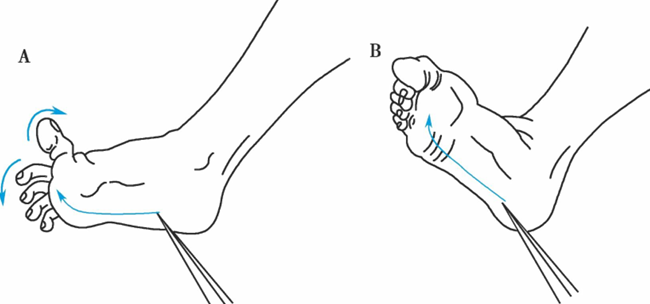
- Damage of the corticospinal tract causes abnormal extensor reflex in response to stimulation of the sole, which is also called Babinski sign
- Corticobulbar pathway 皮质延髓
- 面部
- Axons of the corticobulbar tract (皮层脑干束) descend from the cerebral cortex along with the corticospinal tract through the internal capsule. Some of the axons decussate, others do not.
皮质脑干束的轴突与皮质脊髓束一同自大脑皮层下行,穿过内囊.部分轴突发生交叉,其余则不交叉 - The axons terminate in the motor nuclei of nine pairs of cranial nerves that control precise, voluntary movements of the eyes, tongue, neck, chewing, facial expression, speech and swallowing
这些轴突终止于九对脑神经的运动核,支配眼、舌、颈部、咀嚼肌、面部表情肌以及言语和吞咽动作的精确随意运动
- Corticospinal pathway 皮质脊髓
- Classification of body movement
- Autonomic Nervous System
- 介绍
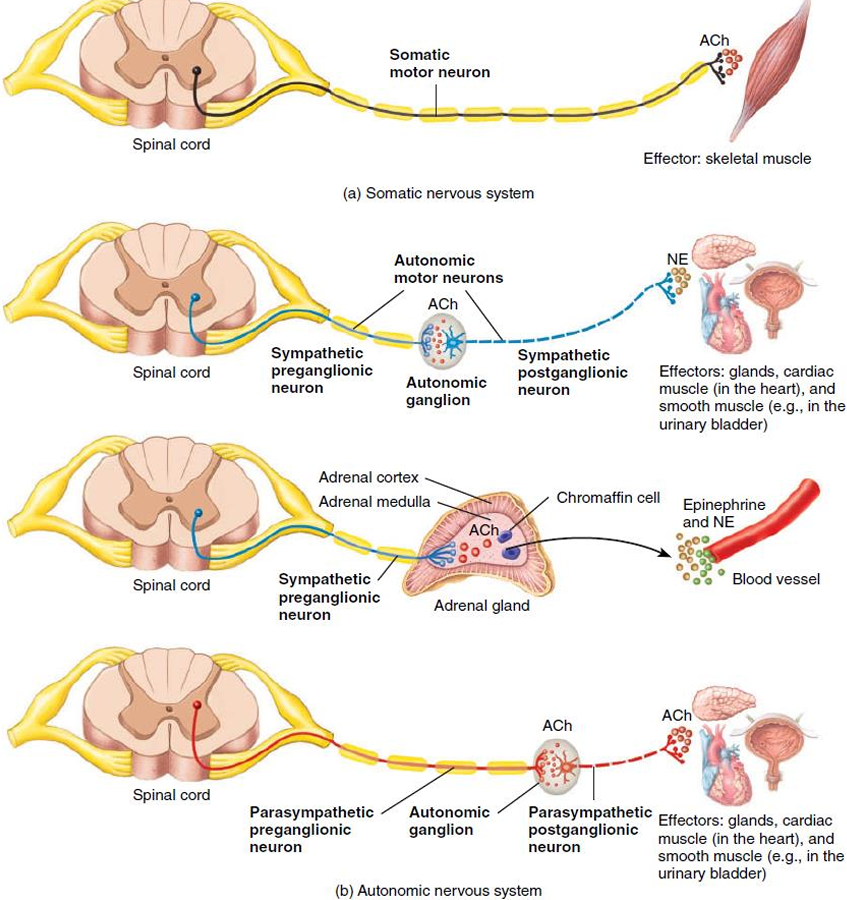
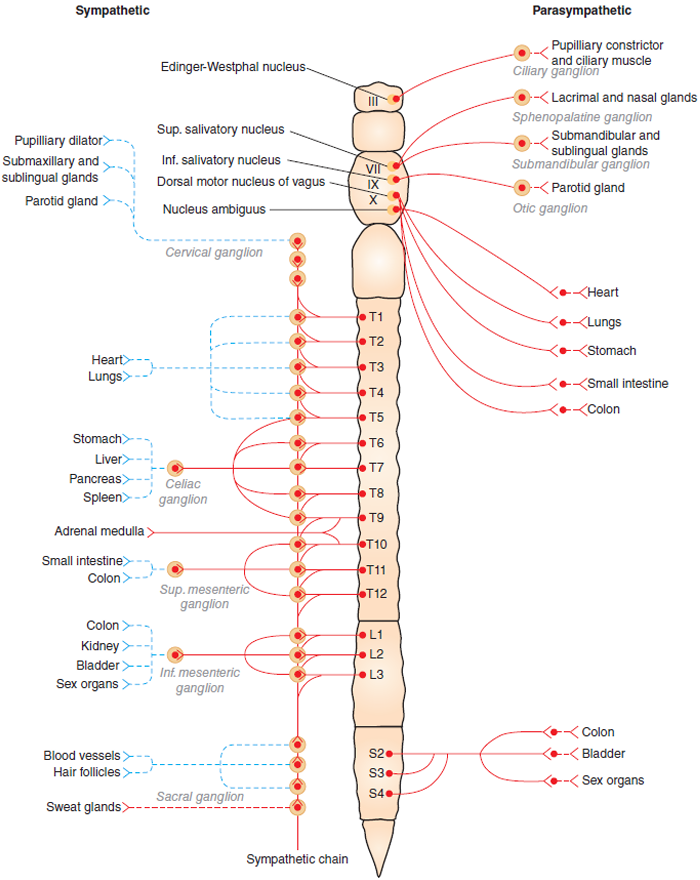
- The somatic nervous system controls skeletal muscles
- The autonomic nervous system regulates cardiac muscle, smooth muscle and glands
- The ANS consists of two main divisions
- the sympathetic nervous system
- the parasympathetic nervous system
- Most organs receive nerves from both divisions, an arrangement known as dual innervation双重支配
- The ENS can be counted as the third division of the ANS
enteric nervous system 肠神经系统
- Anatomy of autonomic pathways
- autonomic fibers
- preganglionic 节前神经元
- myelinated B fibers
- postganglionic 节后神经元
- unmyelinated C fibers
- preganglionic 节前神经元
- 神经节&核
- 都是神经元cell body的聚集
- ganglion神经节在PNS中
- nucleus神经核在CNS中
- 图
- 看图说话
- 神经节前有髓鞘,神经节后没有
- 神经节sympathetic与parasympathetic神经递质都是ACh乙酰胆碱
- 到effector的神经递质sympathetic是epinephrine和NE,parasympathetic是ACh
- parasympathetic的神经节更靠近effector
- 一头一尾副交感,中间交感
- autonomic fibers
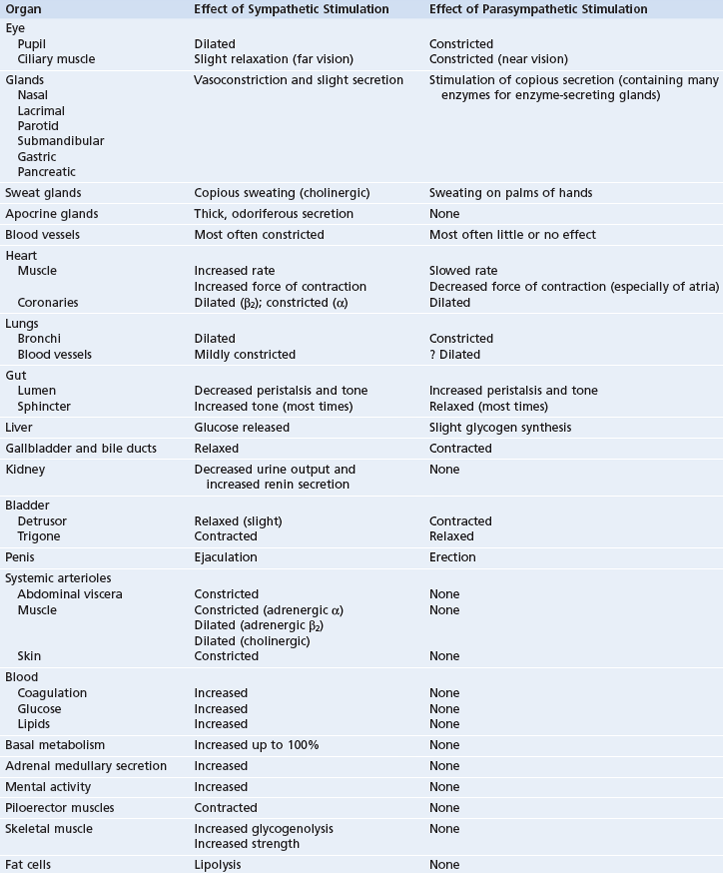
- effect
- 交感增强,副交感削弱
- 交感增强,副交感削弱
- 介绍
- Brain Waves and Higher Brain Functions
- Brain Waves
- The spontaneous electrical activity of brain is rhythmic potential changes in the superficial layers of the cerebral cortex without stimulation.
- The evoked诱发 cortical皮质 potential is potential changes that occur in a certain place of the cerebral cortex after stimulation
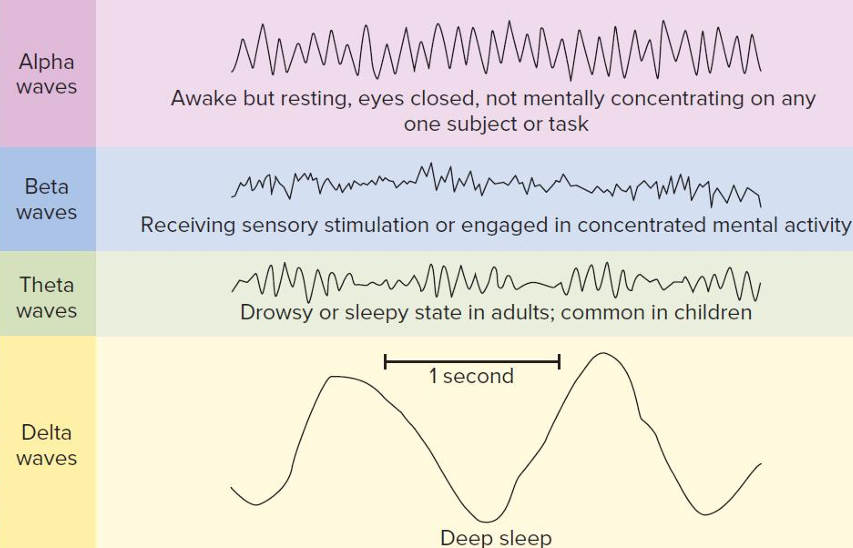
- types of brain waves recorded in an EEG
- 图
- beta wave frequency 比 alpha wave 高
- 大脑活动越强,frequency 越高
- 图
- brain waves 来源
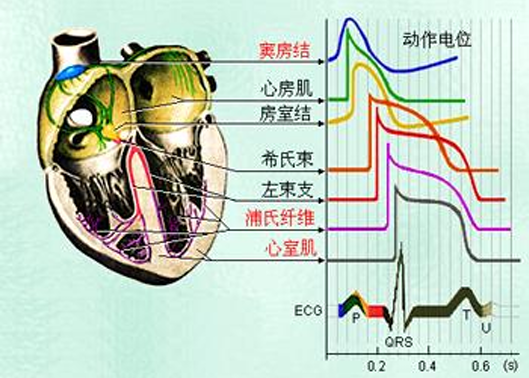
- Brain waves result from synchronized postsynaptic potentials
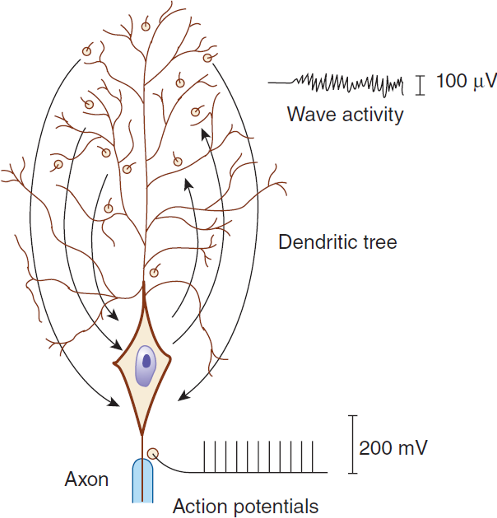
EEG↑,看得出来脑电波与action potential相比非常小
- ECG↓,心电图是action potential
- Brain waves are predominantly主要 postsynaptic potentials of pyramidal cells
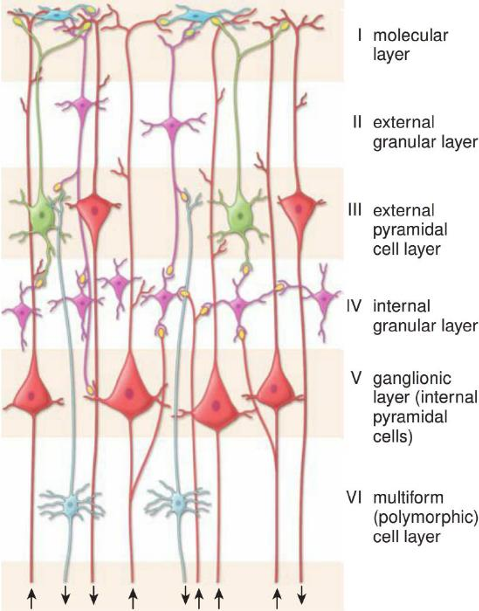
主要来自V这种锥体细胞,电压最大
- Brain waves result from synchronized postsynaptic potentials
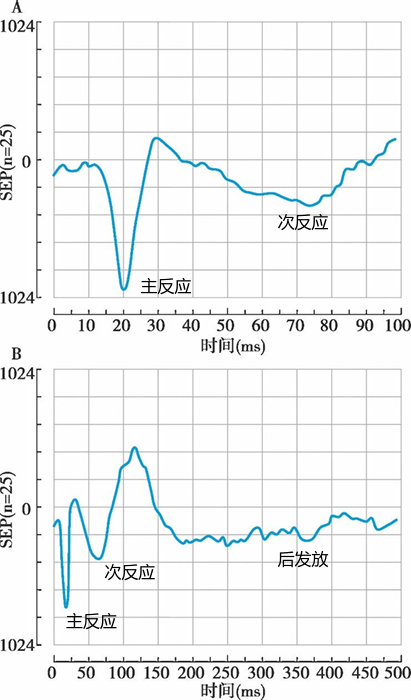
- evoked cortical
- A typical evoked cortical potential consists of the primary evoked potential (主反应), the diffuse secondary response ( 次反应) and the after discharge (后发放)
- The primary evoked potential is associated with the specific projection system
- The diffuse secondary response associated with is the nonspecific projection system
- The after discharge is due to reverberating回荡 or parallel after-discharge circuit
- 图
- Sleep
- 图
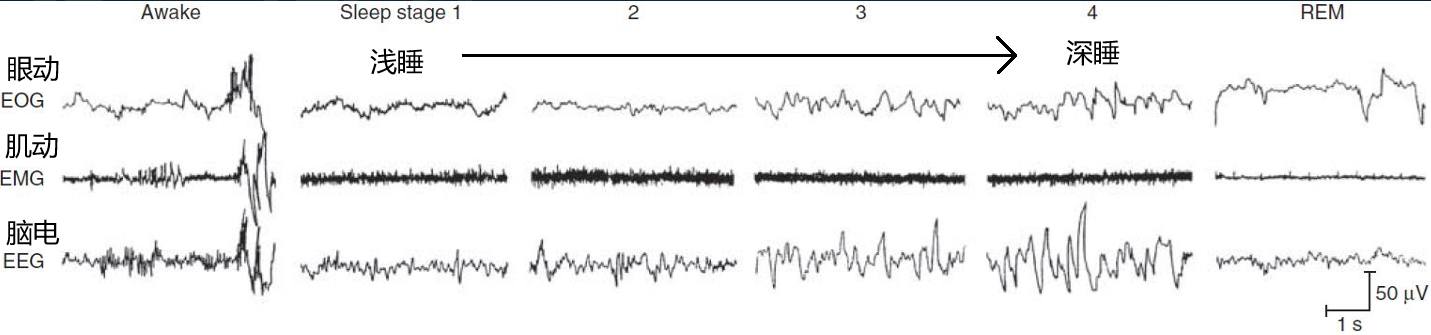
- REM sleep
- rapid eye movement
- decrease in muscle tone
肌肉动不了,梦游的人大脑损伤,肌肉可以动 - high-frequency and small-amplitude brain waves.
- NREM sleep
- non-rapid eye movement
- moderate muscle tone
- slow brain waves with large amplitude
- A sleep cycle (from NREM stage 1 sleep to REM sleep) usually lasts for about 90 min
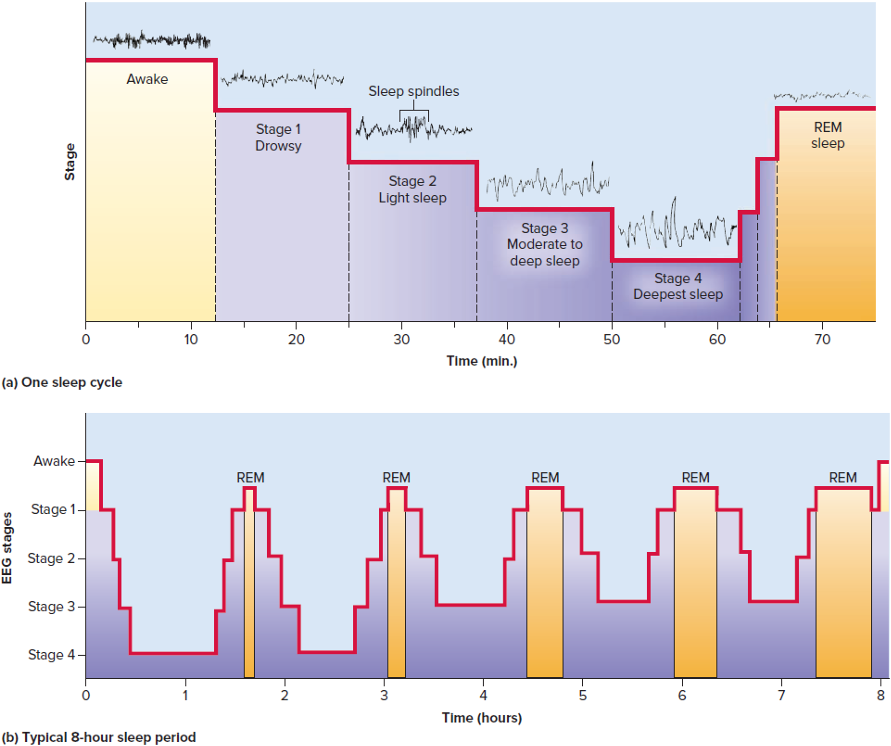
每个睡眠周期都会做梦,但是只有在REM阶段醒来才会记住梦
- 一种睡眠机制-腺苷
- As awakening lasts, more and more ATP degrades to adenosine, and adenosine causes sleep.
- adenosine can
- bind to A1 receptor, inhibit excitatory neurons and facilitate sleep
- bind to A2receptor of GABAergic neurons in VLPO to facilitate sleep
- bind to A1 receptor, inhibit excitatory neurons and facilitate sleep
- Caffeine is a natural blocker of adenosine receptors
- 图
- Learning
- Nonassociative learning 非联合型学习
- In habituation (习惯化), repeated exposure to an irrelevant stimulus causes a decreased behavioral response.
好比你室友每天6点起,刚开始会被吵醒,后来就能自动忽略了 - In sensitization (敏感化), repeated exposure to a noxious stimulus causes an increased behavioral response
一朝被蛇咬,十年怕井绳
- In habituation (习惯化), repeated exposure to an irrelevant stimulus causes a decreased behavioral response.
- Associative learning 联合型学习
- classical conditioning (经典条件反射)
巴普洛夫的狗 - operant conditioning (操作式条件反射)
小鼠学会按投食按钮,需要主动操作
- classical conditioning (经典条件反射)
- Nonassociative learning 非联合型学习
- memory
- Declarative memory (陈述性记忆)
- is the memory of experiences that can be verbalized such as facts, events, objects, names and places
- This type of memory requires conscious recall and is stored in the association areas of the cerebral cortex
- Procedural memory (程序性记忆)
- is the memory of motor skills. Examples include swimming, dancing, riding a bike
- This type of memory does not require conscious recall, and it is stored in the basal ganglia, cerebellum and premotor area
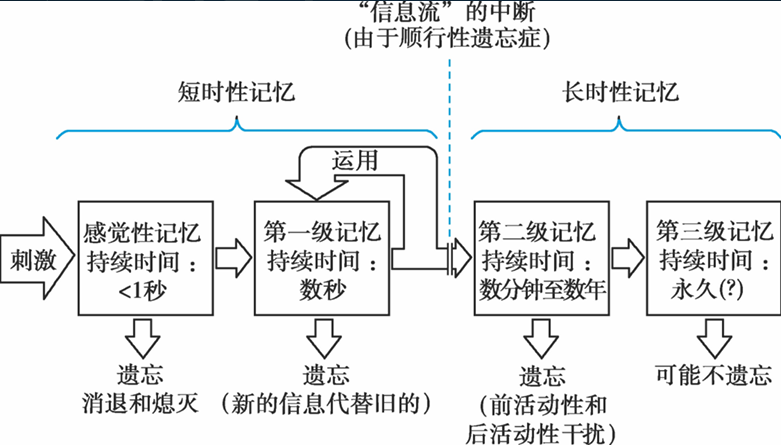
- Short-term memory and long-term memory
- 图
- 图
- Declarative memory (陈述性记忆)
- Language
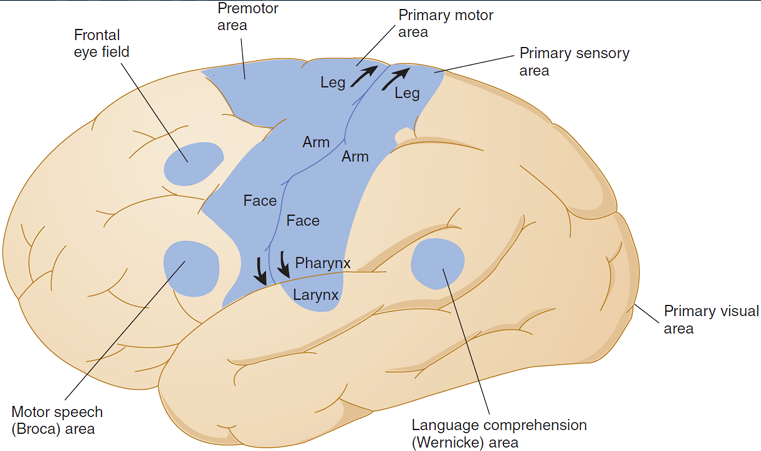
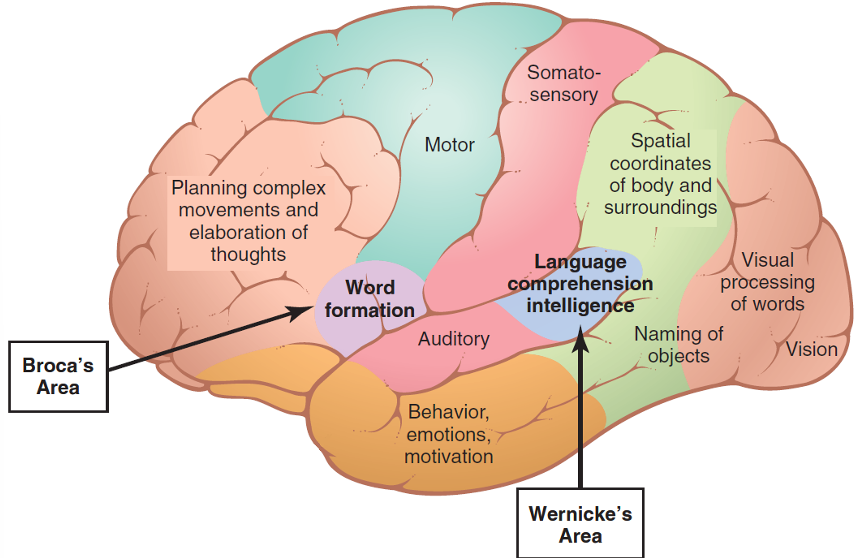
- Broca 负责发音,Wernick 负责理解
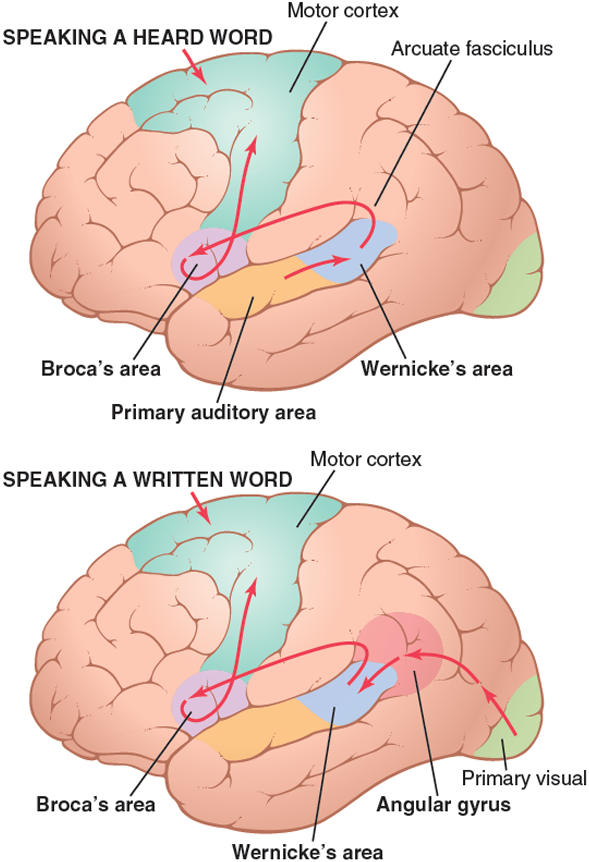
- 分别展示了听到一个词复数与读一个词时候大脑皮层的活动
- Broca 负责发音,Wernick 负责理解
- Brain Waves
All articles in this blog are licensed under CC BY-NC-SA 4.0 unless stating additionally.