生理学_呼吸系统
呼吸系统
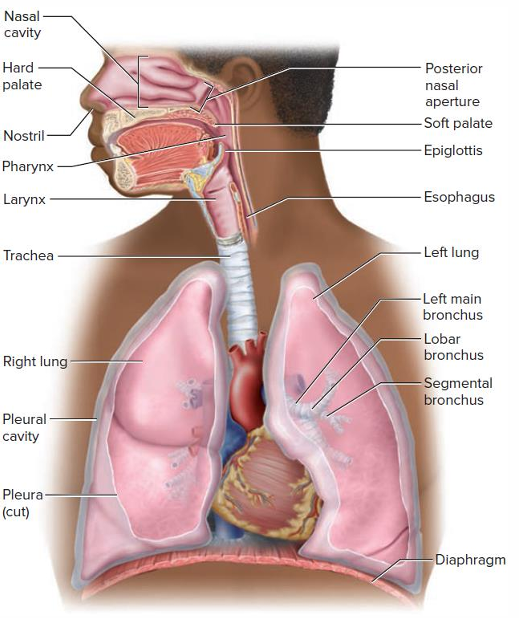
- Anatomy of the respiratory system
- 图
- The upper respiratory tract
- nose, nasal cavity, pharynx
- 鼻子、鼻腔、咽部
- The lower respiratory tract
- larynx, trachea, bronchi, lungs
- 喉、气管、支气管、肺
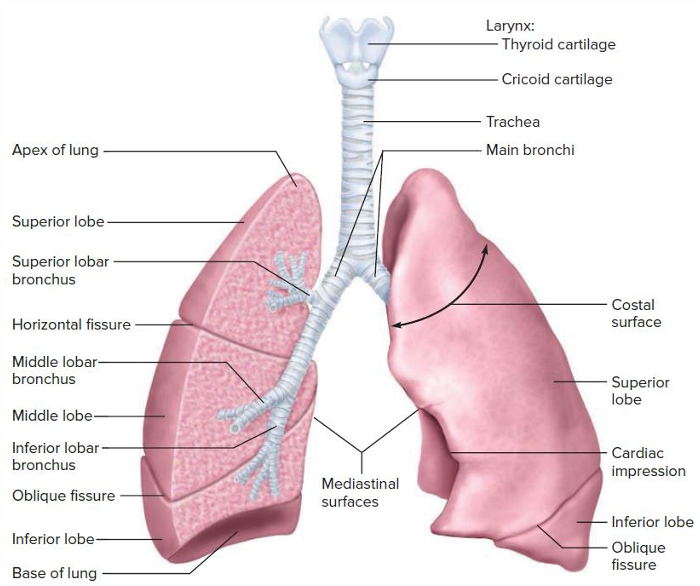
- Lungs
- The right lung has 3 lobes,the left lung has 2 lobes
- The right lung has 3 lobes,the left lung has 2 lobes
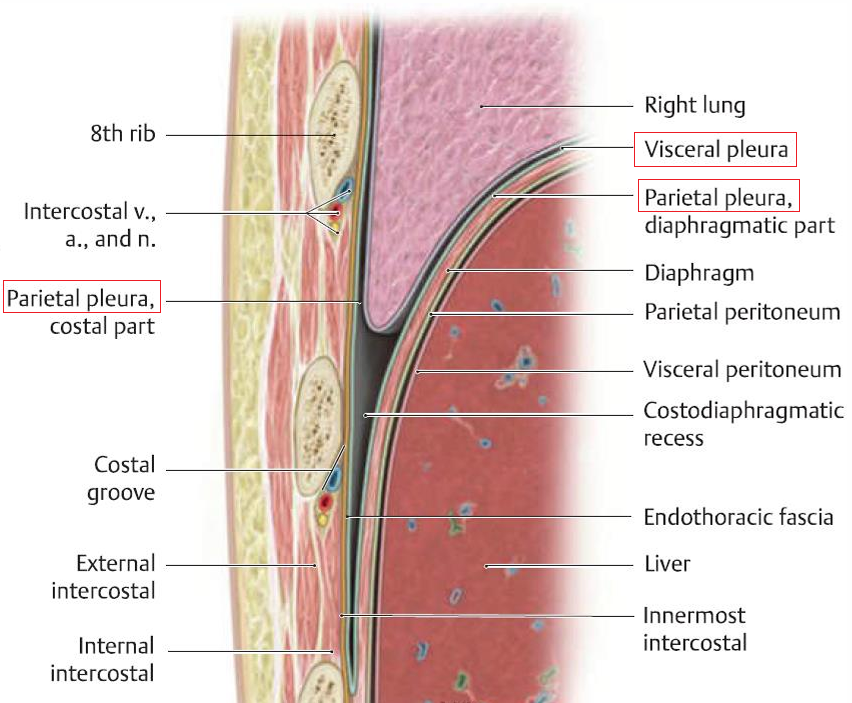
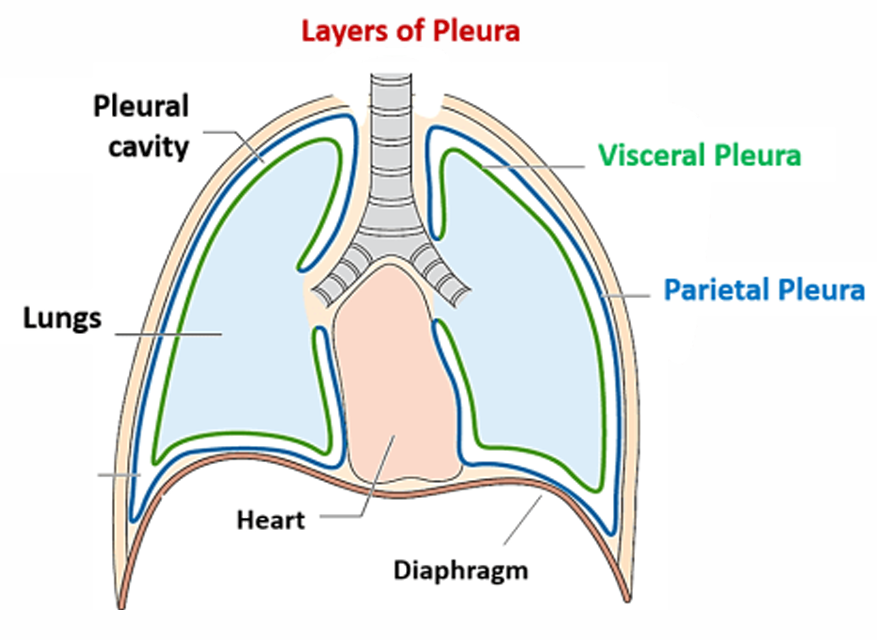
- Pleura胸膜
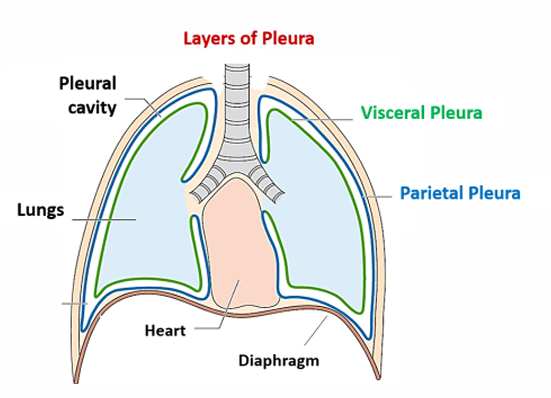
- Pleura = visceral pleura (胸膜脏层) + parietal pleura (胸膜壁层)
- The visceral pleura covers the surface of the lung and extends into the fissures裂缝 between lobes
- The parietal pleura adheres附着 to the mediastinum (纵隔), the rib cage and the diaphragm (膈)
- The space between the two pleurae is the pleural cavity胸膜腔,it contains a thin film of lubricating pleural fluid润滑性胸膜液
- Pleura = visceral pleura (胸膜脏层) + parietal pleura (胸膜壁层)
- Trachea & bronchi 气管 & 支气管
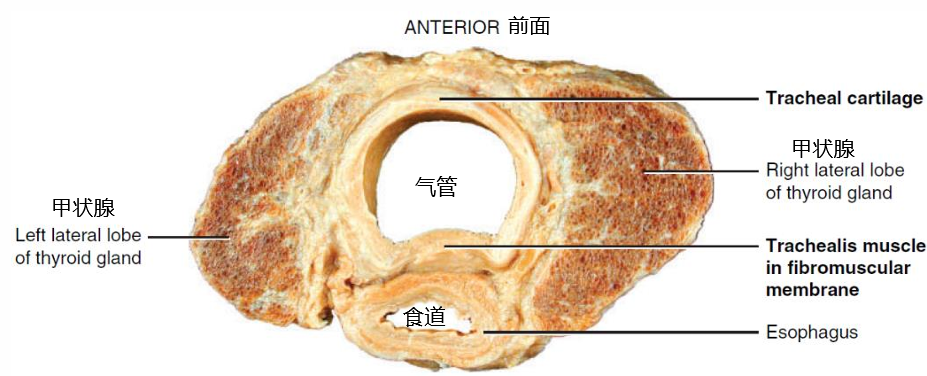
- Cross section of trachea, esophagus and thyroid gland
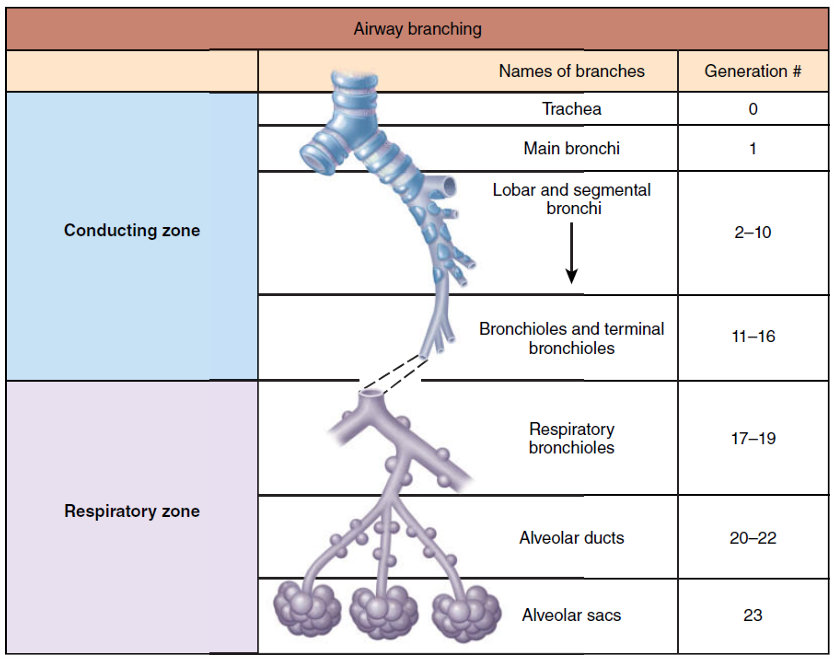
- Branching of airways from the trachea
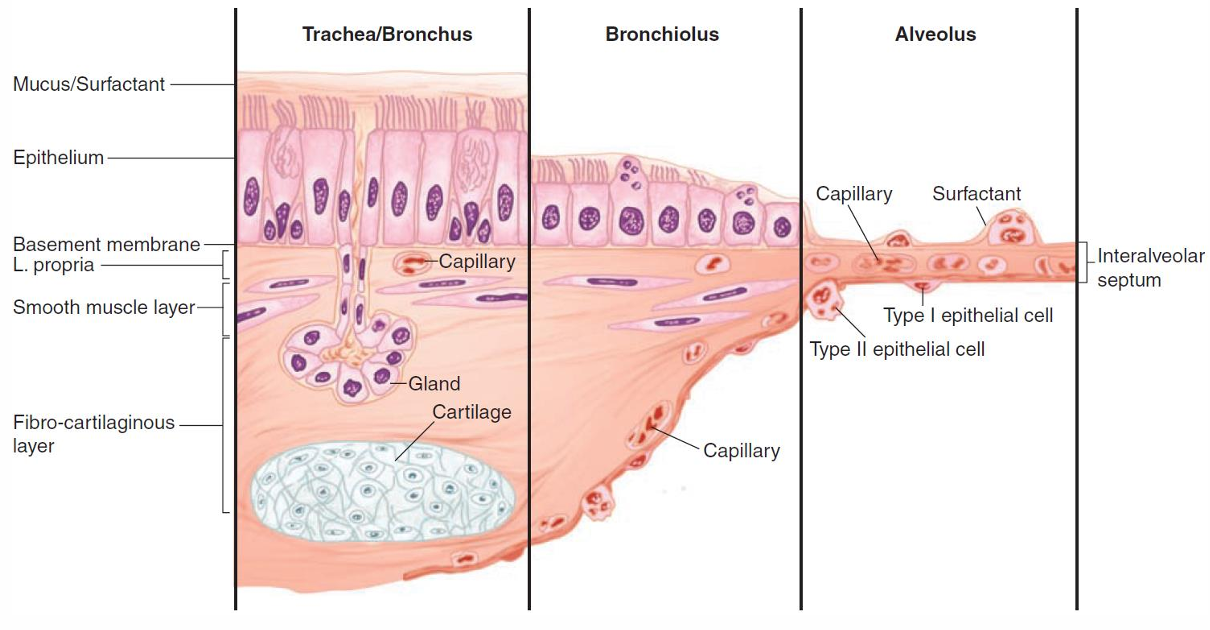
- cellular transition from trachea to alveolus,从气管→毛细支气管→肺泡,气管的gland腺分泌mucus粘液
- Cross section of trachea, esophagus and thyroid gland
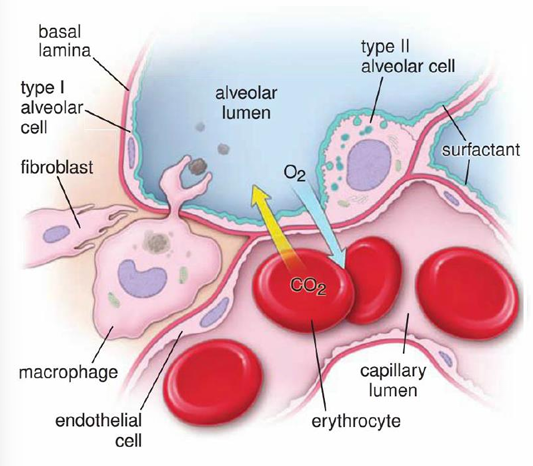
- Alveoli 肺泡
- Type Ⅰ alveolar cells (40%)
- cover 95% of the alveoli surface
- form the air-blood barrier
- Type Ⅱ alveolar cells (60%)
- secrete surfactant分泌表面活性剂
- can divide into type Ⅰ alveolar cells
- Alveolar macrophages
- remove fine dust particle
- 图
- Type Ⅰ alveolar cells (40%)
- Respiratory muscles
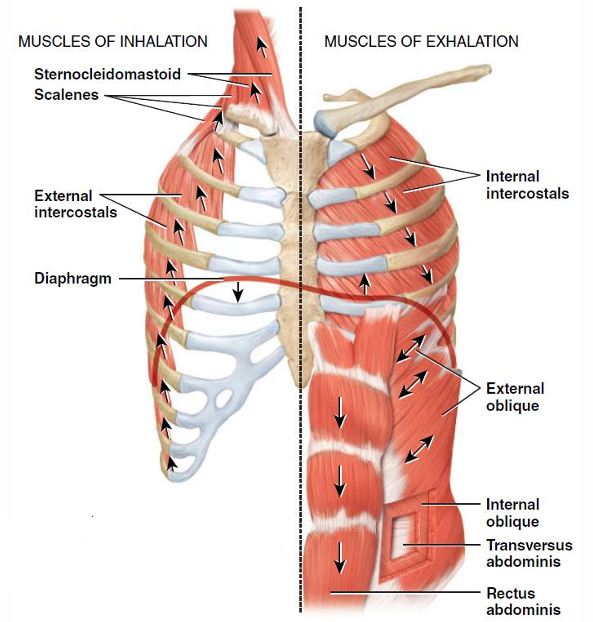
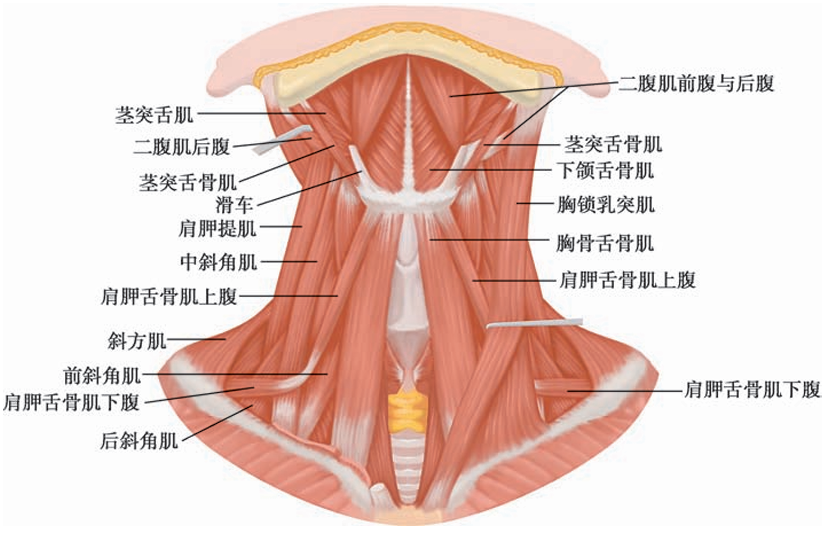
- Muscles of inhalation
- the diaphragm隔膜 & external intercostals (肋间外肌)
- sternocleidomastoid胸锁乳突肌 & scalenes斜角肌
- Muscles of exhalation
- the abdominal腹部的 & internal intercostals (肋间内肌)
- direction of respiratory muscles contraction
- Muscles of inhalation
- 图
- Pulmonary ventilation通气
- basic
- Pulmonary ventilation, or breathing, is the flow air into and out of the lungs
- Inhalation permits O2 to enter the lungs and exhalation permits CO2 to leave the lungs
- The differences in pressure between the alveoli and the air drives pulmonary ventilation
- Lack of muscles, lungs themselves can not contract or relax
- Passive changes in lung volume are caused by the contraction/relaxation of respiratory muscles
- Respiratory movement
- ①Inhalation
- the diaphragm隔膜 & external intercostals contract 肋间外肌
- ②Exhalation
- the diaphragm & external intercostals relax.
- 正常呼气没有肌肉收缩,肌肉放松自动呼气
- ③Forced inhalation
- ① plus the sternocleidomastoid胸锁乳突肌 and scalenes斜角肌 contract.
- ① plus the sternocleidomastoid胸锁乳突肌 and scalenes斜角肌 contract.
- ④Forced exhalation
- ② plus the abdominal腹部的 & internal intercostals contract 肋间内肌
- ①Inhalation
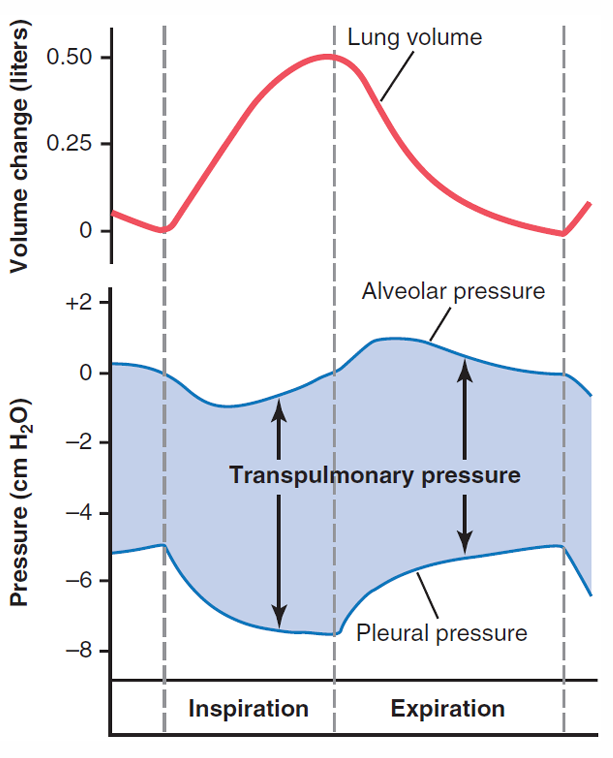
- Alveolar & pleural pressure
- 图
- 呼吸时压力变化,transpulmonary pressure 跨肺压,胸膜压力随胸腔体积变化,肺泡压力<0,肺体积变大,压力>0,肺体积变小
- 图
- Breathing patterns
- Eupnea (平静呼吸)
- 12~18breaths/min, active inhalation, passive exhalation, only muscles of inhalation participate.
- Forced/deep breathing ( 用力呼吸/ 深 呼吸)
- active inhalation & exhalation, all muscles of respiration participate.
- Thoracic/costal breathing (胸式呼吸)
- movements of chest due to contraction of external intercostal muscles.
- Abdominal/diaphragmatic breathing (腹式/膈式呼吸)
- movements of the abdomen due to contraction of the diaphragm.
- 婴儿都是腹式呼吸,因为肋骨还没有长到胸骨上
- Eupnea (平静呼吸)
- Resistance to airflow
- Elastic resistance 平静呼吸时占70%
- elastic resistance of the lungs
- Elastic forces of the lung tissue 1/3
- Elastic forces caused by surface tension of the fluid that lines the inside walls of the alveoli, 2/3
- The elastic resistance of lungs resists inhalation but drives exhalation
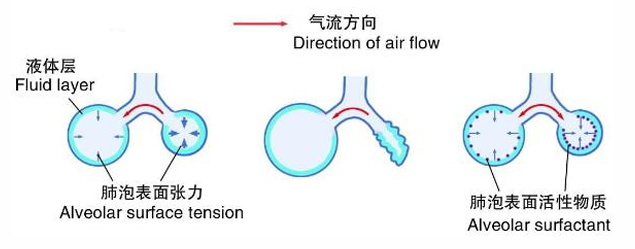
- Pressure in alveoli caused by surface tension P = 2T / r,T是肺泡表面张力(N/m)
- 根据上面那个公式,小的肺泡表面张力更大,会把气全都吹到大的肺泡里
- 因此有 Surfactant表面活性剂 reduces the surface tension to about 1/10
- Surfactant is a mixture of phospholipids (90%) and proteins, which is secreted by type Ⅱ alveolar cells
- elastic resistance of the thoracic cage
- The thoracic cage at rest, no elastic resistance, 2/3 lung capacity (end of inhalation during eupnea)
- <2/3 lung capacity (exhalation), the elastic resistance resists exhalation but drives inhalation
2/3 lung capacity (forced inhalation), the elastic resistance resists inhalation but drives exhalation
- elastic resistance of the lungs
- Inelastic resistance 平静呼吸时占30%
- airway resistance (气道阻力) 80~90%
- factors that influence airway resistance
- ①inhalation/exhalation
- ②airway smooth muscles
- factors that influence airway resistance
- inertial resistance (惯性阻力)
- viscous resistance (黏滞阻力)
- airway resistance (气道阻力) 80~90%
- Elastic resistance 平静呼吸时占70%
- Spirometry 肺活量测定
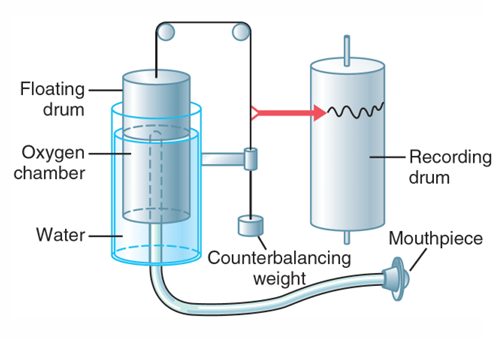
- 传统方法是弄个水桶倒着插进来个柱状体往里吹气
- 图
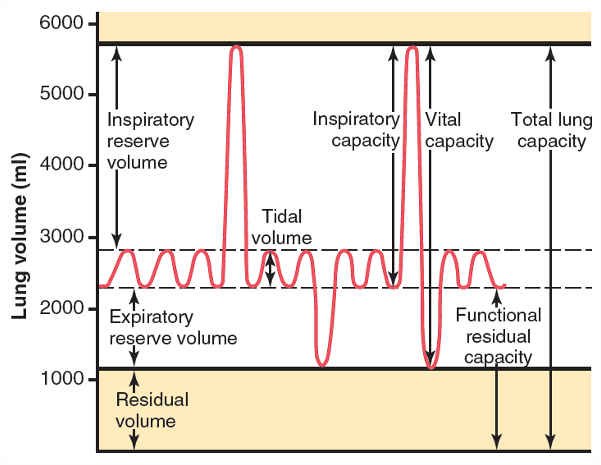
- Total lung capacity (肺总量) is the maximum amount of air the lungs can contain. ≈5800ml
- Tidal volume (潮气量) is the amount of air inhaled or exhaled in a cycle during eupnea. ≈500ml
- Inspiratory reserve volume (补吸气量) is the amount of air in excess of tidal volume that can be inhaled with maximum effort. ≈3000ml
- Inspiratory capacity (深吸气量) is the maximum amount of air that can be inhaled. ≈3500ml
- Expiratory reserve volume (补呼气量) is the amount of air in excess of tidal volume that can be exhaled with maximum effort. ≈1100ml
- Residual volume (余气量) is the amount of air remaining in the lungs after maximum exhalation. ≈1200ml
- Functional residual capacity (功能余气量) is the amount of air remaining in the lungs after a normal exhalation. ≈2300ml
- Vital capacity (肺活量) is the maximum amount of air that can be inhaled and then exhaled with maximum effort. ≈4600ml
- Forced vital capacity (用力肺活量) is the maximum amount of air exhaled as rapidly as possible.
- Forced expiratory volume during the first second (1秒用力呼气量) is the amount of air exhaled within the first second of FVC.
- 传统方法是弄个水桶倒着插进来个柱状体往里吹气
- Alveolar ventilation 肺泡通气
- The rate at which new air reaches the respiratory zone is called alveolar ventilation (肺泡通气量).
- Areas where gas exchange does not occur are called dead spaces (无效腔).
- Anatomic dead space (解剖无效腔) = conducting zone ≈ 150ml
- Alveolar dead space (肺泡无效腔) is due to absent or poor blood flow. ≈0
- Physiological dead space (生理无效腔) = total dead space
- basic
- Gas exchange
- gas law
- Dalton’s law
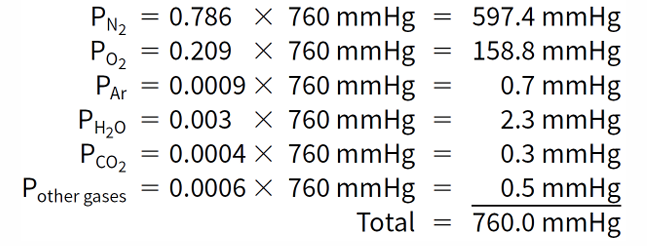
- Atmospheric pressure = PN2 +PO2 +PAr +PH2O +PCO2 + ···
- Atmospheric pressure = PN2 +PO2 +PAr +PH2O +PCO2 + ···
- Henry’s law
- The quantity of a gas that will dissolve in a liquid is proportional to the partial pressure of the gas and its solubility
- Factors that influence gas diffusion
- Partial pressure difference
- Molecular weight
- Solubility (air-liquid interface)
- Surface area
- Diffusion distance
- Temperature
- 速度
- Dalton’s law
- Alveolar gas exchange
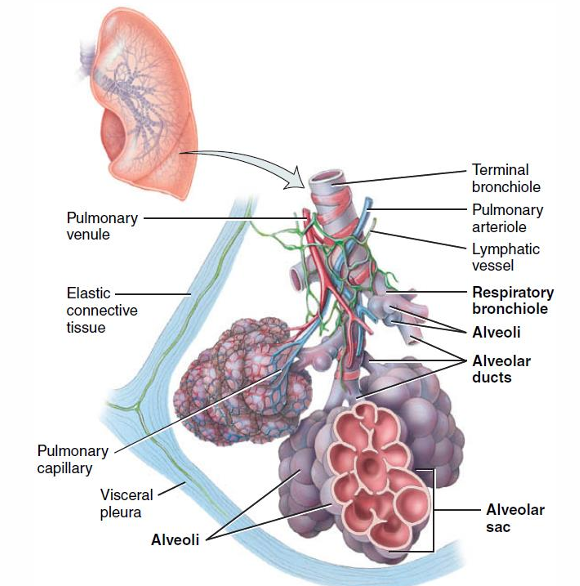
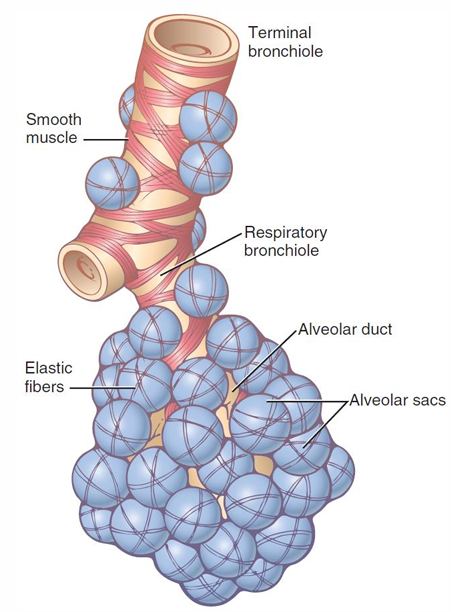
- Respiratory unit
- A respiratory bronchiole 呼吸性细支气管
- Alveolar ducts 肺泡管
- Alveolar sacs 肺泡囊,连接着好几个肺泡
- Alveoli 肺泡
- 图
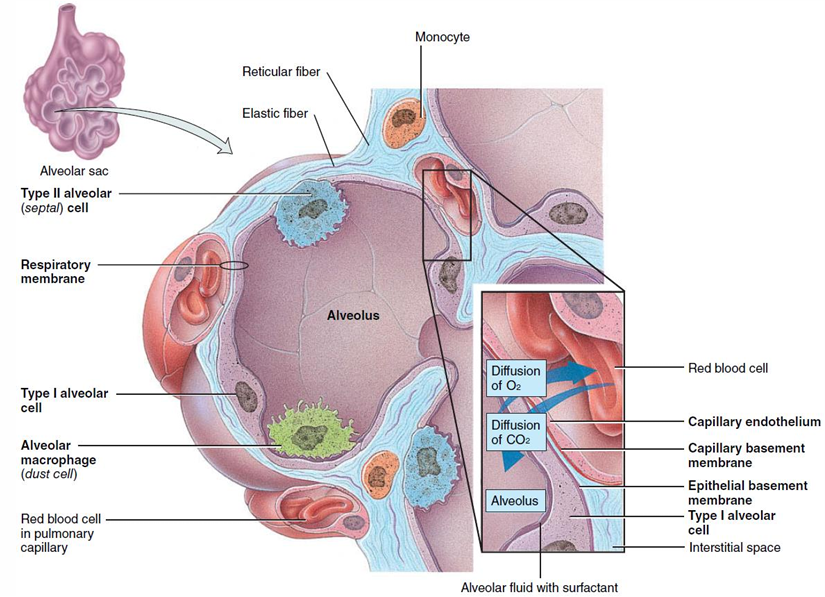
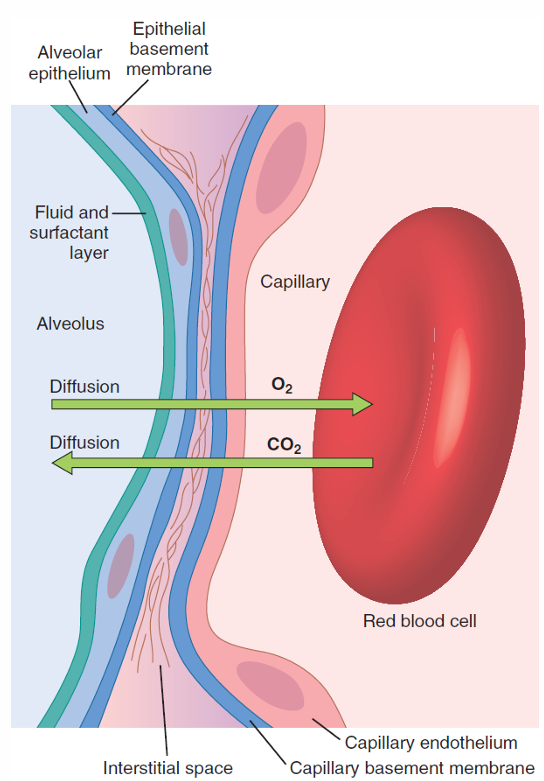
- Respiratory membrane
- A layer of fluid containing surfactant that lines the alveolus
- The alveolar epithelium 上皮
- An epithelial basement membrane 上皮基底膜
- A thin interstitial间质的 space
- A capillary basement membrane 毛细基底膜
- The capillary endothelial membrane 毛细血管内皮膜
- 图
- The total surface area of the respiratory membrane is about 70m²
- The total quantity of blood in the capillaries of the lungs at any given instant is 60~140ml
- Ventialtion/perfusion ratio (通气/血流比值)
- VA / Q ≈ 0.84
- 我们看作血流Q 60~140 ≈100
- VA ≈ 84mL
- Respiratory unit
- Systemic gas exchange
- The directions of gas diffusion is different.
- The interface is different.
- gas law
- Gas transport
- Oxygen transport
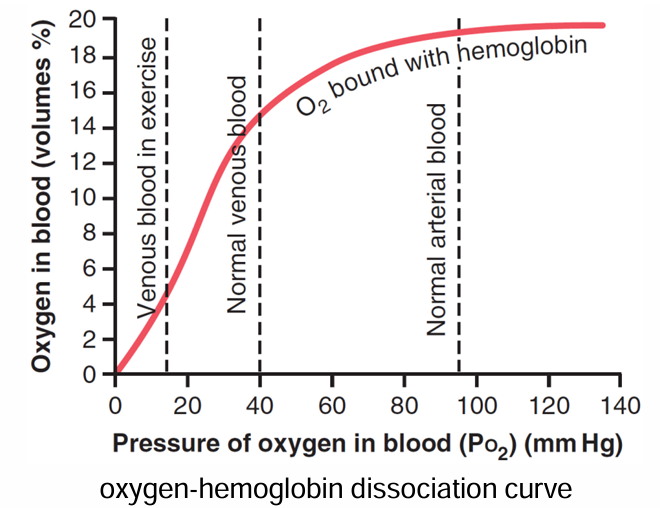
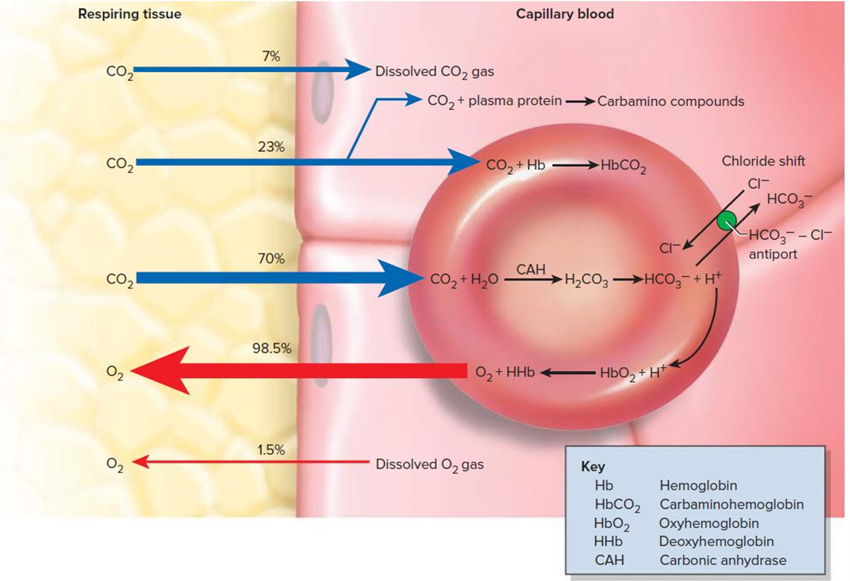
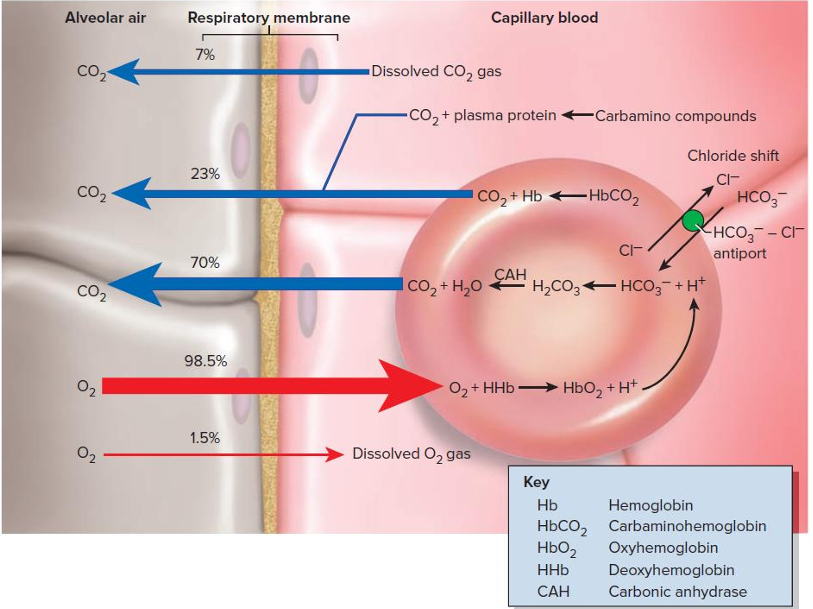
- O2 does not dissolve easily in water, thus about 1.5% of inhaled O2 is dissolved in blood plasma
- About 98.5% of blood O2 is bound to hemoglobin in RBCs
- Each 100ml of oxygenated blood contains the equivalent of 20ml of O2.
- 动脉里氧气分压约为95mmHg,静脉里约为40mmHg,运动时静脉可以更低
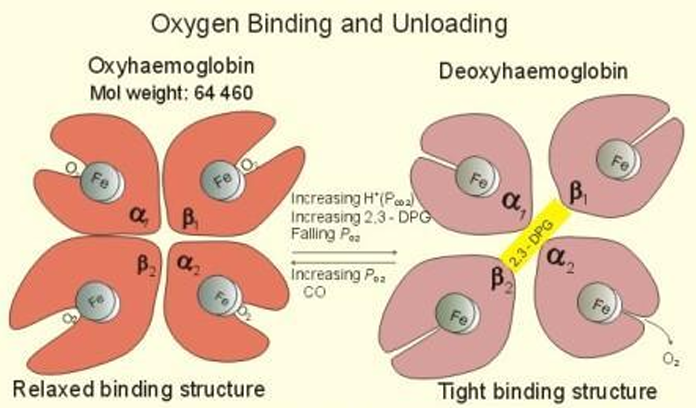
- 血红蛋白
- relaxed有O2,tight没有O2
- When O2 binds to hemoglobin, allostery T→R, affinity to O2↑, more O2 binds to hemoglobin
- When O2 dissociates from hemoglobin, allostery R→T, affinity to O2↓, more O2 dissociates from hemoglobin
- 正反馈调节,O2越多,O2越多,O2越少,O2越少
- relaxed有O2,tight没有O2
- Factors affecting the affinity of hemoglobin for oxygen
碱冷利氧- ①pH
- pH↑, affinity↑
- pH↓, affinity↓
- ②PCO2
- PCO2 ↑, affinity↓
- PCO2 ↓, affinity↑
- ③temperature
- temp↑, affinity↓
- temp↓, affinity↑
- ④DPG(二磷酸甘油酸)
- DPG↑, affinity↓
- DPG↓, affinity↑
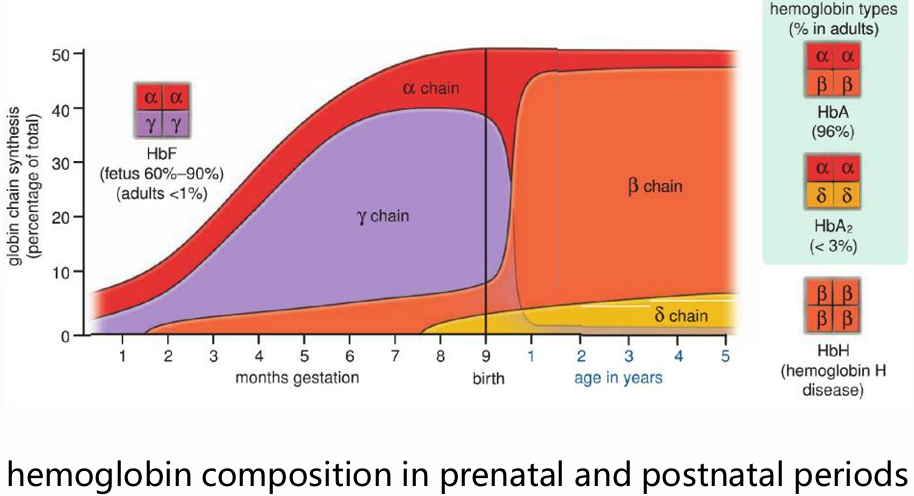
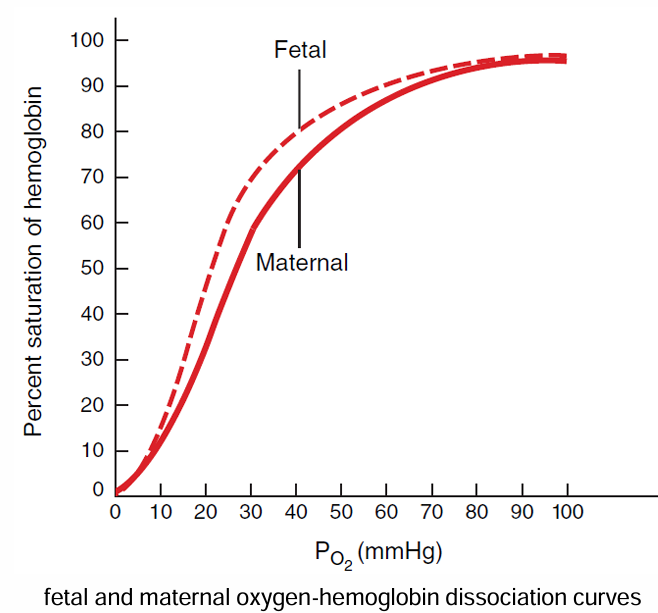
- 胎儿血红蛋白构成与成人不同
- 胎儿血红蛋白的affinity比母亲的大
- ⑤CO
- The affinity of hemoglobin for CO is 250 times greater than that for O2.
- ①pH
- Carbon dioxide transport
- Each 100ml of deoxygenated blood contains 53ml of CO2
- 7% dissolved in plasma
- 23% combines with proteins (such as hemoglobin) in the blood to form carbamino compounds (氨基甲酰化合物)
- 70% as HCO3-
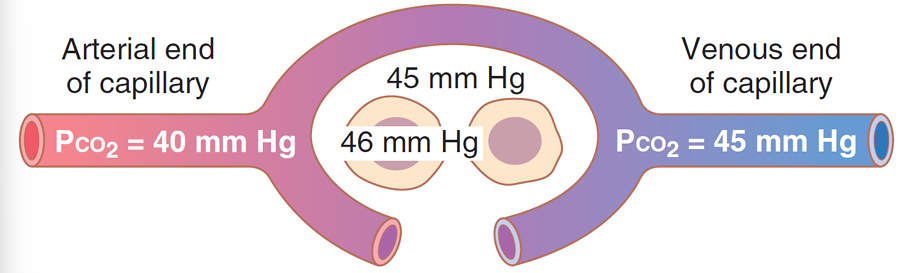
- 在动脉里40mmHg,静脉里45mmHg
- systemic gas exchange
- alveolar gas exchange
- 神奇的CAH既可以催化CO2变成H2CO3又可以催化反向反应
- Oxygen transport
- Regulation of respiration
- receptors
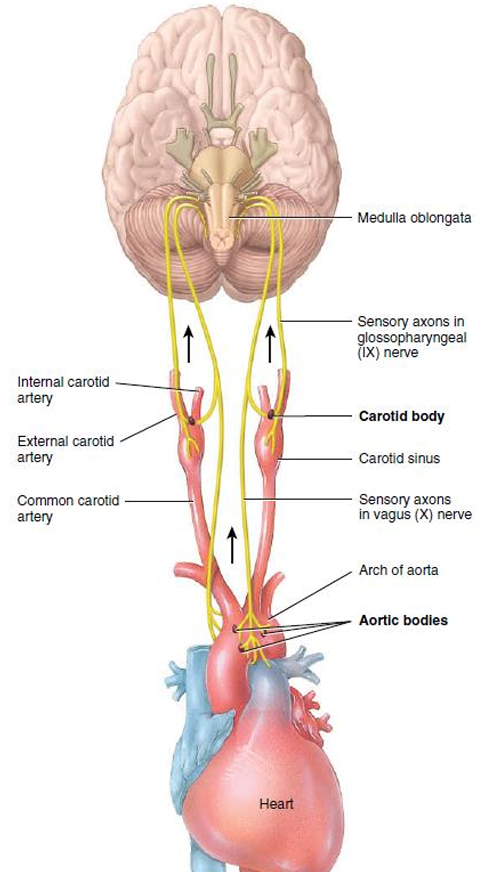
- Peripheral chemoreceptors
- 位于主动脉体和颈动脉体,传递信号到延髓
- aortic bodies 主动脉体连着vagus nerve 迷走神经
- carotid body 颈动脉体连着glossopharyngeal nerve 舌咽神经
- sensitive to PO2,less sensitive to PCO2 and H+
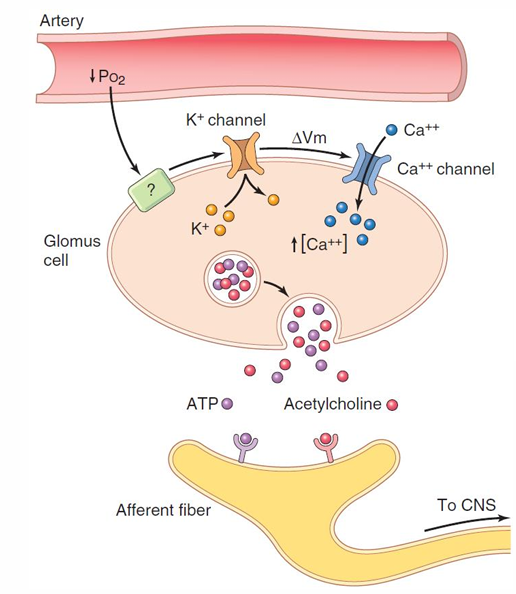
- Ⅰ型细胞感受到以下条件时,会通过导致K+通道失活,细胞去极化导致Ca2+通道打开,Ca2+浓度升高释放神经递质
- PO2 ↓, impulses↑
- PCO2 ↑, impulses↑
- H+↑, impulses↑
- 位于主动脉体和颈动脉体,传递信号到延髓
- Central chemoreceptors
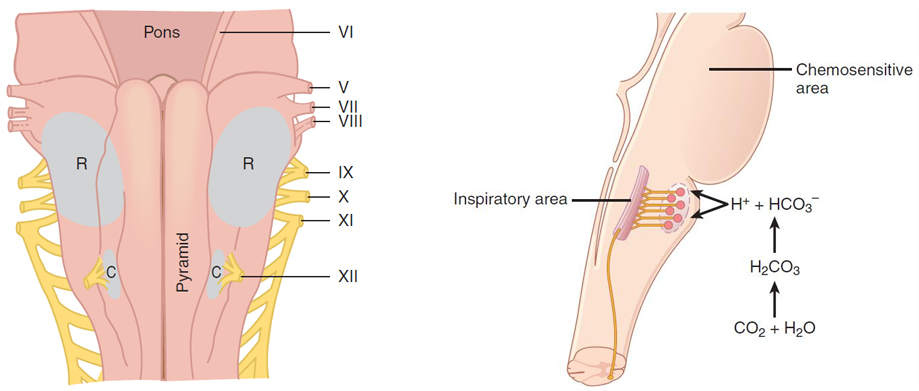
- Central chemoreceptors are located on the ventral腹部 surface of rostral/caudal medulla延髓头端/尾端
- Central chemoreceptors do not monitor PO2 or PCO2 , but H+ in the cerebrospinal fluid (脑脊液).
- They are 25 times more sensitive to H+ than peripheral chemoreceptors.
- H+ is produced by CO2 diffused across the blood-brain barrier.
- Central chemoreceptors are located on the ventral腹部 surface of rostral/caudal medulla延髓头端/尾端
- Stretch receptors
- Pulmonary stretch receptors (肺牵张感受器) are located in the smooth muscle of bronchi and bronchioles.
- When the lungs become overly inflated膨胀 (the tidal volume > 1.5L), these receptors transmit signals through the vagi into the respiratory center.
- It appears to be mainly a protective mechanism for preventing excess lung inflation rather than an important ingredient in normal control of respiration
- Peripheral chemoreceptors
- respiratory center
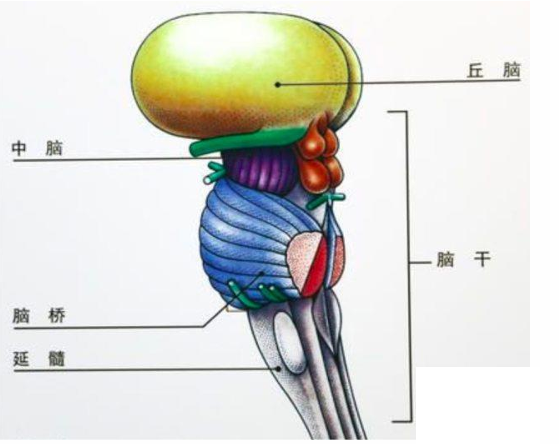
- Brainstem (脑干) = midbrain (中脑) + pons (脑桥) + medulla (延髓)
- The lower brainstem = pons + medulla
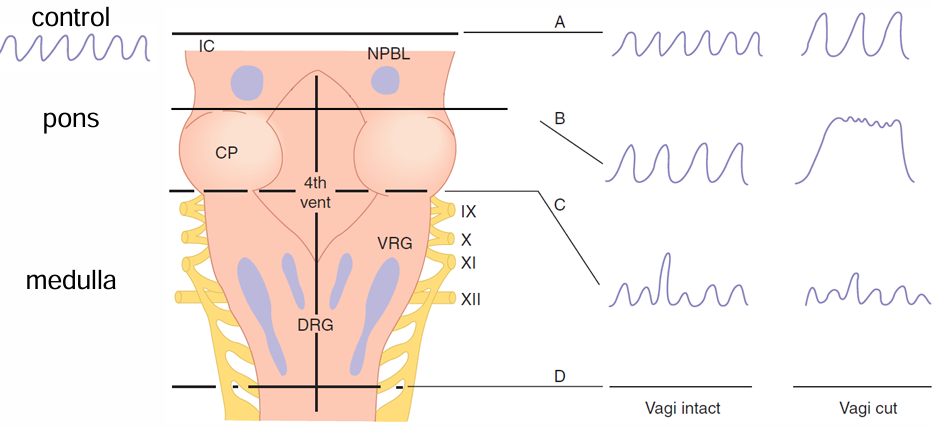
- The lower brainstem实验
- 切哈基米的低位脑干,观察呼吸变化,图里蓝的是呼吸中枢位置
- 切A
- transection between the midbrain中脑 and the pons脑桥
- No change in breathing with vagi intact
- Eupnea changes to deep breathing with vagi cut
- 说明中枢在A下面
- 切D
- transection between the medulla延髓 and the spinal cord脊髓
- Breathing ceases with/without vagi
- 说明中枢在D上面
- 切B
- transection at the middle of pons
- Breathing becomes deep with vagi intact
- Breathing becomes apneusis (长吸式呼吸) with vagi cut.
- Pneumotaxic center (呼吸调整中枢) in the upper zone of pons
- 切C
- transection between the pons脑桥 and the medulla延髓
- Breathing becomes gasping
- Apneustic长呼吸 center in the lower zone of pons
- Gasping喘息 center in the medulla
- 结论
- The pneumotaxic center呼吸调整中枢 inhibits apneustic center and switches inhalation to exhalation.
- The apneustic center长呼吸中枢 promotes inhalation.
- The gasping center喘息中枢 maintains a basic respiratory rhythm.
- The vagi promotes exhalation and inhibits inhalation
- 切哈基米的低位脑干,观察呼吸变化,图里蓝的是呼吸中枢位置
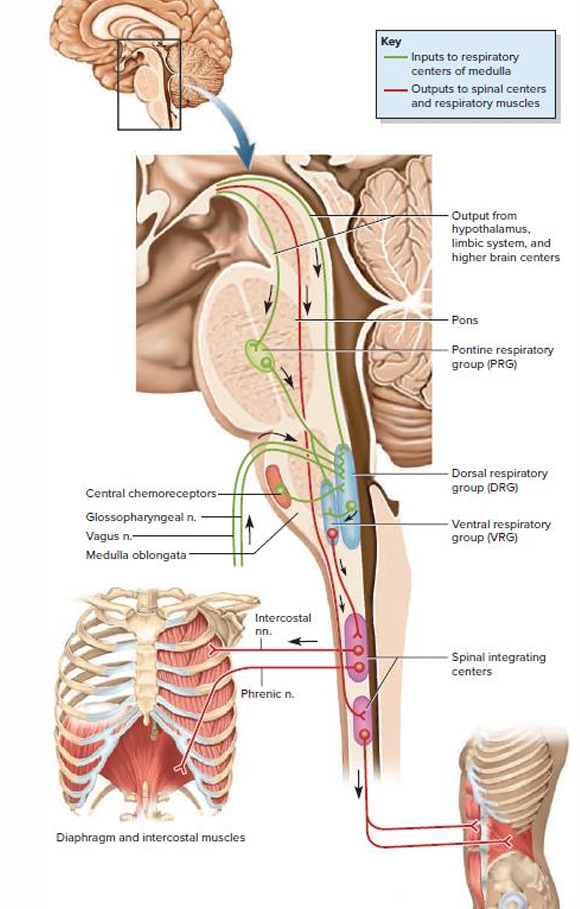
- DRG与VRG位于延髓,PRG位于脑桥
- DRG
- Neurons of dorsal respiratory group ( 背侧呼吸组 ) are located within NTS (孤束核).
- During eupnea, neurons of DRG generate impulses to the diaphragm via phrenic nerves隔运动神经 and the external intercostal肋间 muscles via intercostal nerves.
- The impulses last for 2s, and DRG become inactive for 3s
- VRG
- Neurons of ventral respiratory group (腹侧呼吸组) remain almost totally inactive during eupnea.
- They do not appear to participate in the basic respiratory rhythm.
- During forced inhalation, neurons of VRG send impulses to the accessory muscles辅助肌 of inhalation.
- During forced exhalation, these neurons send impulses to muscles of exhalation.
- PRG
- The pontine respiratory group ( 脑桥呼吸组 ) is the pneumotaxic area呼吸调整中枢
- Neurons of PRG transmit impulses to DRG, modifying the basic rhythm of breathing
- 限制吸气,使吸气向呼气转换
- Cortex 大脑皮层
- Because the cerebral cortex has connections with the respiratory center, we can voluntarily alter the pattern of breathing
- Nerve impulses from the hypothalamus (下丘脑) and limbic system (边缘系统) also alter breathing via emotional stimuli
- Brainstem (脑干) = midbrain (中脑) + pons (脑桥) + medulla (延髓)
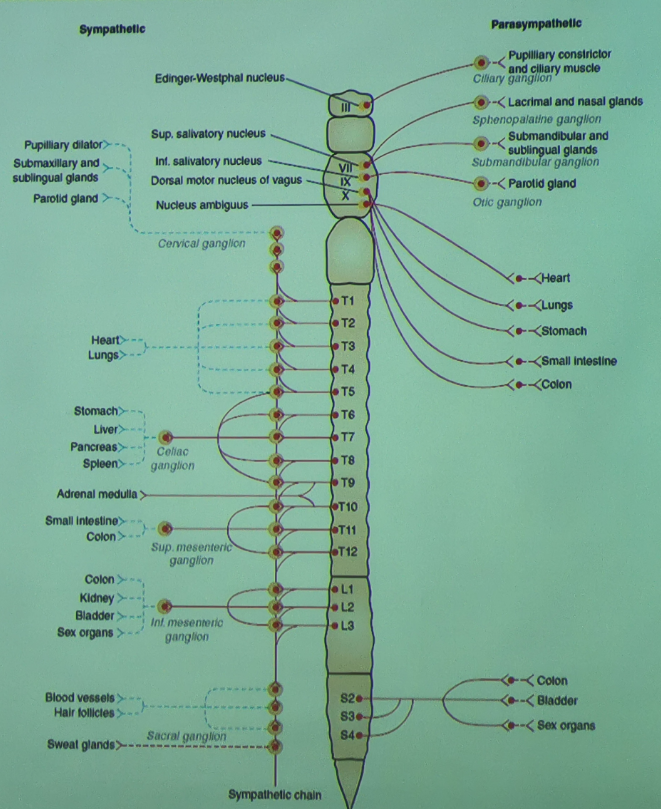
- motor nerve
- 图
- C3-C5 control diaphragm
- T1-T5 control intercostals肋间肌 and abdominal腹肌
- 图
- receptors

All articles in this blog are licensed under CC BY-NC-SA 4.0 unless stating additionally.