
生物化学_Nucleotides and Nucleic Acids
1011.Nucleotides and Nucleic Acids
- Nitrogenous Bases
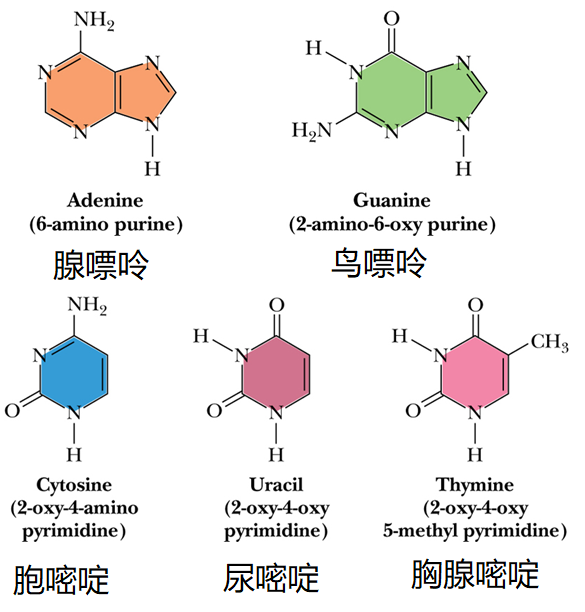
- Two purines 嘌呤 and three pyrimidines 嘧啶 are commonly found in cells
- Two purines 嘌呤 and three pyrimidines 嘧啶 are commonly found in cells
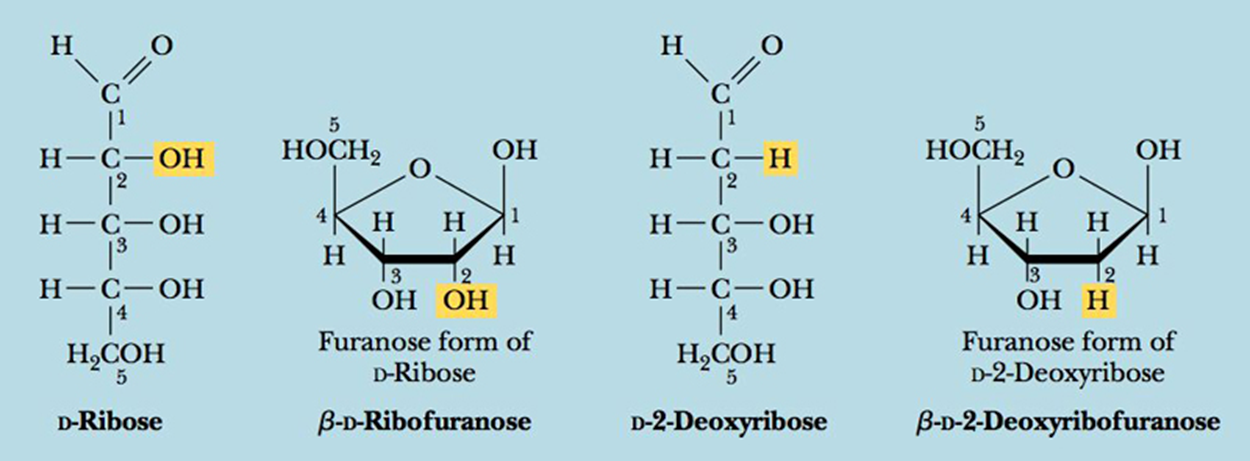
- The Pentoses of Nucleotides and Nucleic Acids
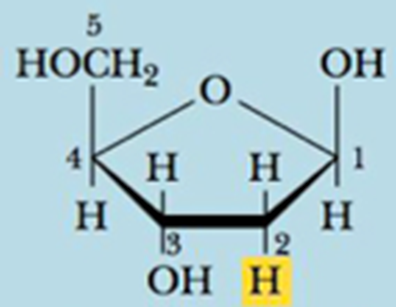
- In both RNA and DNA, the pentose is in the five-membered ring form known as furanose 呋喃糖 - D-ribofuranose for RNA and 2-deoxy-D-ribofuranose for DNA
- In both RNA and DNA, the pentose is in the five-membered ring form known as furanose 呋喃糖 - D-ribofuranose for RNA and 2-deoxy-D-ribofuranose for DNA
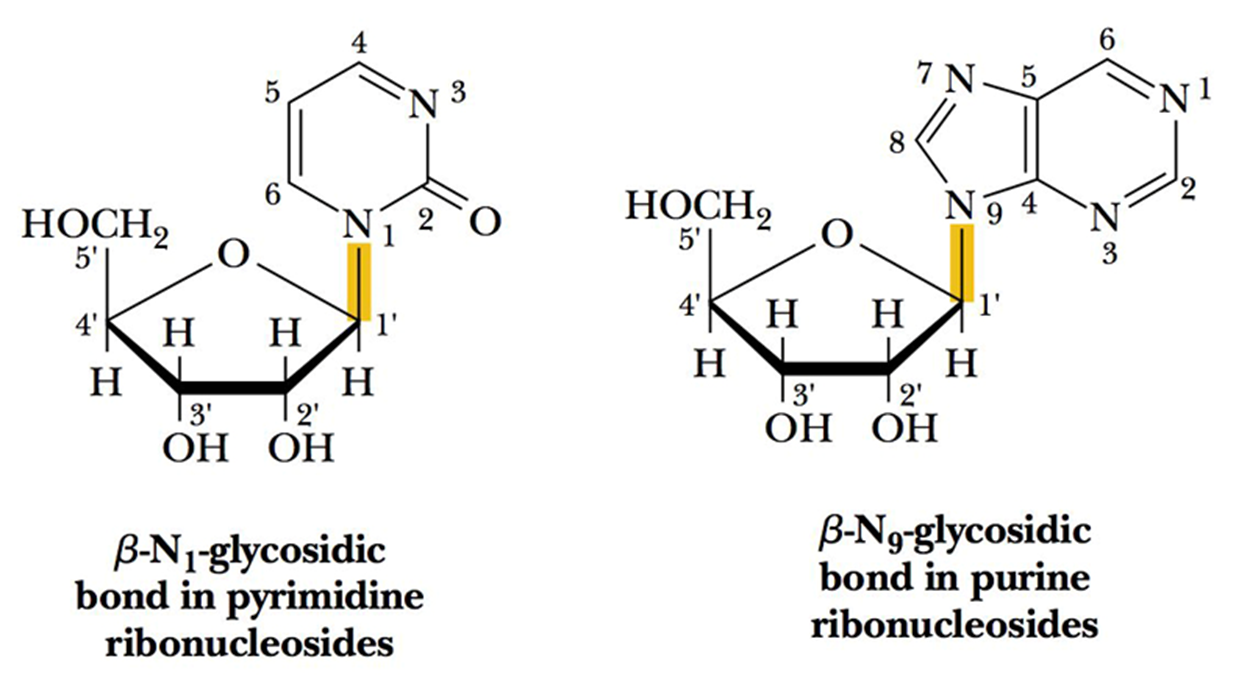
- Nucleosides Are Formed by Joining a Nitrogenous Base to a Sugar
- b-Glycosidic bonds 糖苷键 link nitrogenous bases and sugars to form nucleosides 核苷
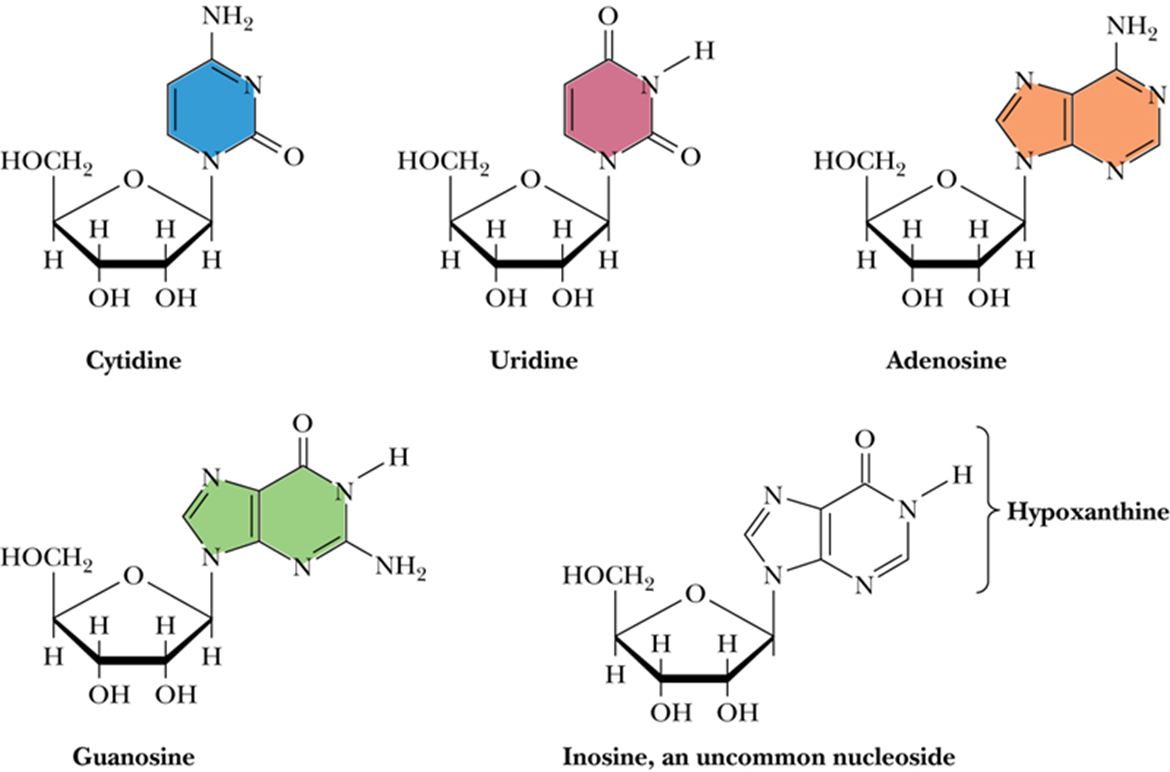
- The common ribonucleosides—cytidine, uridine, adenosine,and guanosine. Also,inosine drawn in anti conformation
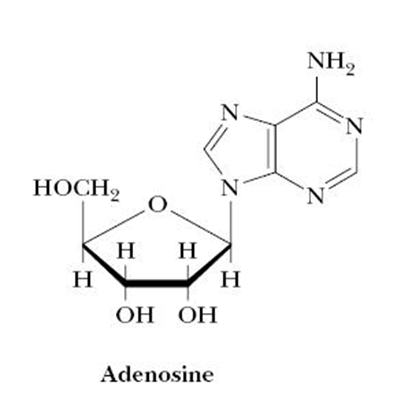
- Adenosine腺苷 - A Nucleoside with Physiological Activity
- For the most part, nucleosides have no biological role other than to serve as component parts of nucleotides, Adenosine腺嘌呤核苷is an exception.
- In mammals, adenosine functions as an autocoid自体有效物质, or “local hormone.”
- Among its physiological activities, by blocking the flow of electrical current, adenosine slows the heart rate.
- In addition, adenosine is implicated in sleep regulation.
- During periods of extended wakefulness, extracellular adenosine levels rise as a result of metabolic activity in the brain, and this increase promotes sleepiness, since adenosine slows the heart rate. During sleep, adenosine levels fall.
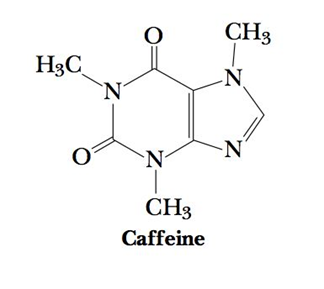
- Caffeine 咖啡因 promotes wakefulness by blocking the interaction of extracellular adenosine with its neuronal receptors through competition.
- For the most part, nucleosides have no biological role other than to serve as component parts of nucleotides, Adenosine腺嘌呤核苷is an exception.
- b-Glycosidic bonds 糖苷键 link nitrogenous bases and sugars to form nucleosides 核苷
- Nucleotides Are Nucleoside Phosphates
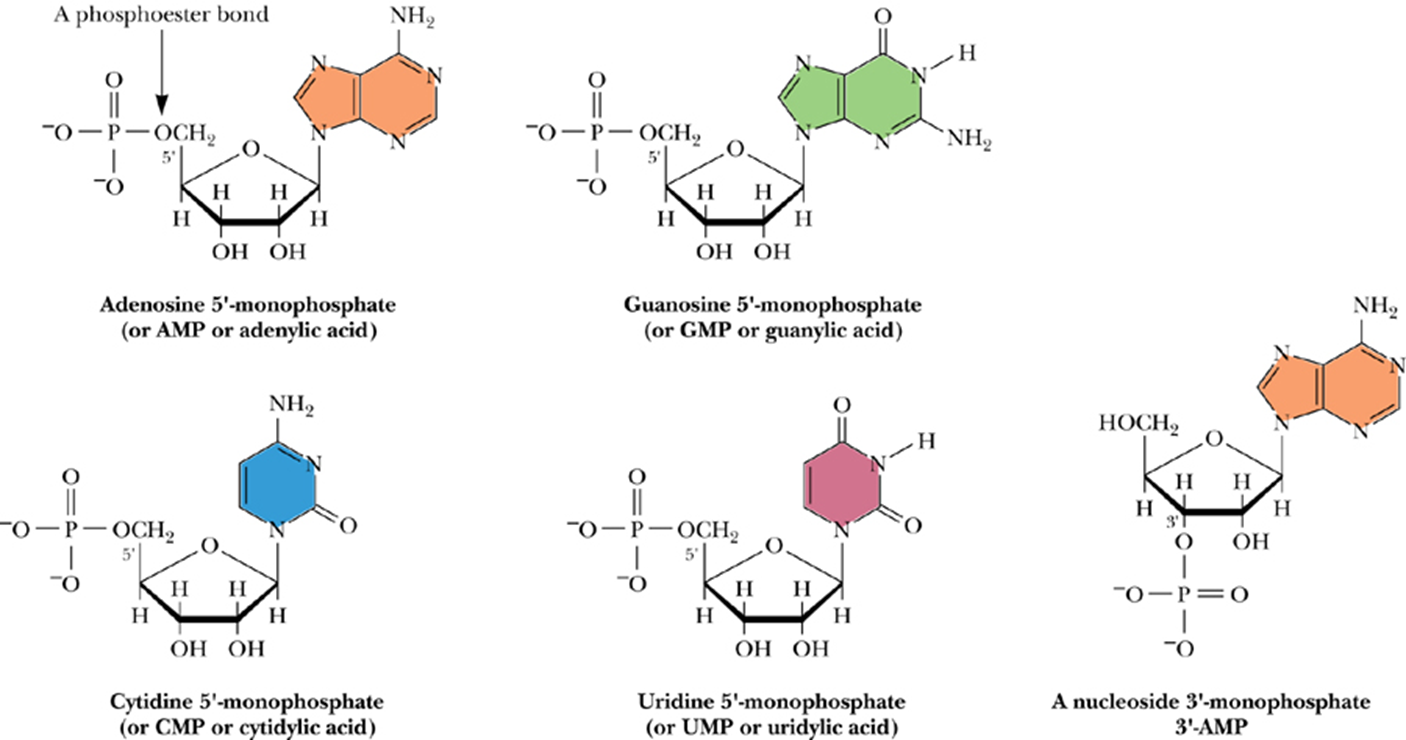
- A nucleotide 核苷酸 results when phosphoric acid is esterified to a sugar -OH group of a nucleoside 核苷
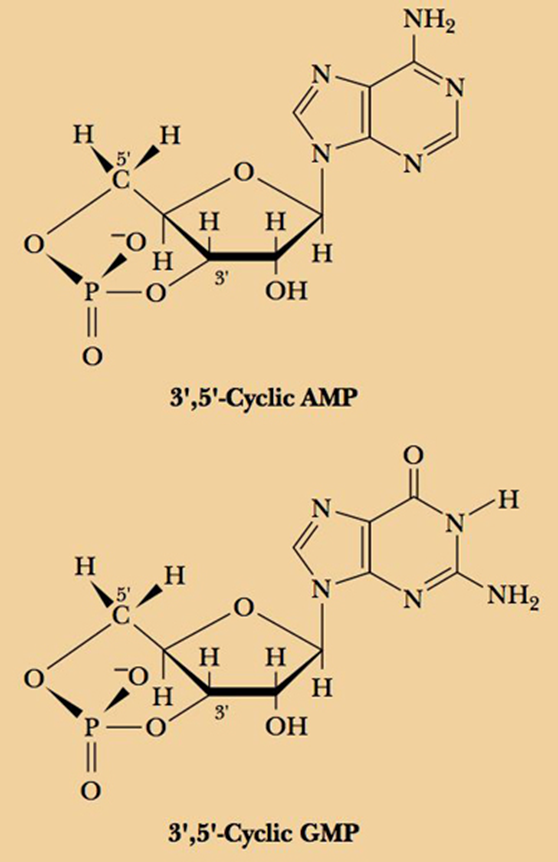
- Cyclic Nucleotides - cAMP and cGMP, are important regulators of cellular metabolism
- Nucleoside monophosphates in which the phosphoric acid is esterified to two of the available ribose hydroxyl groups are found in all cells.
- Forming two such ester linkages with one phosphate results in a cyclic structure - 3,5-cyclic AMP, often abbreviated cAMP, and its guanine analog 3,5-cyclic GMP, or cGMP.
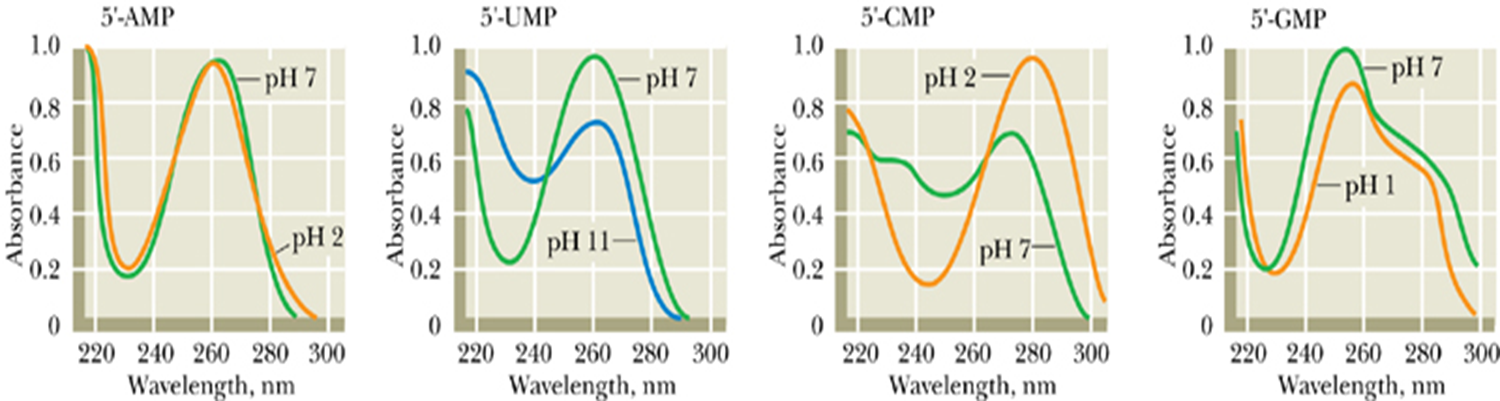
- A property of pyrimidines and purines is their strong absorbance of ultraviolet (UV) light, which is also a consequence of the aromaticity of their heterocyclic ring structures.
This property is particularly useful in quantitative and qualitative analysis of nucleotides and nucleic acids.- Here shows characteristic absorption spectra of several of the common bases of nucleic acids - adenine, uracil, cytosine, and guanine - in their nucleotide forms - AMP, UMP, CMP, and GMP.
- Here shows characteristic absorption spectra of several of the common bases of nucleic acids - adenine, uracil, cytosine, and guanine - in their nucleotide forms - AMP, UMP, CMP, and GMP.
- Nucleoside Diphosphates and Triphosphates
- Successive addition of phosphate groups via phosphoric anhydride 酐 linkages forms ADP and ATP.
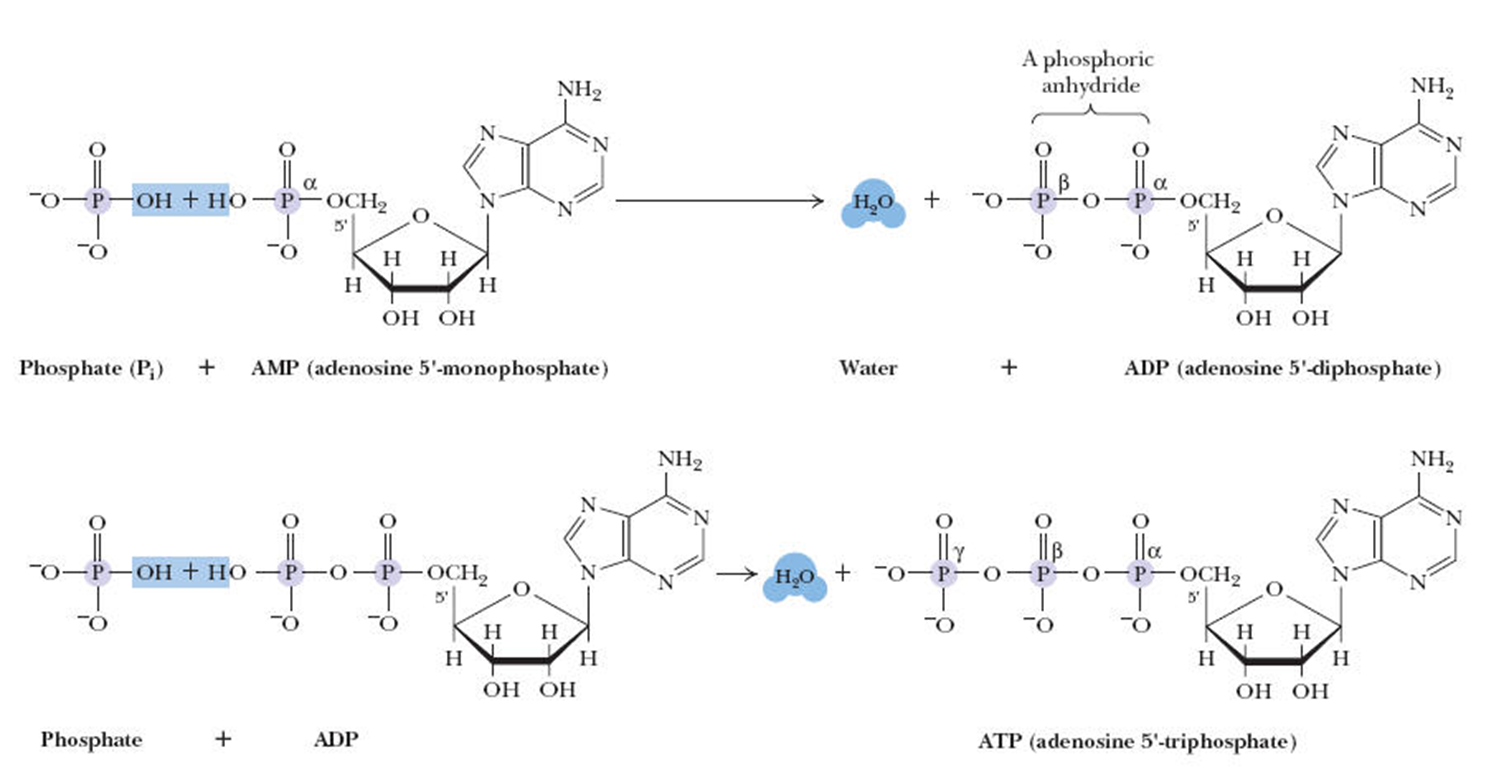
Note the removal of equivalents of H2O in these dehydration synthesis reactions.
- Successive addition of phosphate groups via phosphoric anhydride 酐 linkages forms ADP and ATP.
- Nucleoside 5’-Triphosphates Are Carriers of Chemical Energy
- ATP, GTP, CTP, UTP and dATP, dGTP, dCTP, dTTP.
Four NTPs and their dNTP counterparts are the substrates for the synthesis of the nucleic acids - The evolution of metabolism has led to the dedication of one of these four NTPs to each of the major branches of metabolism
- ATP has been termed the energy currency of the cell.
- GTP is the major energy source for protein synthesis.
- CTP is an essential metabolite in phospholipid synthesis.
- UTP forms activated intermediates with sugars that go on to serve as substrates in the biosynthesis of complex carbohydrates and polysaccharides
- ATP, GTP, CTP, UTP and dATP, dGTP, dCTP, dTTP.
- A nucleotide 核苷酸 results when phosphoric acid is esterified to a sugar -OH group of a nucleoside 核苷
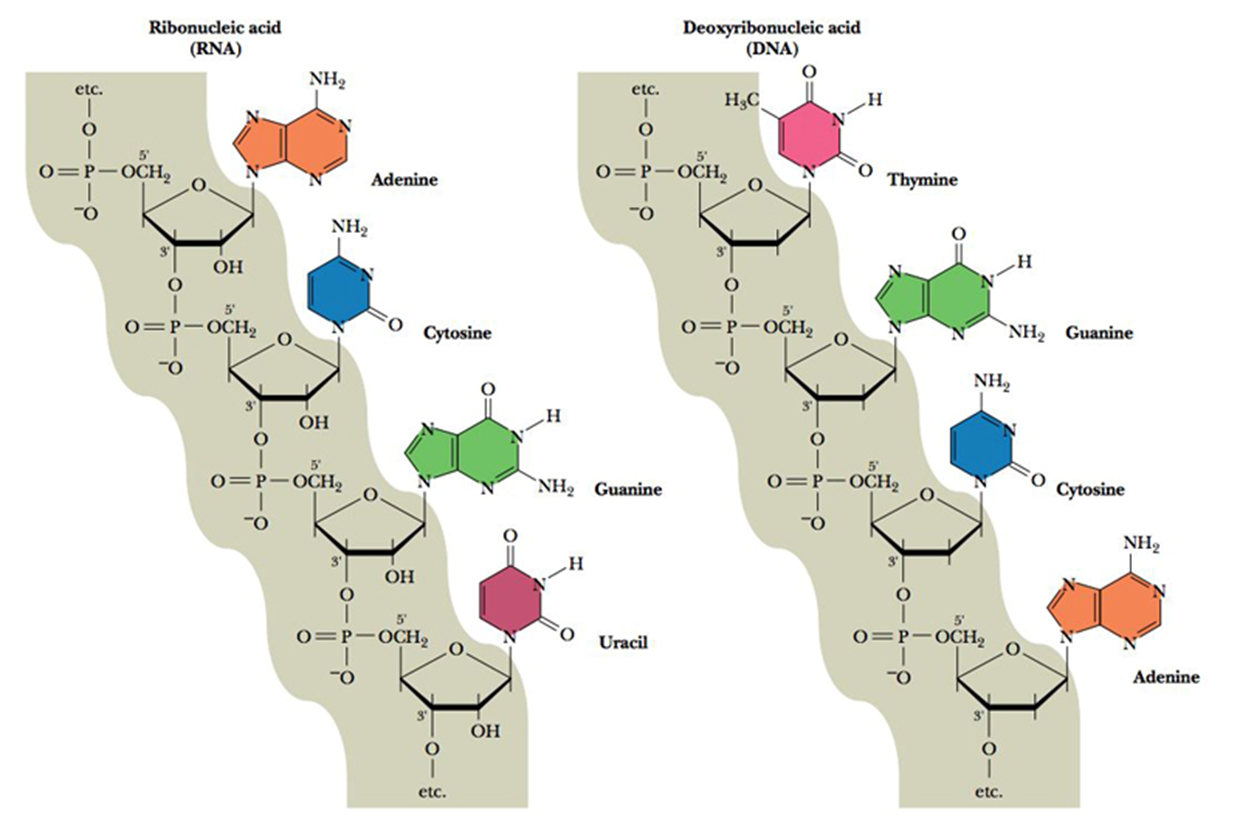
- Nucleic Acids Are Polynucleotides 核酸是多聚核苷酸
- Nucleicacids are linear polymers of nucleotides linked 3’ to 5’ by phosphodiester bridges
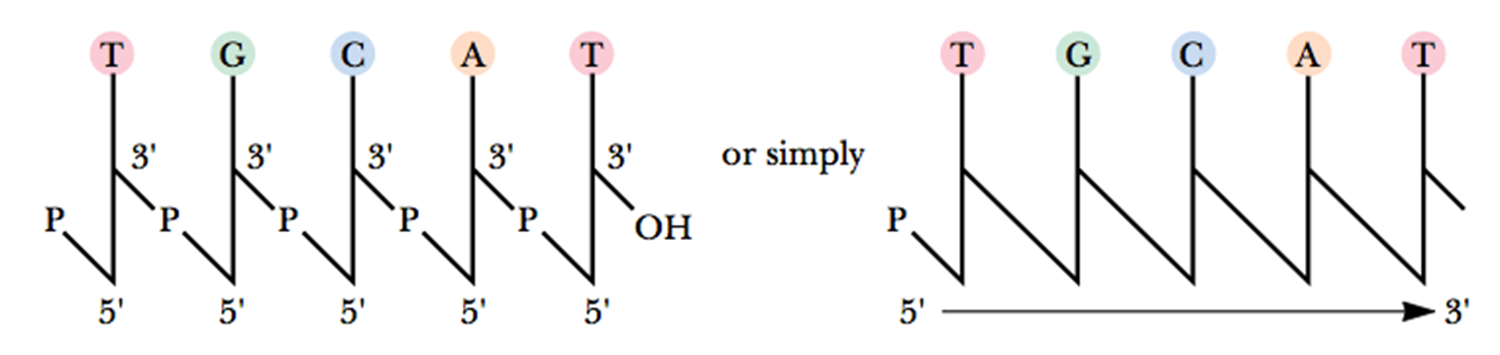
- They are formed as 5’-nucleoside monophosphates are successively added to the 3’-OH group of the preceding nucleotide, a process that gives the polymer a directional sense 5’-3’
- In 2-deoxy-D-ribofuranose for DNA, only the 3’- and 5’-hydroxyl groups are available for inter nucleotide phosphodiester bonds.
- The convention in all notations of nucleic acid structure is to read the polynucleotide chain from the 5-end of the polymer to the 3-end, 5’-3’. It is the direction of its biosynthesis
- Nucleicacids are linear polymers of nucleotides linked 3’ to 5’ by phosphodiester bridges
- DNA
- only one biological role
- preserve information of making all the functional macromolecules of the cell(even DNA itself)
- form
- In viruses or bacteria
- only a single DNA molecule (or chromosome)
- DNA is a threadlike molecule
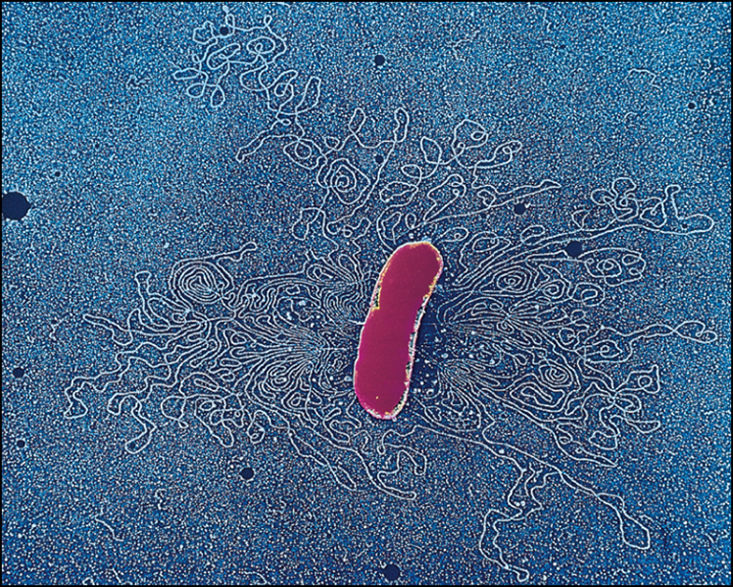
- The diameter of the DNA double helix is only 2 nm, but the length of the DNA molecule forming the E. coli chromosome is over 1.6X10^6 nm (1.6 mm).
- Because the long dimension of an E. coli cellis only 2000 nm (0.002 mm), its DNA must be highly folded
- Bacterial chromosome DNA surrounding the cell in electron micrographs.
- The single chromosome of prokaryotic cells is typically a circular DNA molecule associated with relatively little protein
- In eukaryotic cells 真核细胞
- have many chromosomes, and DNA is found principally in two copies in the diploid 二倍体 chromosomes of the nucleus
- it also occurs in mitochondria and in chloroplasts
- DNA molecules of eukaryotic cells are linear and richly adorned with proteins, in the form of chromosomes
- histones 组蛋白 interact ionically with the anionic phosphate groups in the DNA backbone to form nucleosomes 核小体
- In viruses or bacteria
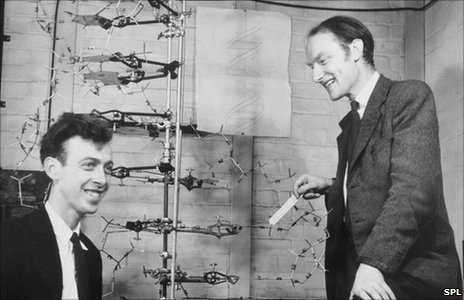
- discovery of DNA double helix structure
- Rosalind Franklin’s x-ray diffraction photo of sodium deoxyribose nucleate from calf thymus
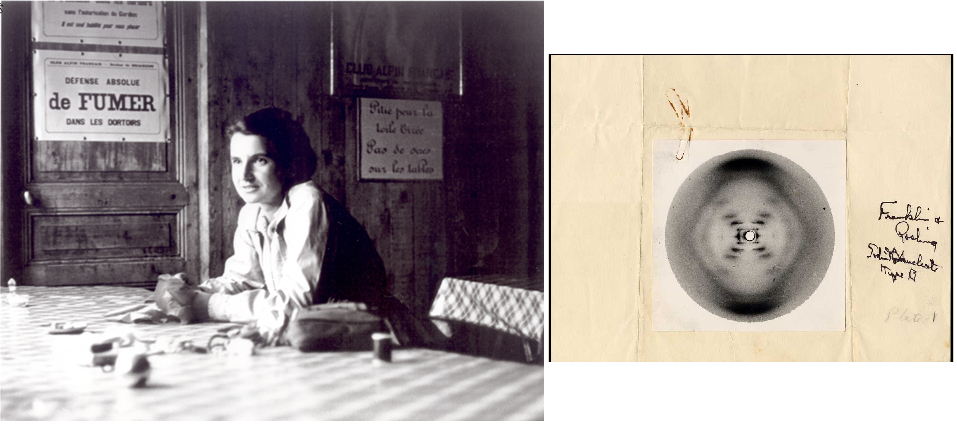
罗莎琳德·富兰克林拍摄的牛胸腺脱氧核糖核酸钠X射线衍射照片
- James Watson and Francis Crick, at Cambridge University in 1953
- Rosalind Franklin’s x-ray diffraction photo of sodium deoxyribose nucleate from calf thymus
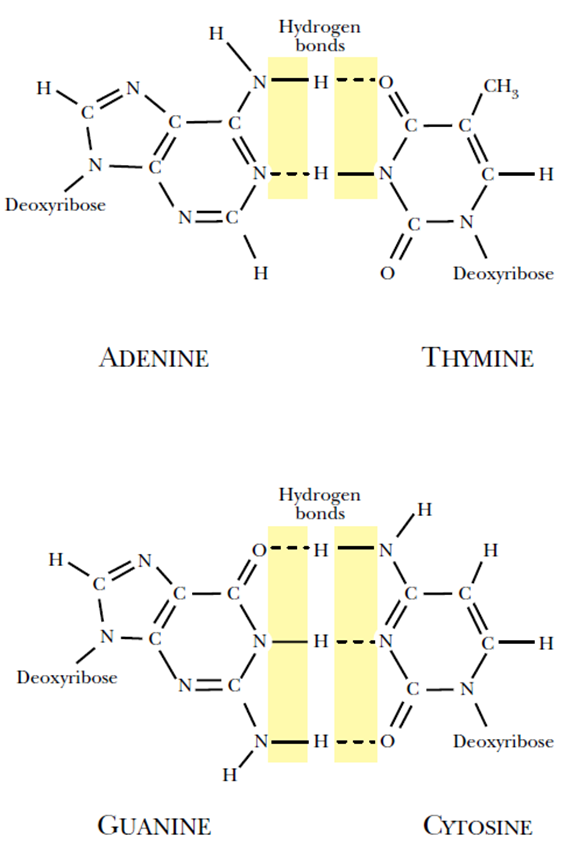
- Base Pairs are Held Together by Hydrogen Bonds
- Purines(adenine and guanine) pair with pyrimidines (thymine and cytosine) by hydrogen bonding (colored regions). When the purines and pyrimidines first cometogether, they form the bonds indicated by the dotted lines
- Purines(adenine and guanine) pair with pyrimidines (thymine and cytosine) by hydrogen bonding (colored regions). When the purines and pyrimidines first cometogether, they form the bonds indicated by the dotted lines
- only one biological role
- RNA
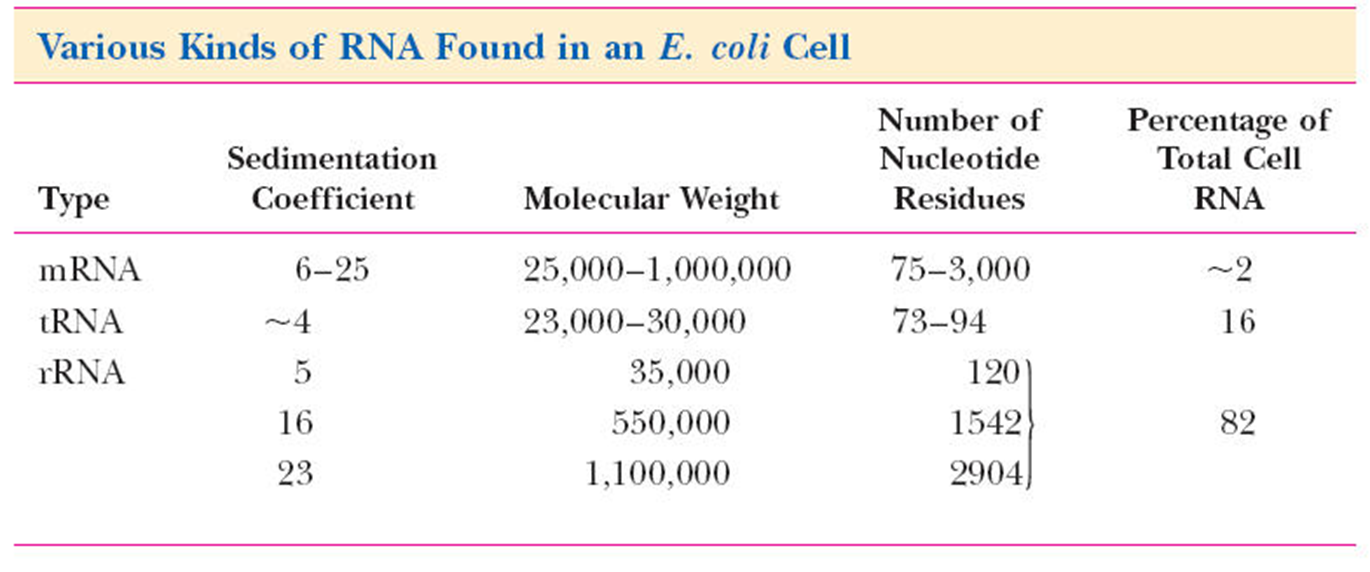
- RNA occurs in multiple copies and various forms
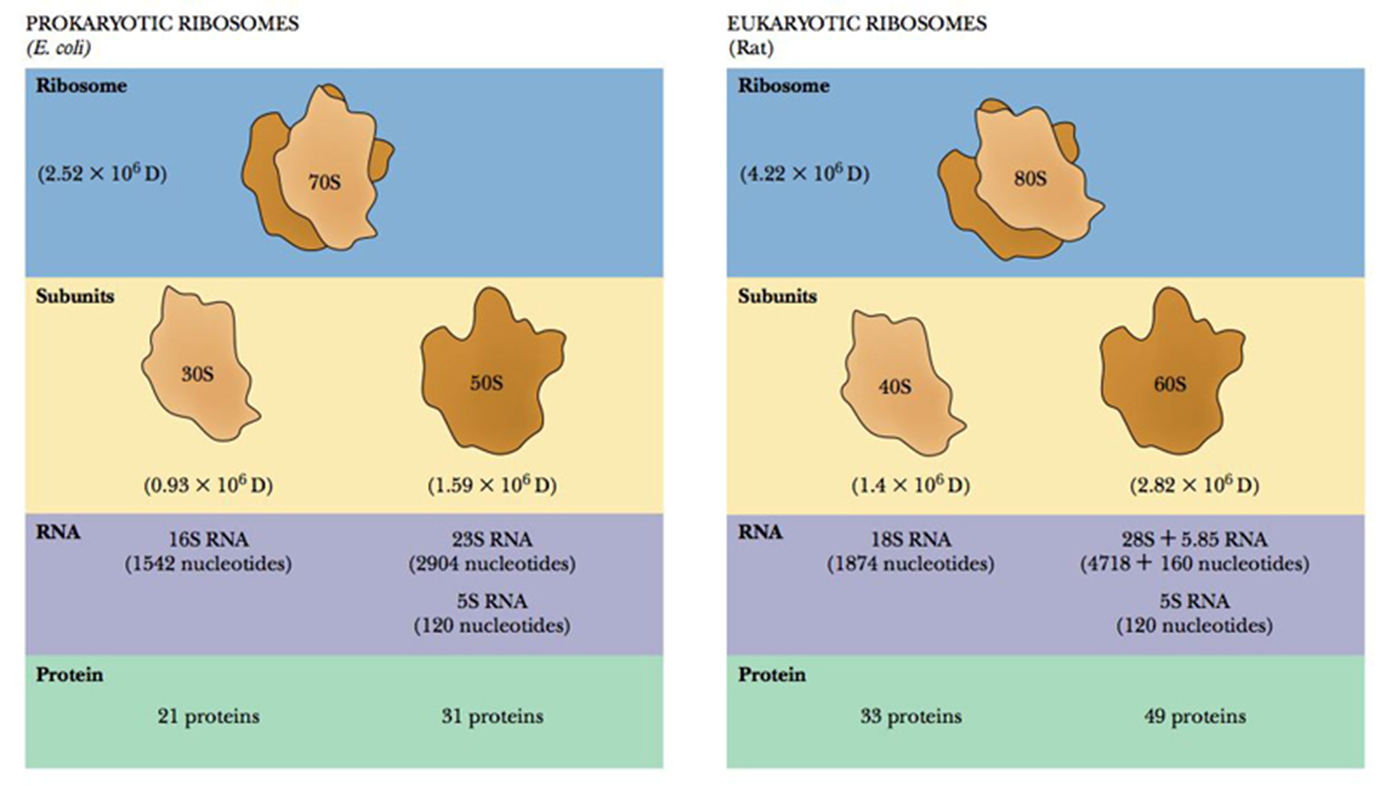
- Ribosomal RNA – provides the structural and functional foundation for ribosomes
- Ribosomes核糖体 contain about 65% RNA of the ribosomal RNA type.
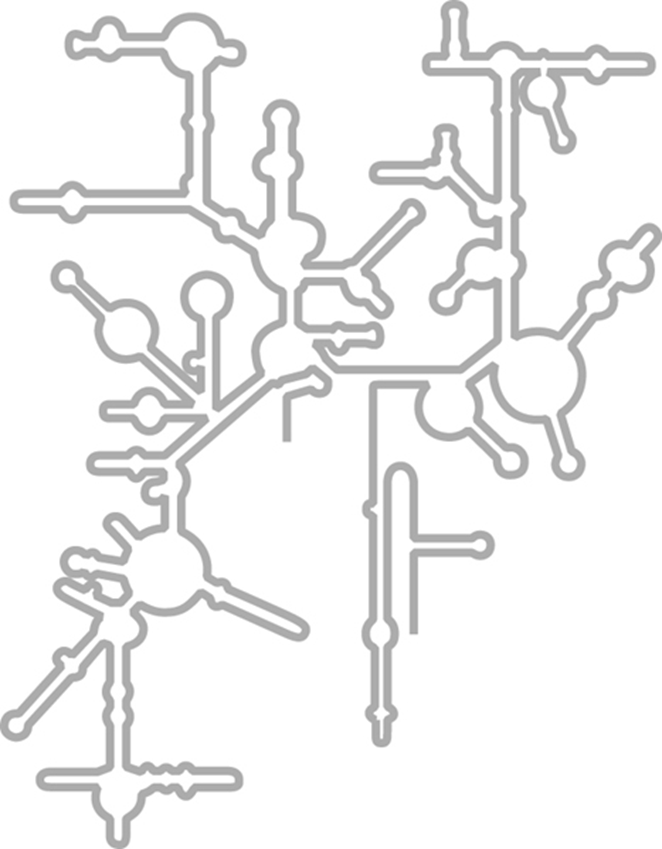
- Ribosomal RNA has a complex secondary structure due to many intrastrand hydrogen bonds
- The different species of rRNA are generally referred to according to their sedimentation, which are a rough measure of their relative size
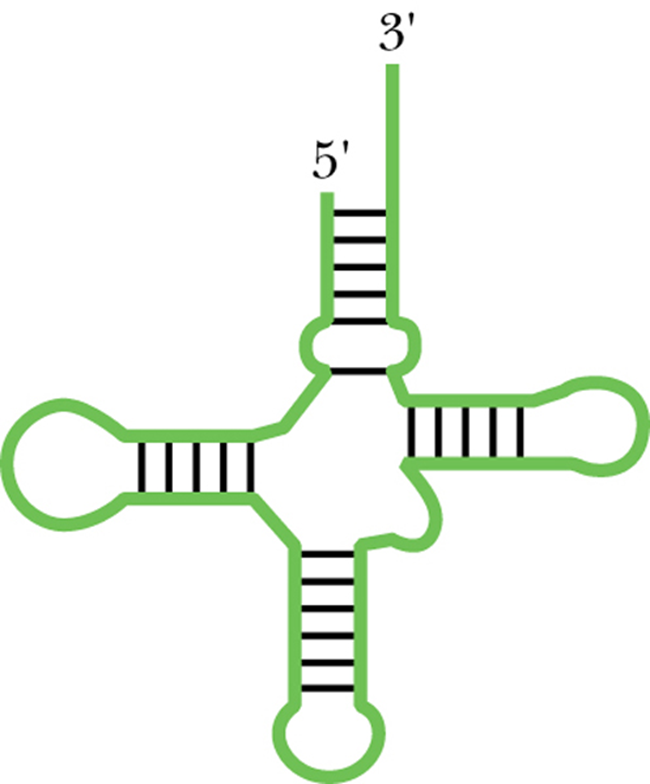
- Transfer RNAs – carry amino acids to ribosomes for use in protein synthesis
- Transfer RNA also has a complex secondary structure due to many intrastrand hydrogen bonds
- Transfer RNA also has a complex secondary structure due to many intrastrand hydrogen bonds
- Messenger RNA - carries the sequence information for synthesis of a protein
- RNA occurs in multiple copies and various forms
- DNA vs RNA
- Two fundamental chemical differences distinguish DNA from RNA
- DNA contains 2-deoxyribose instead of ribose.
- DNA contains thymine instead of uracil
- DNA is a more stable polymeric form than RNA.
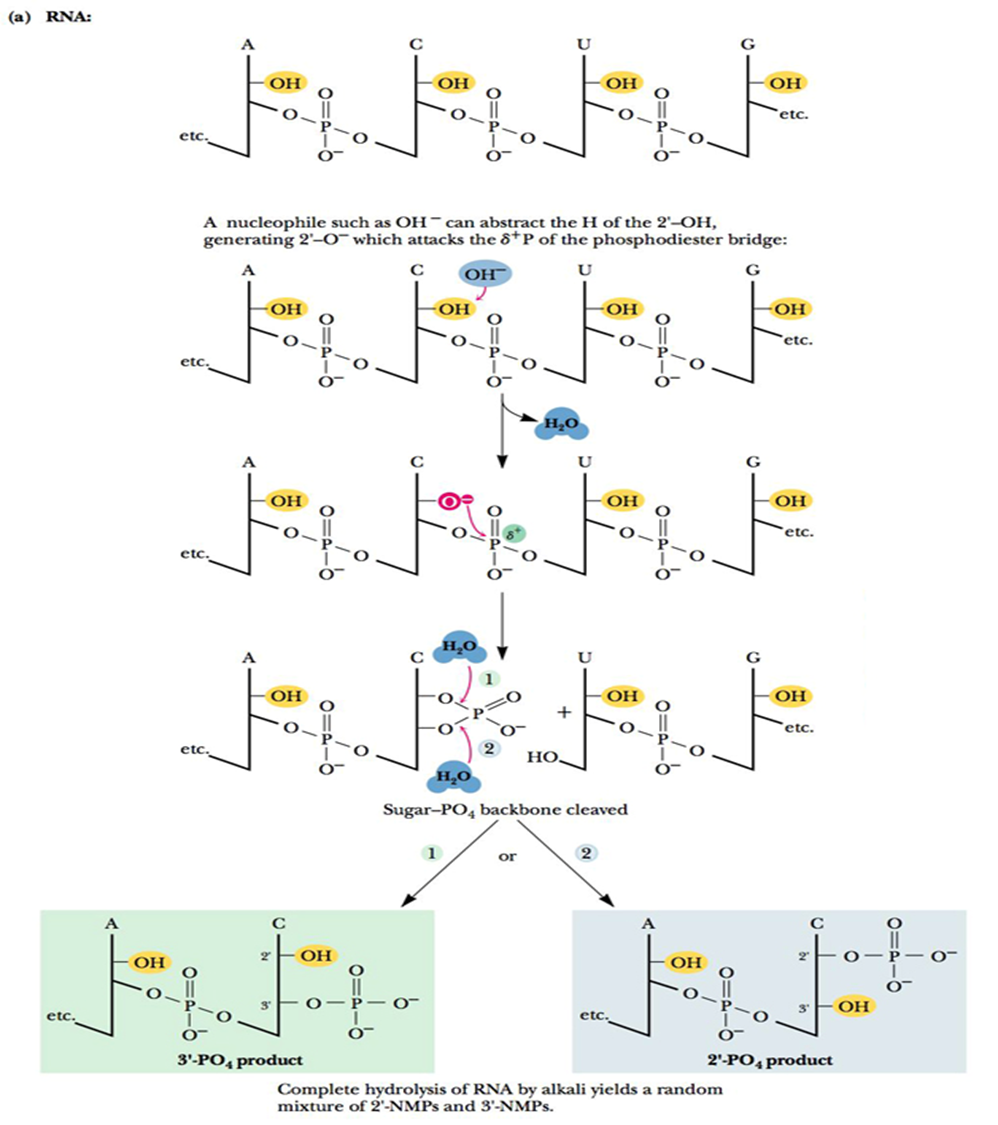
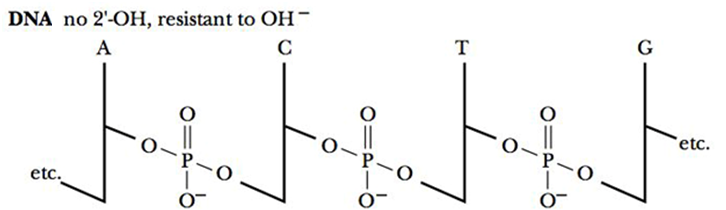
- The 2-deoxyribose makes DNA more resistance to alkaline hydrolysis
- Hydrolysis of RNA by alkali - sodium hydroxide (NaOH)
- DNA is resistant to alkali hydrolysis
- Thymine help the cellular repair mechanism “proofreads” to remove transformed U
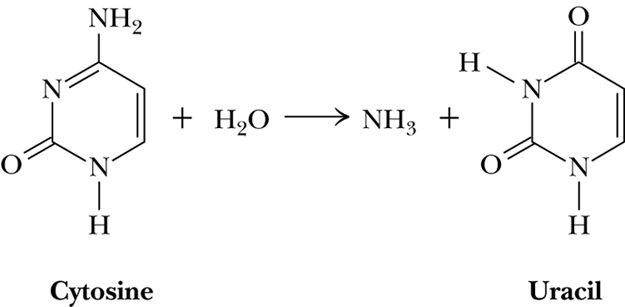
- Deamination of cytosine胞嘧啶 form suracil尿嘧啶
- 细胞内的DNA修复机制(如尿嘧啶-DNA糖基化酶)能够“校对”并去除由胞嘧啶转化而来的尿嘧啶,从而维持遗传信息的准确性, 而DNA使用胸腺嘧啶(T)而非尿嘧啶(U)的好处之一,就是让这些错误的U更容易被修复系统识别和清除
- Two fundamental chemical differences distinguish DNA from RNA
- Hydrolysis of Nucleic Acids
- Hydrolysis by Acid or Base
- Base
- DNA is not susceptible to alkaline hydrolysis
- RNA is alkali labile 不稳定的 and is readily hydrolyzed by dilute sodium hydroxide (NaOH)
- Acid
- RNA is relatively resistant to the effects of dilute acid
- gentle treatment of DNA with 1 mM HCl(hydrogen chloride) leads to hydrolysis
- This information can be used to separate DNA and RNA from cell respectively
- Tris-saturated phenol pH 8.0 for DNA
DNA提取用Tris饱和酚 - Water-saturated phenol pH 6.0 for RNA
RNA提取用水饱和酚
- Tris-saturated phenol pH 8.0 for DNA
- Base
- Enzymatic Hydrolysis
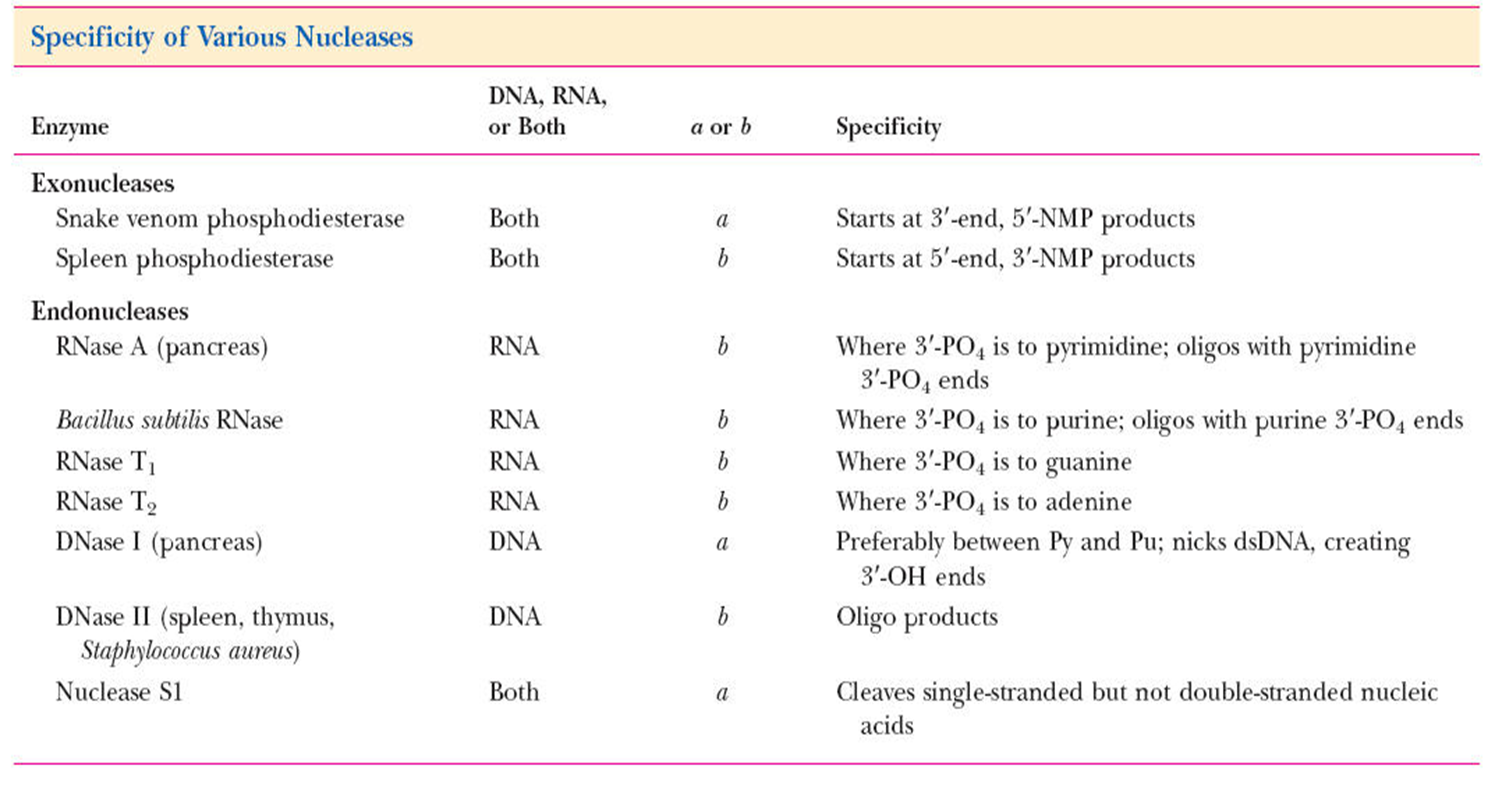
- Enzymes that hydrolyze nucleicacids are called nucleases, nucleases are phosphodiesterases that catalyze the cleavage of phosphodiester bonds by H2O
- Some nucleases act only on DNA (DNases), while others are specific for RNA (RNases)
- 一些核酸外切酶与核酸内切酶
- Exonucleases 外切酶 - 从多糖核苷酸链末端进行水解,产物为单个核苷酸
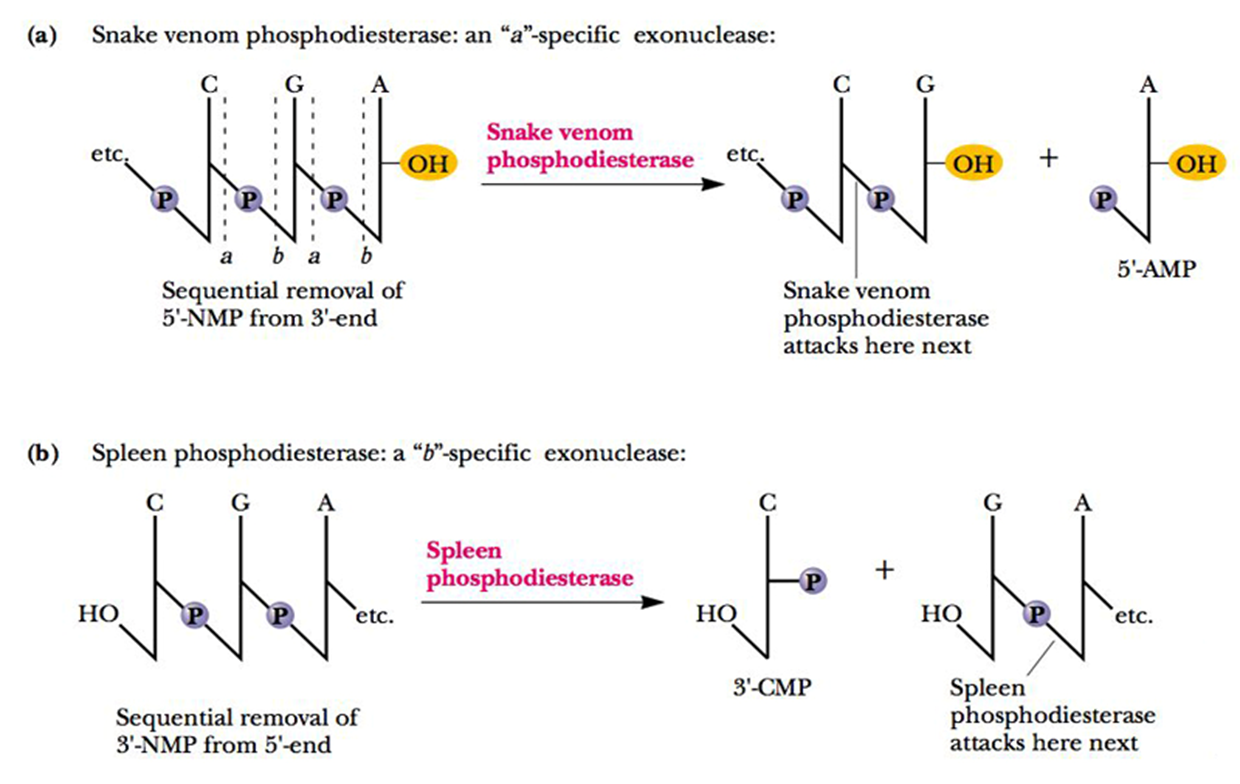
(a) 3’→5’外切酶 (b) 5’→3’外切酶
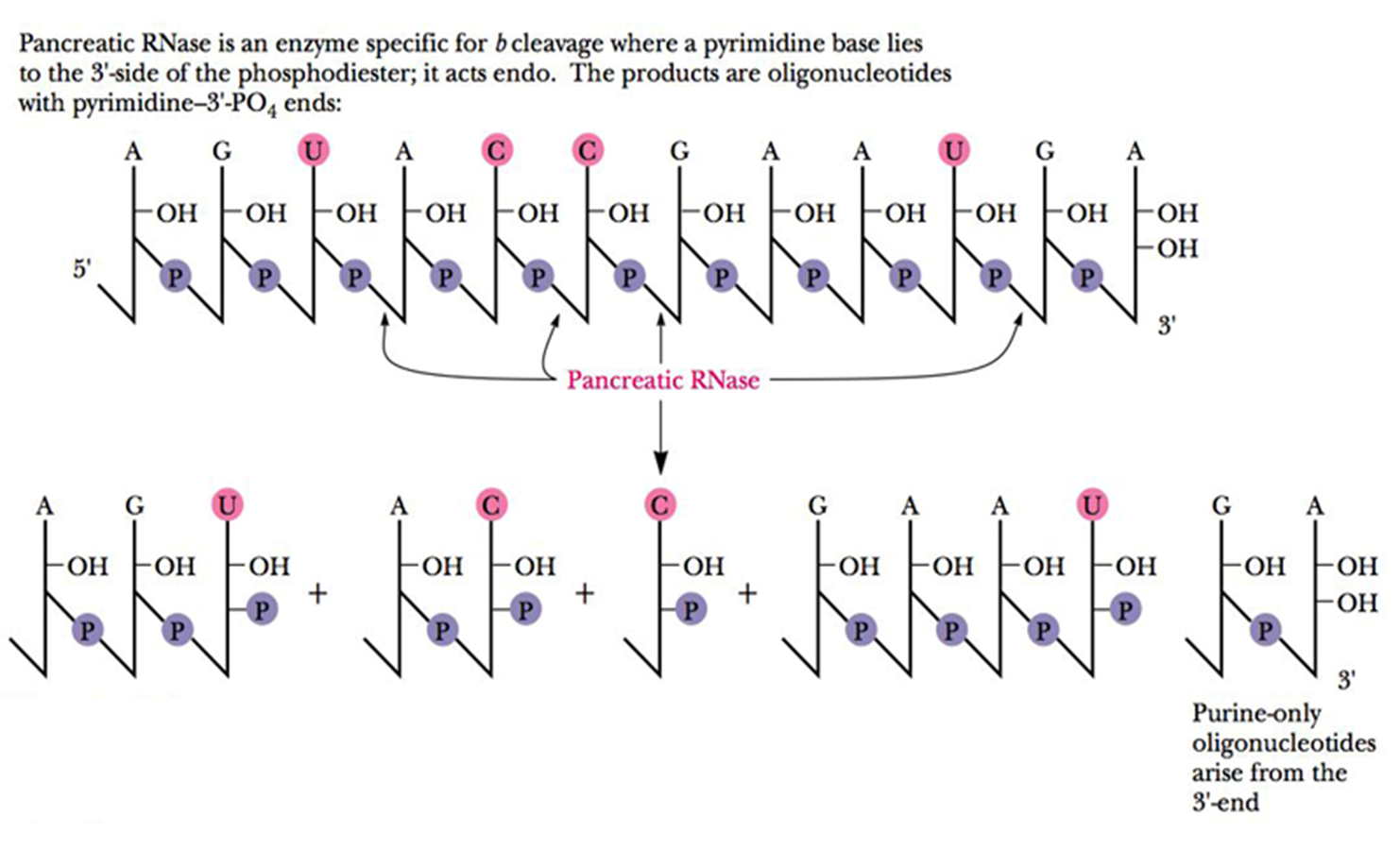
- Endonucleases - 内切酶:从多糖核苷酸链中间进行水解,使核苷酸链断裂
- CRISPR-Cas9 Genome Editing Technology
- Hydrolysis by Acid or Base
All articles in this blog are licensed under CC BY-NC-SA 4.0 unless stating additionally.