
生物化学_Nitrogen Acquisition and Amino Acid Metabolism
- Nitrogen Acquisition and Amino Acid Metabolism
- Nitrogen Is Cycled Between Organisms and the Inanimate Environment
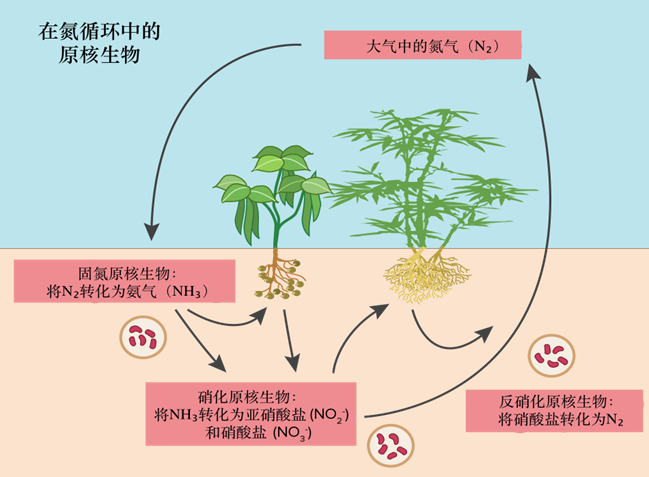
- The nitrogen cycle. Organic nitrogenous compounds are formed by the incorporation of NH4+ into carbon skeletons. Note that denitrification and nitrogen fixation are anaerobic processes.
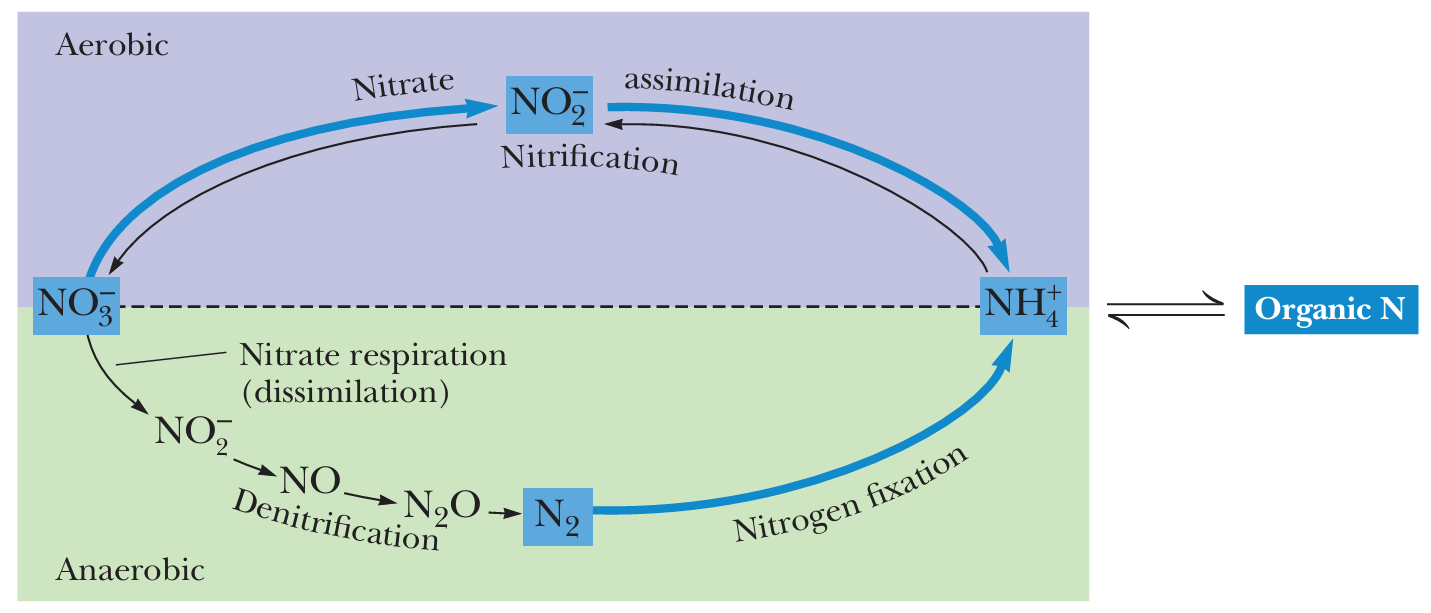
反硝化作用和固氮作用都是厌氧过程
- 图
- The reduction of NO3- to NH4+ occurs in green plants, various fungi, and certain bacteria in a two-step metabolic pathway known as nitrate assimilation硝酸盐同化.
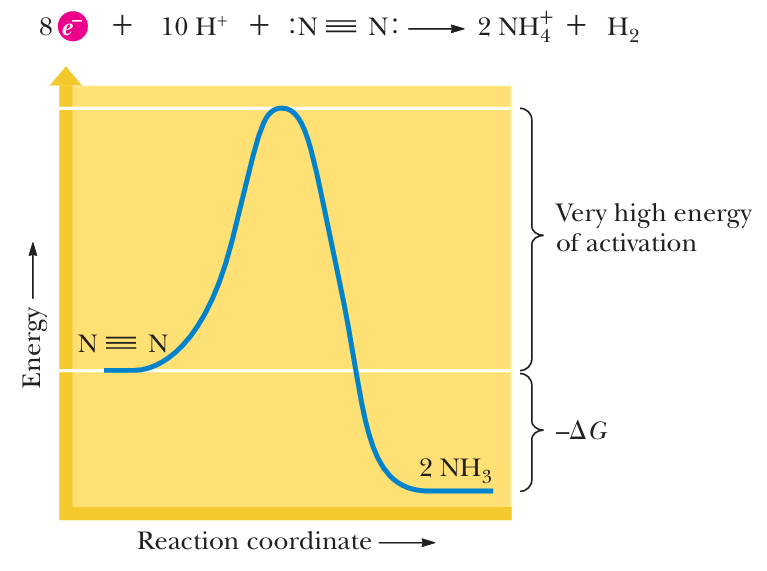
- The formation of NH4+ from N2 gas is termed nitrogen fixation.
- N2 fixation is an prokaryotic only process,although bacteria in symbiotic 共生的 association with certain green plants also carry out nitrogen fixation.
- No animals are capable of either nitrogen fixation or nitrate assimilation, so they are totally dependent on plants and micro organisms for the synthesis of organic nitrogenous compounds, such as amino acids and proteins, to satisfy their requirements for this essential element.
- Animals release excess nitrogen in a reduced form, either as NH4+ or as organic nitrogenous compounds such as urea尿素.
- The release of N occurs both during life and as a consequence of microbial decomposition following death.
氮的释放既发生在生物的生命过程中,也作为死后微生物分解的结果而发生 - Various bacteria return the reduced forms of nitrogen back to the environment by oxidizing them.
各种细菌通过氧化作用,将还原态的氮转化回环境中 - The oxidation of NH4+ to NO3- by nitrifying bacteria , provides the sole source of chemical energy for the life of these microbes.
硝化细菌将 NH4+ 氧化为 NO3- 的过程,为这些微生物的生命活动提供了唯一的化学能量来源 - Nitrate nitrogen returns to the atmosphere as N2 as a result of the metabolic activity of denitrifying bacteria反硝化细菌.These bacteria are capable of using NO3- and similar oxidized, inorganic forms of nitrogen as electron acceptors in place of O2 in energy-producing pathways. The NO3- is reduced ultimately to N2.
硝态氮在反硝化细菌的代谢活动作用下,以 N2 的形式返回大气. 这些细菌能够利用 NO3- 及其类似的氧化态无机氮代替 O2,在产能代谢途径中作为电子受体. NO3- 最终被还原为 N2.
- The nitrogen cycle. Organic nitrogenous compounds are formed by the incorporation of NH4+ into carbon skeletons. Note that denitrification and nitrogen fixation are anaerobic processes.
- Nitrate Assimilation 硝酸盐同化作用
the Principal Pathway for Ammonium Biosynthesis 铵盐生物合成的主要途径- Nitrate assimilation is the predominant means by which green plants, algae, and many micro organisms acquire nitrogen.
- accounts for more than 99% of the inorganic nitrogen (nitrate or N2) assimilated into organisms
- reaction
- 酶(1) - nitrate reductase 硝酸还原酶
- Nitrate Reductase Contains Cytochrome b557 and Molybdenum钼 Cofactor
- Nitrate reductases typically are cytosolic 220-kD dimeric proteins.
- Mo cofactor is necessary for both nitrate reductase activity and the assembly of nitrate reductase subunits into the active dimeric holoenzyme全酶 form.
- prosthetic group - molybdenum cofactor 钼辅因子
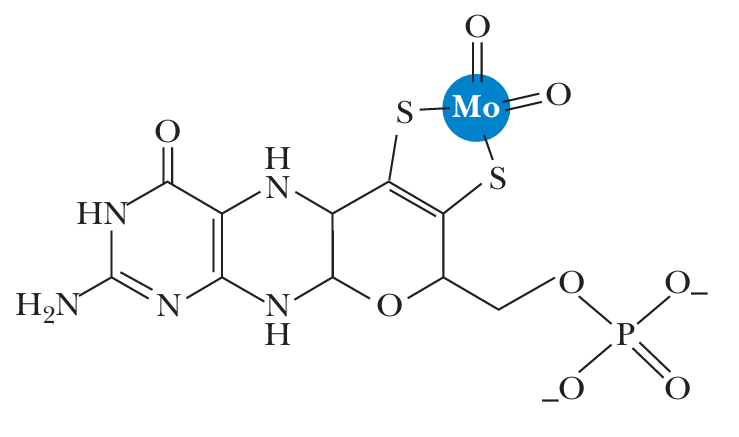
prosthetic group辅基是连在蛋白质上的东西, 扩展了蛋白的功能, 这里面使用钼原子可以传递电子
- A pair of electrons is transferred from NADH to nitrate and reduce nitrate to nitrite.
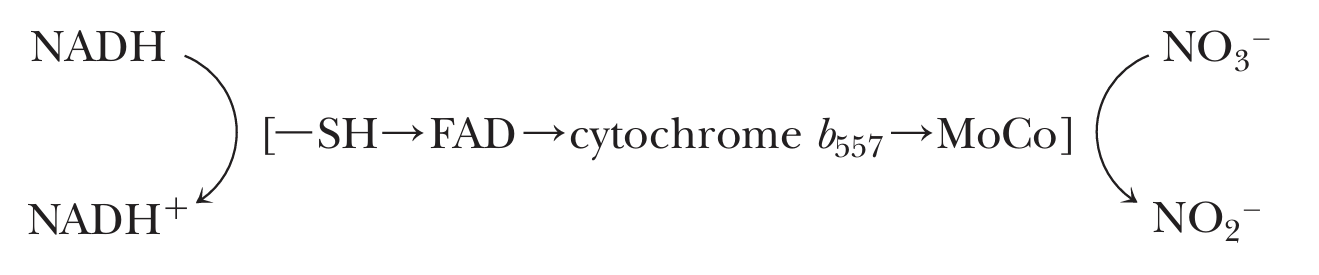
This transfer is via enzyme-associated sulfhydryl groups 巯基,FAD, cytochrome b557, and MoCo (an essential molybdenum钼-containing cofactor).
- The brackets [ ] denote the protein-bound prosthetic groups that constitute an e- transport chain between NADH and nitrate.
- 酶(2) - nitrite reductase 亚硝酸还原酶
- prosthetic group - Siroheme 西罗血红素
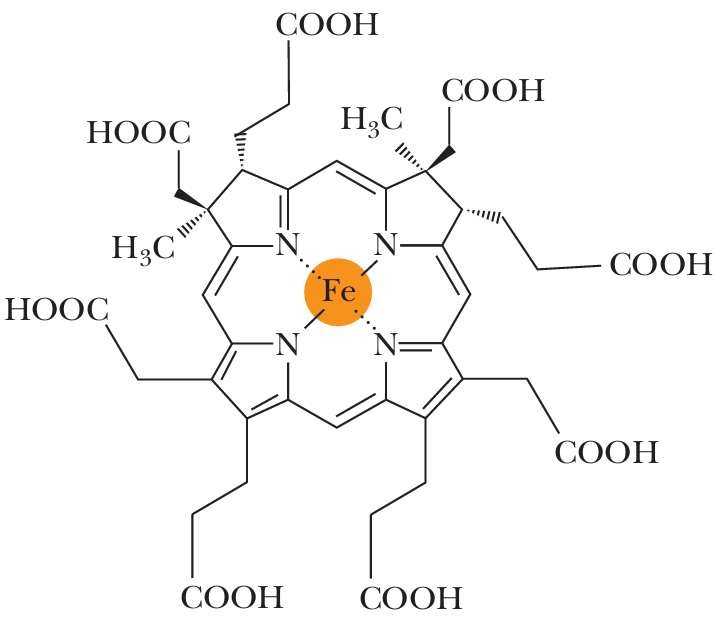
有8个-COOH侧链, These -COOH may act as H+ donors during the reduction of NO2- to NH4+
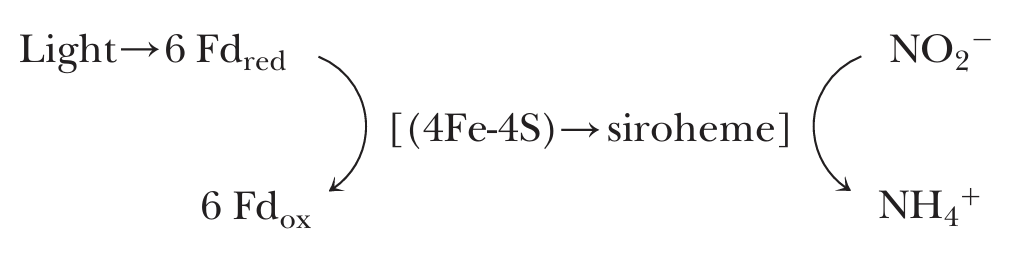
- Six electrons are required to reduce NO2- to NH4+
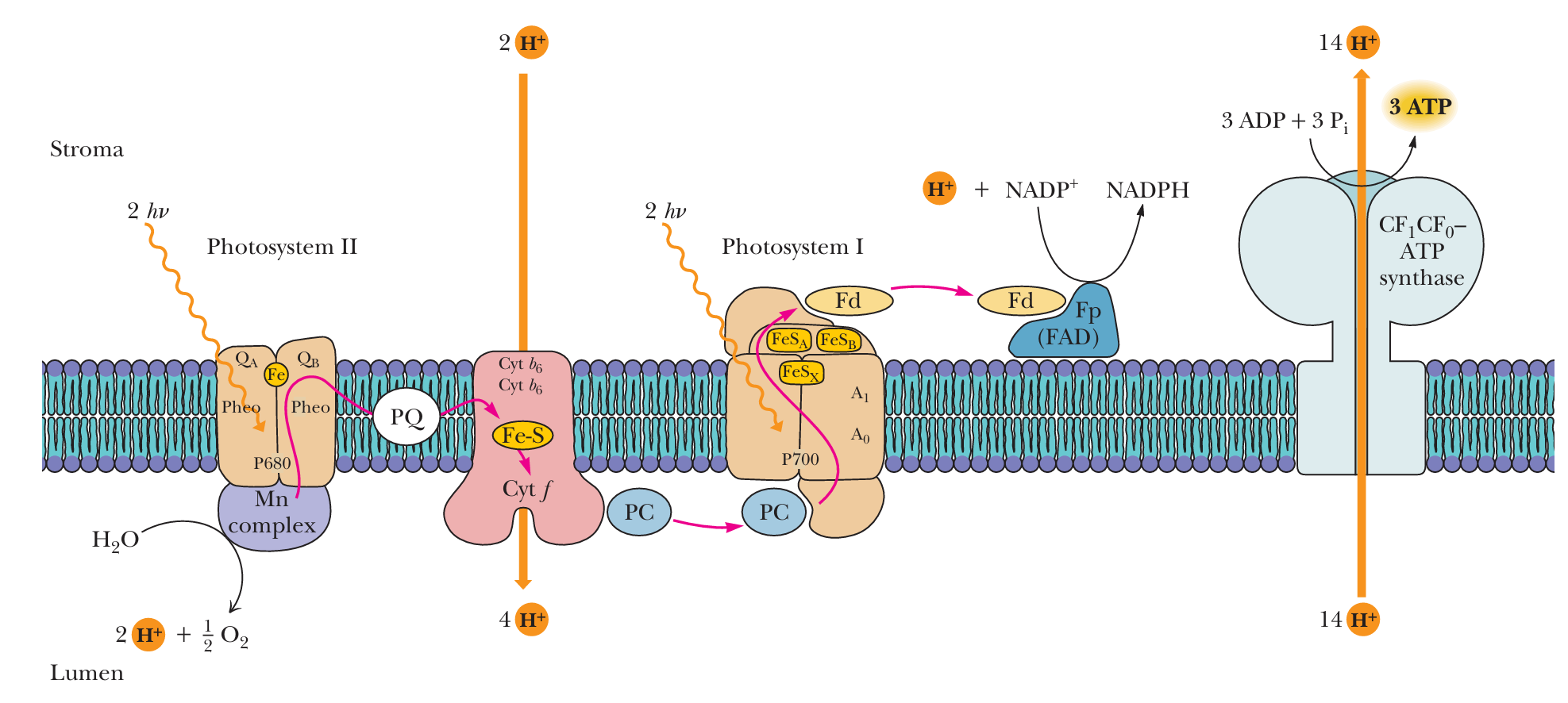
- Nitrite reductases in photosynthetic organisms obtain these electrons from six molecules of photosynthetically reduced ferredoxin (Fdred) 光合还原铁氧还蛋白
- In higher plants, nitrite reductase is found in chloroplasts, where it has ready access to its primary reductant Fdred
- prosthetic group - Siroheme 西罗血红素
- Nitrogen Fixation
Organisms Gain Access to Atmospheric N2 Via the Pathway of Nitrogen Fixation- basic
- Less than 1% of the inorganic N incorporated into organic compounds by organisms can be attributed to nitrogen fixation, 但是是唯一利用大气中N2的途径
- N2-fixing bacteria may be either free-living or living as symbionts with higher plants, 可以自己活也可以和高等生物共生, 比如 Rhizobia 根瘤菌 与 soybeans 大豆
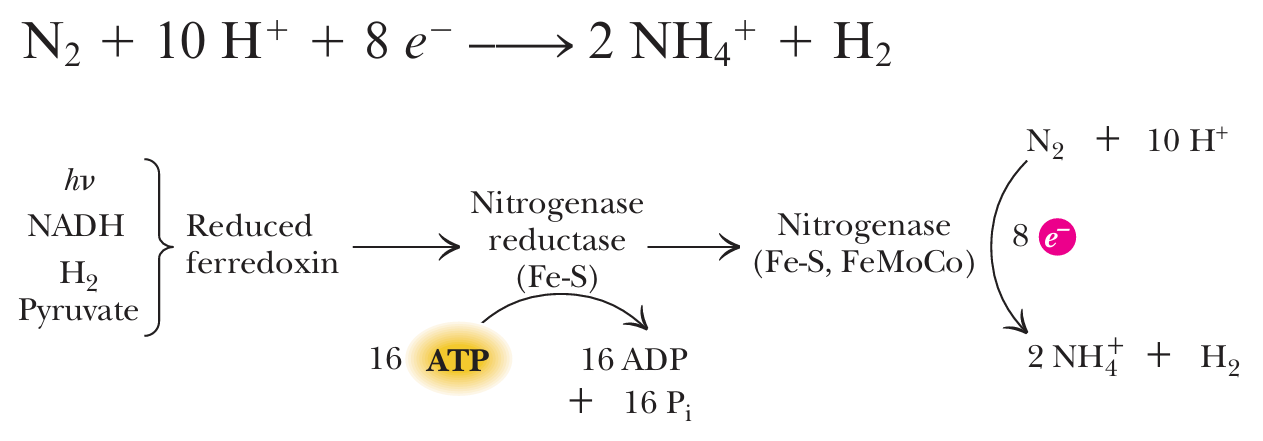
- reaction
- 酶 - nitrogenase固氮酶
- found only in prokaryotic cells
- Composed of Two Metalloproteins
- Fe-protein, also called nitrogenase reductase
- MoFe-protein, also called nitrogenase
这地方起名乱七八糟的, 这个名字既可以指这种金属蛋白, 也可以指整个系统
- MoFe-protein, also called nitrogenase
- Both nitrogenase reductase and nitrogenase is very oxygen labile
labile - 不稳定的, 易变的, 易受破坏的, 这俩碰到氧气都会失活
- Nitrogenase is a rather slow enzyme
- Its optimal rate of e- transfer is about 12 e- pairs per second per enzyme molecule
最佳速度是每秒12对电子 - that is, it reduces only three molecules of nitrogen gas per second.
每秒固定3分子N2 - Because its activity is so weak, nitrogen-fixing cells maintain large amounts of nitrogenase so that their requirements for reducing N can be met.
- As much as 5% of the cellular protein may be nitrogenase.
- Its optimal rate of e- transfer is about 12 e- pairs per second per enzyme molecule
- requirements of reaction
- the enzyme nitrogenase
- a strong reductant, such as reduced ferredoxin
- Depending on the bacterium, electrons for N2 reduction may come from light, NADH, hydrogen gas, or pyruvate.
- The primary e- donor for the nitrogenase system is reduced ferredoxin
- ATP
- very strong bonding between the two N atoms in N2, need ATP energy to break the bond
- O2-free conditions
- Two Metalloproteins is oxygen labile
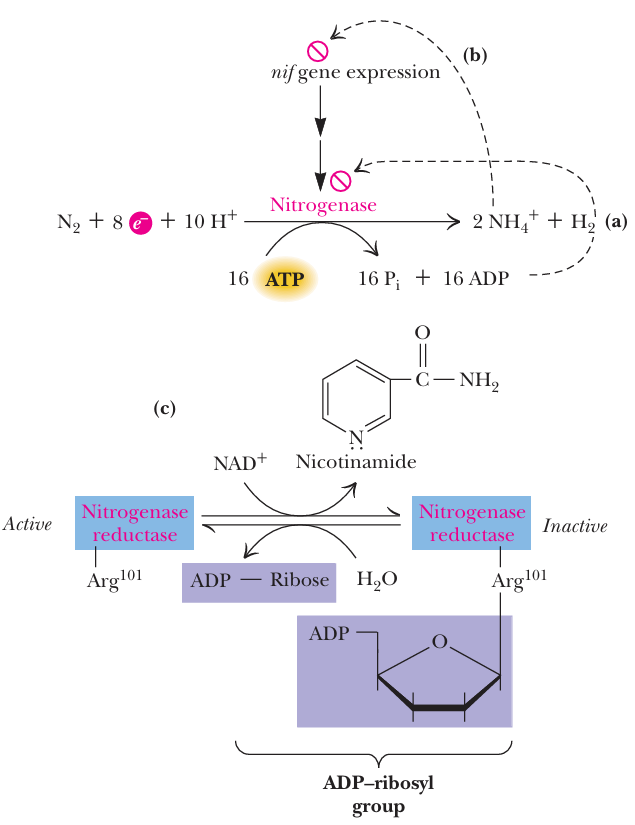
- regulation
- (a) ADP inhibits nitrogenase activity
- (b) NH4+ represses nif gene expression
nif基因 - 固氮基因 - (c) In some organisms, the nitrogenase complex is regulated by covalent modification. ADP–ribosylation 核糖基化 of nitrogenase reductase leads to its inactivation.
- 图
- basic

All articles in this blog are licensed under CC BY-NC-SA 4.0 unless stating additionally.