生物化学_Photosynthesis
21.Photosynthesis
- basic
- Photosynthesis Occurs in Membranes
- In photosynthetic eukaryotes, the photosynthetic membranes are localized in large organelles known as chloroplast 叶绿体
- In photosynthetic prokaryotes, like cyanobacteria蓝藻, the photosynthetic membranes fill up the cell interior
- 总反应
- Chloroplasts 叶绿体
- thylakoid membrane 类囊体膜
- Characteristic of all chloroplasts is the organization of the inner membrane system, the so-called thylakoid membrane 类囊体膜
- The thylakoid membrane has a highly characteristic lipid composition
类囊体膜具有独特的脂质组成 - like the inner membrane of the mitochondrion, is impermeable to most ions and molecules
与线粒体的内膜类似,对大多数离子和分子不具有通透性
- Chloroplasts possess DNA, RNA, and ribosomes
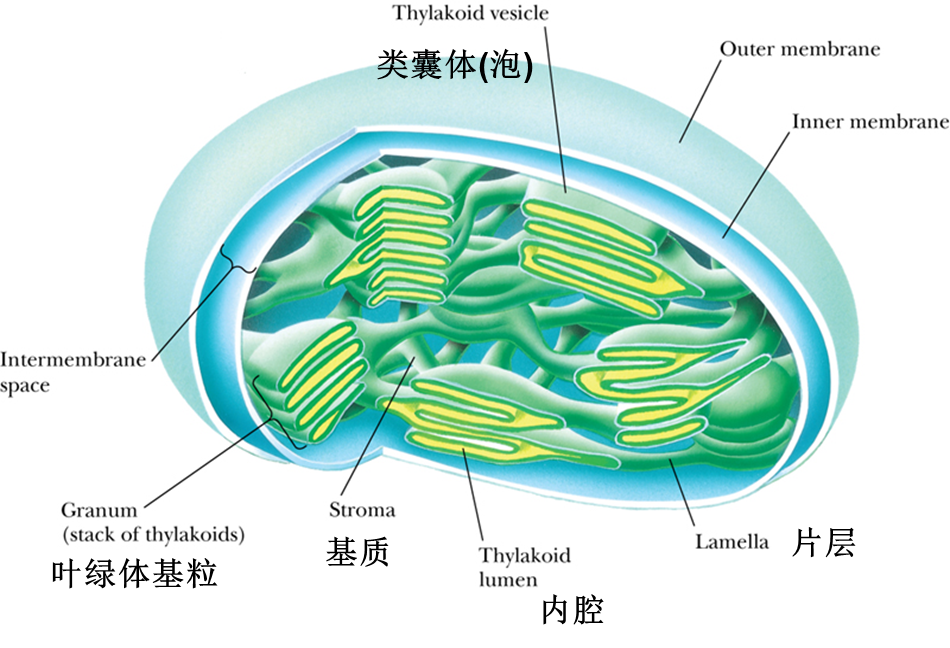
- 3 membrane-bound aqueous compartments
- the intermembrane space 膜间隙
- the stroma 基质
- thylakoid space/lumen 类囊体腔
- the interior of the thylakoid vesicles类囊体小泡
- Lumen serves an important function in the transduction of light energy into ATP formation
- 图
- thylakoid membrane 类囊体膜
- Light Reaction
- associated with the thylakoid membranes
- light is transformed by a specific photochemical system located in the thylakoids to generate chemical energy in the form NADPH and ATP
- Dark Reaction
- located at the stroma
- NADPH and ATP can then be used to drive the endergonic吸能过程 process of hexose formation from CO2 by a series of enzymatic reactions
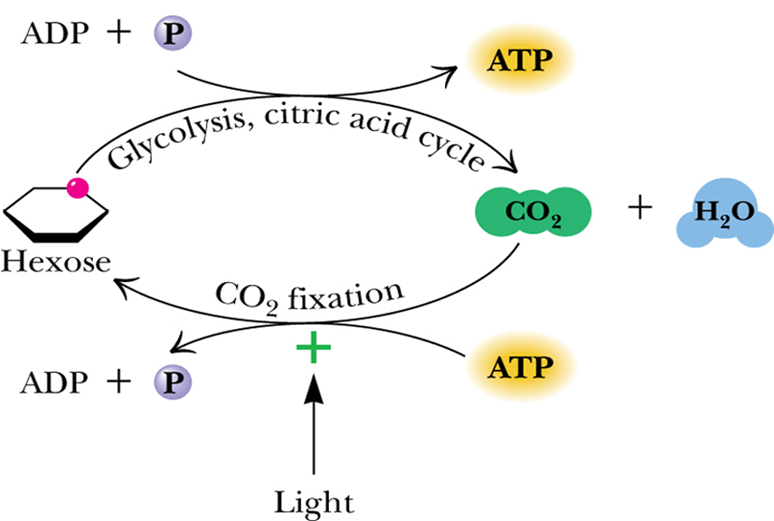
- Thermodynamic 热力学
- anabolism - Dark Reaction
- catabolism - Glycolysis and TCA cycle
- Energy input in anabolism > Energy output in catabolism
- the energy necessary for biosynthesis of any substance exceed the energy available from its catabolism
- 否则生物就变成永动机了
- anabolism - Dark Reaction
- Photosynthesis Occurs in Membranes
- Light Reaction
- Chlorophyll 叶绿素
- 结构
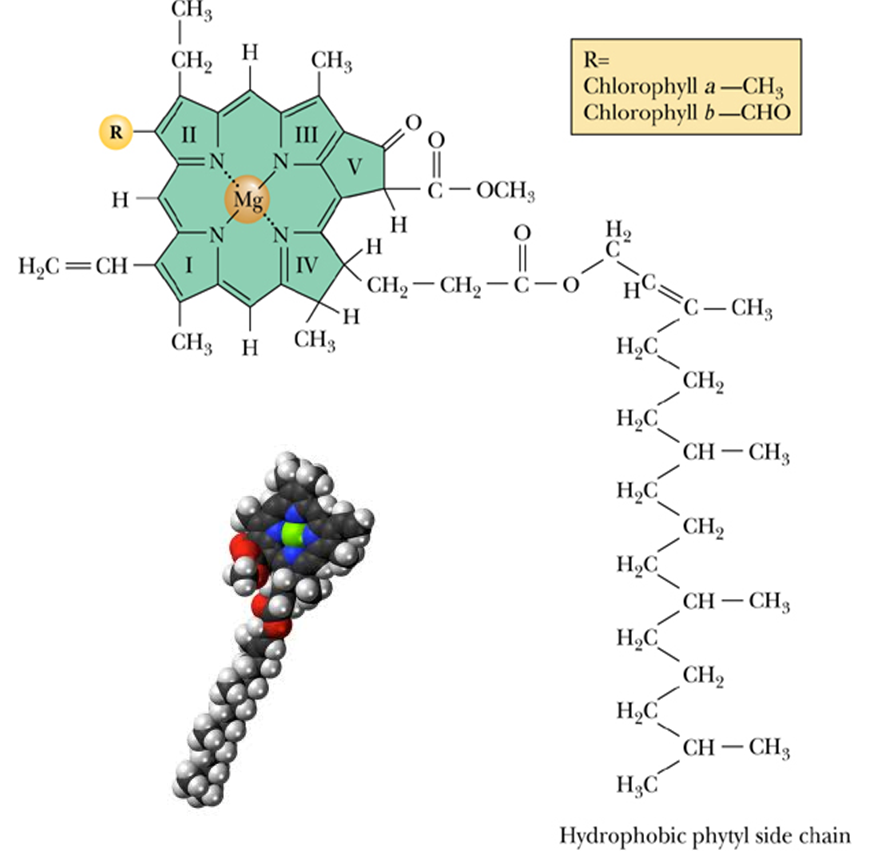
- Chlorophylls are magnesium-containing substituted tetrapyrroles四吡咯
- Its basic structure is similar to heme, the iron-containing porphyrin
- Chlorophylls are excellent light absorbers because of their aromaticity
由于芳香性, 是良好的光能吸收剂- they possess delocalized π electrons above and below the planar ring structure.
- 其平面环状结构的上下两侧分布着离域 π 电子
- The phytyl side chain of ring IV provides a hydrophobic tail to anchor the chlorophyll in membrane protein complexes
叶绿素四环结构中,环 Ⅳ 的植醇侧链构成疏水性尾部,使叶绿素能够锚定在膜蛋白复合体上 - 图
- 叶绿体存在于三类 macromolecular assemblies 大分子复合体中
- light-harvesting complexes (LHC) 光捕获复合体
- PSI complexes 光系统I复合体
- PSII complexes 光系统II复合体
- 分类
- 叶绿素吸收光谱
- 分类
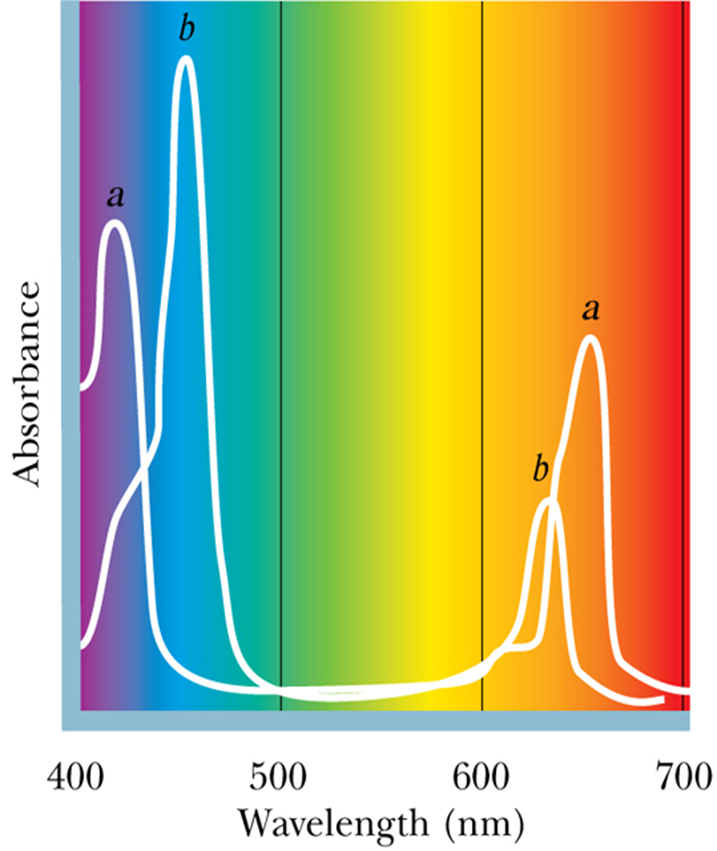
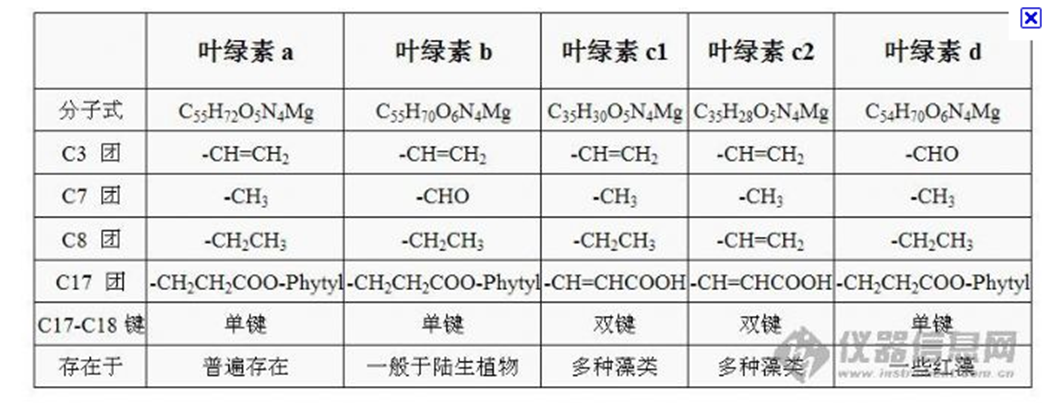
- The absorption spectra of chlorophylls a and b differs, plants that possess both chlorophylls can harvest a wider spectrum of incident energy.
- 叶绿素吸收光谱
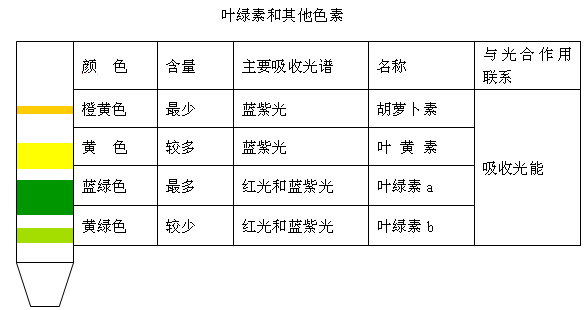
- accessory light-harvesting pigments 辅助光捕获色素
- two primary roles
- light harvesting
- photoprotection through destruction of ROS that arise as byproducts of photoexcitation
清除光激发过程中产生的活性氧 (ROS) 来实现光保护
- 图
- increase the possibility for absorption of incident light of wavelengths not absorbed by the chlorophylls
- possess many conjugated double bonds and thus absorb visible light
含有许多共轭双键,因此能够吸收可见光 - They persist longer than the green chlorophylls after leaf death, finally imparting their particular hues to the plant
这些辅助色素在叶片死亡后比叶绿素存在更久, 形成枯叶的颜色
- two primary roles
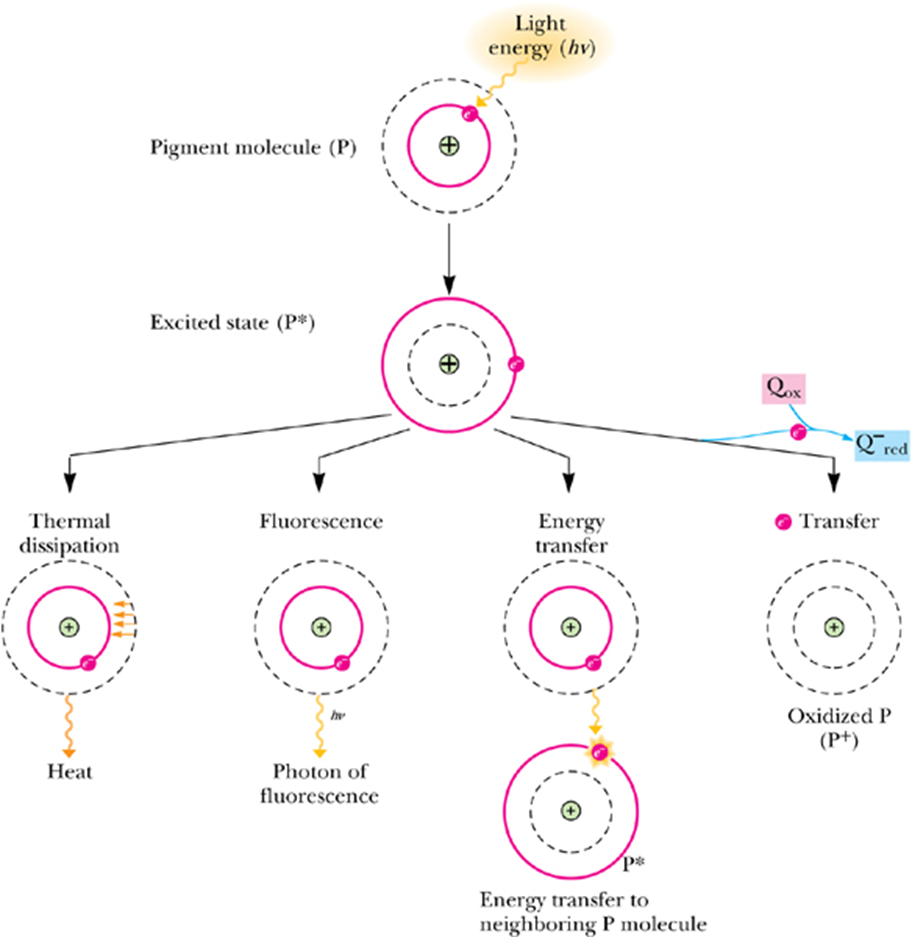
- The Fate of Light Energy Absorbed 被吸收光的能量去向
- 图
- a. Loss as heat
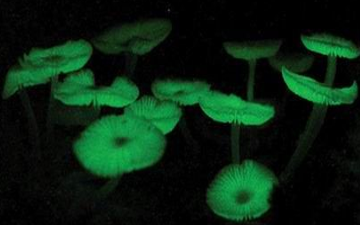
- b. Loss as light (fluorescence)
- 荧光
- 荧光
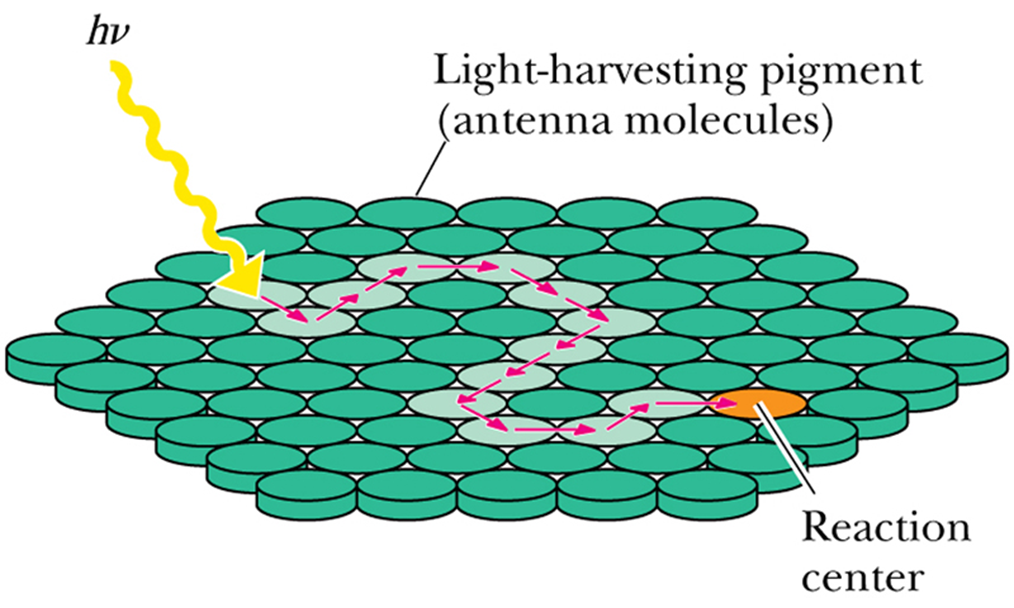
- c. Resonance energy transfer 共振能量转移, 转移给隔壁的色素分子
- Schematic diagram of a photosynthetic unit
- The light-harvesting pigments(antenna 天线 molecules)(green) ,absorb and transfer light energy to the specialized chlorophyll dimer that constitutes the reaction center (orange)
- Schematic diagram of a photosynthetic unit
- d. Energy transduction 能量转导
- Reaction of this excited-state electron donor with an electron acceptor situated in its vicinity附近 leads to the transduction of light energy to chemical energy (reducing power)
激发态电子供体与其周围的电子受体发生反应,可将光能转化为化学能(还原力)
- Reaction of this excited-state electron donor with an electron acceptor situated in its vicinity附近 leads to the transduction of light energy to chemical energy (reducing power)
- 图
- 结构
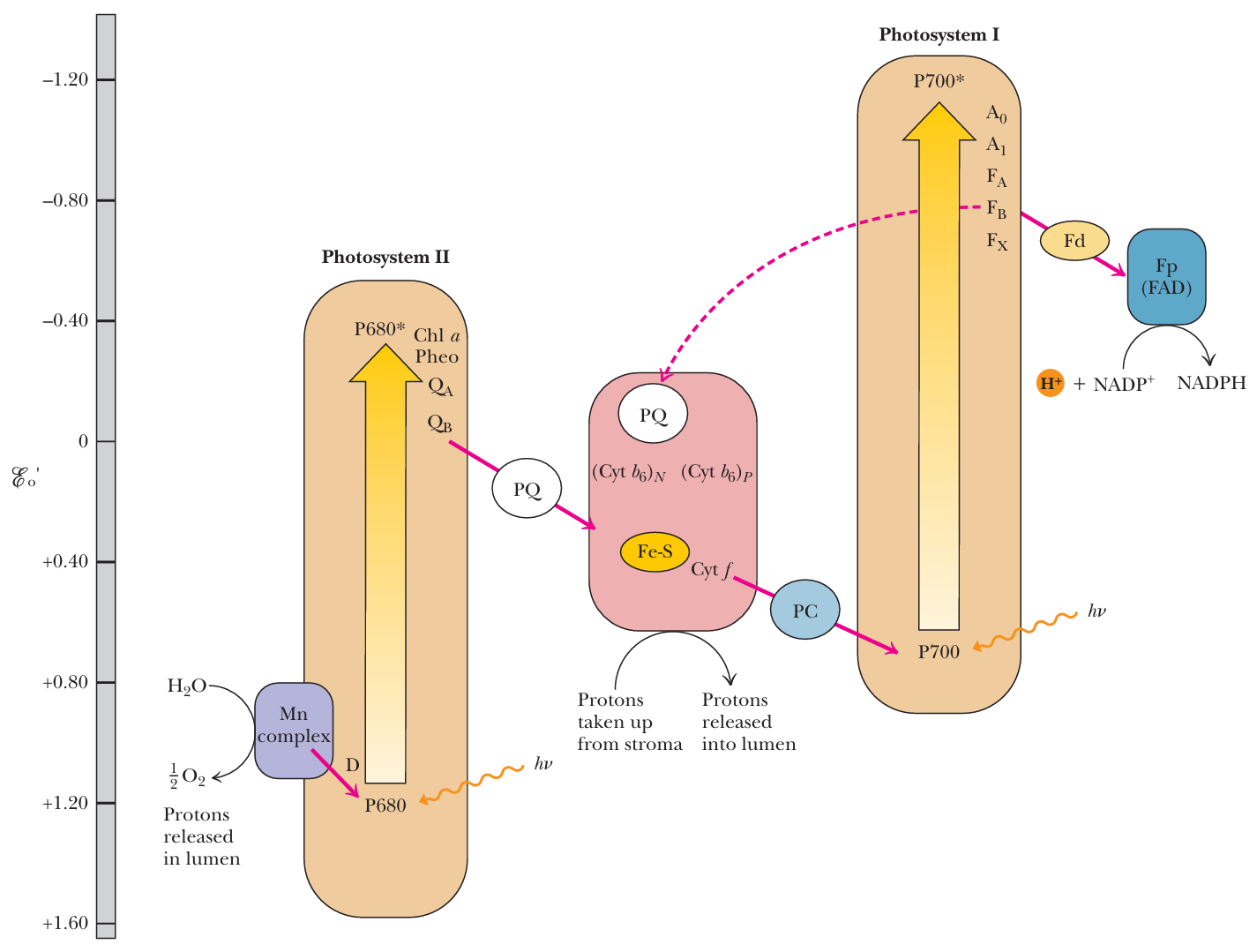
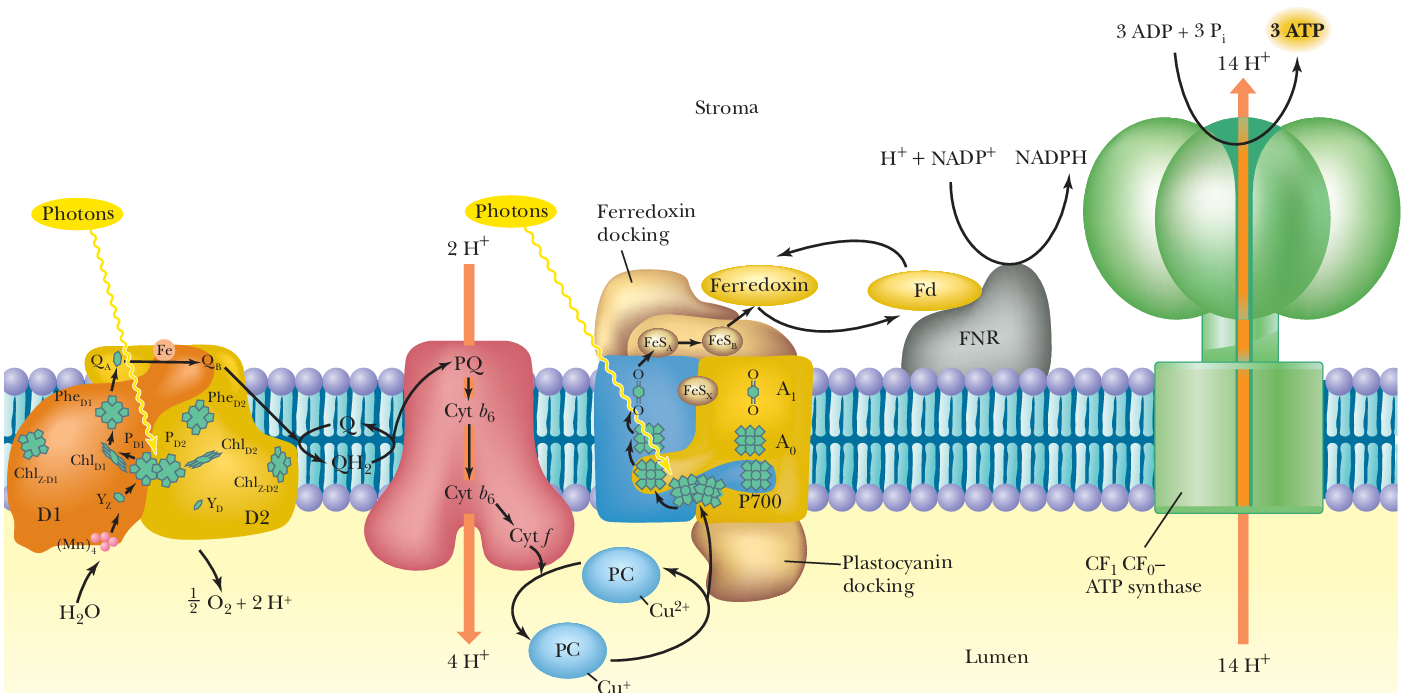
- Photosynthetic Electron Transfer 光合电子传递
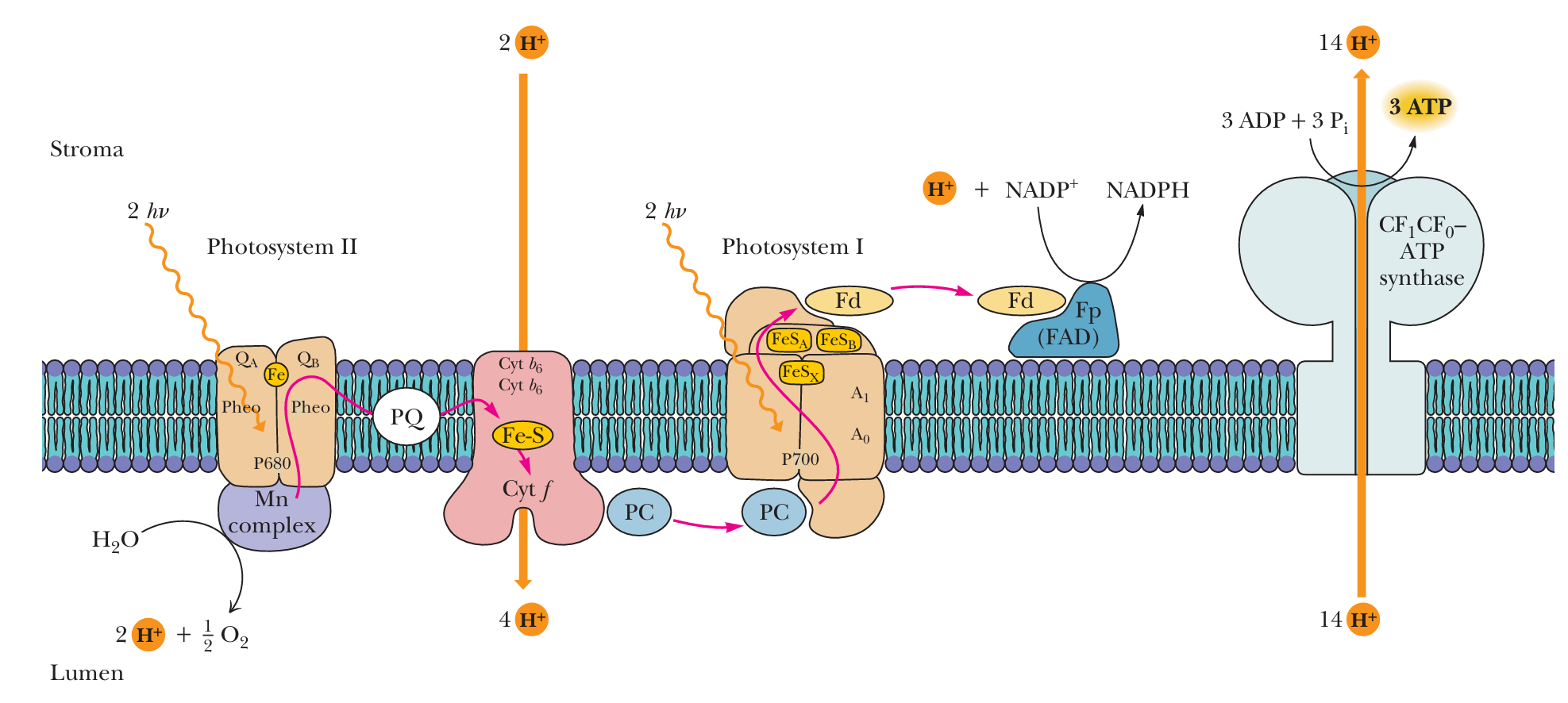
- 4 photons (2 per photosystem) driving the passage of an electron pair from water to NADP+
- 图
- accomplished by three membrane-spanning supramolecular complexes
三类跨膜超分子复合体- PSII complex
- the cytochrome b6/cytochrome f complex
- PSI complex
- 过程
- Light-Driven Electron Flow from H2O through PSII to PQ (plastoquinone)
- Electron Transfer from PQ to the Cytochrome b6/Cytochrome f Complex
- Electron Transfer from the Cytochrome b6/Cytochrome f Complex to PSI
- Generation of NADPH in Ferredoxin reductase complex
- PSII
- The PSII complex is described as a light driven water - plastoquinone oxidoreductase 水-质体醌氧化还原酶
- it is the enzyme system responsible for photolysis of water, also referred to oxygen-evolving complex OEC 氧释放复合物
- splits water, producing O2, and feeds the electrons
- PSI
- provides reducing power in the form of NADPH
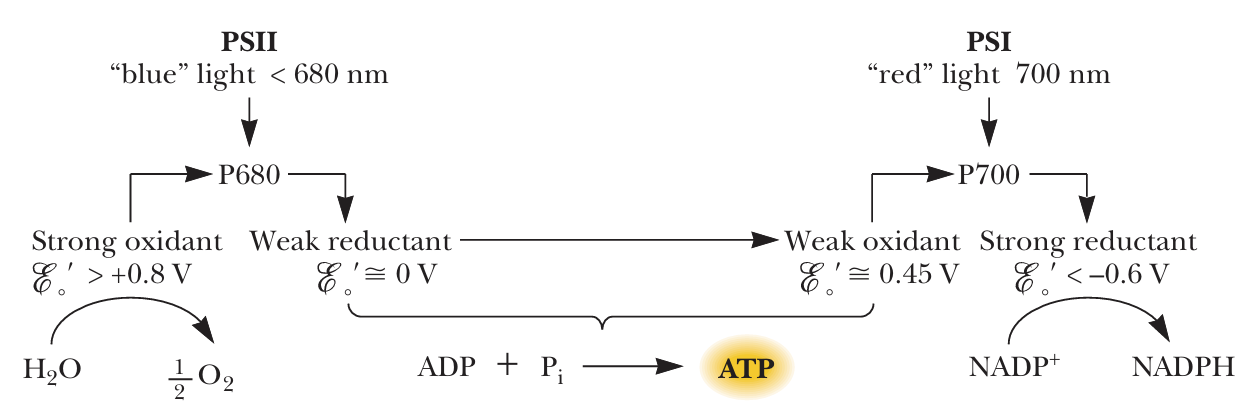
- z scheme
- p680/p700
- 这两个都是特殊的叶绿素a二聚体
- 光作用在这两个东西上面
- 可以吸收光能并被激发, 变成p680*/p700*
- p680*有足够强正电性可以从H2O抢电子
- p700*被激发后能量很高, 把电子扔给Fd铁氧还原蛋白, Fd在FAD处给出电子还原NADP+ → NADPH
- p680*到p700之间掉的能量用于创造质子浓度差后续合ATP
- Photophosphorylation 光合磷酸化
ATP synthase- ATP synthesis is based on an H+/ATP ratio of 14/3
- The Mechanism of Photophosphorylation Is Chemiosmotic 化学渗透
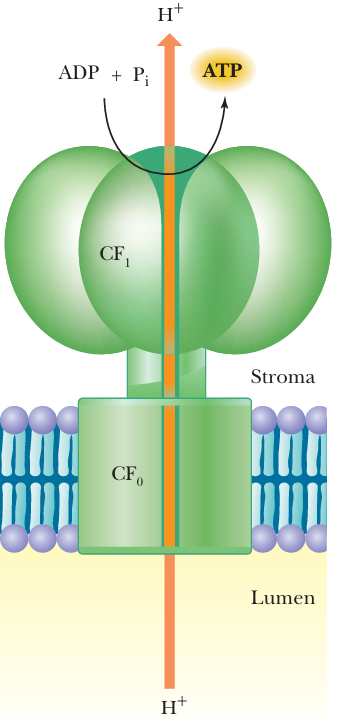
- CF1CF0 ATP Synthase
- C symbolizing chloroplast
- a heteromultimer of a , b , γ , δ , ε , a , b , c subunits
- consisting of a knoblike structure some 9 nm in diameter (CF1) attached to a stalked base (CF0) embedded in the thylakoid membrane
结构包含一个直径约 9 纳米的球状头部CF1,该头部连接于一个带柄的基部CF0,而基部则嵌入类囊体膜中 - 图
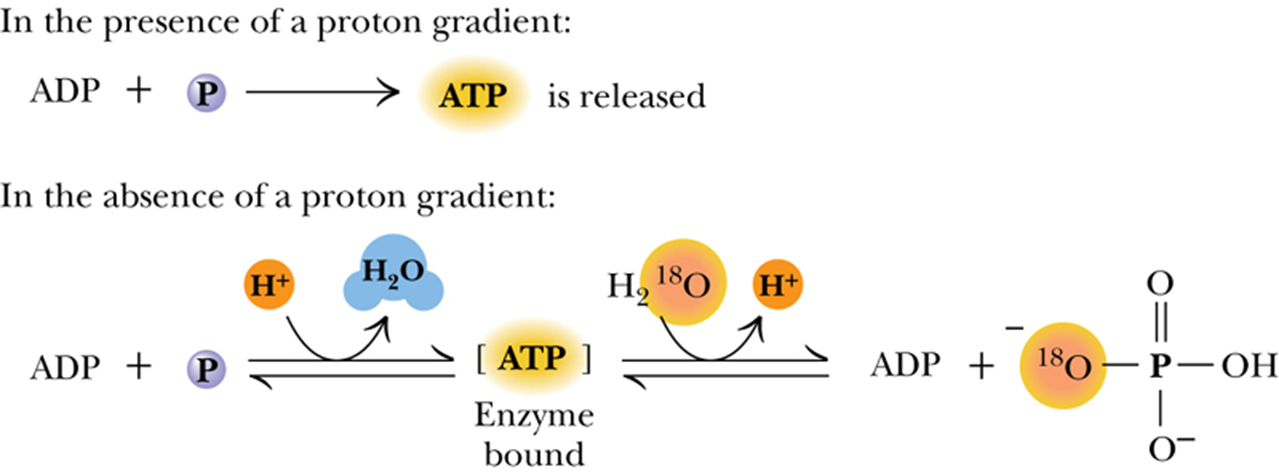
- Boyer’s 18O Exchange Experiment Identified the Energy-Requiring Step
- 图
- When O18 was in water, it was rapidly transferred to inorganic phosphate, even though the overall reaction was ATP synthesis.
- The O18 exchange was reversible, meaning that ATP could be broken back down into ADP and Pi.
- 结论
- 能量用在放ATP下来这一步, ATP与ADP和Pi互相转换不用能量
- formation of enzyme-bound ATP doesnot require energy
- movement of protons through the F0 channel causes the release of newly synthesized ATP from the enzyme
- 图
- 2 modes
- noncyclic mode
- 电子传递路径不可逆,伴随 NADPH 生成和水光解,同时合成 ATP
- 电子传递路径不可逆,伴随 NADPH 生成和水光解,同时合成 ATP
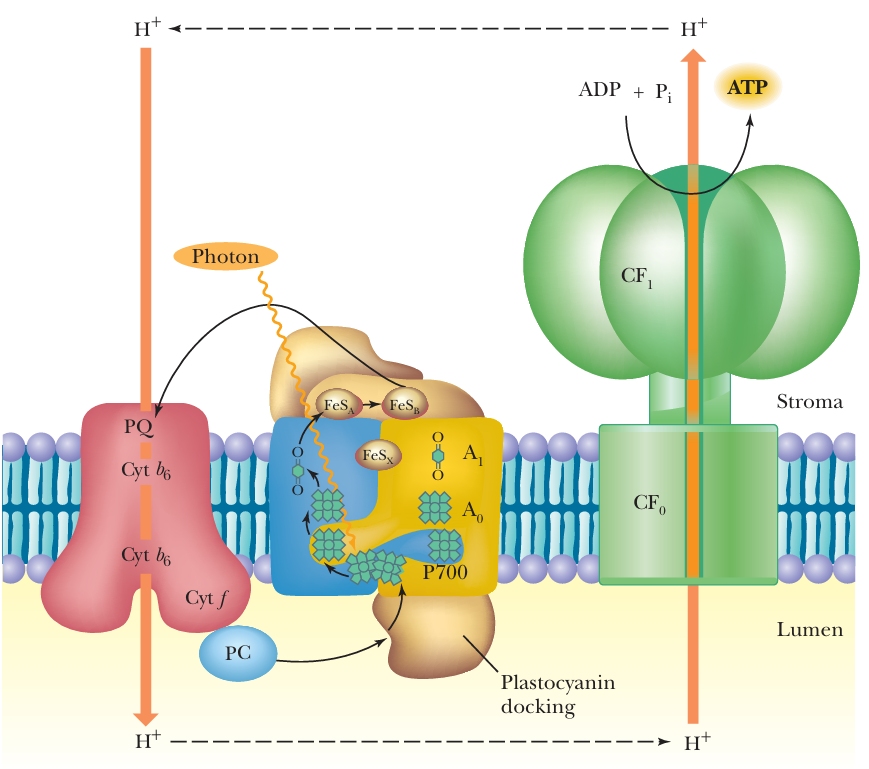
- cyclic mode
- 图
- accomplished only by photosystem I
- Electrons lost after photon absorption by the P700 pigment molecule are not passed along the photosynthetic electron transport chain, but returns to the P700 pigment molecule via a different branch
P700 色素分子吸收光子后丢失的电子,不沿光合电子传递链传递,而是通过另一条支路返回至 P700 色素分子 - 电子完成一轮循环后,会以低能态回到 P700,下一轮循环启动时再次被光激发
- Cyclic electron flow only drives the phosphorylation of ADP to produce ATP, no reducing NADPH and no oxygen
- Cyclic photophosphorylation may occur when cells have sufficient reducing NADPH and require more ATP to meet metabolic needs.
- 图
- noncyclic mode
- metal requirements
- 图
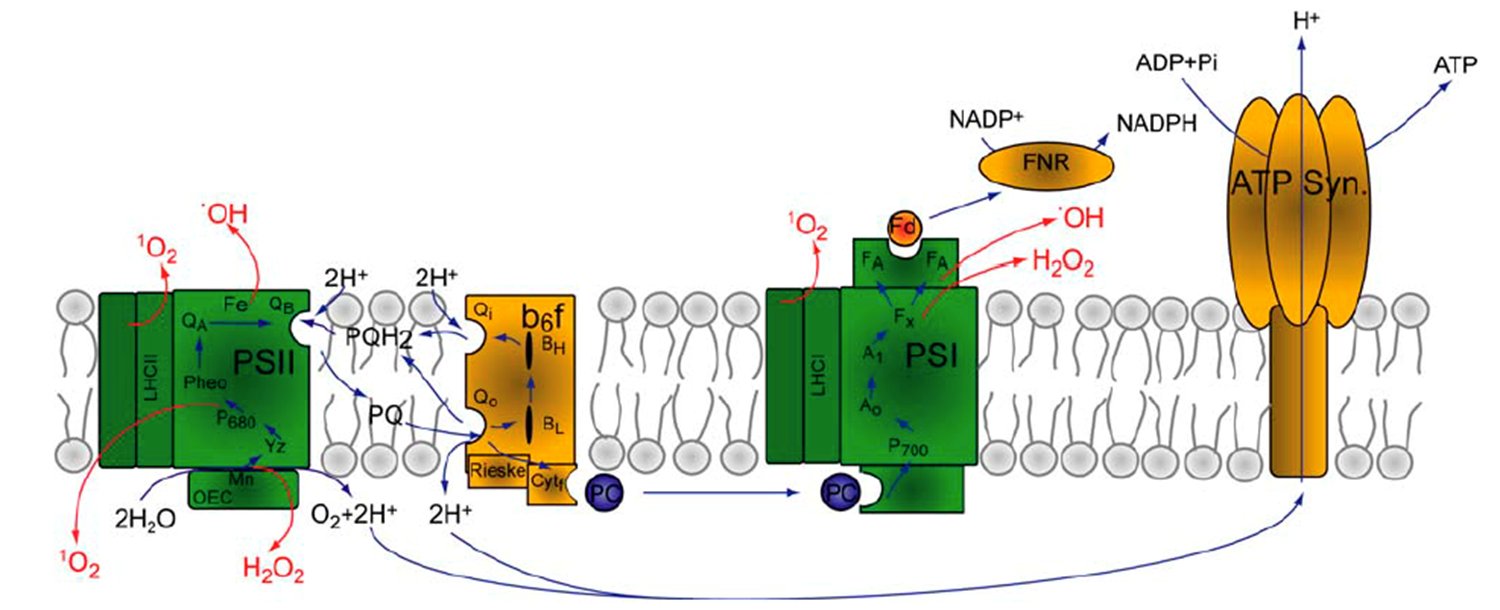
- Electron transfer reactions are indicated by blue arrows and ROS-generating reactions are red arrows.电子传递反应以蓝色箭头标注,活性氧生成反应以红色箭头标注
- The photosynthetic electron transport chain is composed of the PSI, PSII and cytochrome b6f.光合电子传递链由光系统 I(PSI)、光系统 II(PSII)和细胞色素 b6f 复合体组成
- Extraction of electrons from water is catalyzed on the donor side of PSII by a cluster of four Mn ions.光系统 II 供体侧的四核锰离子簇催化水光解产电子过程
- In addition, PSII contains two Fe atoms, a nonheme Fe on the acceptor side, and cytochrome b559.此外,光系统 II 含 2 个铁原子(受体侧 1 个非血红素铁)及细胞色素 b559
- Cyanobacteria contain an extra cytochrome (cytochrome c550) attached to the donor side of the complex.蓝细菌的该复合体供体侧额外结合了一种细胞色素(细胞色素 c550)
- The reaction center contains 36 chl (叶绿素) molecules.反应中心含 36 个叶绿素分子
- Additional LHCII chls can increase the effective absorption cross section of the photosystem.额外的光系统 II 捕光复合体(LHCII)叶绿素可增大该光系统的有效吸收截面积
- Electrons are transferred from PSII to cytochrome b6f via plastoquinol molecules.电子经质体醌醇分子从光系统 II 传递至细胞色素 b6f 复合体
- Cytochrome b6f contains four b-type cytochromes (bH, bL, b6, and heme x), one c-type cytochrome f, and one 2Fe-2S cluster.细胞色素 b6f 复合体含 4 种 b 型细胞色素(bH、bL、b6 及血红素 x)、1 种 c 型细胞色素 f 和 1 个 [2Fe-2S] 簇
- Cytochrome b6f is the major proton pump that creates the potential gradient that is utilized by ATP synthase to produce ATP.细胞色素 b6f 复合体是主要质子泵,其建立的电势梯度为 ATP 合酶合成 ATP 提供能量
- Plastocyanin (PC), a Cu protein, transfers electrons from cytochrome b6f to PSI.质体蓝素(PC)是一种铜蛋白,负责将电子从细胞色素 b6f 复合体传递至光系统 I(PSI)
- In PSI, three 4Fe-4S clusters (FX, FA, and FB) participate in the electron transfer chain.光系统 I 中,3 个 [4Fe-4S] 簇(FX、FA、FB)参与电子传递链反应。
- PC can migrate in and out of the membrane.质体蓝素可在膜内外自由穿梭
- Electrons from PSI are transferred to ferredoxin (Fd), a 4Fe-4S soluble protein.光系统 I 的电子传递至铁氧还蛋白(Fd),该蛋白为含 [4Fe-4S] 簇的可溶性蛋白
- The reaction center core of PSI contains 96 chls with additional LHCI chls that contribute to the absorption cross section.光系统 I 反应中心核心含 96 个叶绿素分子,额外的光系统 I 捕光复合体(LHCI)叶绿素可进一步扩大其吸收截面积
- 图
- Chlorophyll 叶绿素
- Dark Reaction
- net reaction
- Carbon Dioxide Fixation
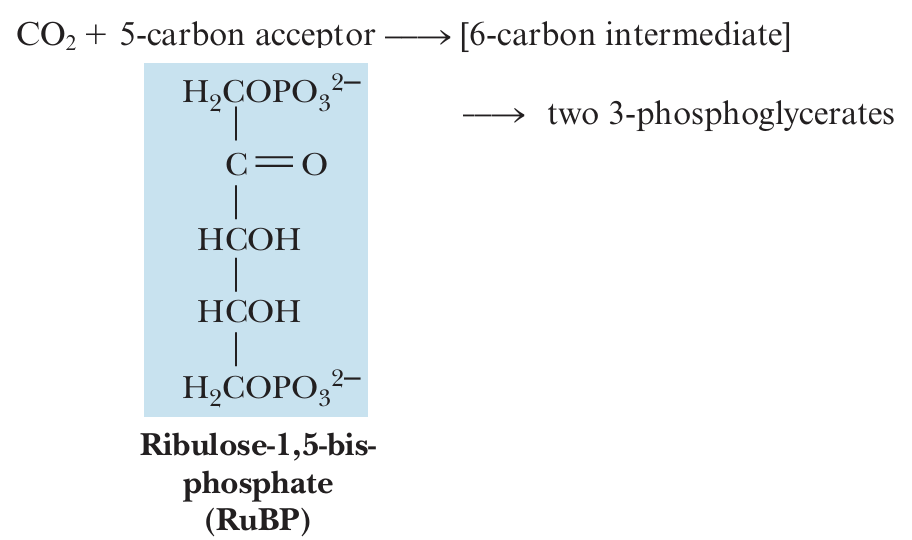
卡尔文循环第一步, 吃进CO2- addition of CO2 to ribulose-1,5-bisphosphate (RuBP)
- 酶 - rubisco
- ribulose bisphosphate carboxylase/oxygenase二磷酸核酮羧化酶/加氧酶
- 简称 rubisco
- in the chloroplast stroma
- It is a very abundant enzyme, constituting more than 15% of the total chloroplast protein
- large
- 550-kD heteromultimeric (α8β8) complex
- consisting of eight identical large subunits (55 kD) and eight small subunits (15 kD)
- The large subunit is the catalytic unit of the enzyme, it binds both substrates (CO2 and RuBP) and Mg2+
- The small subunit modulates the activity of the enzyme, increasing kcat more than 100-fold
- addition of CO2 to ribulose-1,5-bisphosphate (RuBP)
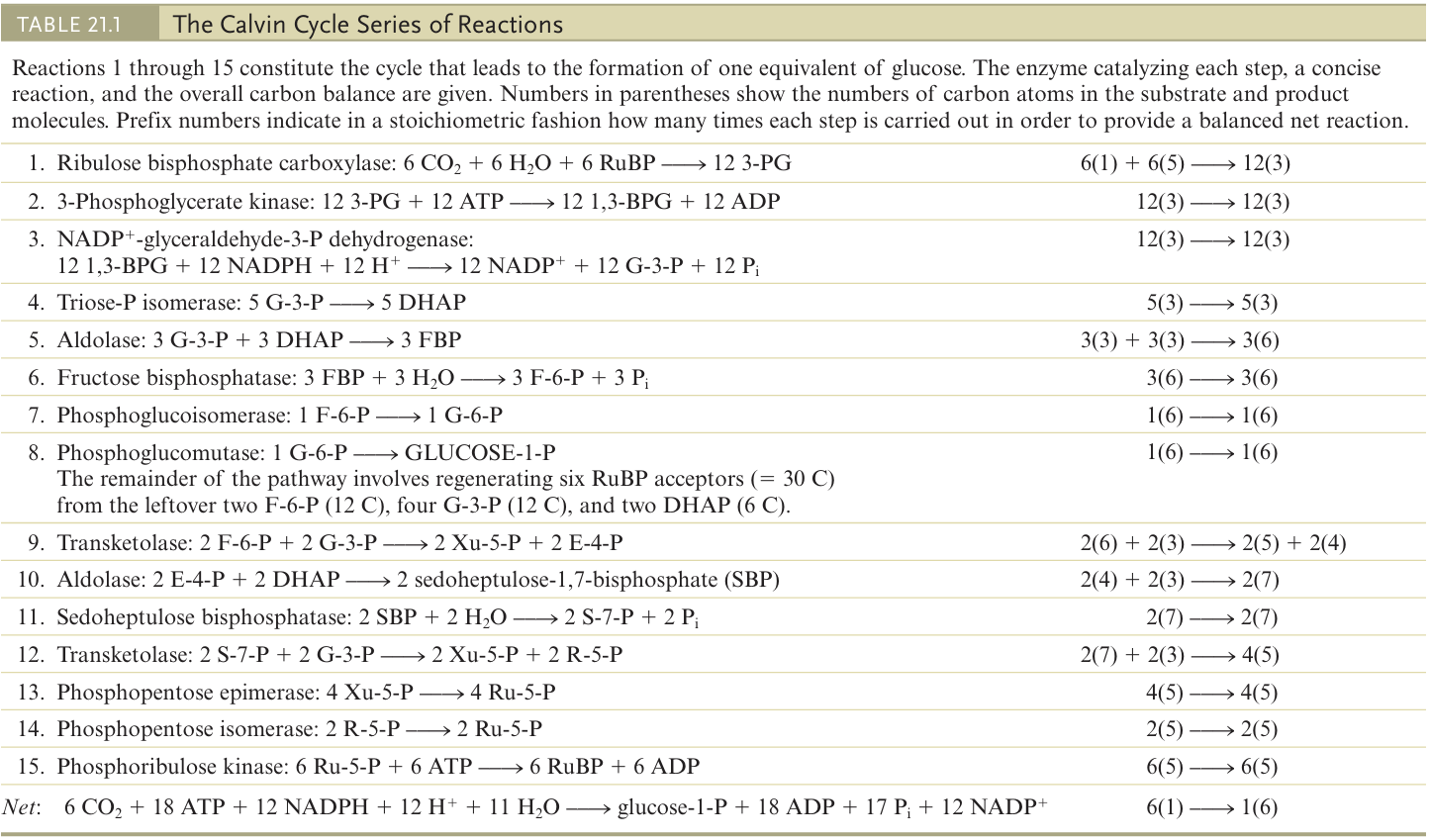
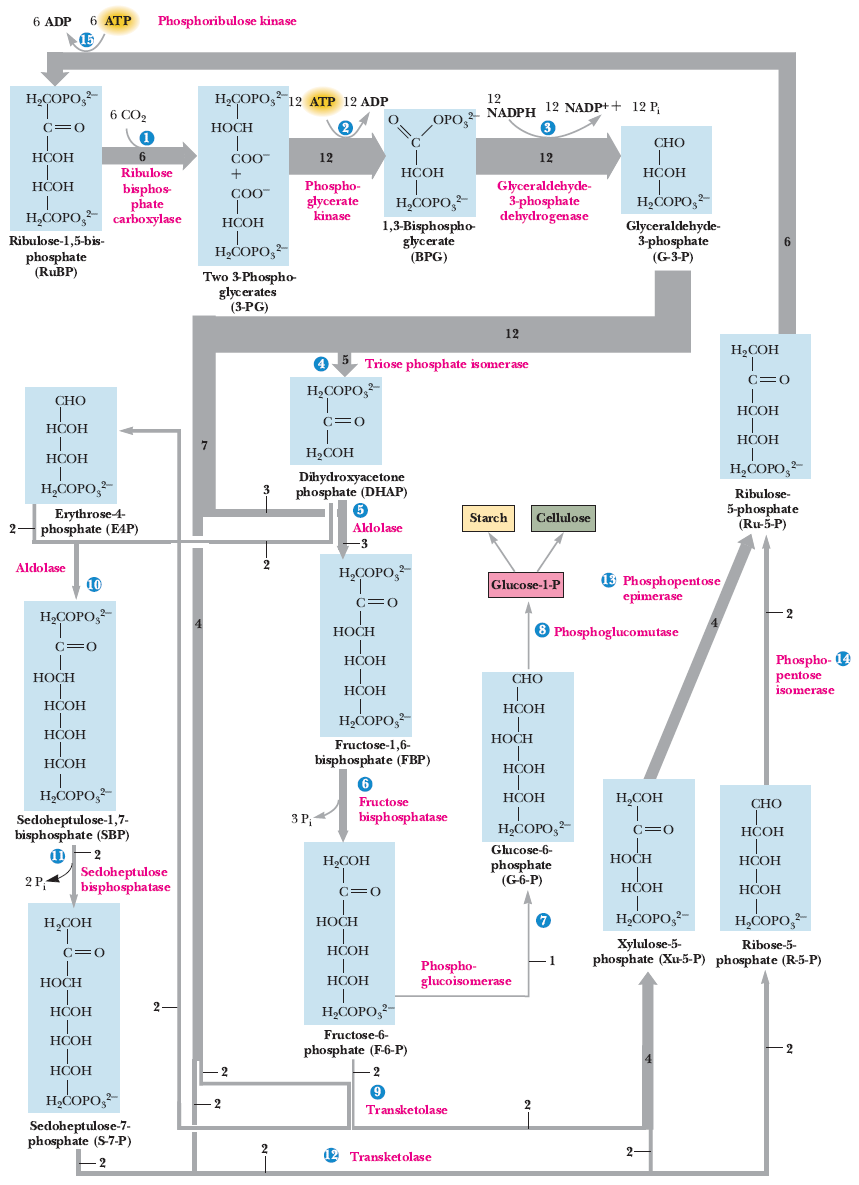
- The Calvin–Benson Cycle
- Most of the enzymes mediating the reactions of the Calvin cycle also participate in either glycolysis or the pentose phosphate pathway
- the NADPH and ATP produced in the light reactions are consumed.
- 括号里面是碳原子数, 括号前面是几个底物产生 1 glucose
- The number associated with the arrow at each step indicates the number of molecules reacting in a turn of the cycle that produces one molecule of glucose
- regulation
- basic
- 防止线粒体吃糖叶绿体产糖互博, 细胞可以调控开尔文循环
- the activities of key Calvin cycle enzymes are coordinated with the output of photosynthesis
- these enzymes respond indirectly to light activation
- 有光的情况下卡尔文循环进行, 黑暗情况下停止
- 防止线粒体吃糖叶绿体产糖互博, 细胞可以调控开尔文循环
- 光诱导的调控因素
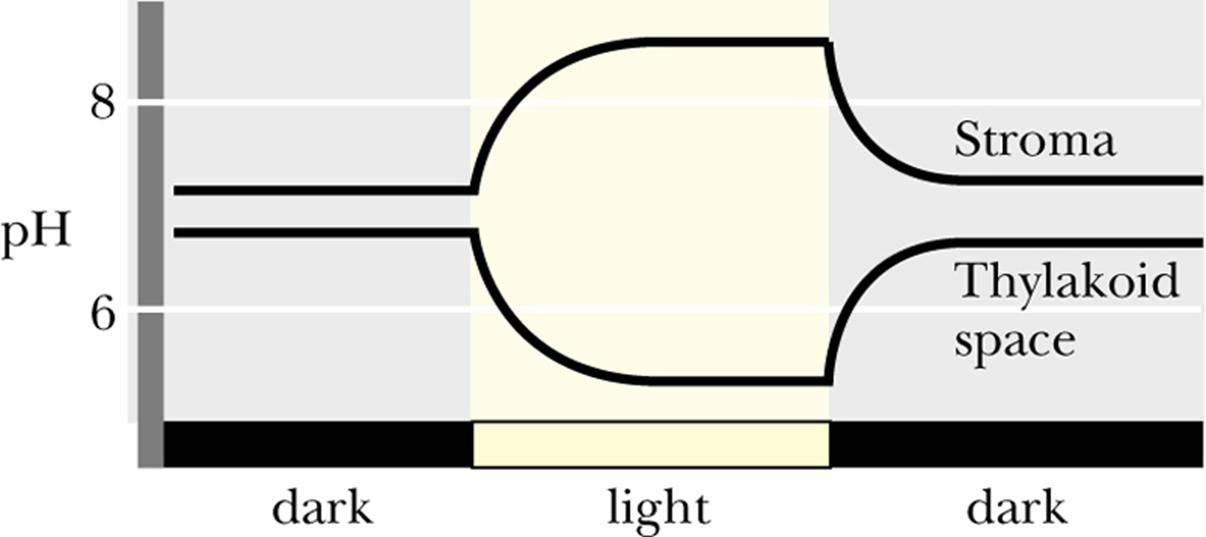
- changes in stromal pH
- 叶绿体受光照后会通过光驱动将质子泵入类囊体腔,引起基质和类囊体腔的 pH 变化
- The stromal基质 pH rises to pH 8
- rubisco and rubisco activase are more active at pH 8 激活CO2固定步骤
核酮糖二磷酸羧化酶(Rubisco)和 Rubisco 活化酶在 pH 值为 8 时活性更高 - Fructose - 1,6 - bisphosphatase, ribulose - 5 - phosphate kinase, and glyceraldehyde - 3 - phosphate dehydrogenase all have alkaline pH optima
果糖 - 1,6 - 二磷酸酶、核酮糖 - 5 - 磷酸激酶以及 3 - 磷酸甘油醛脱氢酶均以碱性环境为最适 pH 值
- 叶绿体受光照后会通过光驱动将质子泵入类囊体腔,引起基质和类囊体腔的 pH 变化
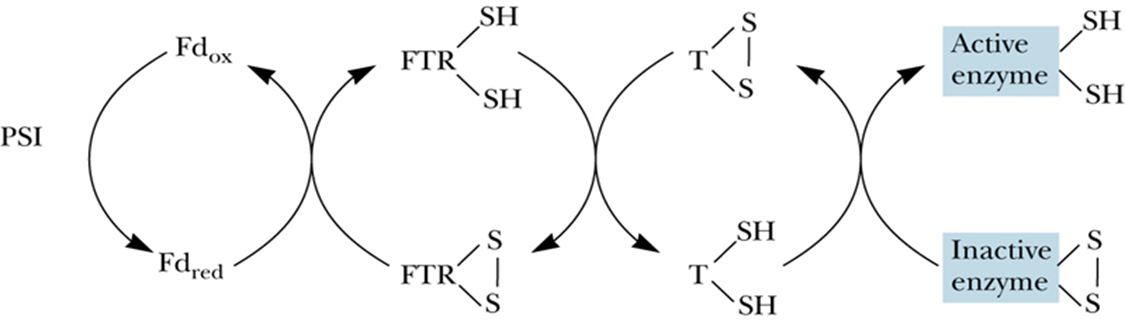
- generation of reducing power
- reducing power is in the form of reduced ferredoxin 铁氧化还原蛋白 and NADPH
- 总的来说 Fdred → FTR → T → enzyme 通过 reducing power 顺着激活
- enzyme
- fructose-1,6-bisphosphatase (step6)
- NADP-malate dehydrogenase (与C4光合有关)
- ribulose-5-P kinase (step15)
- T = thioredoxin (催化 -S-S- 变成 -SH -SH) , FTR = ferredoxin–thioredoxin reductase
- Mg2+ efflux from the thylakoid lumen
- efflux of Mg²⁺ ions from vesicles into the stroma light-driven proton pumping
镁离子伴随质子泵动从类囊体腔外流至基质中 - 镁离子的外流在一定程度上抵消了质子内流导致的电荷积累,这也是叶绿体中质子泵动引发的膜电位变化小于线粒体的原因之一
- ribisco and fructose-1,6-bisphosphatase(step6) are Mg²⁺-activated enzymes
Mg2+进入基质激活这两个酶
- efflux of Mg²⁺ ions from vesicles into the stroma light-driven proton pumping
- changes in stromal pH
- fructose-1,6-bisphosphatase (step6)
- Activity measurements have indicated that it’s the rate-limiting step in the Calvin cycle
- 多个因素可调控这个酶
- key point of control in the Calvin cycle
- rubisco
- three forms
- an inactive form designated E
- a carbamylated,氨基甲酰化 but inactive, form designated EC
- carbamylated and has Mg2+ at its active sites as well, an active form, ECM
- 因素
- pH 8
- carbamylation reaction occurs spontaneously
- E → EC
- Mg²⁺
- Mg²⁺ binds to EC, rubisco achieves its active ECM form
- RuBP
- Substrate RuBP binds much more tightly to the inactive E form of rubisco (KD ≈ 20 nM) than to the active ECM form (Km for RuBP ≈ 20µM)
RuBP与 E 型的结合能力远强于其与 ECM 型的结合能力 - RuBP is also a inhibitor of rubisco activity
- Rubisco 活性位点上结合的 RuBP 需在 Rubisco activase 的介导下才能释放
- Rubisco 活化酶是一种调控蛋白,它可与 E 型 Rubisco 结合,并在 ATP 供能的反应中促使 RuBP 释放
- Rubisco activase itself is activated in an indirect manner by light
间接方式受光照调控激活
- Substrate RuBP binds much more tightly to the inactive E form of rubisco (KD ≈ 20 nM) than to the active ECM form (Km for RuBP ≈ 20µM)
- pH 8
- ECM rubisco displays a Km for CO2 of 10 to 20 µM
- three forms
- basic
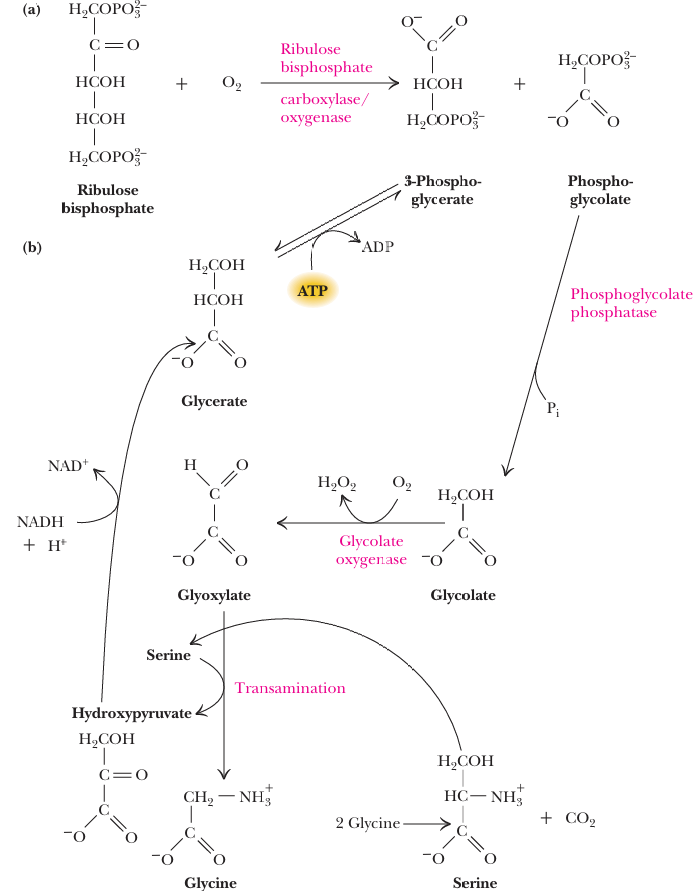
- Photorespiration 光呼吸
吃O2与吃CO2竞争- 图
- 第一步 rubisco 催化 O2 而不是 CO2 added to RuBP
- 会导致RuBP的损失, 降低植物的光合效率
- 根据 rubisco 和 O2 的 km 和大气中气体组成计算, 结合CO2的反应与结合O2的反应在4:1~3:1
- is termed photorespiration or C₂ cycle
- 对抗光呼吸
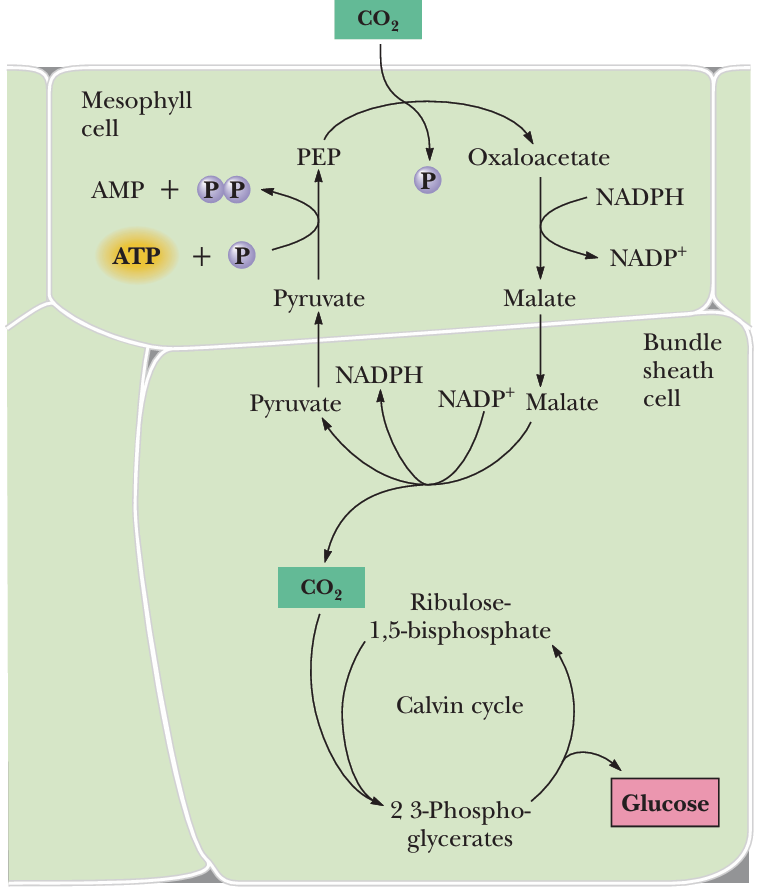
- C-4 pathway
搬运CO2(空间)- Tropical grasses热带植物, such as maize玉米 and sugarcane甘蔗具有这种机制对抗光呼吸
- 甘蔗与大豆对比
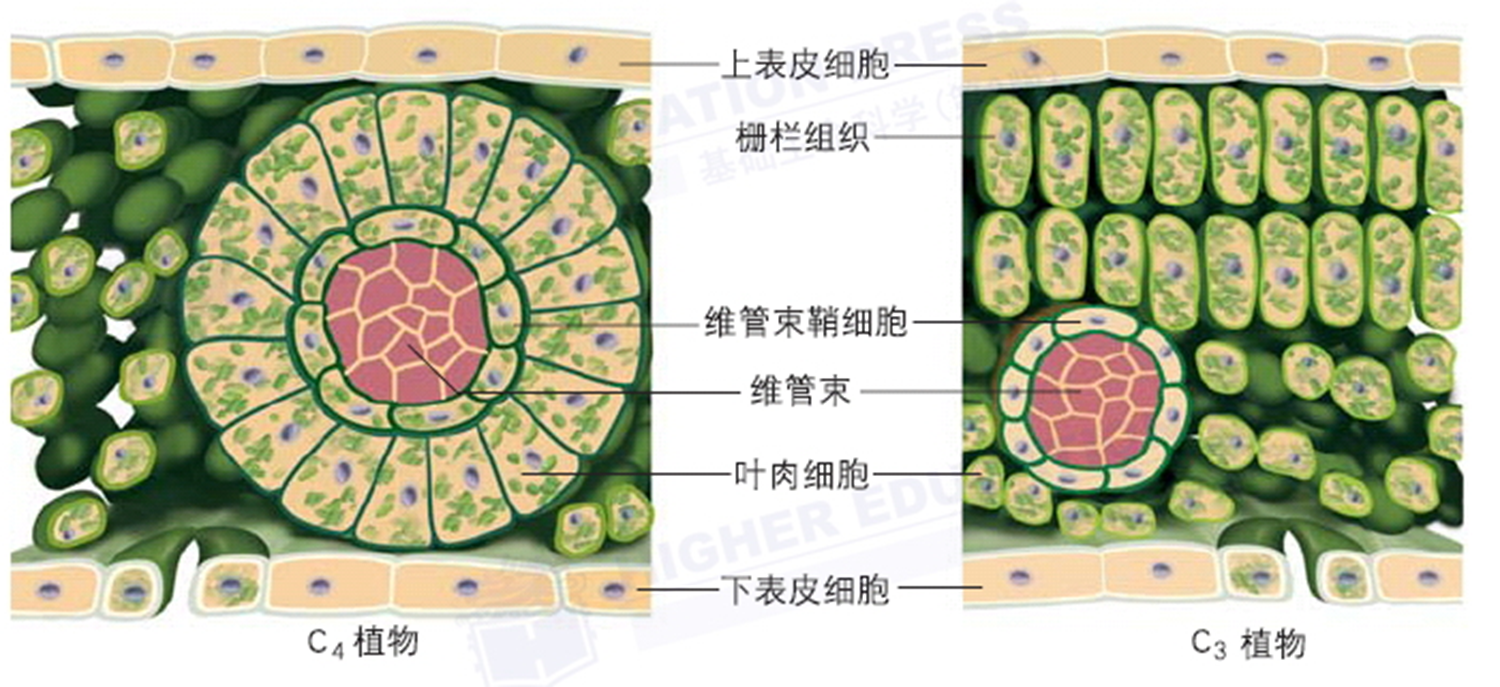
C-4 叶片的维管束周围紧密排列着两圈特殊的叶绿体数量更多的光合作用细胞,紧靠维管束的一圈细胞称为维管束鞘细胞(bundle sheath cells),外圈是叶肉细胞(mesophyll cells).
- 将CO2在 mesophyll cells 叶肉细胞固定, 运送到维管束鞘细 bundle sheath cells 胞释放CO2进入开尔文循环, 合成glucose进入维管束
- Crassulacean Acid Metabolism 景天酸代谢 CAM
储存CO2(时间)- succulent plants 多肉植物 native to semiarid 半干旱 and tropical热带 environments
- open their stomata to take up CO₂ only at night, when temperatures are lower and water loss is less likely
仅在夜间开放气孔吸收二氧化碳,此时温度较低,水分流失的可能性更小 - 晚上存储CO2, 白天拿出来用于暗反应
- common to succulents of the Crassulaceae family
普遍存在于景天科多肉植物中
- 图
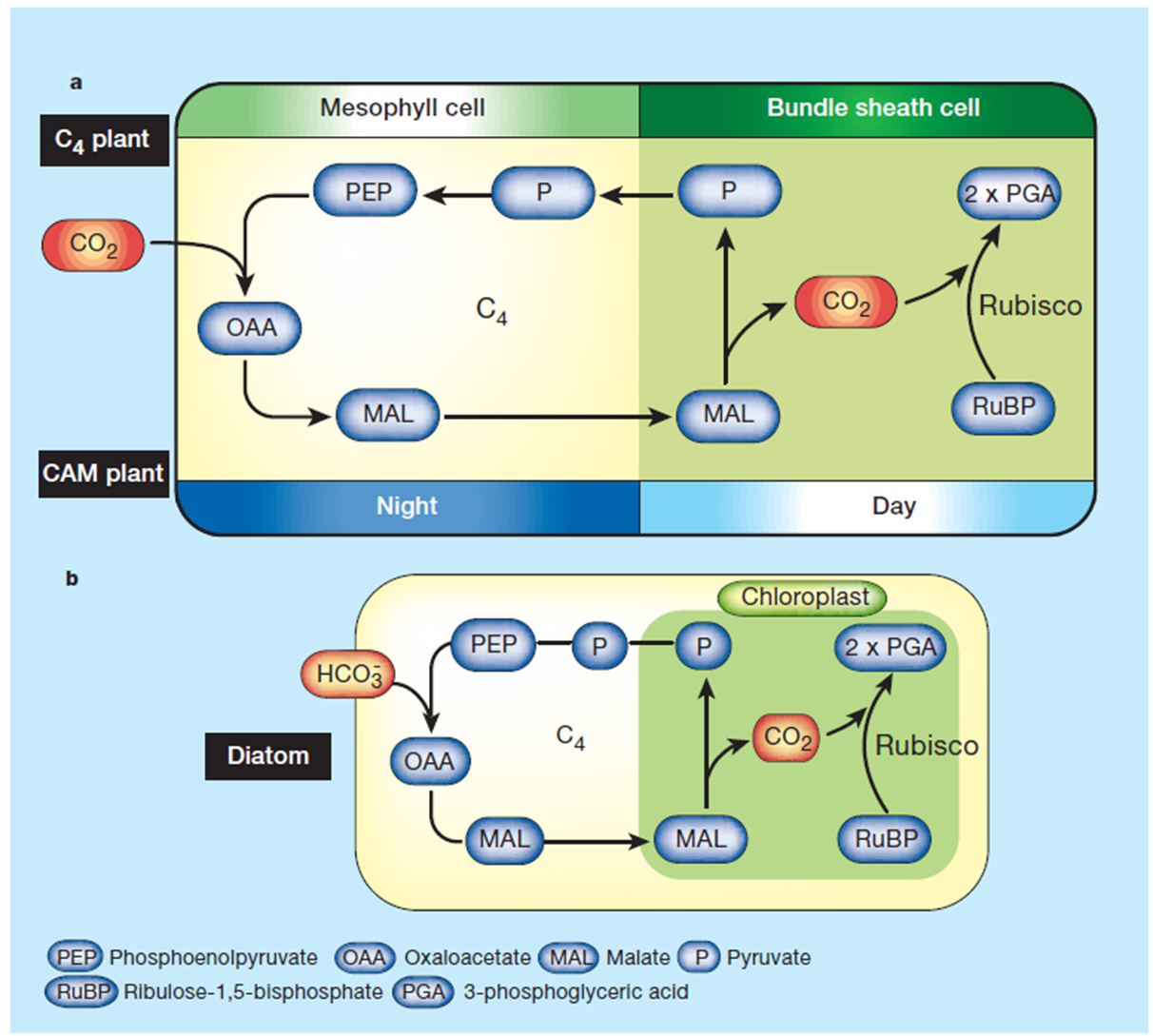
diatom硅藻也用这种机制来富集水中低浓度CO2
- C-4 pathway
- 图
- net reaction






All articles in this blog are licensed under CC BY-NC-SA 4.0 unless stating additionally.