
生物化学_Thermodynamics of Biological Systems
3.Thermodynamics of Biological Systems
- Basic Thermodynamic Concepts
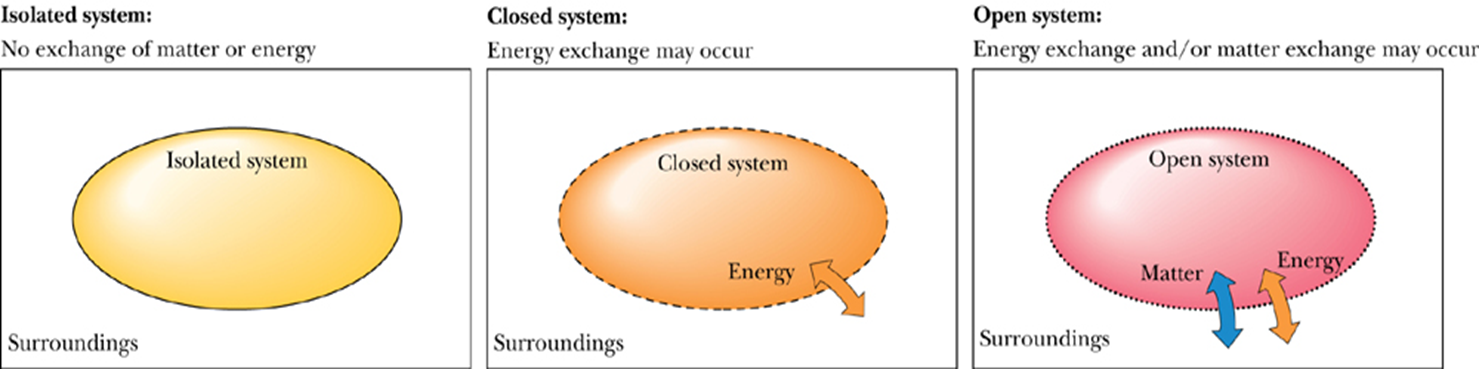
- 系统
- 分为三类
- Living things are typically open systems that exchange matter (nutrients and waste products) and energy (heat from metabolism) with their surroundings.
- 分为三类
- The Second Law and Entropy
- entropy, S, which is a measure of disorder and randomness in the system (or the surroundings)
- An organized or ordered state is a low-entropy state, whereas a disordered state is a high-entropy state.
- When a thermodynamic system undergoes an increase in entropy, it becomes more disordered.
- All else being equal, reactions involving large, positive entropy changes, S, are more likely to occur than reactions for which S is not large and positive.
- 有序是一种高度不稳定的状态, 比如瓶子里在两侧完美分开的气体
- So large amounts of energy are required to construct and maintain living organisms.
- Energy input is required to produce information-rich, organized structures such as proteins and nucleic acids.
- Schrödinger pointed out that organisms must “acquire negentropy” to sustain life.
薛定谔指出,生物必须 “获取负熵” 以维持生命
- 系统
- The High-Energy Biomolecules
- 化学能
- Organisms share common mechanisms for generating a useful form of chemical energy.
生物具有生成有用化学能的共同机制 - Once captured in chemical form, energy can be released in controlled exergonic 放能 reactions to drive a variety of life processes
- Organisms share common mechanisms for generating a useful form of chemical energy.
- 能量介导分子
- A small family of universal biomolecules mediates the flow of energy from exergonic reactions to the energy requiring processes of life.
- 分类
- reduced coenzymes 还原型辅酶
- 转递质子和电子
- high-energy phosphate compounds 高能磷酸化合物
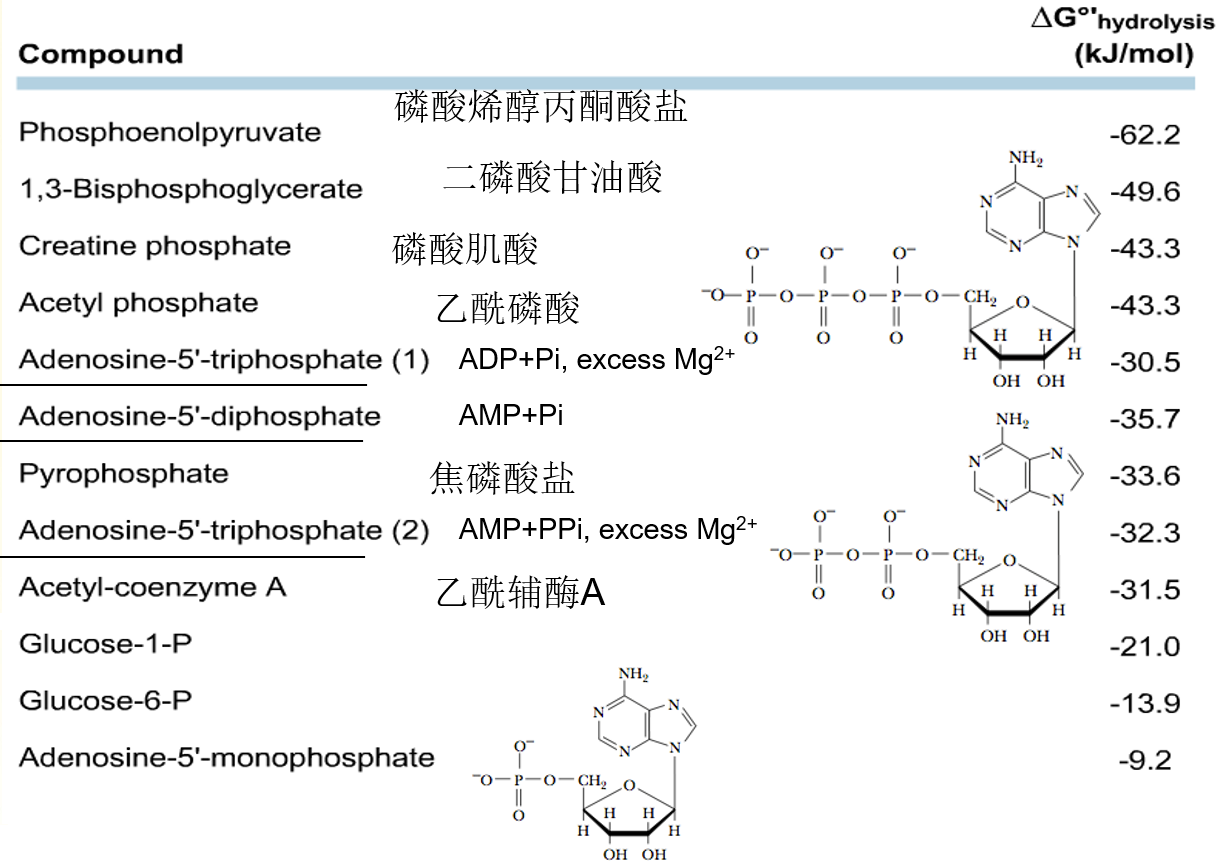
- Phosphate compounds are considered high energy if they exhibit large negative free energies of hydrolysis (that is, if ∆G°’is more negative than -25 kJ/mol)
水解自由能为较大负值的磷酸化合物为高能磷酸化合物,即∆G°’小于 - 25 kJ/mol - 分类
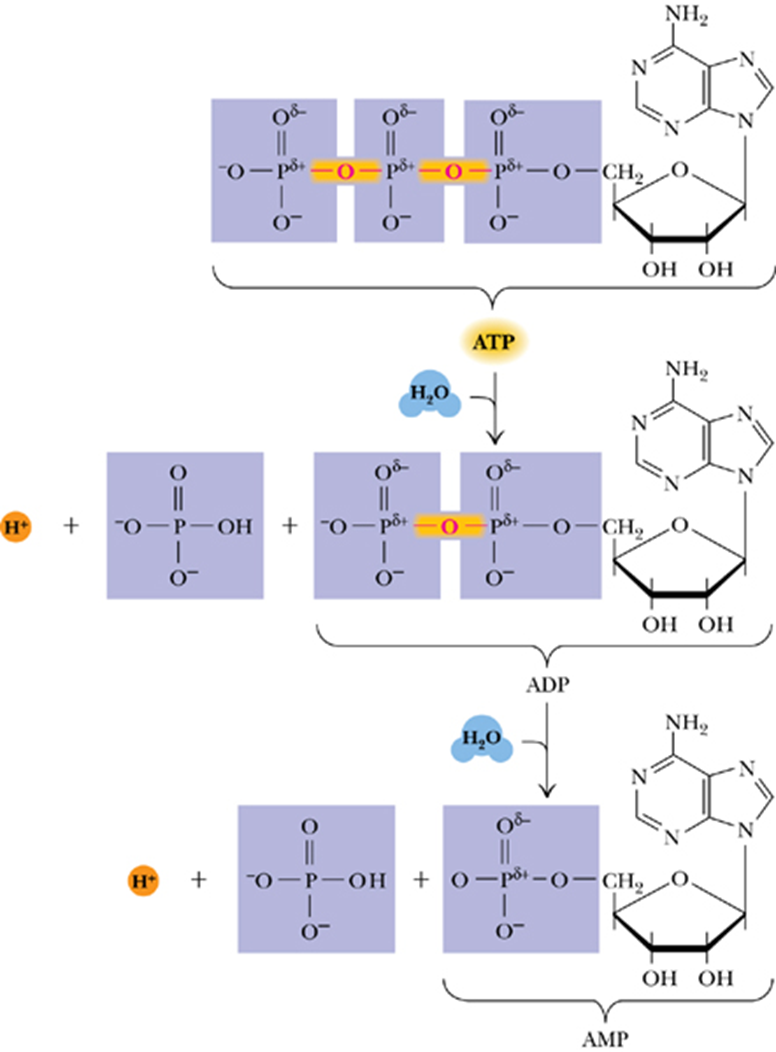
- phosphoric anhydrides 酸酐 (ATP, ADP)
- enol 烯醇 phosphate (PEP)
- acyl phosphate (acetyl 乙酰 phosphate)
- guanidino phosphate (creatine phosphate)
- thioesters 硫酯,such as acetyl-CoA
- 图
- Phosphate compounds are considered high energy if they exhibit large negative free energies of hydrolysis (that is, if ∆G°’is more negative than -25 kJ/mol)
- reduced coenzymes 还原型辅酶
- 特性
- not long-term energy storage substances
- They are transient forms of stored energy, meant to carry energy from point to point, from one enzyme system to another, in the minute-to-minute existence of the cell.
- stable
- the term high-energy compound should not be constructed to imply that these molecules are unstable and hydrolyze or decompose unpredictably.
- ATP, for example, is quite a stable molecule.
- not long-term energy storage substances
- 化学能
- ATP
- activation energy
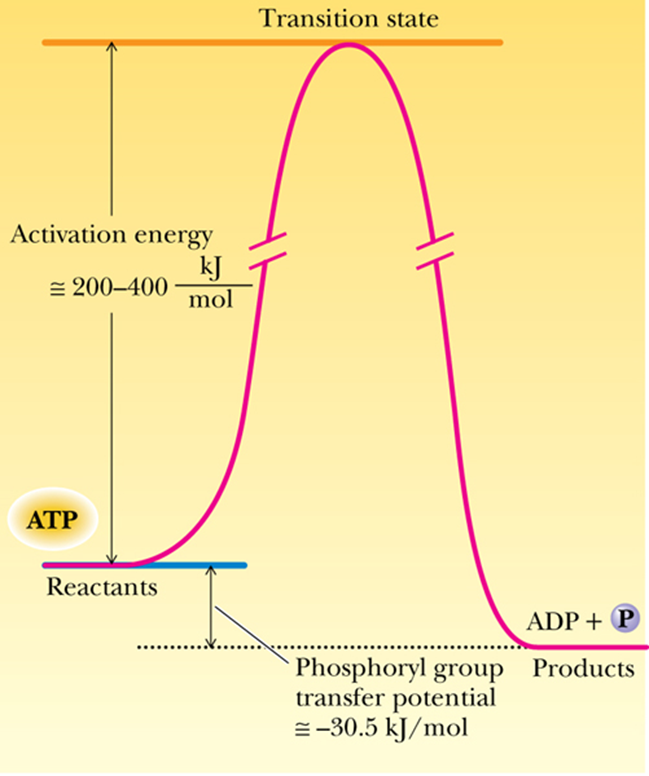
- A substantial activation energy must be delivered to ATP to hydrolyze the terminal phosphate group.
- In fact, the activation energy that must be absorbed by the molecule to break the O-P bond is normally 200 to 400 kJ/mol
- which is substantially larger than the net 30.5 kJ/mol released in the hydrolysis reaction.
- ATP的T0地位
- ATP Is an Intermediate Energy-Shuttle Molecule
- ATP holds an middle place in the rank of high-energy phosphates.
PEP, cyclic AMP, 1,3-BPG, phosphocreatine, acetyl phosphate, and pyrophosphate all exhibit higher values of ∆G° - ATP is uniquely situated between the very high energy phosphates synthesized in the breakdown of fuel molecules and the numerous lower-energy acceptor molecules that are phosphorylated in the course of further metabolic reactions.
ATP独特地处于分解燃料分子时合成的高能磷酸基团与后续代谢反应中被磷酸化的众多低能受体分子之间 - ATP的ΔG°可以接受高能的能量来源, 也可以用于低能量的反应
- The ATP/ADP pair is an intermediately placed acceptor/donor system among high-energy phosphates.
- 结构
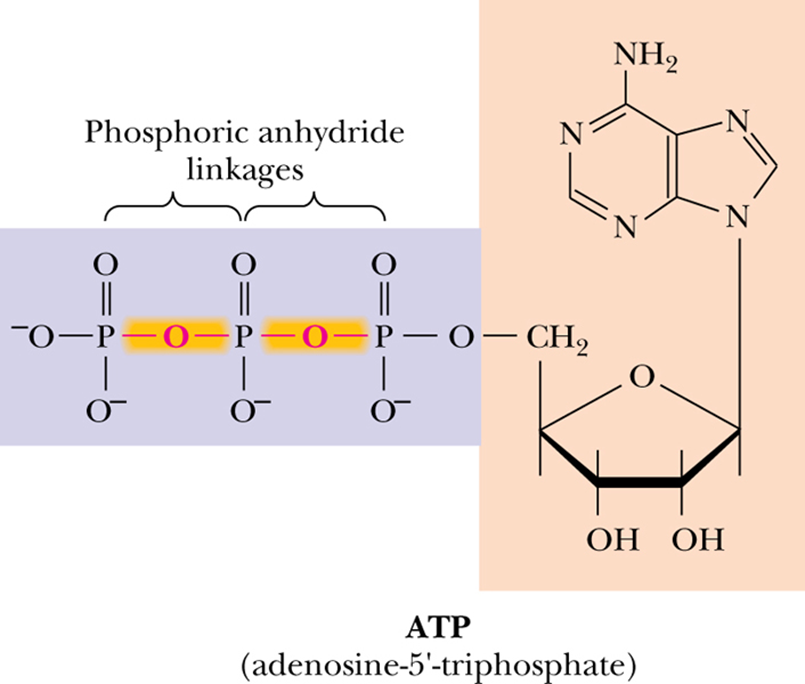
- Compounds containing phosphoric acid anhydride 磷酸酐 linkages all exhibit large negative free energies of hydrolysis.
- 有三个P
- Compounds containing phosphoric acid anhydride 磷酸酐 linkages all exhibit large negative free energies of hydrolysis.
- The Multiple Ionization States of ATP
- ATP在不同的pH环境下可以解离出H+
- ATP has four dissociable protons
- Three of the protons on the triphosphate chain dissociate at low pH.
低pH时候就可以解离,正常生理状况7.4全部解离,the last proton to dissociate from the triphosphate chain possesses a pKa of 6.95 - The adenine ring amino group exhibits a pKa of 4.06
- 与Mg2+结合
- The Daily Human Requirement for ATP
- A thermodynamic efficiency of approximately 50%. (of the 11,700 kJ a person consumes as food, about 5,860 kJ end up in the form of synthesized ATP)
转换效率大约50% - The hydrolysis of 1 mole of ATP yields approximately 50 kJ of free energy under cellular conditions.
- This means that the body cycles through 5860/50=117 moles of ATP each day.
- The disodium salt of ATP has a molecular weight of 551 g/mol, so that an average person hydrolyzes about 64,467 g of ATP per day
- Fortunately, we have a highly efficient recycling system for ATP/ADP utilization.
- The typical 70-kg body contains only about 50 grams of ATP/ADP total.
- Therefore, each ATP molecule in our bodies must be recycled nearly 1300 times each day
- A thermodynamic efficiency of approximately 50%. (of the 11,700 kJ a person consumes as food, about 5,860 kJ end up in the form of synthesized ATP)
- activation energy
All articles in this blog are licensed under CC BY-NC-SA 4.0 unless stating additionally.