
生物化学_Glycolysis
18.Glycolysis
- basic
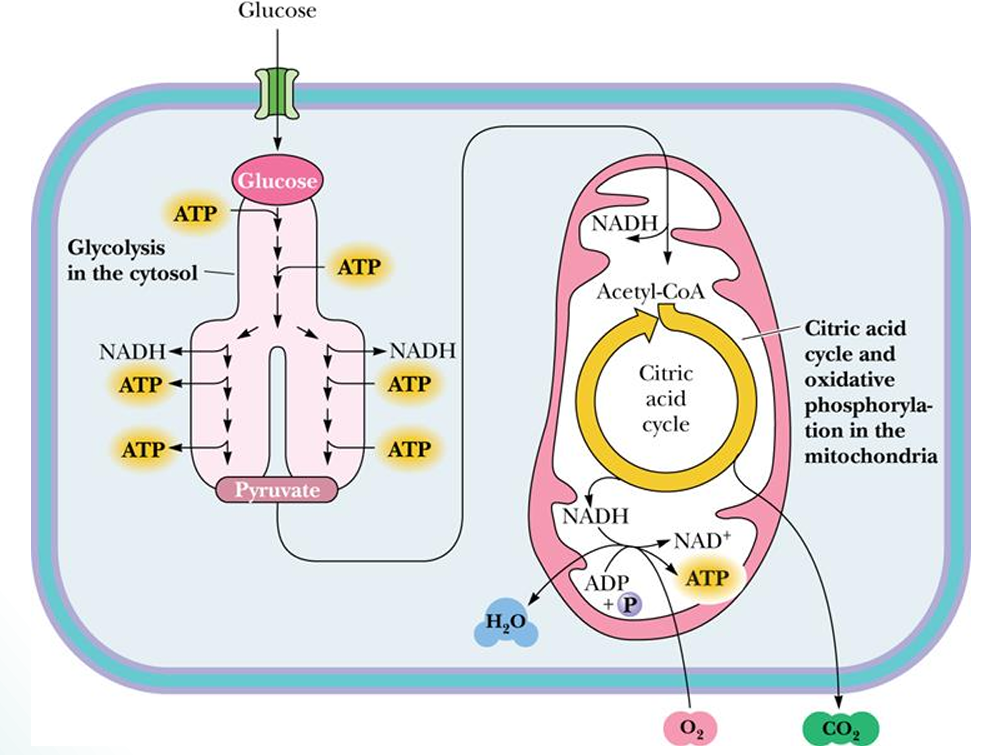
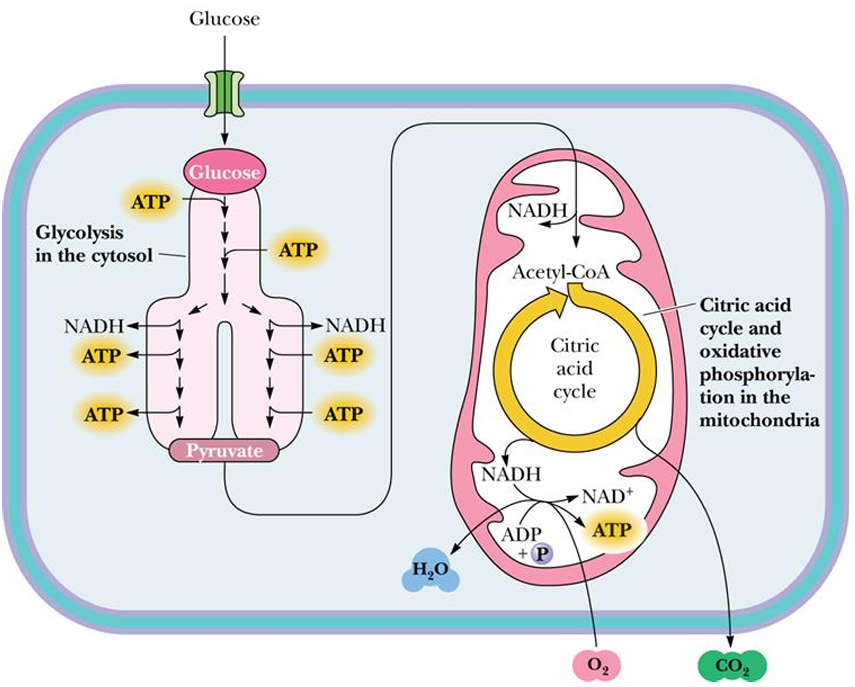
- Carried out in the cytosol of cells, it is basically an anaerobic 厌氧 process
- its principal steps occur with no oxygen
- provide precursor molecules for aerobic catabolic pathways 有氧代谢过程
- Compartmentalization of glycolysis, the citric acid cycle, and oxidative phosphorylation.
- 图
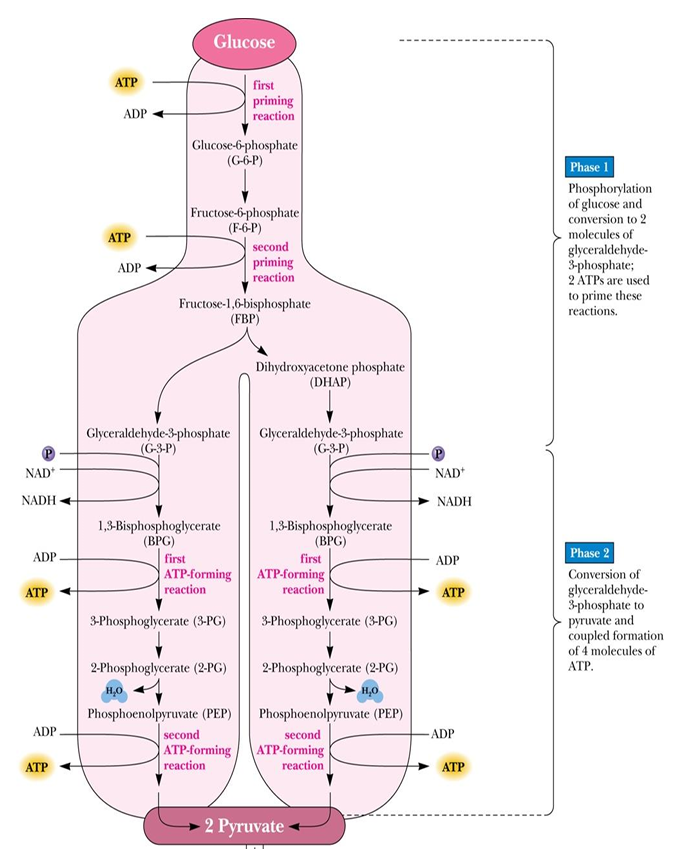
- two phase
- first phase
- basic
- glucose → two molecules of glyceraldehyde-3-phosphate (G-3-P) 3-磷酸甘油醛
- consume 2 ATP
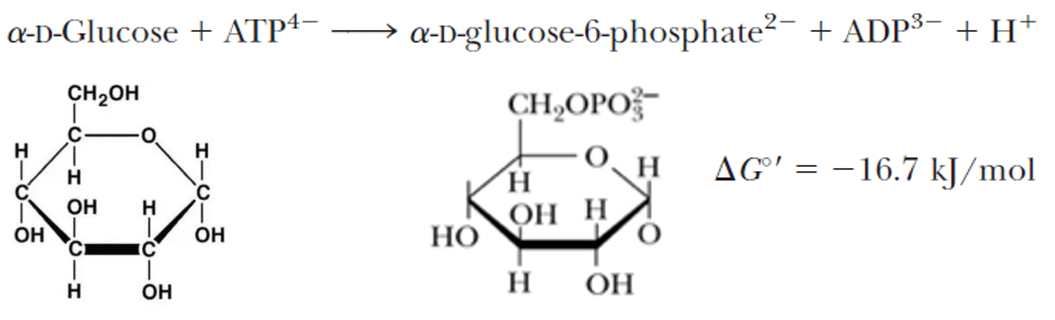
- Reaction 1 - Phosphorylation of Glucose → G-6-P (-ATP) 调控步骤
The First Priming Reaction- glucose → Glucose-6-Phosphate
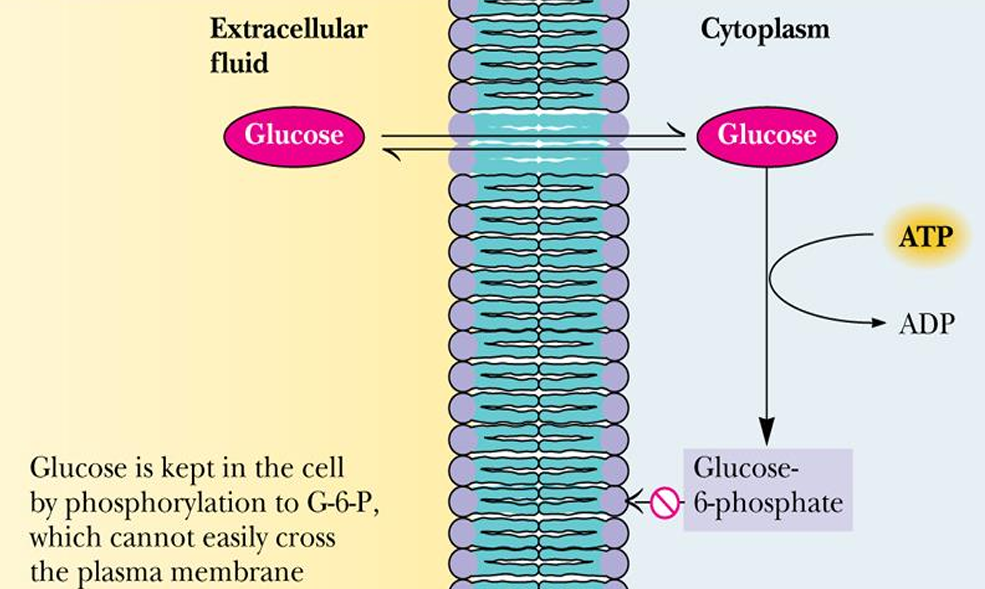
- Cellular Advantages 对细胞有什么好处
- phosphorylation keeps the substrate in the cell, G-6-P带负电出不去
- keeps the intracellular concentration of glucose low, 可以让更多glucose扩散进来
- because regulatory control can be imposed only on reactions not at equilibrium (∆G=0), the favorable thermodynamics of this first reaction makes it an important site for regulation 这步反应可以用于调节
- 酶 - Hexokinase 己糖激酶 or Glucokinase 葡(萄)糖激酶
- Hexokinase 己糖激酶
- In most animal, plant, and microbial cells, the enzyme that phosphorylates glucose is hexokinase
- can phosphorylate a variety of hexose sugars, including glucose, mannose 甘露糖, and fructose 果糖
- Mg2+ is required for this reaction, the true substrate for the hexokinase reaction is MgATP2-
- The Km for glucose is ~0.1 mM, and the enzyme thus work efficiently at normal blood glucose levels of 4 mM
- regulation
- Different body tissues possess different isozymes同工酶 of hexokinase , each exhibiting somewhat different kinetic properties
- 负反馈调节
- The animal enzyme is allosterically inhibited by the product, G-6-P
- 被产物变构抑制
- levels of G-6-P inhibit hexokinase activity until consumption by glycolysis lowers its concentration
- The hexokinase reaction is one of three points in the glycolysis pathway that are regulated
- Glucokinase 葡(萄)糖激酶
- Liver contains an enzyme called glucokinase
- highly specific for D-glucose
自然界中存在的葡萄糖 - has a much higher Km for glucose, ~10.0 mM, works only when liver glucose levels are high, and store G-6-P in liver as glycogen
- not product-inhibited
- is an inducible enzyme诱导酶, the amount present in the liver is controlled by insulin 胰岛素
环境中有信号诱导酶才会大量合成, Patients with type 2 diabetes 糖尿病 produce insufficient insulin
- Hexokinase 己糖激酶
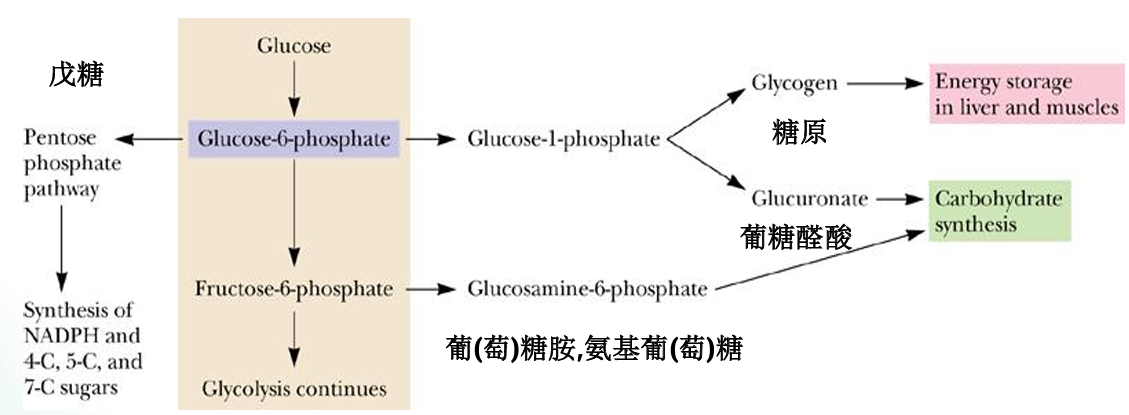
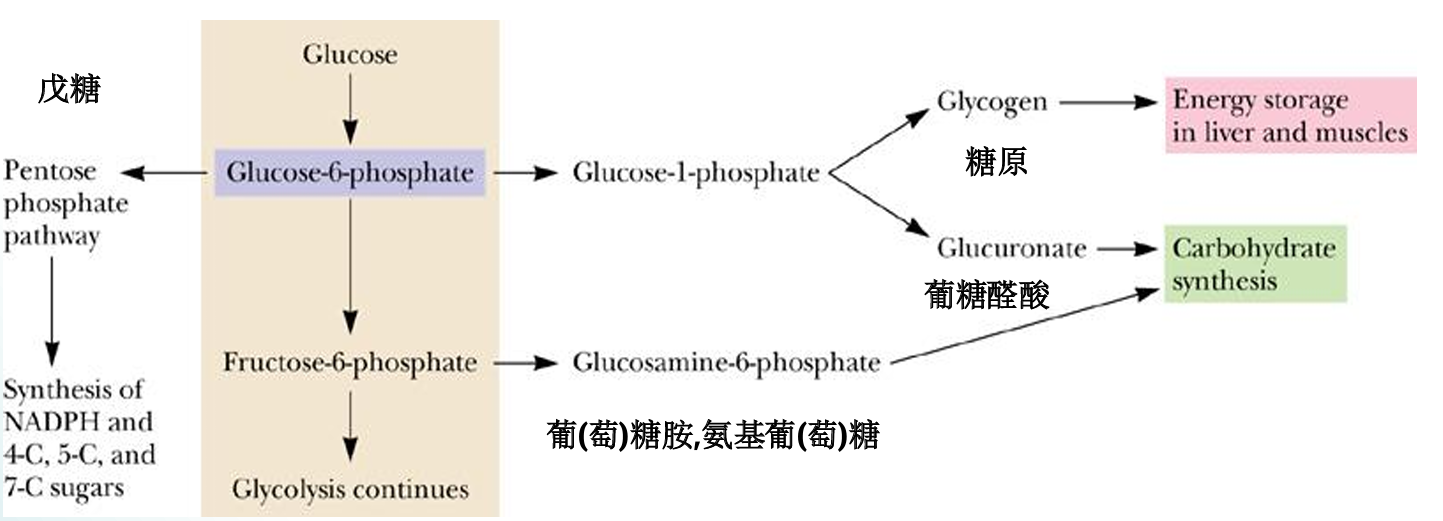
- Glucose-6-phosphate is the branch point for several metabolic pathways
- 图
- 图
- glucose → Glucose-6-Phosphate
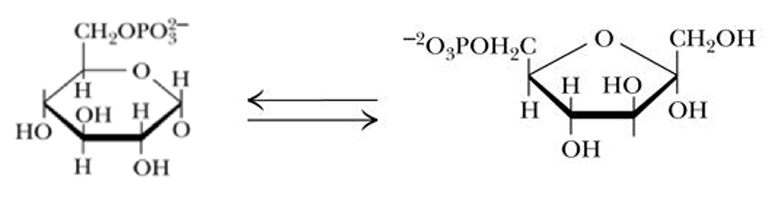
- Reaction 2 - the Isomerization 异构化 of G-6-P → F-6-P
- Glucose-6-Phosphate → Fructose-6-Phosphate
- 具体机制
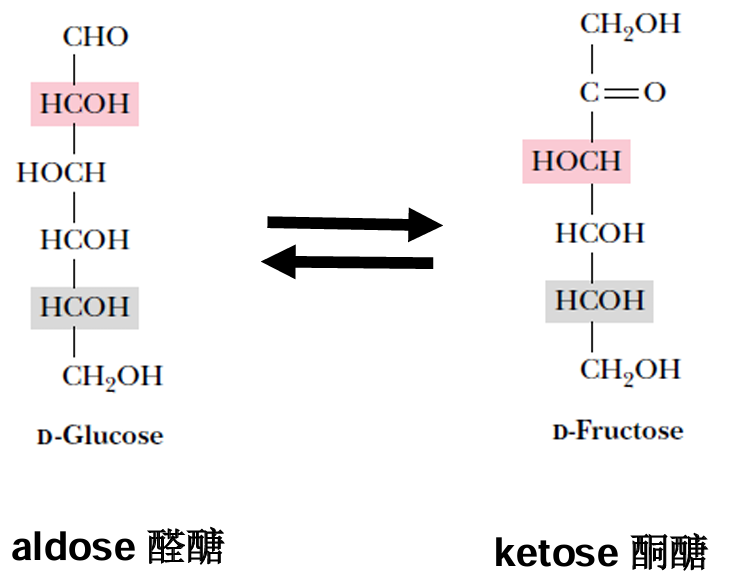
- 醛酮互变异构
- 图
- opening of the pyranose 吡喃糖ring (Step A)
- proton abstraction leading to enediol烯二醇formation (Step B)
- and proton addition to the double bond, followed by ring closure (Step C)
- The furanose 呋喃糖 is formed by attack of the C-5 hydroxyl on the carbonyl group
- 醛酮互变异构
- 作用
- First, the next step in glycolysis is phosphorylation at C-1, and the hemiacetal半缩醛-OH of glucose would be more difficult to phosphorylate than a simple primary hydroxyl 羟基.
- 第一,糖酵解的下一步是在 C-1 位发生磷酸化,而葡萄糖的半缩醛羟基比简单的伯羟基更难发生磷酸化
- Second, the isomerization to fructose (with a carbonyl group at position 2 in the linear form) activates carbon C-3 for cleavage in the fourth step of glycolysis
- 第二,异构化为果糖(其线性形式中 C-2 位含羰基)可激活 C-3 位碳,以便在糖酵解第四步中发生断裂
- 酶 - phosphoglucose isomerase 磷酸葡萄糖异构酶
- phosphoglucose isomerase 磷酸葡糖异构酶, also known as glucose phosphate isomerase
- requires Mg2+, highly specific for glucose-6-phosphate
- ∆G =1.67kJ/moL namely, 0.4 kcal/mol, means that the reaction operates near equilibrium in the cell and is readily reversible 在细胞内接近平衡, 容易逆向发生
- Glucose-6-Phosphate → Fructose-6-Phosphate
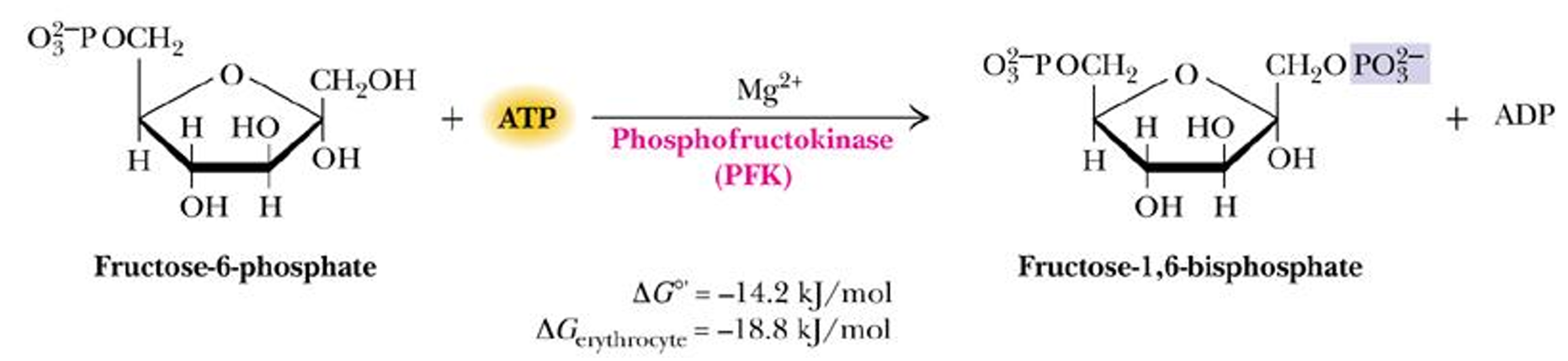
- Reaction 3 - F-6-P → FBP (-ATP) 调控步骤
The Second Priming Reaction- Fructose-6-Phosphate → Frutose-1,6-BiPhosphate
- At pH 7 and 37°C
- the phosphofructokinase reaction equilibrium lies far to the right
- commits 指派the cell to metabolizing glucose rather than converting it to another sugar or storing it
- 酶 - phosphofructokinase 磷酸果糖激酶
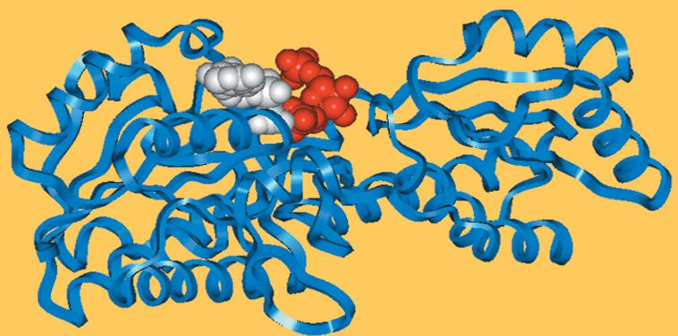
- Phosphofructokinase with ADP shown in white and fructose-6-P in red
- most important site of regulation in the glycolytic pathway
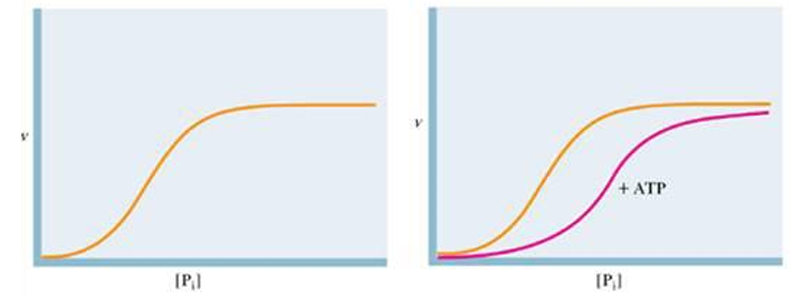
- regulation - allosteric
- ↓ ATP
- ATP is an allosteric inhibitor of this enzyme
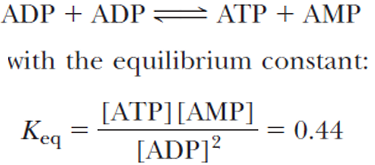
- adenylate kinase腺苷酸激酶会催化以下反应
- ATP and AMP levels represent the cellular energy status
- ATP is an allosteric inhibitor of this enzyme
- ↓ citrate 柠檬酸盐
- Glycolysis and TCA are coupled via phosphofructokinase
- citrate 柠檬酸盐, an intermediate in the citric acid cycle, is an allosteric inhibitor of phosphofructokinase
- When the citric acid cycle reaches saturation, glycolysis slows down
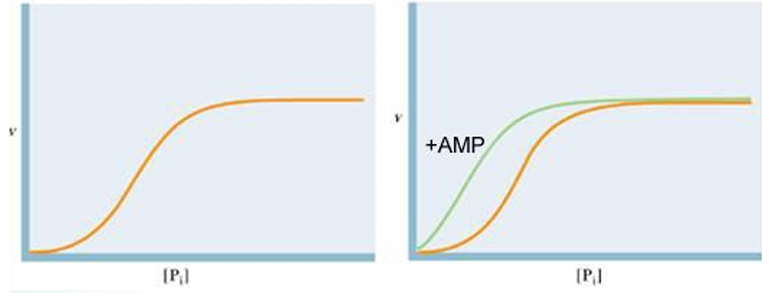
- ↑ AMP
- AMP reverses the inhibition due to ATP
- AMP reverses the inhibition due to ATP
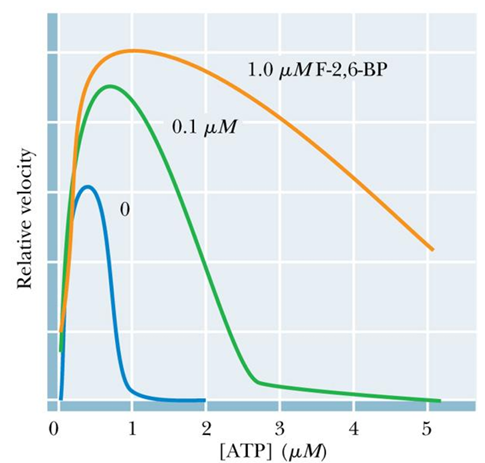
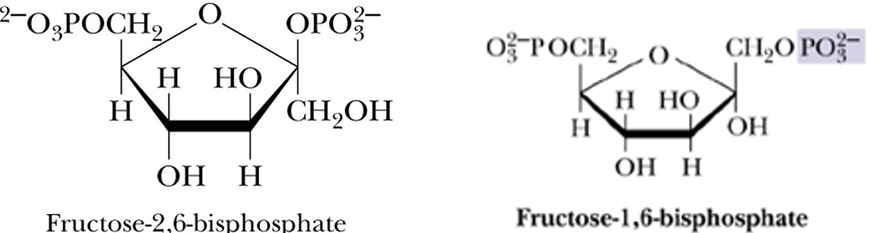
- ↑ β-D-fructose-2,6-bisphosphate
- 三个功能
- increases the affinity of phosphofructokinase for the substrate fructose-6-phosphate
- decreasing the inhibitory effects of ATP
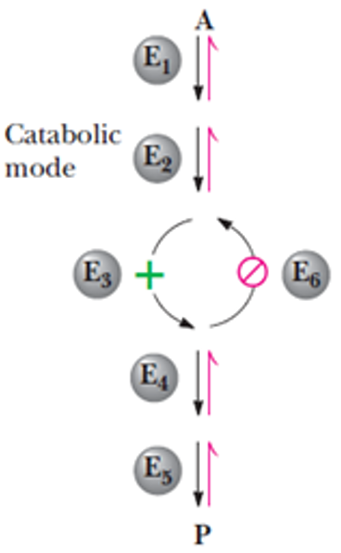
- inhibiting fructose-1,6bisphosphatase, the enzyme that catalyzes this reaction in the opposite direction
- increases the net flow of glucose through glycolysis by stimulating phosphofructokinase
- 这个增强剂与这步反应的产物对比
- 被PFK-2 & F-2,6-BPase调控
- 三个功能
- ↓ ATP
- Phosphofructokinase with ADP shown in white and fructose-6-P in red
- Fructose-6-Phosphate → Frutose-1,6-BiPhosphate
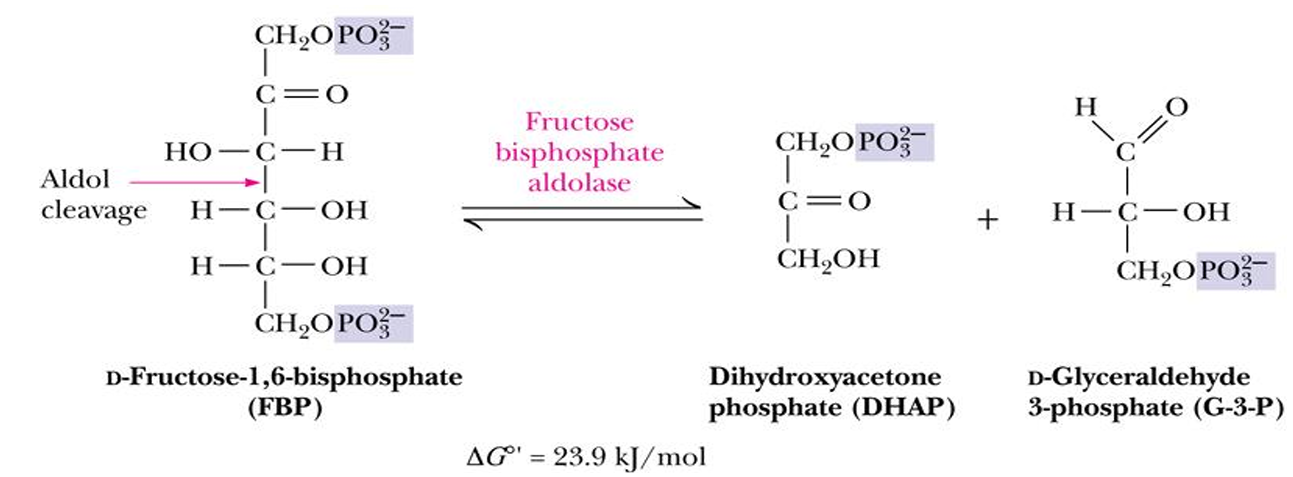
- Reaction 4 - Cleavage of FBP → DHAP + G-3-P
- Fructose-1,6-bisP → DiHydroxyAcetone Phosphate + Glyceraldehyde-3-Phosphate
- cleaves fructose-1,6-bisphosphate between the C-3 and C-4 carbons to yield two triose phosphates 磷酸丙糖
- dihydroxyacetone phosphate (DHAP) 磷酸二羟基丙酮
- glyceraldehyde-3-phosphate (G-3-P) 3-磷酸甘油醛
- 酶 - Fructose bisphosphate aldolase 果糖二磷酸醛缩酶
- equilibrium constant of approximately 10^-4 M, and a corresponding ∆G° of 23.9 kJ/mol.
- 表面数据这个反应很难发生, 但是是一个分子产生两个分子, 受到浓度影响大
- The value of ∆ G in erythrocytes 红细胞 is actually -0.23 kJ/mol.
- At physiological concentrations, the reaction is essentially at equilibrium
- Fructose-1,6-bisP → DiHydroxyAcetone Phosphate + Glyceraldehyde-3-Phosphate
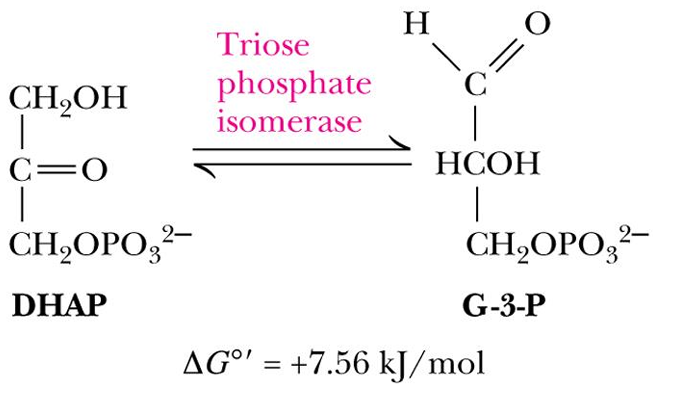
- Reaction 5 - DHAP ⇄ G-3-P
- DiHydroxyAcetone Phosphate ⇄ Glyceraldehyde-3-Phosphate
- 这步和上一步加起来相当于FBP → 2G-3-P
- 只有G-3-P能进入glycolysis二阶段, 所以要把DHAP变成G-3-P
- 酶 - Triose Phosphate Isomerase 磷酸丙糖异构酶
- DiHydroxyAcetone Phosphate ⇄ Glyceraldehyde-3-Phosphate
- energy
- Although the last two steps of the pathway are energetically unfavorable, the overall five-step reaction sequence has a net ∆G°of +2.2 kJ/mol (Keq≈0.43).
- It is the free energy of hydrolysis from the two priming molecules of ATP that brings the overall equilibrium constant close to 1 under standard-state conditions.
- The net ∆ G under cellular conditions is quite negative (-53.4 kJ/mol in erythrocytes)
- basic
- second phase
- basic
- two molecules of glyceraldehyde-3-phosphate → two molecules of pyruvate 丙酮酸
- produce 4 ATP
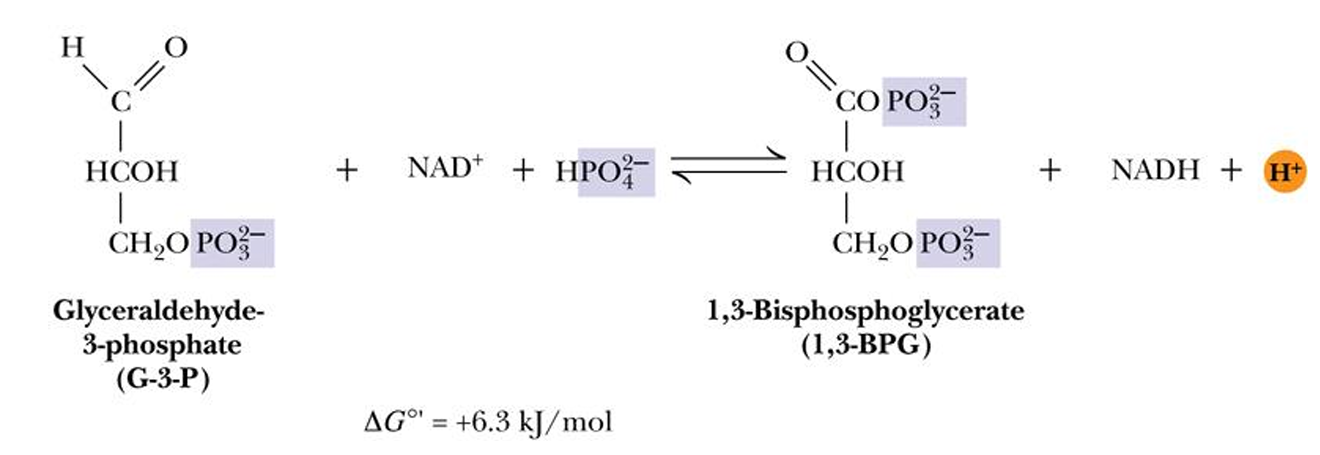
- Reaction 6 - G-3-P → 1,3-BPG (-2P +2NADH)
- G-3-P → 1,3-BPG
- makes a high-energy phosphate in preparation for ATP synthesis
- 酶 - Glyceraldehyde-3-Phosphate Dehydrogenase 脱氢酶
- Although the oxidation of an aldehyde to a carboxylic acid is a highly exergonic放能 reaction
- the overall reaction involves both formation of a carboxylic-phosphoric anhydride and the reduction of NAD to NADH
- therefore slightly endergonic吸能的 at standard state, with a ∆G of +6.30 kJ/mol
- Although the oxidation of an aldehyde to a carboxylic acid is a highly exergonic放能 reaction
- G-3-P → 1,3-BPG
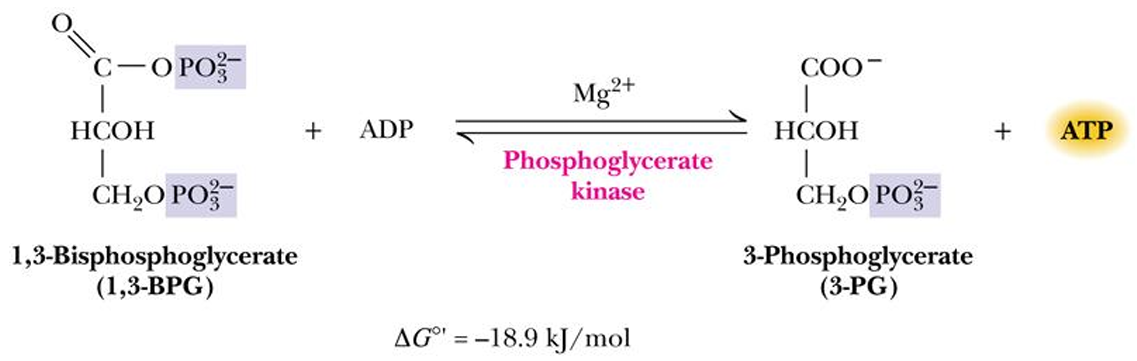
- Reaction 7 - 1,3-BPG → 3-PG (+2ATP)
- 1,3-BPG → 3-PG
- 酶 - Phosphoglycerate Kinase 磷酸甘油酸激酶
- Mg2+ ion is required for activity
- exergonic 放能
- In fact, the aldolase 醛缩酶 and triose phosphate isomerase 磷酸三糖异构酶 are also pulled forward by phosphoglycerate kinase
这步放能拉着前面两步能量不利的往前反应
- 1,3-BPG → 3-PG
- Reaction 8 - phosphoryl transfer
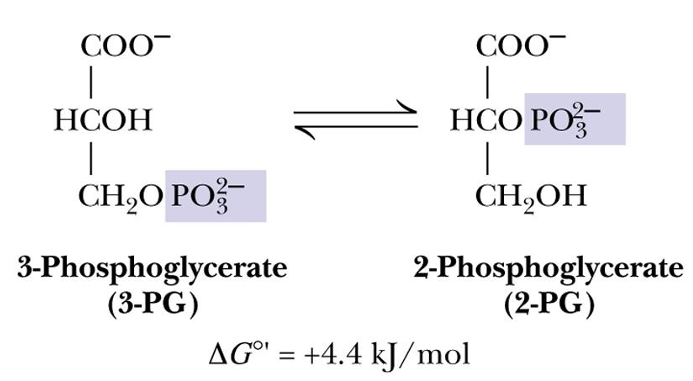
- 3-PhosphoGlycerate → 2-PhosphoGlycerate
- 酶 - Phosphoglycerate mutase 磷酸甘油酸变位酶
- The term mutase 变位酶 is applied to enzymes that catalyze migration of a functional group within a substrate molecule
- The free energy change for this reaction is very small under cellular conditions
- 3-PhosphoGlycerate → 2-PhosphoGlycerate
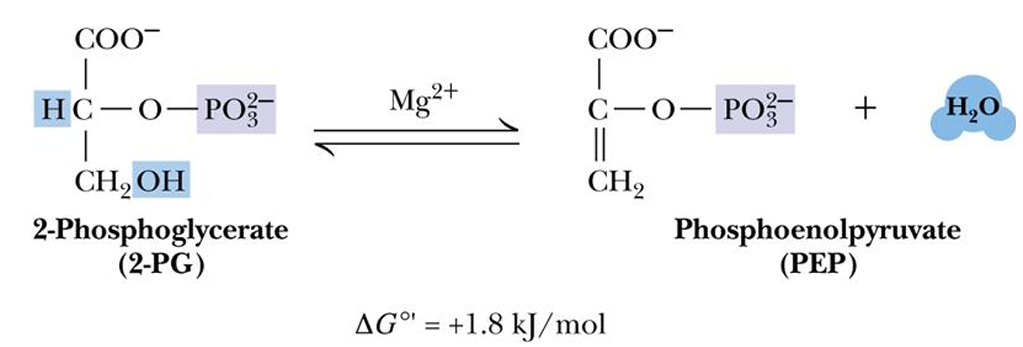
- Reaction 9 - Dehydration 2-PG → PEP (-H2O)
- 2-PhosphoGlycerate → PhosphoEnolPyruvate 磷酸烯醇丙酮酸
- makes a high-energy phosphate in preparation for ATP synthesis
- 酶 - Enolase 烯醇酶
- The ∆G° for this reaction is relatively small at 1.8 kJ/mol (Keq 0.5)
- under cellular conditions, ∆G is very close to zero
- 2-PhosphoGlycerate → PhosphoEnolPyruvate 磷酸烯醇丙酮酸
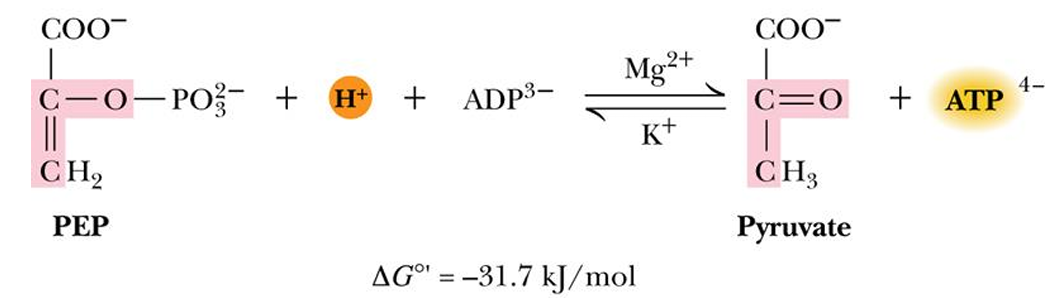
- Reaction 10 - PEP → pyruvate (+2ATP) 调控步骤
- PhosphoEnolPyruvate → pyruvate
- 酶 - Pyruvate Kinase 丙酮酸激酶
- The reaction requires Mg2+ ion and is stimulated by K+ and certain other monovalent cations单价阳离子
- Keq at 25°C is 3.63×10^5, equilibrium far right
- The large negative G of this reaction makes pyruvate kinase a target site for regulation of glycolysis 适合调控
- regulation - allosteric
- ↑ AMP
- ↑ fructose-1,6-bisphosphate
- ↓ ATP
- ↓ acetyl-CoA
- ↓ alanine丙氨酸
- Furthermore, liver pyruvate kinase is regulated by covalent modification
- PhosphoEnolPyruvate → pyruvate
- basic
- first phase
- The Products of Glycolysis
- ATP
- NADH
- NADH must be recycled to NAD+, lest以免 NAD+ become limiting in glycolysis.
- NADH can be recycled by both aerobic需氧的 and anaerobic厌氧的 paths, either of which results in further metabolism of pyruvate.
- pyruvate 丙酮酸
- after glycolysis
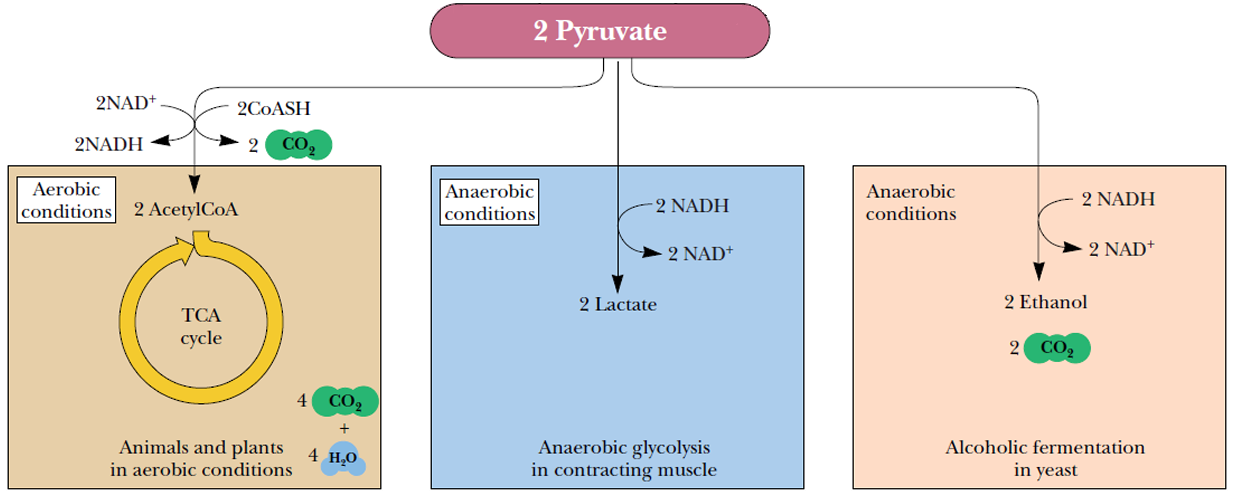
- Aerobic 有氧
- pyruvate sent into the citric acid cycle (TCA)
- it is oxidized to CO2 with the production of additional NADH (and FADH2).
- the NADH produced in glycolysis and the citric acid cycle is reoxidized to NAD+ in the mitochondrial electron transport chain
- 图
- Anaerobic 无氧
- fermentation 发酵
- pyruvate → lactate/ethanol都算fermentation
- the production of ATP energy by reaction pathways in which organic molecules function as donors and acceptors of electrons
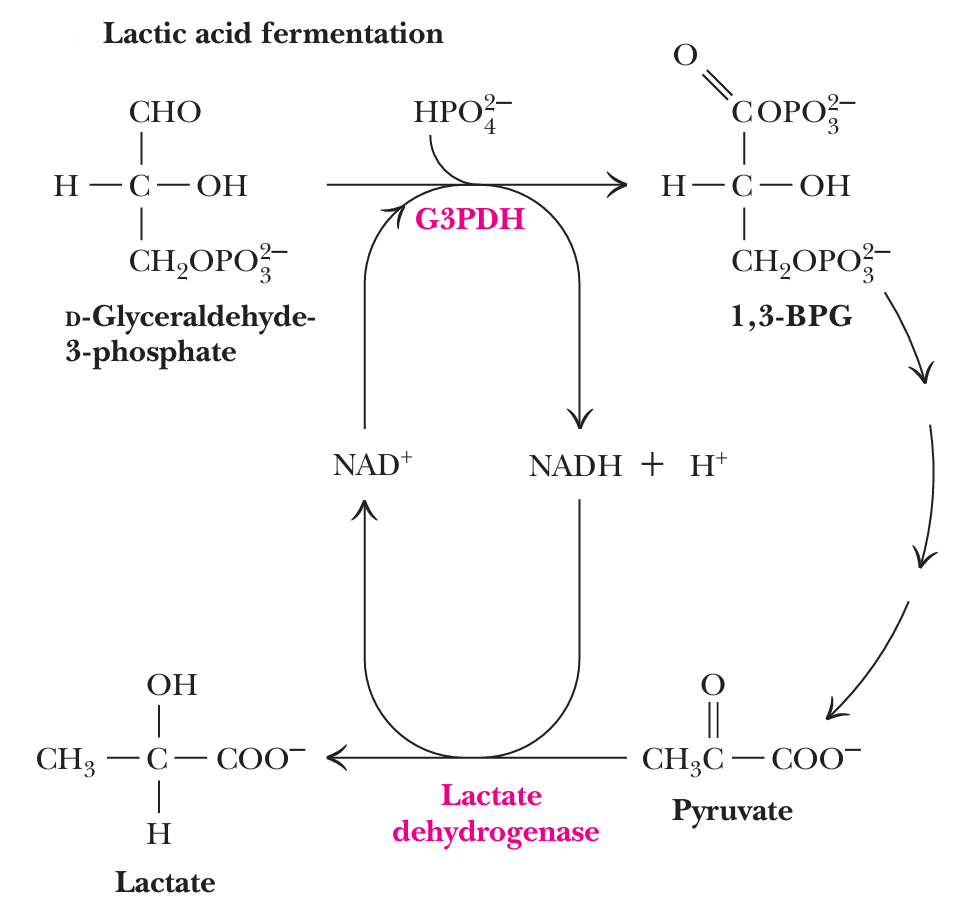
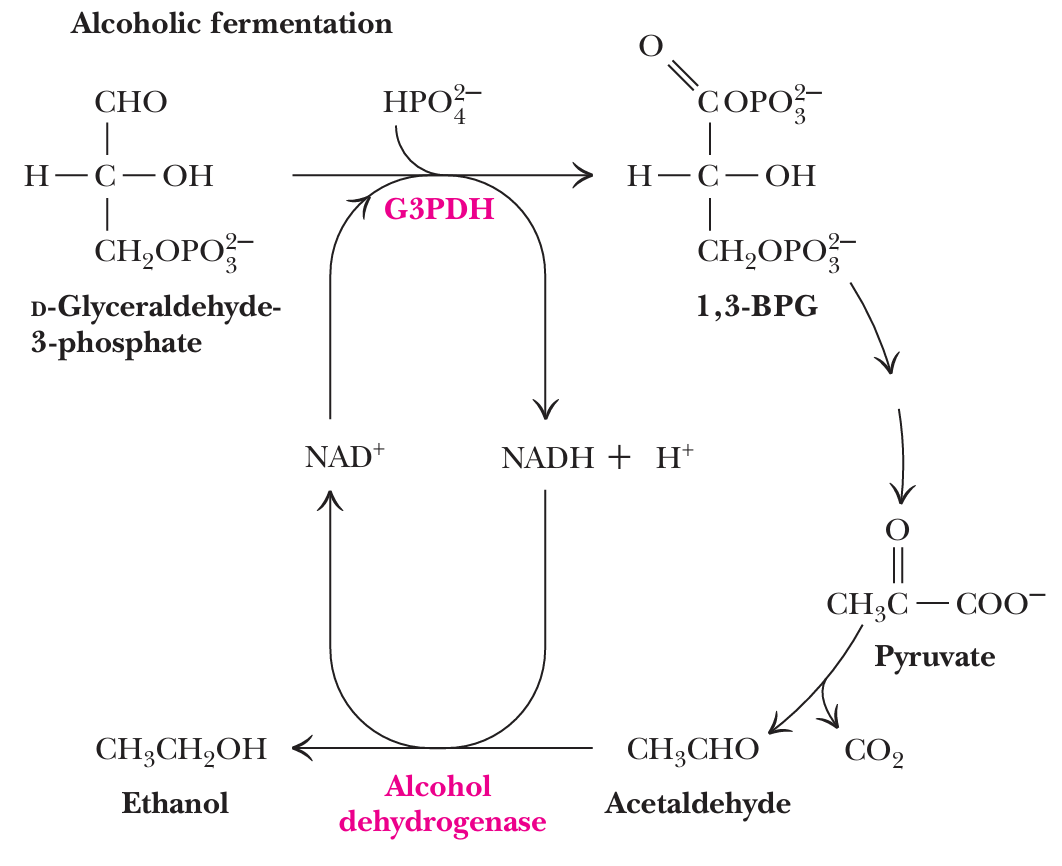
- In either case, reduction of pyruvate provides a way of reoxidizing the NADH produced in the glyceraldehyde-3-phosphate dehydrogenase reaction of glycolysis
- pyruvate → lactate 乳酸
in microorganisms(other than yeast) and animals- NAD is regenerated in the lactate dehydrogenase reaction
- produce the taste of sour milk characteristic taste and fragrance of sauerkraut 泡菜, which in reality is fermented cabbage
- Lactate Accumulates Under Anaerobic Conditions in Animal Tissues
- Pyruvate reduction occurs in tissues that normally experience minimal access to blood flow (e.g. the cornea 角膜) and also in rapidly contracting skeletal muscle
- In anaerobic muscle tissue, lactate represents the end of glycolysis
- cramps 抽筋 and muscle soreness 酸痛, fatigue 疲劳 associated with the buildup 堆积 of lactic acid in the muscle
- Most of this lactate must be carried out of the muscle by the blood and transported to the liver, where it can be resynthesized into glucose in gluconeogenesis
- 酶 - lactate dehydrogenase 乳酸脱氢酶 LDH
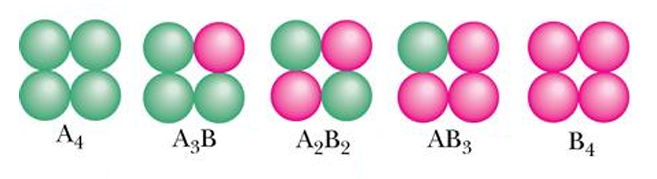
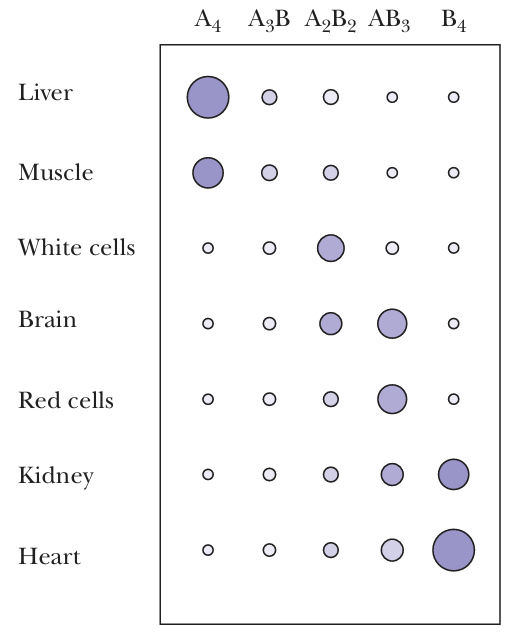
- Mammalian LDH exists as five different isozymes同工酶
Enzymes with Slightly Different Subunits, 催化同一种反应但是催化效率与倾向不同 - depending on the tetrameric 四聚体 association of two different subunits(A&B)
- A4, A3B, A2B2, AB3, B4
- their relative affinities for the various substrates and their sensitivity to inhibition by product are different
- Different tissues express different isozyme forms
- muscle
- anaerobic
- needs LDH to regenerate NAD from NADH so glycolysis can continue
- The muscle LDH isozyme (A4) works best in the NAD regenerating direction
- heart
- aerobic 有氧
- uses lactate as a fuel, converting it to pyruvate via LDH
- using the pyruvate to fuel the citric acid cycle to obtain energy
- The heart LDH isozyme (B4) is inhibited by excess pyruvate so the fuel won’t be wasted
- 图
- muscle
- Mammalian LDH exists as five different isozymes同工酶
- Lactic acid fermentation
- pyruvate → ethanol + CO2
in yeast- provides a means for regenerating NAD consumed in the glyceraldehyde-3-P dehydrogenase reaction
- Alcoholic fermentations are the basis for the brewing酿造 of beers and the fermentation of grape sugar in wine making
- Alcoholic fermentation
- fermentation 发酵
- 总结
- 图
- 图
- Aerobic 有氧
- 其他
- energy elegance
- 反应在标准状态以及细胞内的自由能
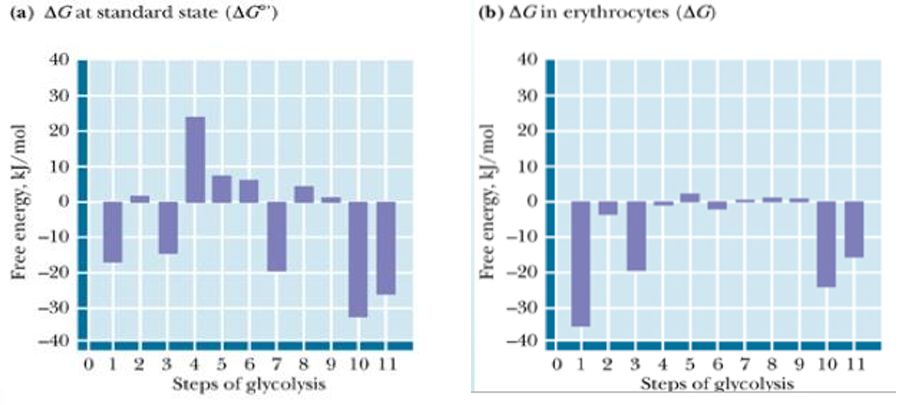
- 细胞内反应2和反应4-9 ∆G is very close to zero, so that these reactions operate essentially at equilibrium
- The driving force for glycolysis lies in the hexokinase (1), phosphofructokinase (3), and pyruvate kinase (10) reactions
- These reactions are thus the sites of glycolytic regulation
- gluconeogenesis 糖质新生
- the biosynthesis of glucose
- different enzymes are used to carry out reactions 1, 3, and 10 in reverse, effecting the net synthesis of glucose.
- The maintenance of reactions 2 and 4 through 9 at or near equilibrium permits these reactions (and their respective enzymes) to operate effectively in either the forward or reverse direction
- 反应在标准状态以及细胞内的自由能
- Other Substrates in Glycolysis
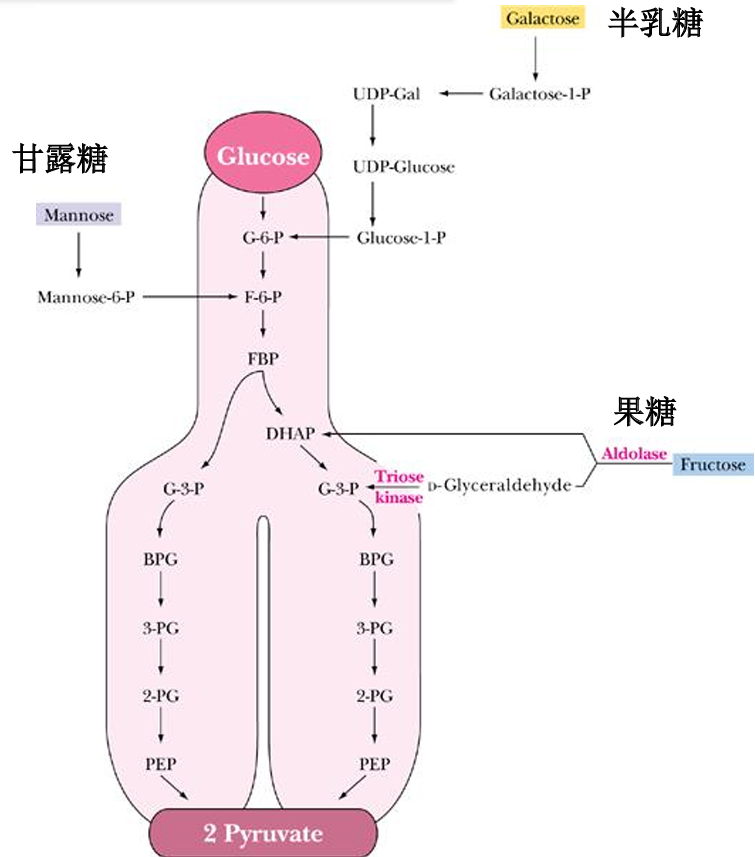
- Mannose, galactose, fructose, and other simple metabolites can enter the glycolytic pathway through being converted by appropriate enzymes to one of the intermediates of glycolysis.
- Mannose, galactose, fructose, and other simple metabolites can enter the glycolytic pathway through being converted by appropriate enzymes to one of the intermediates of glycolysis.
- Nucleoside 5’-Triphosphates Are Carriers of Chemical Energy
- ATP, GTP, CTP, UTP and dATP, dGTP, dCTP, dTTP.
Four NTPs and their dNTPcounterparts are the substrates for the synthesis of the nucleic acids - The evolution of metabolism has led to the dedication of one of these four NTPs to each of the major branches of metabolism
- ATP has been termed the energy currency of the cell.
- GTP is the major energy source for protein synthesis.
- CTP is an essential metabolite in phospholipid synthesis.
- UTP forms activated intermediates with sugars that go on to serve as substrates in the biosynthesis of complex carbohydrates and polysaccharides
- ATP, GTP, CTP, UTP and dATP, dGTP, dCTP, dTTP.
- energy elegance



All articles in this blog are licensed under CC BY-NC-SA 4.0 unless stating additionally.