
生物化学_Gluconeogenesis, Glycogen, the Pentose Phosphate Pathway
22.Gluconeogenesis, Glycogen, the Pentose Phosphate Pathway
- Gluconeogenesis 糖异生
- basic
- 为什么需要gluconeogenesis
- Human metabolism, for example, consumes about 160±20 grams of glucose per day, about 75% of this in the brain
- Body fluids carry only about 20 grams of free glucose, and glycogen stores normally can provide only about 180 to 200 grams of free glucose
- 糖原只带着人够一天多的葡萄糖供给
- 所以人要从不是碳水化合物的前体合成葡萄糖来用
- The Substrates of Gluconeogenesis include pyruvate, lactate, and amino acid, as well as glycerol and all the TCA cycle intermediates.
- Nearly All Gluconeogenesis Occurs in the Liver and Kidneys in Animals
- organs that consume the most glucose, namely, brain and muscle, carry out very little glucose synthesis
- The major sites of gluconeogenesis are the liver and kidneys, which account for about 90% and 10% of the body’s gluconeogenic activity
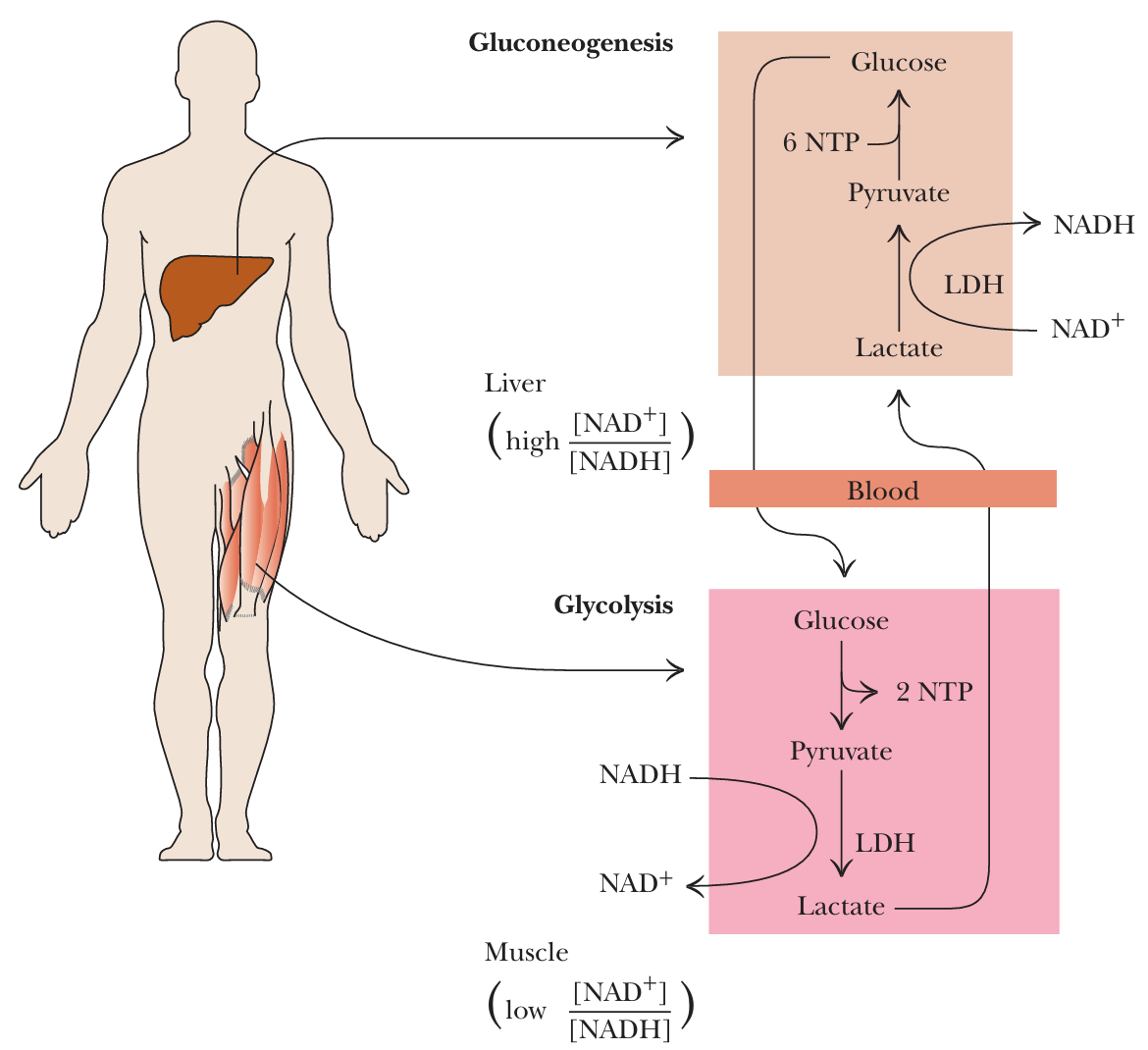
- cori cycle
- Liver, with a typically high NAD+/NADH ratio (about700), readily produces more glucose than it can use
- 肝和肾合成的葡萄糖进入血液去到大脑和肌肉这些大量消耗的地方
- Muscle that is vigorously exercising will enter anaerobiosis厌氧 and show a decreasing NAD+/NADH ratio, which favors reduction of pyruvate to lactate
- 肌肉产生的 lactate 通过血液回到肝和肾合成葡萄糖
- 图
- Gluconeogenesis Is Not Merely the Reverse of Glycolysis, Something Borrowed, Something New
- glycolysis中7步反应在gluconeogenesis中为简单逆转
- glycolysis中3步高度放能调控反应在gluconeogenesis中通过四个新的反应完成
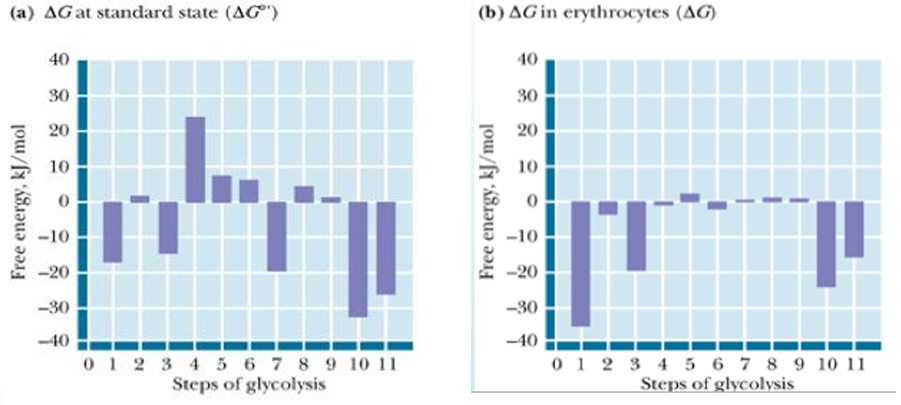
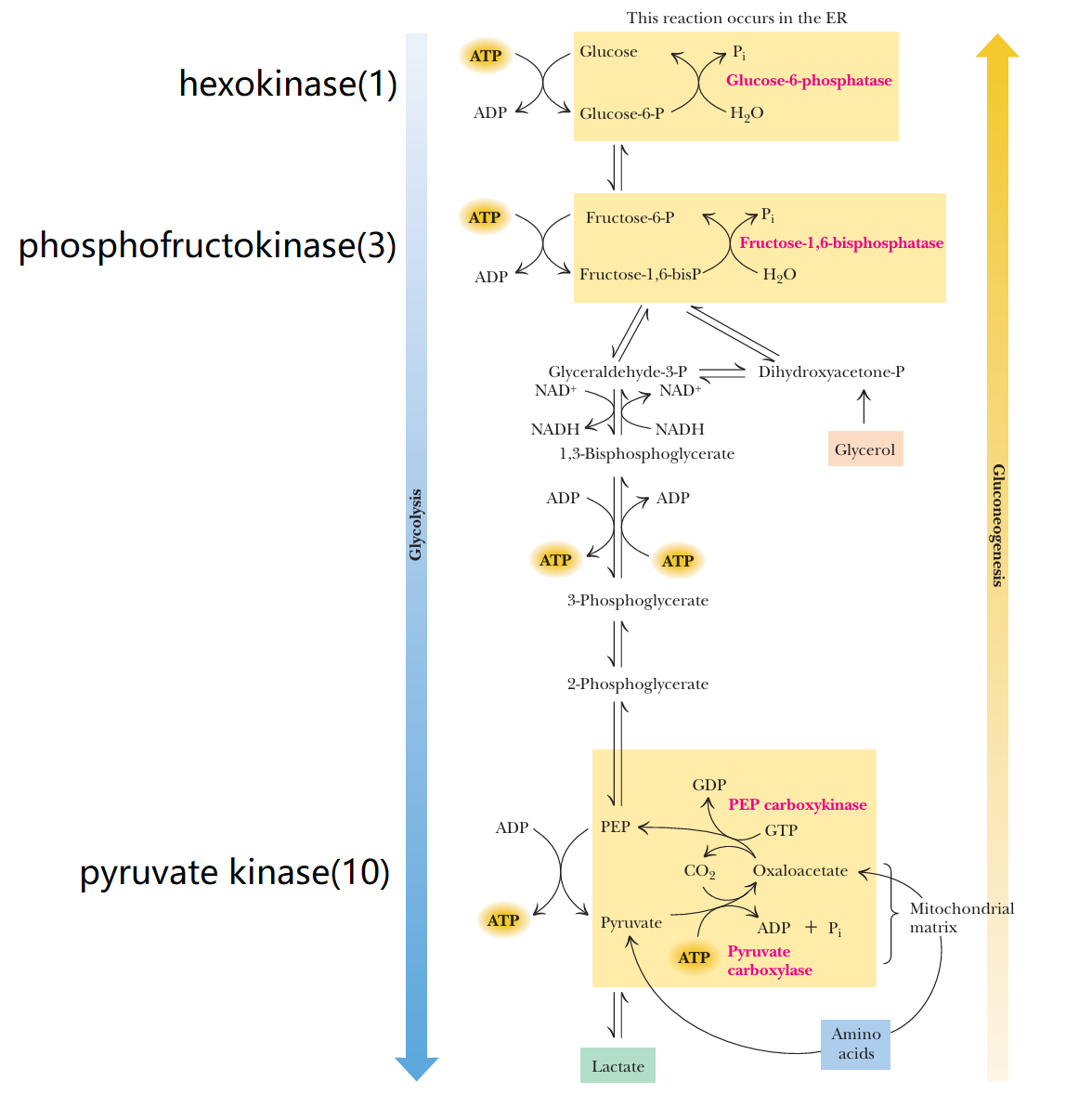
- glycolysis 的 hexokinase(1), phosphofructokinase (3), pyruvate kinase (10) 催化的反应高度放能, 高度调控
- glycolysis 的 hexokinase(1), phosphofructokinase (3), pyruvate kinase (10) 催化的反应高度放能, 高度调控
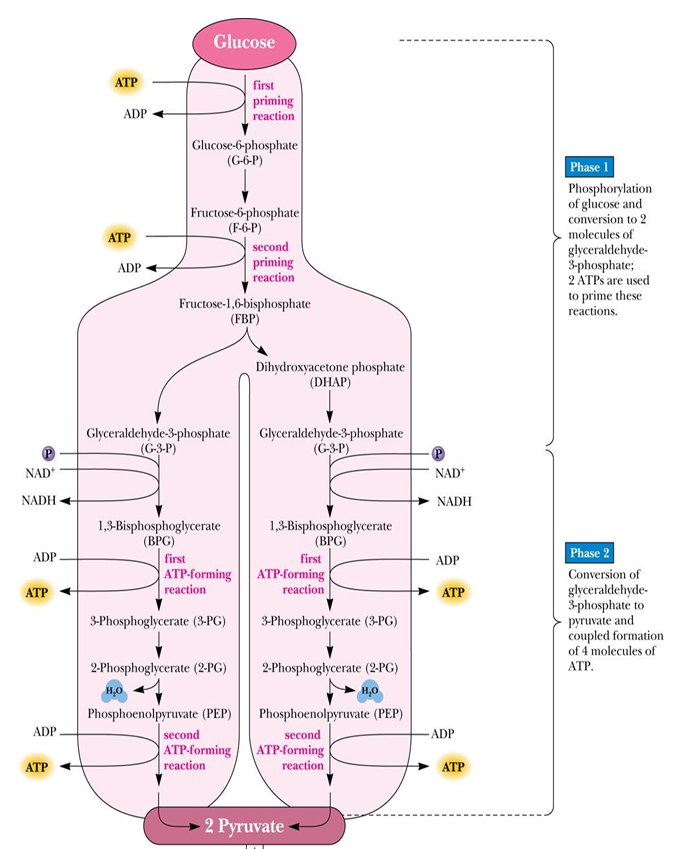
- glycolysis流程图
- glycolysis与gluconeogenesis
- net reaction, ∆ G° = -15.6 kJ/mol under physiological conditions, 消耗 6 nucleoside triphosphates
- ! 如果直接反过来 glycolysis, ΔG = +74 kJ/mol, 反应不发生, 需要独特的四个酶同时多消耗 4 nucleoside triphosphates
- 为什么需要gluconeogenesis
- four unique reaction
- pyruvate → oxaloacetate
- 反应
- 酶-Pyruvate Carboxylase 羧化酶
- regulation - allosteric
- ↑ acetyl-coenzyme A as an allosteric activator
- High levels of ATP and CoA derivatives are signs that energy is abundant and that metabolites will be converted to glucose and perhaps even glycogen
高含量的ATP和CoA代表能量充足, pyruvate 可以被转化为 glucose 甚至 glycogen - 能量低时候 pyruvate 会进入 TCA
- exist only in the matrix of the mitochondria
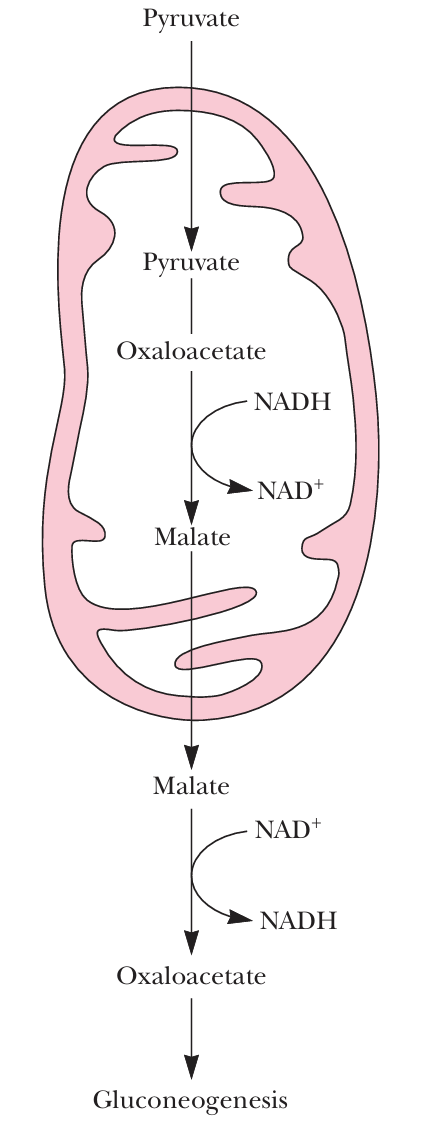
- 这个反应先在线粒体基质进行, 进行后变成 malate 出去, 再变回 oxaloactate 继续糖异生
- 这个反应先在线粒体基质进行, 进行后变成 malate 出去, 再变回 oxaloactate 继续糖异生
- regulation - allosteric
- 这个反应跟The Anaplerotic补给里面的是一个东西
- oxaloacetate → PEP (PhosphoEnolPyruvate)
- 反应
- 酶 - PEP carboxykinase 羧化激酶
- 能量来源于脱羧以及GTP, 肝脏条件下 ΔG = - 22.6 kJ/mol
- FBP → F-6-P
- 反应
- Under physiological conditions in the liver, the reaction is exergonic ∆G = - 8.6 kJ/mol)
- 酶 - Fructose-1,6-Bisphosphatase
- regulation - allosteric
- ↑ Citrate enhance bisphosphatase activity
- ↓ Fructose-2,6-bisphosphate is a potent allosteric inhibitor
- PFK-2 & F-2,6-BPase
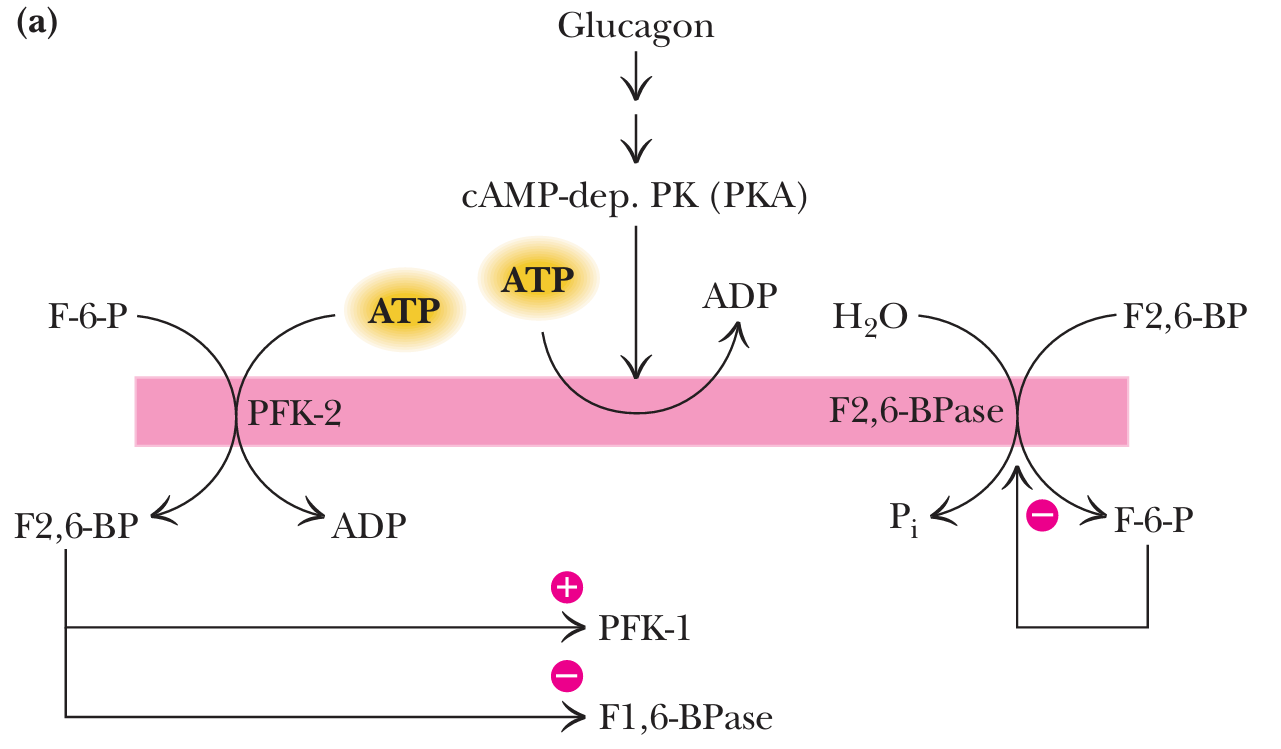
- Cellular levels of F-2,6-BP are controlled by phosphofructokinase-2 (PFK-2) and fructose-2,6-bisphosphatase (F-2,6-BPase)
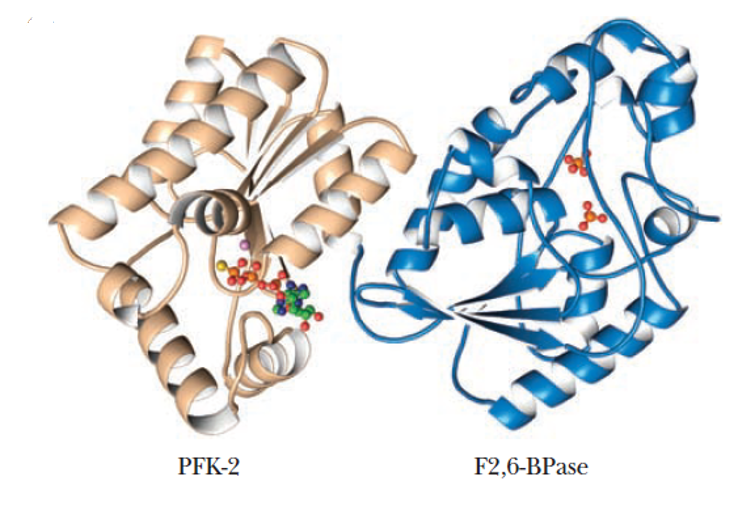
- both two enzymatic activities are found in the same protein molecule, which is a bifunctional, or tandem enzyme 双功能酶或串联酶
- Cellular levels of F-2,6-BP are controlled by phosphofructokinase-2 (PFK-2) and fructose-2,6-bisphosphatase (F-2,6-BPase)
- PFK-2 & F-2,6-BPase
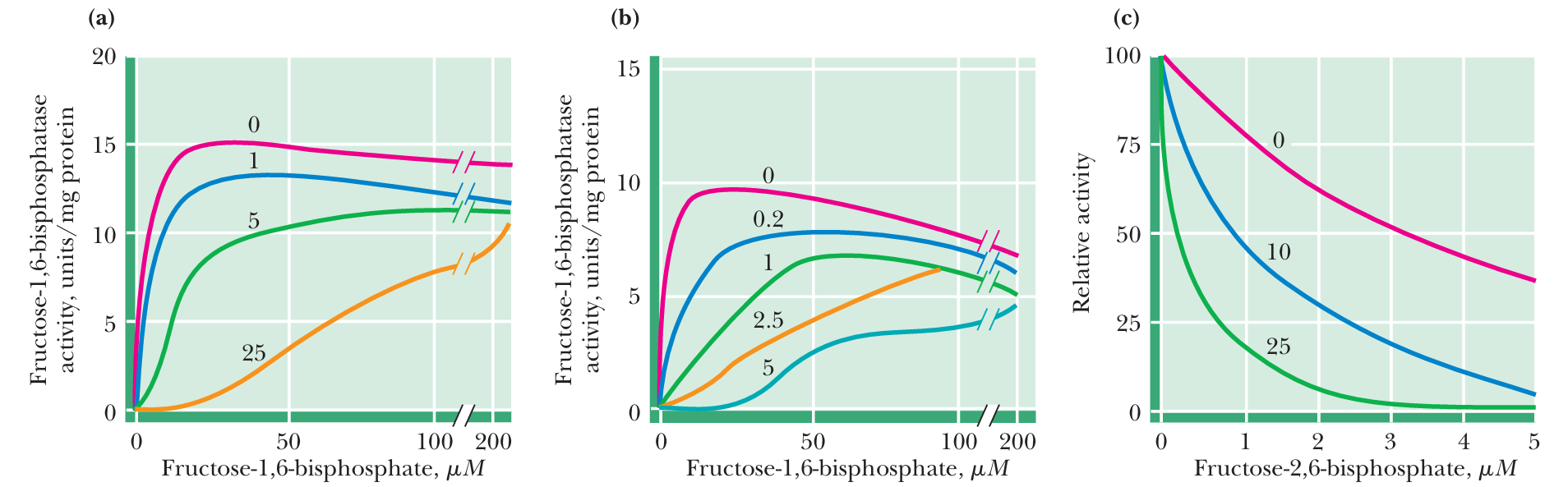
- ↓ AMP also inhibits the bisphosphatase, the inhibition by AMP is enhanced by fructose-2, 6-bisphosphate.
- the effects of ↓ AMP and ↓ fructose-2,6-bisphosphate are synergistic 协同
- (a)(b)分别是无/有25mM的AMP情况下F-2,6-BP不同浓度的影响,x轴是底物浓度,标注数字是F-2,6-BP, (c)是F-2,6-BP在存在 0/10/25 mM的AMP情况下对酶抑制的影响
- (a)(b)分别是无/有25mM的AMP情况下F-2,6-BP不同浓度的影响,x轴是底物浓度,标注数字是F-2,6-BP, (c)是F-2,6-BP在存在 0/10/25 mM的AMP情况下对酶抑制的影响
- regulation - allosteric
- 可以对比glycolysis中催化相反反应的酶 - phosphofructokinase 磷酸果糖激酶的调控, 这套调控系统令两个酶不会同时作用
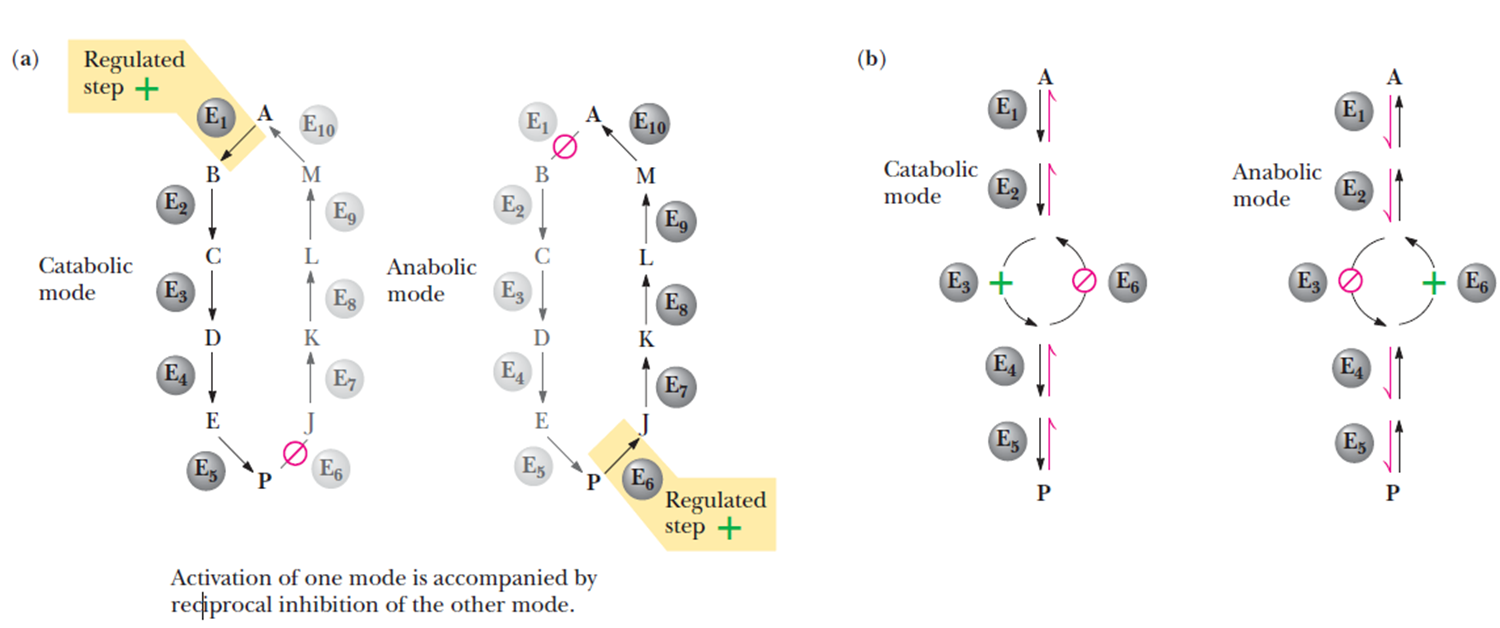
- 对 anabolism and catabolism 的独立调控有两种方式
- (a).two contrasting processes move alongdifferent routes
- (b).the rate-limiting steps serving as the points of regulation are catalyzed by different enzymes at opposing sequence
这一对酶属于(b) - 图
- G-6-P → glucose
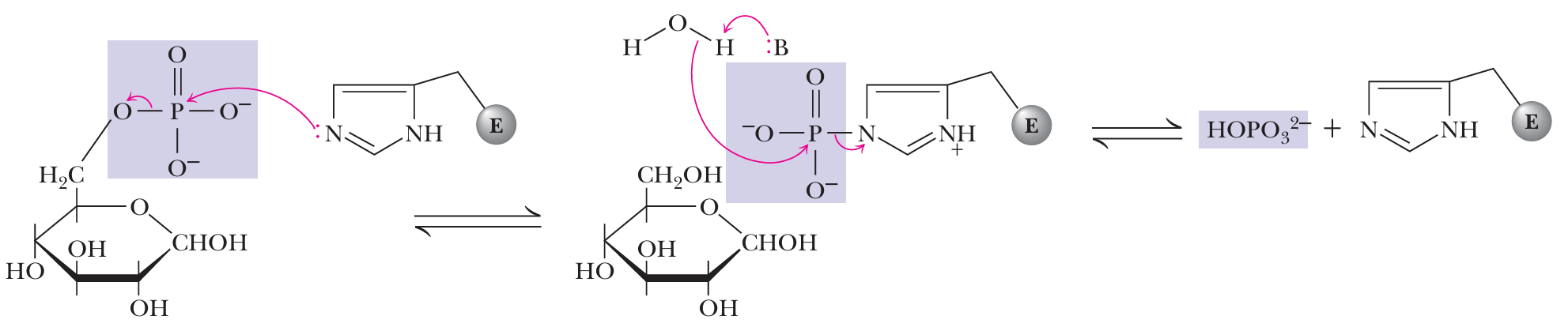
- The glucose-6-phosphatase reaction involves formation of a phosphohistidine intermediate
- The ∆G for the glucose-6-phosphatase reaction in liver is -5.1 kJ/mol
- 酶 - Glucose-6-Phosphatase
- localized in the ER membrane of liver and kidney cells, absent in muscle and brain
- Conversion of glucose-6-phosphate to glucose occurs during transport into the ER
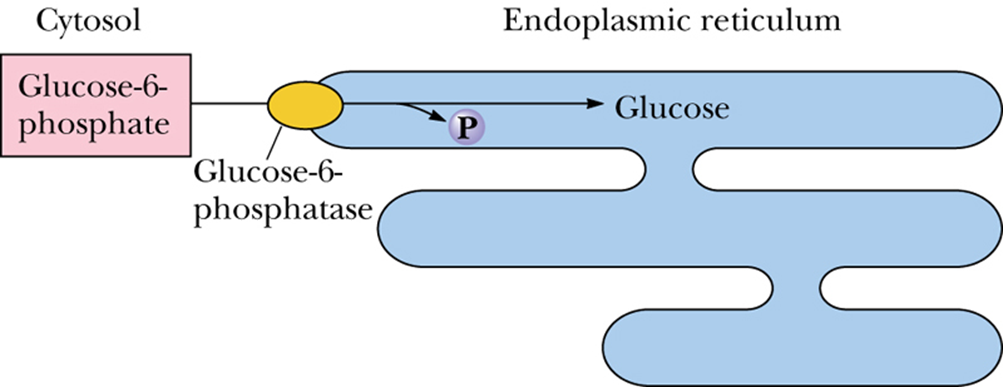
包裹在 vesicles 中转移出肝/肾细胞, 进入血液
- regulation
- not under allosteric control
- the Km for the substrate, glucose-6-phosphate, is considerably higher than the normal range of substrate concentrations
它对底物葡萄糖 - 6 - 磷酸的米氏常数 Km显著高于底物的正常浓度范围 - glucose-6-phosphatase displays a near-linear dependence of activity on substrate concentrations and is thus said to be under substrate-level control by glucose-6-phosphate
该酶的活性与底物浓度呈近线性依赖关系,故而被称为受葡萄糖 - 6 - 磷酸的底物水平调控
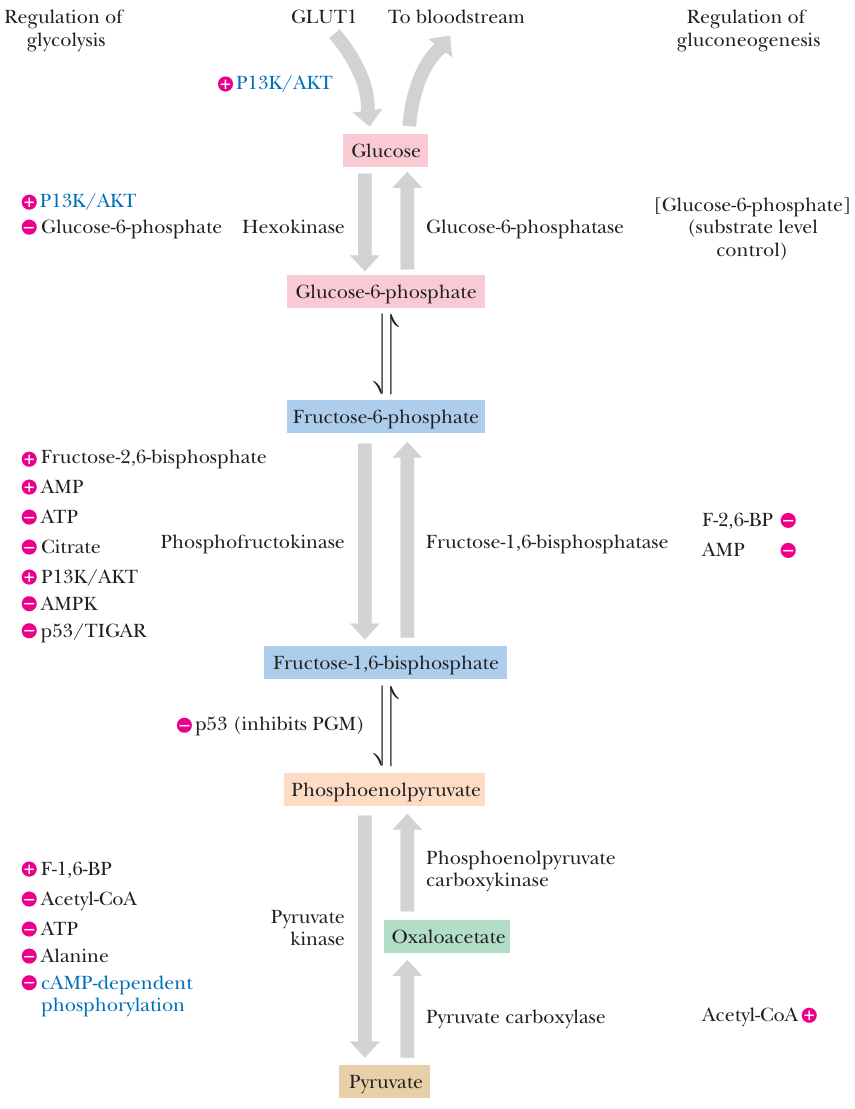
- regulation - 包括substrate level regulation & allosteric regulation
- 图
- 图
- basic
- Glycogen
- Catabolism 分解代谢
- 摄入淀粉的代谢(全消化掉)
- 支链淀粉的主链由α-(1→4)连接, 分支点是α-(1→6)
- 酶
- amylase
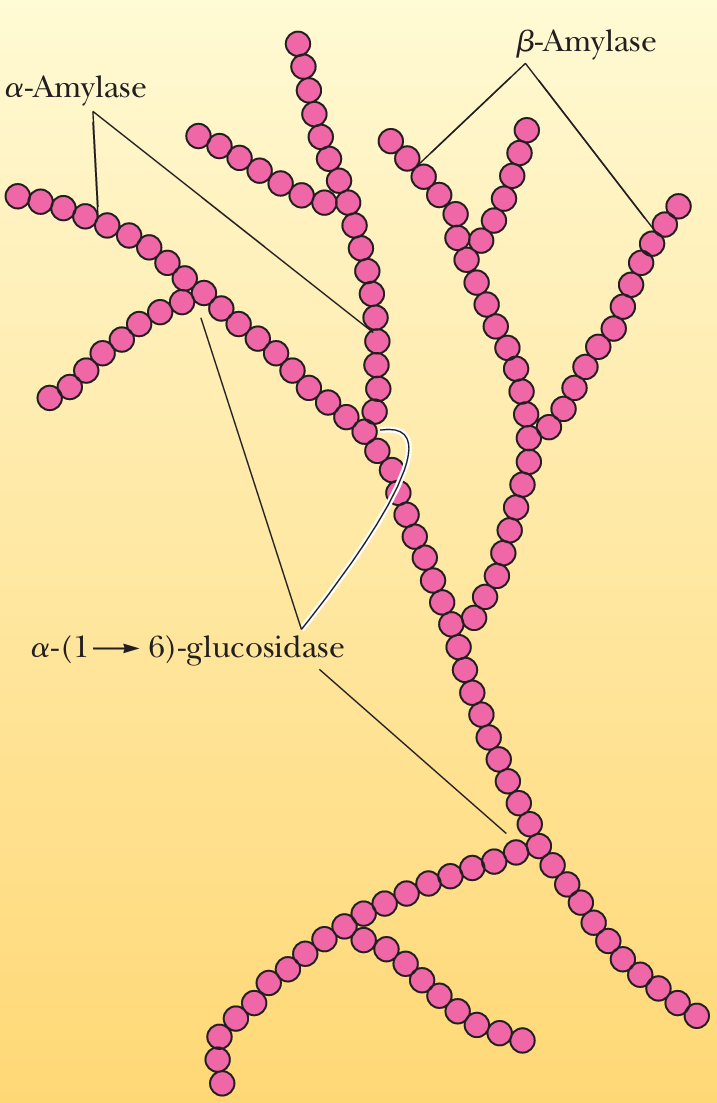
digest starch淀粉 and glycogen- α-amylase
随便切, 分支点附近四个不能切- an important component of saliva 唾液 and pancreatic juice 胰液
- α-Amylase is an endoglycosidase 内切糖苷酶
- hydrolyzes α(1→4) linkages of amylopectin支链淀粉 and glycogen at random positions, eventually producing a mixture of maltose, maltotriose [with three α(1→4)-linked glucose residues], and other small oligosaccharides.
可随机水解支链淀粉和糖原中的 α-(1→4) 糖苷键,最终生成麦芽糖、麦芽三糖及其他小分子寡糖的混合物 - α-Amylase can cleave on either side of an amylopectin branch point, but activity is reduced in highly branched regions of the polysaccharide and stops four residues from any branch point
α- 淀粉酶可在糖原或支链淀粉分支点的两侧进行切割,但在多糖的高度分支区域其活性会降低,且在距离任何分支点 4 个残基的位置停止切割
- b-amylase
从尾巴上切麦芽糖- found in plants
- β-Amylase is an exoglycosidase 外切糖苷酶
- cleaves maltose units from the free, nonreducing ends of amylopectin branches
从支链淀粉分支的游离非还原端切割麦芽糖(两个葡萄糖)单位 - does not cleave either the α-(1→6) bonds at the branch points or the α-(1→4) linkages near the branch points
- α-amylase
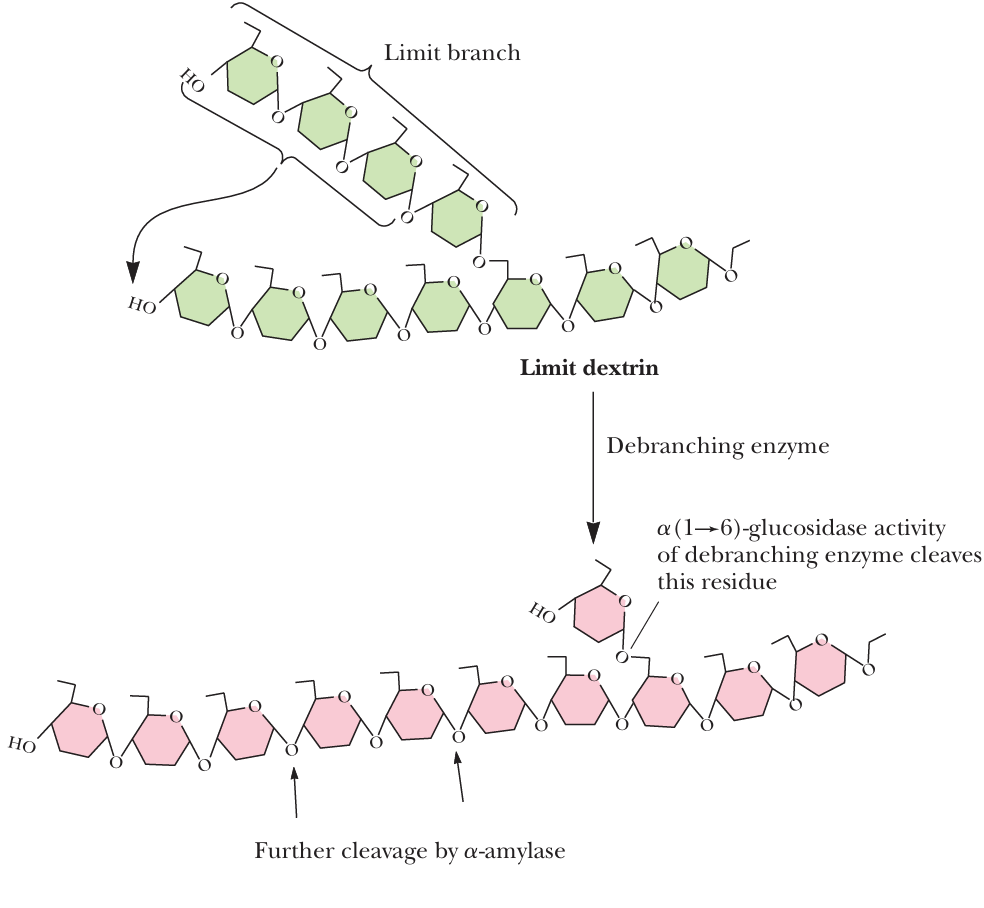
- debranching enzyme
- 活性1 - oligo(α1,4→α1,4) glucanotransferase 寡糖 (α1,4→α1,4) 葡聚糖转移酶活性
- The highly branched polysaccharides that are left after extensive exposure to α-amylase are called limit dextrins 极限糊精
- removes a trisaccharide unit and transfers this group to the end of another, nearby branch
它会切除一个三糖单位,并将该基团转移到附近另一个分支的末端 - This leaves a single glucose residue in α(1→6) linkage to the main chain
- 活性2 - α(1→6) glucosidase α(1→6) 葡糖苷酶活性
- cleaves this residue from the chain, leaving a polysaccharide chain with one branch fewer
- 图
- 活性1 - oligo(α1,4→α1,4) glucanotransferase 寡糖 (α1,4→α1,4) 葡聚糖转移酶活性
- amylase
- 储存糖原的代谢(精准调控)
- 用颗粒存储
- Glycogen reserves in liver and muscle tissue are stored in the cytosol as granules颗粒 exhibiting a molecular weight range from 6 * 10 ^ 6 to 1600 * 10 ^ 6.
- These granular颗粒 aggregates聚集体 contain the enzymes required to synthesize and catabolize the glycogen, as well as all the enzymes of glycolysis
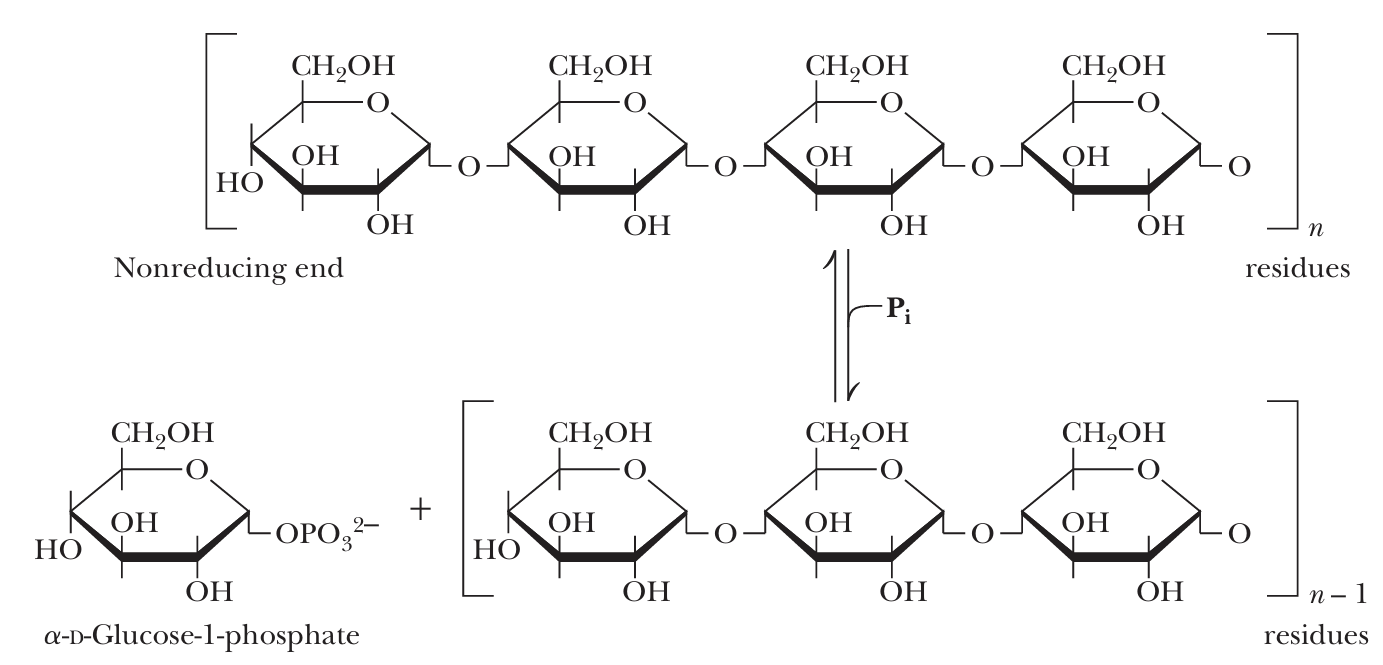
- The glycogen phosphorylase reaction
- this action degrades glycogen to produce limit dextrins, which are further degraded by debranching enzyme
- 图
- 酶 - glycogen phosphorylase 糖原磷酸化酶
- highly regulated enzyme
- 作用机理类似水解酶,可以将A-B化合物分解为AOH和B-phosphate
- regulation
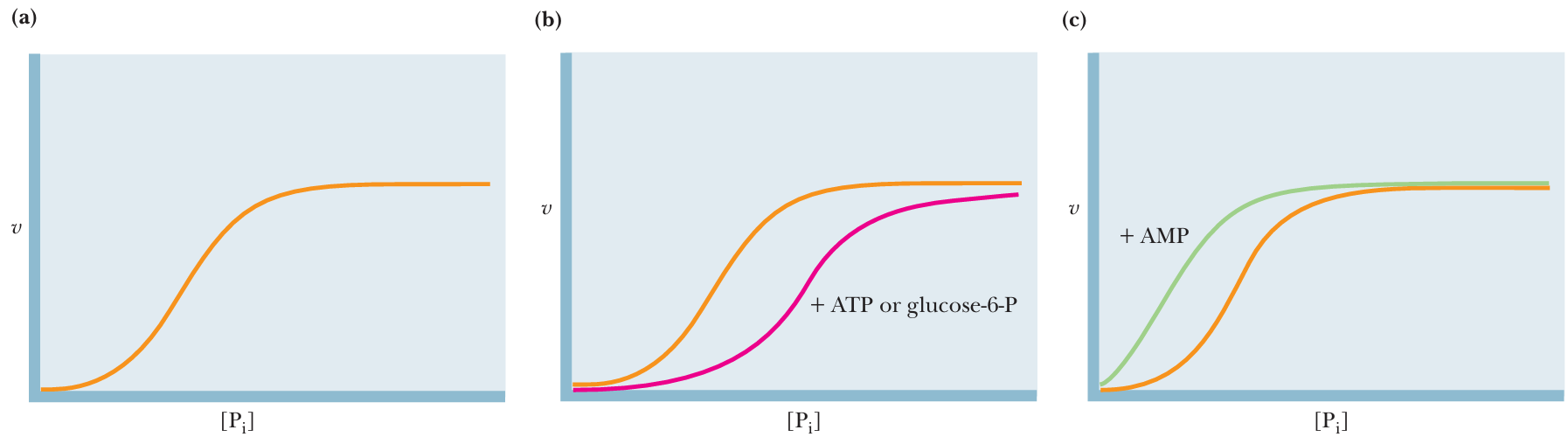
- 别构调节 - 从s曲线可以看出Cooperativity in Substrate Binding结合一个Pi会促进另一个Pi结合, ATP与glucose-6-P是Allosteric Inhibitors, AMP是Allosteric Activator, 分别代表了细胞能量状态, 细胞能量低会激活这个酶代谢糖原
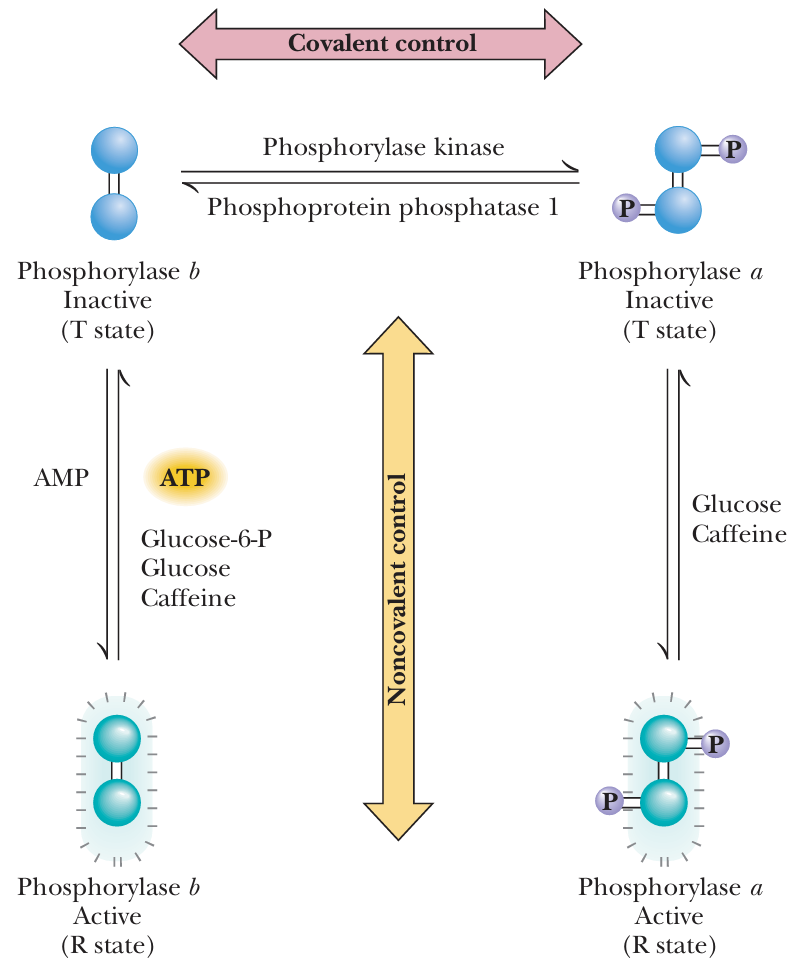
- 别构调节+共价修饰 - The mechanism of covalent modification and allosteric regulation of glycogen phosphorylase, 共价修饰的优先级高于别构调节, 可以把b形式转化到a形式, b形式受到别构调节, a形式不受别构调节且活性大于b形式并持续发挥作用
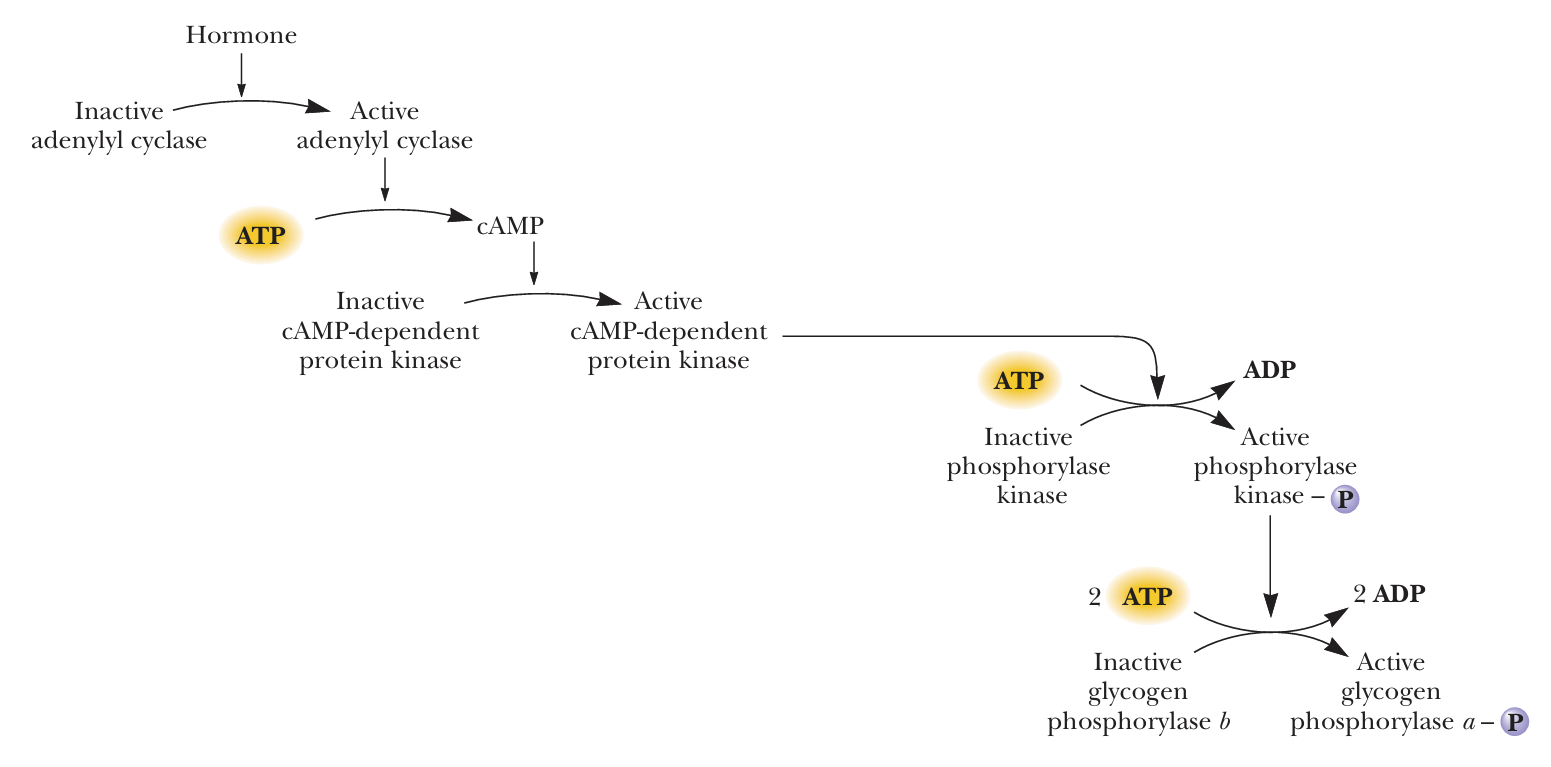
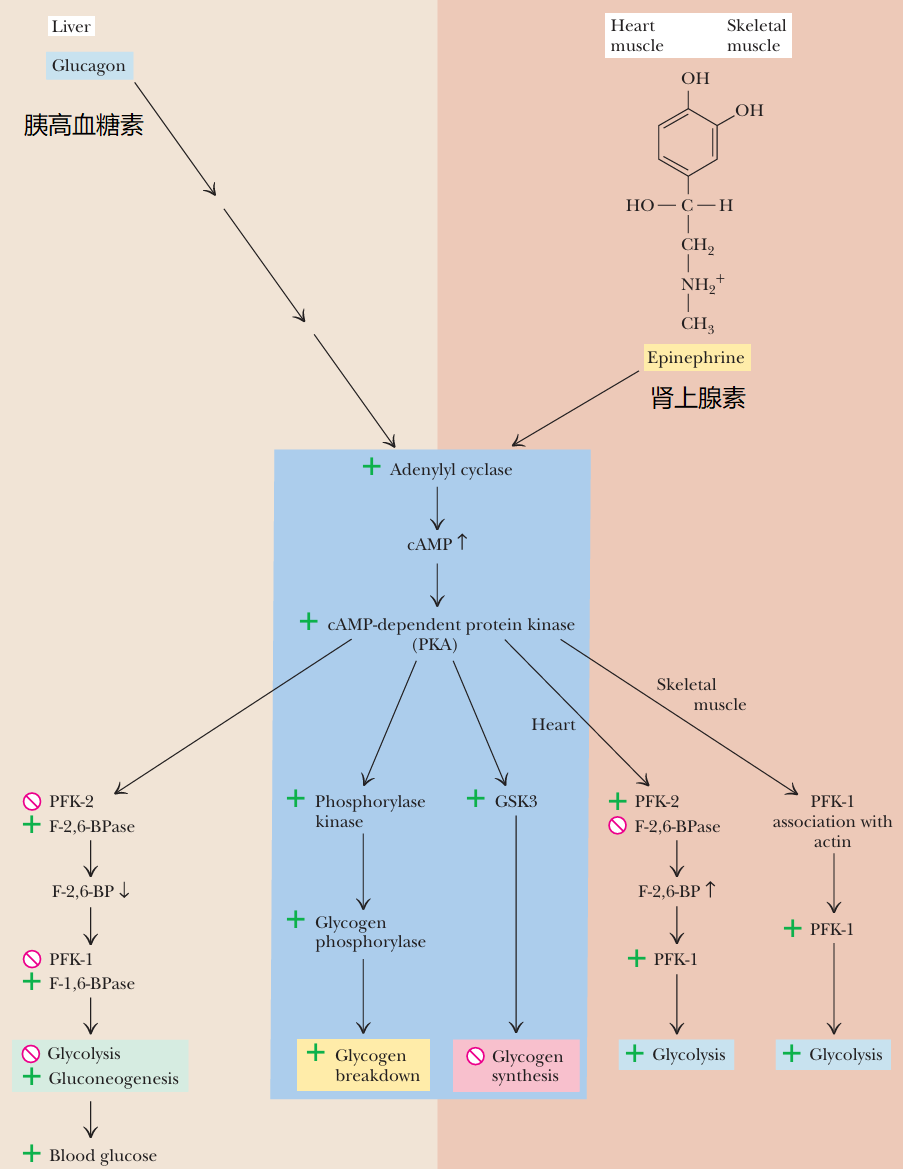
- 共价修饰 - The hormone-activated enzymatic cascade that leads to activation of glycogen phosphorylase
- 别构调节 - 从s曲线可以看出Cooperativity in Substrate Binding结合一个Pi会促进另一个Pi结合, ATP与glucose-6-P是Allosteric Inhibitors, AMP是Allosteric Activator, 分别代表了细胞能量状态, 细胞能量低会激活这个酶代谢糖原
- in vivo, [pi]:[glucose-1-phosphate] = 100:1, ΔG = -6kJ/mol
- There is an energetic advantage to the cell in this phosphorolysis reaction
- If glycogen breakdown were hydrolytic and yielded glucose as a product, it would be necessary to phosphorylate the product glucose (will need one ATP) to start its glycolytic degradation
- 若糖原通过水解分解产生葡萄糖,还需消耗 1 分子 ATP 将葡萄糖磷酸化,才能启动其糖酵解降解过程
- 而这个反应的pi来源不一定是ATP, 可以是无机磷酸, 相当于省ATP了
- Synthesis 合成
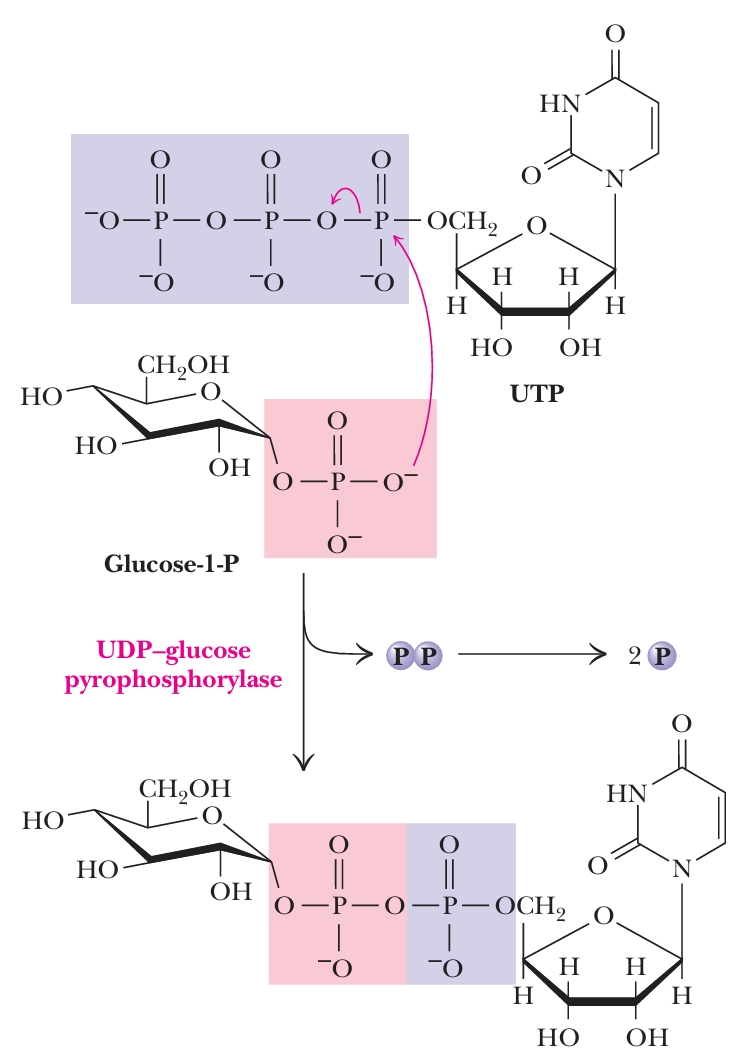
- reaction 1 - UDP–Glucose Synthesis
- 酶 - UDP–glucose pyrophosphorylase UDP-葡萄糖焦磷酸化酶
- The reaction is a phosphoanhydride 磷酸酐 exchange
磷酸酐键 (-O-P-O-P-) - a phosphoryl oxygen of glucose-1-P attacking the α-phosphorus of UTP to form UDP-glucose and pyrophosphate
- Glucose-1-P + UTP + H2O → UDP–glucose + 2 Pi
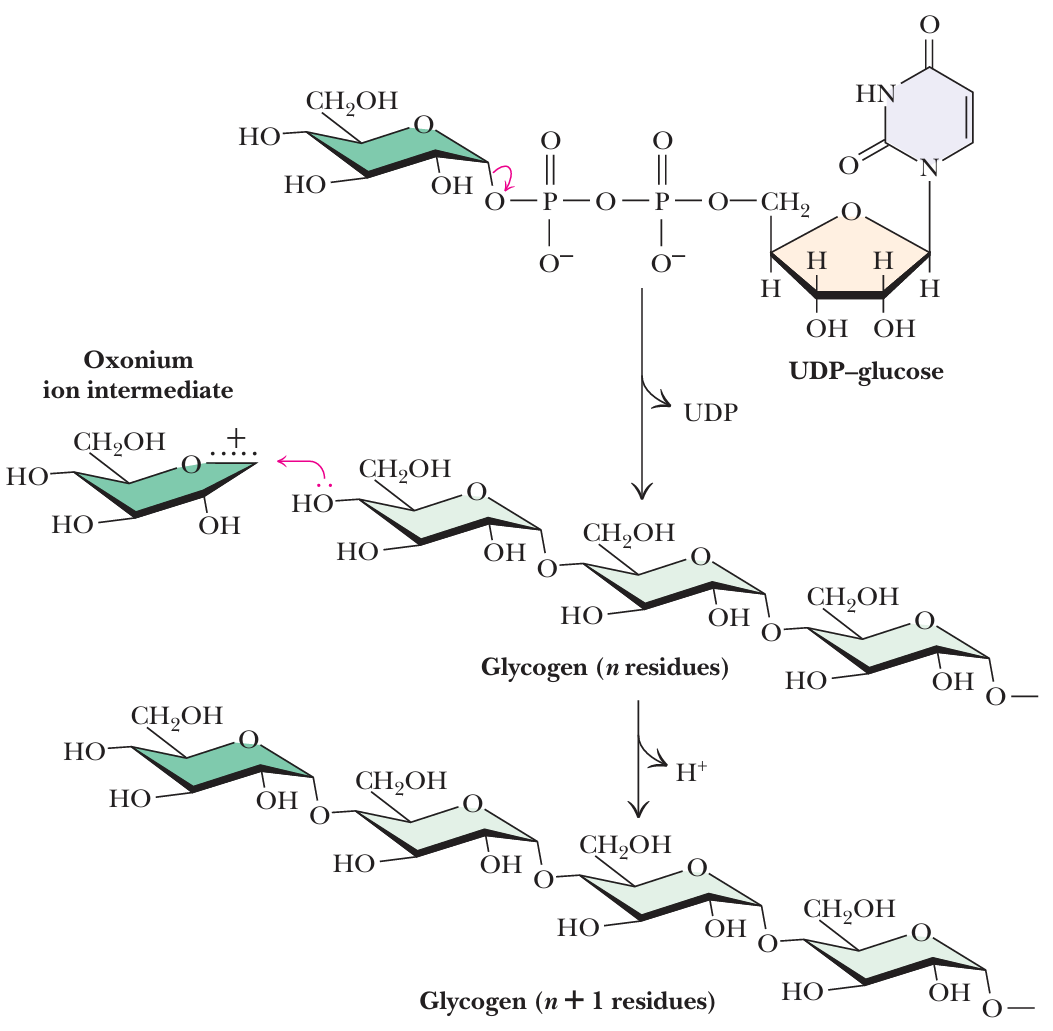
- reaction 2 - Formation of α(1→4) Glycosidic Bonds in Glycogen
- Cleavage of the C-O bond of UDP-glucose yields anoxonium ion 氧鎓 intermediate
UDP - 葡萄糖的碳 - 氧键断裂,生成氧鎓离子中间体 - Attack by the hydroxyl oxygen of the terminal residue of a glycogen molecule completes the reaction
糖原分子末端残基的羟基氧发起亲核进攻,最终完成反应 - 图
- Cleavage of the C-O bond of UDP-glucose yields anoxonium ion 氧鎓 intermediate
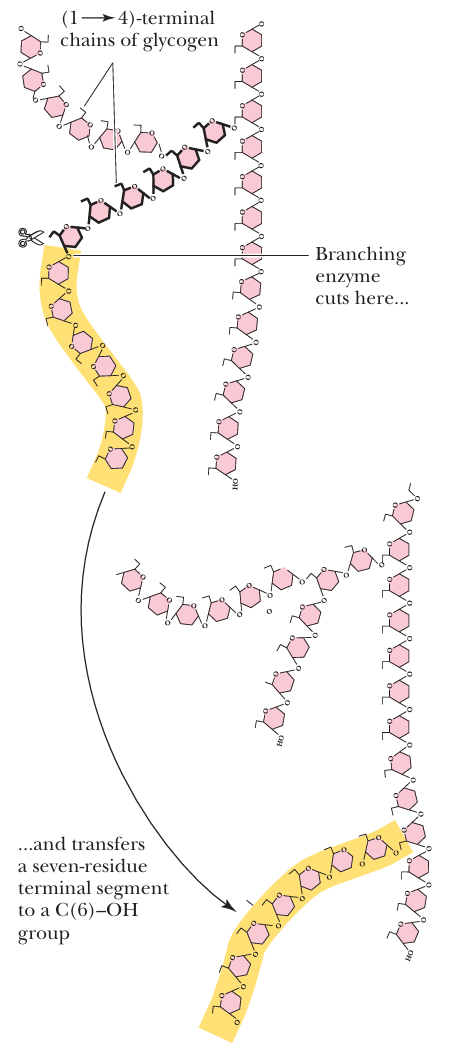
- reaction 3 - Glycogen Branching
- Glycogen Branching Occurs by Transfer of Terminal Chain Segments
- 酶 - amylo-(1,4 to 1,6)-transglycosylase 淀粉-转糖苷酶, also known as branching enzyme
- The reaction involves the transfer of a 6- or 7-residue segment from the nonreducing end of a linear chain at least 11 residues in length to the C-6 hydroxyl of a glucose residue of the same chain or another chain
该反应涉及将一段含 6 或 7 个残基的片段,从一条长度至少为 11 个残基的线性链的非还原端,转移至同一条链或另一条链中某个葡萄糖残基的 C-6 羟基上 - For each branching reaction, the resulting polymer has gained a new terminus at which growth can occur
每发生一次分支反应,生成的聚合物就会新增一个可继续延伸的末端 - 图
- reaction 1 - UDP–Glucose Synthesis
- regulation
- Control of glycogen metabolism is effected via reciprocal相互 regulation of glycogen phosphorylase and glycogen synthase
- Regulation involves both allosteric control and covalent modification, with the latter being under hormonal control
这种调控涉及别构调节和共价修饰两种方式,其中共价修饰受激素调控 - 图
- Catabolism 分解代谢
- The Pentose Phosphate Pathway
- basic
- 作用
- Cells require a constant supply of NADPH for reductive reactions vital to biosynthetic purposes.
给细胞提供电子 - In addition to providing NADPH for biosynthetic processes, this pathway produces ribose-5-phosphate, which is essential for nucleic acid synthesis
提供合成核酸的底物 - Several metabolites of the pentose phosphate pathway can also be shuttled into glycolysis
进入糖酵解
- Cells require a constant supply of NADPH for reductive reactions vital to biosynthetic purposes.
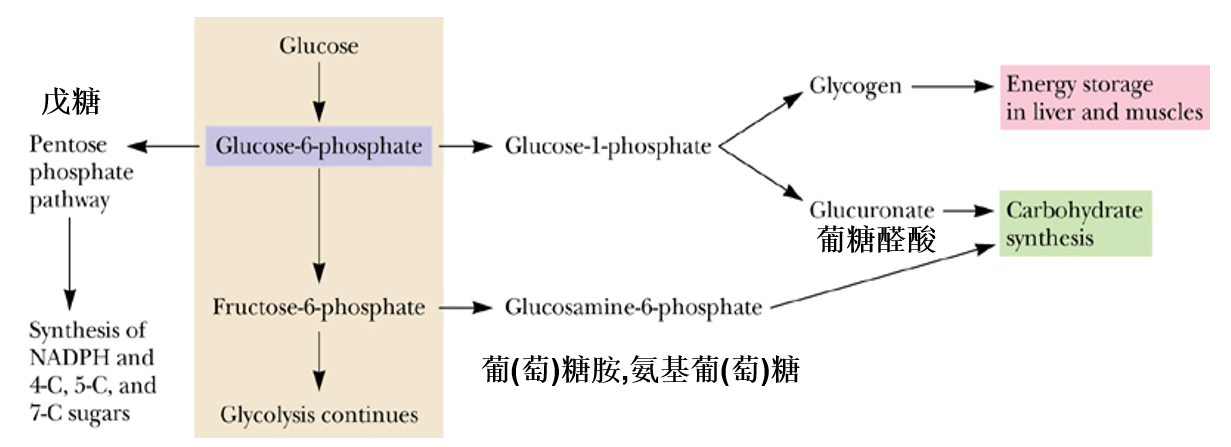
- Pentose Phosphate Pathway 从G-6-P分叉出来
- Glucose-6-phosphate is the branch point for several metabolic pathways
- Glucose-6-phosphate is the branch point for several metabolic pathways
- 位置
- The enzymes of the pentose phosphate pathway are particularly abundant in the cytoplasm of liver and adipose cells.
- These enzymes are largely absent in muscle, where glucose-6-phosphate is used primarily for energy production via glycolysis and the TCA cycle.
- These pentose phosphate pathway enzymes are located in the cytoplasm, which is the site of fatty acid synthesis, a pathway heavily dependent on NADPH for reductive reactions
- 反应
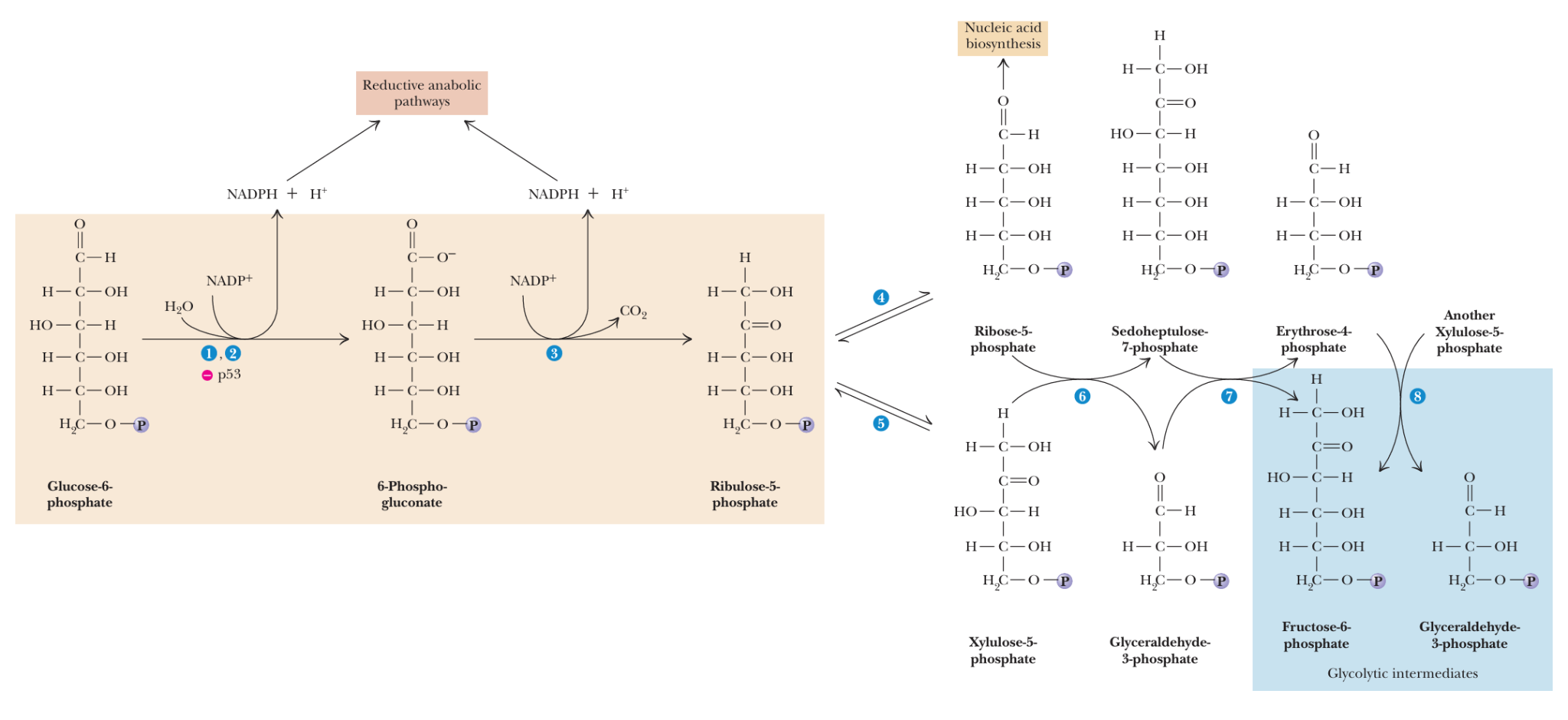
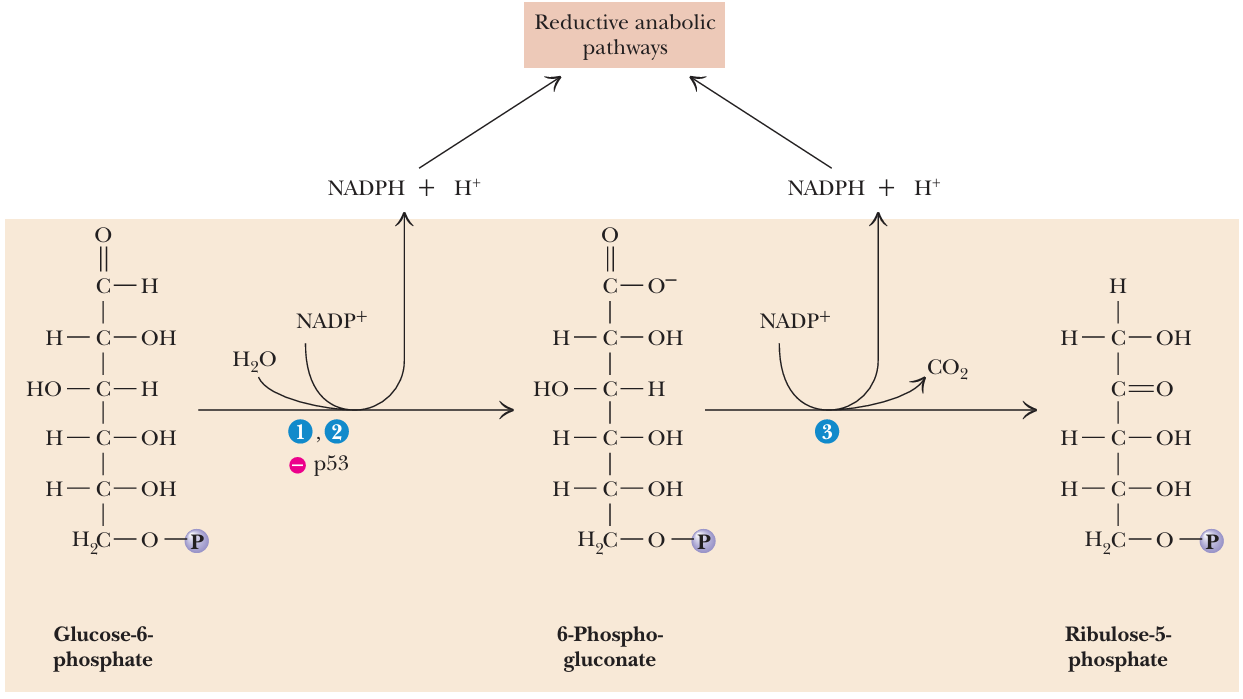
- begins with glucose-6-phosphate(6-C),and produces three-,four-, five-, six-, and seven-carbon sugars.
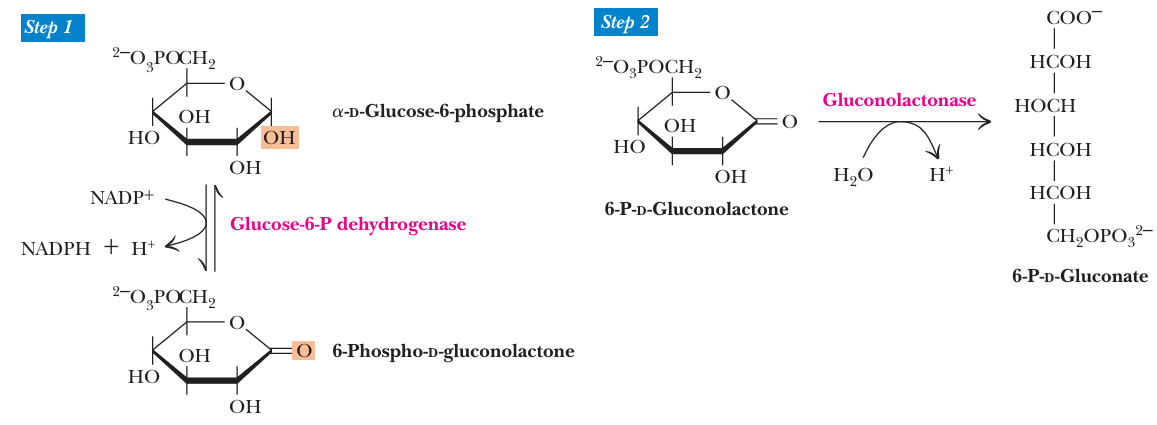
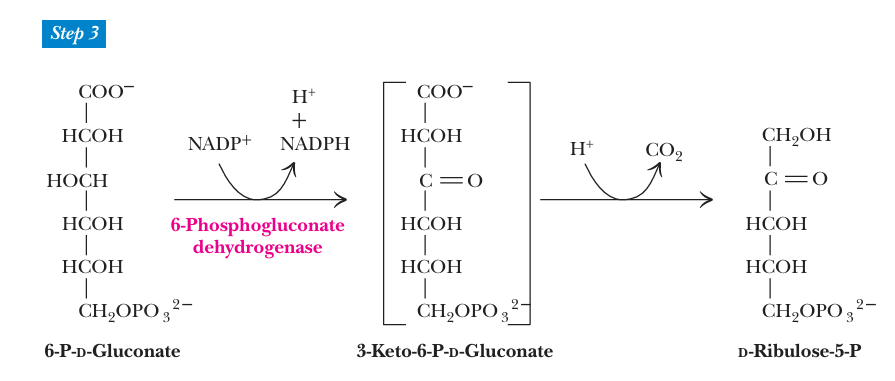
- Two successive oxidations lead to the reduction of NADP to NADPH and the release of CO2.
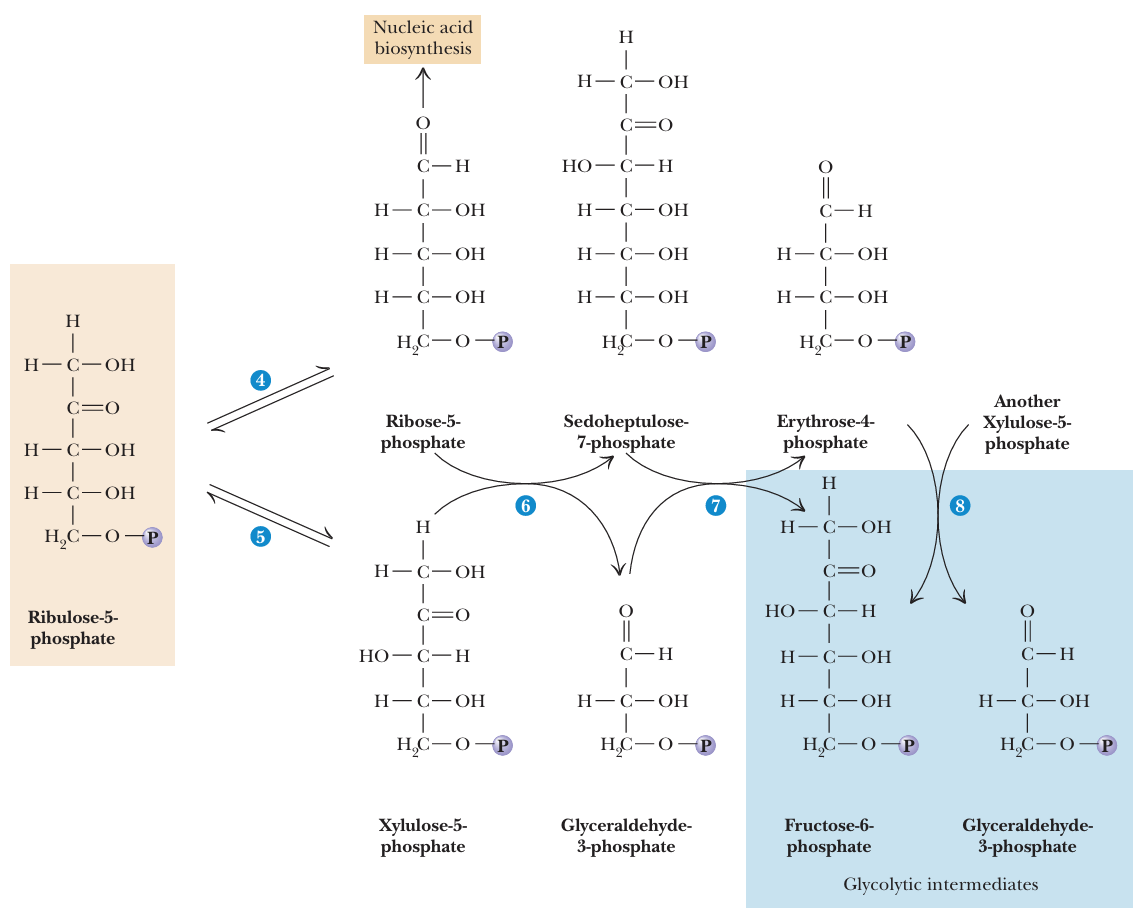
- Five subsequent nonoxidative steps produce a variety of carbohydrates, some of which may enter the glycolytic pathway
- 图
- 作用
- 2 oxidative reaction
- 图
- step1,2 酶-glucose-6-P dehydrogenase(G6PDH脱氢酶) & gluconolactonase
- step3 酶-6-phosphogluconate dehydrogenase(6PGDH脱氢酶)
- 图
- 4 nonoxidative reaction
- 图
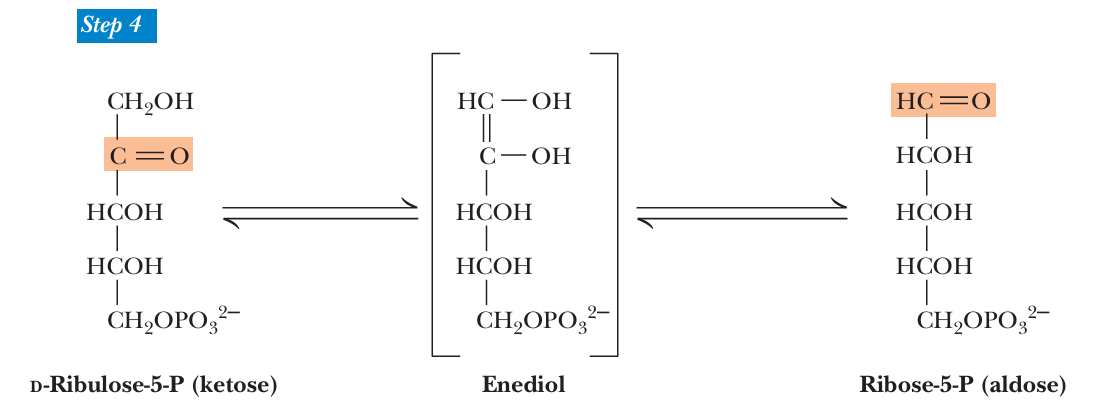
- step4 酶-Phosphopentose Isomerase
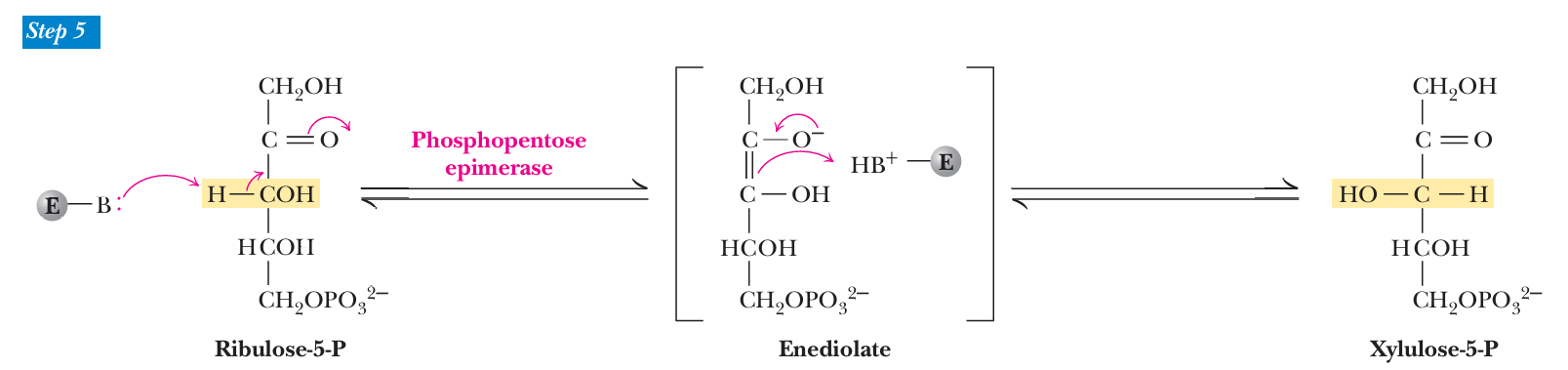
- step5 酶- Phosphopentose epimerase表异构酶
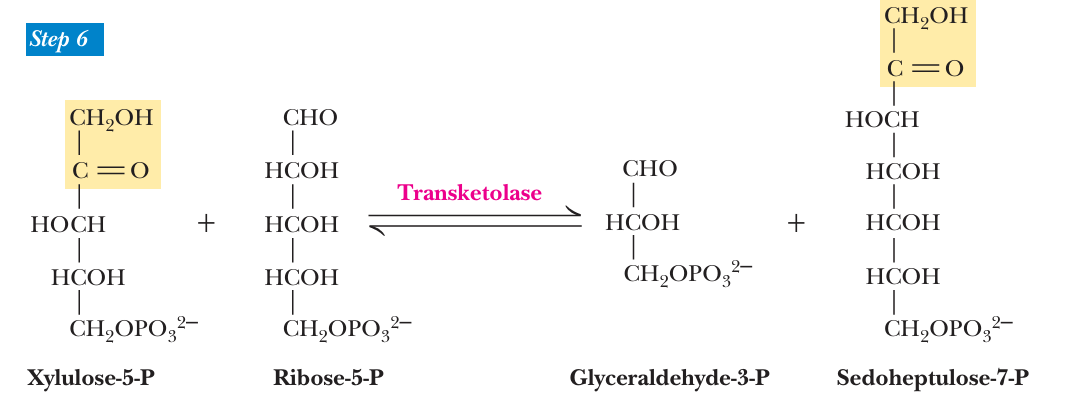
- step6 酶-Transketolase 转酮醇酶
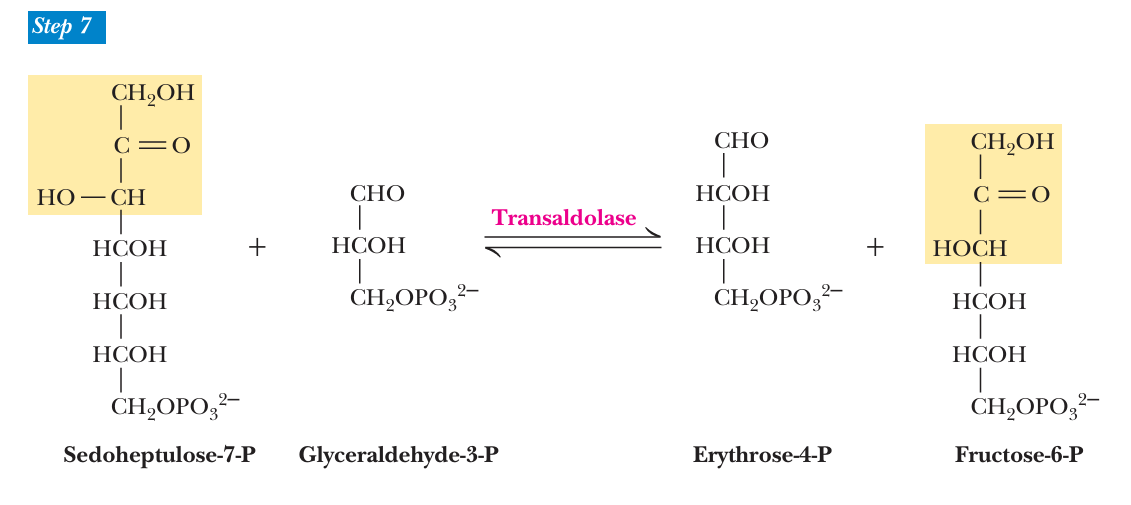
- step7 酶-Transaldolase 转醛醇酶
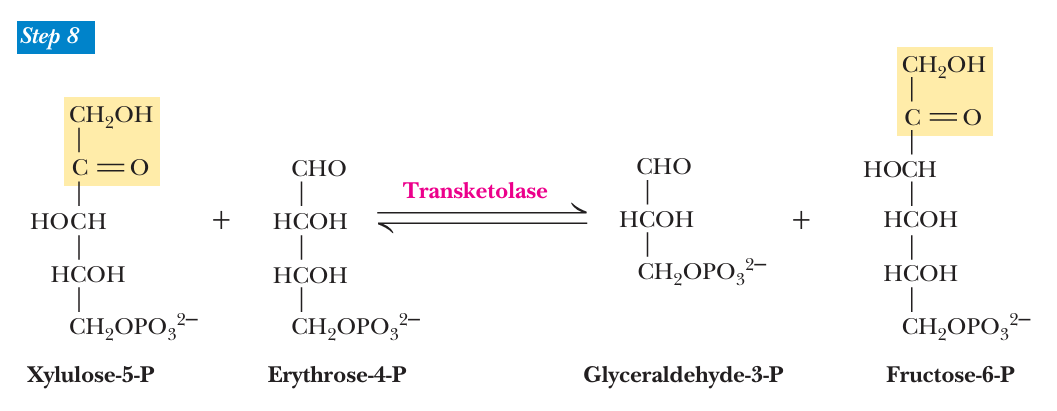
- step8 酶-Transketolase 转酮醇酶
- 图
- Utilization of Glucose-6-P Depends on the Cell’s Need for ATP, NADPH, and Ribose-5-P
细胞如何选择G-6-P的去向- basic
- G-6-P can be used as a substrate either for glycolysis or for the pentose phosphate pathway
细胞可以选择怎么使用G-6-P - ATP can be produced in abundance if G-6-P is channeled into glycolysis.
- if NADPH or ribose-5-phosphate is needed, G-6-P can be directed to the pentose phosphate pathway
- the fate of glucose-6-P is determined to a large extent by the relative activities of phosphofructokinase (PFK) and glucose-6-P dehydrogenase
PFK让G-6-P进入糖酵解, 脱氢酶让G-6-P进入pentose phosphate pathway - PFK (phosphofructokinase)
- inhibited when the ATP/AMP ratio increases
- inhibited by citrate but activated by fructose-2,6-bisphosphate
- when the energy ratio is high, glycolytic flux decreases.
- Glucose-6-P dehydrogenase
- inhibited by high levels of NADPH and also by the intermediates of fatty acid biosynthesis.
- Both of these are indicators that biosynthetic demands have been satisfied.
- However, if NADPH levels drop, the pentose phosphate pathway turns on.
- G-6-P can be used as a substrate either for glycolysis or for the pentose phosphate pathway
- Both Ribose-5-P and NADPH Are Needed by the Cell
- In this case, the first four reactions of the pentose phosphate pathway predominate.
- NADPH is produced by the oxidative reactions of the pathway, and ribose-5-P is the principal product of carbon metabolism.
- As stated earlier, the net reaction forthese processes is
- More Ribose-5-P Than NADPH Is Needed by the Cell
- Synthesis of ribose-5-P can be accomplished without production of NADPH if the oxidative steps of the pentose phosphate pathway are bypassed.
- The key to this route is the withdrawal of fructose-6-P and glyceraldehyde-3-P, but not glucose-6-P, from glycolysis.
- The action of transketolase and transaldolase on fructose-6-P and glyceraldehyde-3-P produces three molecules of ribose5-P from two molecules of fructose-6-P and one of glyceraldehyde-3-P.
转酮醇酶和转醛醇酶作用于这两种底物,使 2 分子果糖 - 6 - 磷酸和 1 分子甘油醛 - 3 - 磷酸反应生成 3 分子 5 - 磷酸核糖 - In this route, as in case 1, no carbon metabolites are returned to glycolysis.
- The net reaction for this route is
- More NADPH Than Ribose-5-P Is Needed by the Cell
- Large amounts of NADPH can be supplied for biosynthesis without concomitant production of ribose-5-P if ribose-5-P produced in the pentose phosphate pathway is recycled to produce glycolytic intermediates.
- This alternative involves a complex interplay between the transketolase and transaldolase reactions to convert ribulose-5-P to fructose-6-P and glyceraldehyde-3-P, which can be recycled to glucose-6-P via gluconeogenesis.
将R-5-P转化为F-6-P和G-3-P再通过糖异生变回G-6-P, 回收R-5-P - The net reaction for this process is
- Both NADPH and ATP Are Needed by the Cell, but Ribose-5-P Is Not
- Under some conditions, both NADPH and ATP must be provided in the cell.
- This can be accomplished in a series of reactions similar to case 3 if the fructose-6-P and glyceraldehyde-3-P produced in this way proceed through glycolysis to produce ATP and pyruvate, which itself can yield even more ATP by continuing on to the TCA cycle.
- The net reaction for this alternative is
- except for the three molecules of CO2, all the other carbon from glucose-6-P is recovered in pyruvate
- basic
- 五碳糖途径可以促进脂肪合成 → Regulation of fatty acid synthesis and oxidation
- When blood [glucose] rises after carbohydrate rich meal, glycolysis and the pentose phosphate pathway are activated in the liver
- 五碳糖途径可以产生NADPH, 为脂肪合成提供 electrons
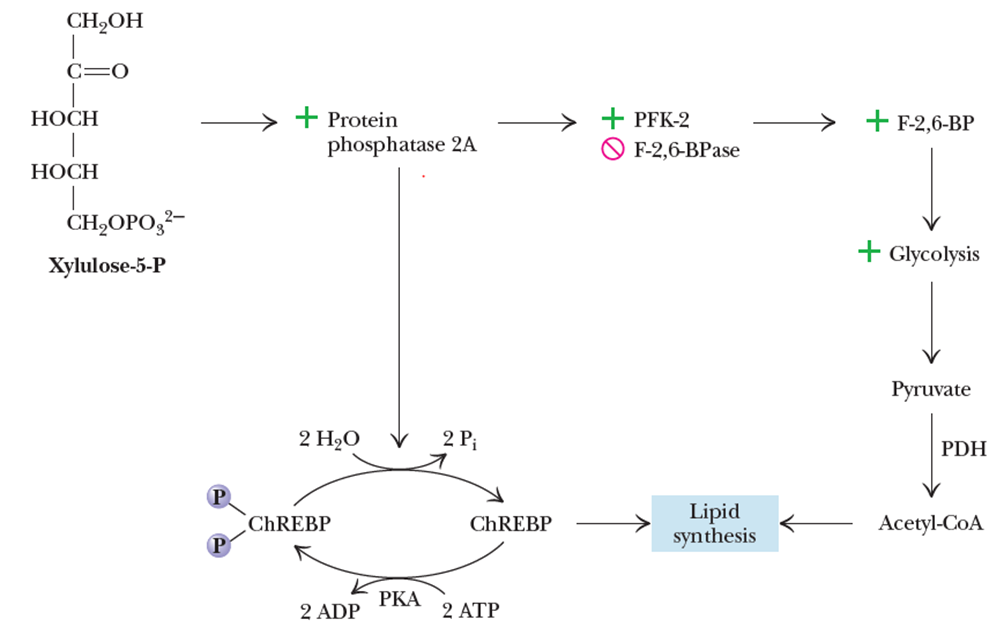
- xylulose-5-phosphate produced in the latter pathway stimulates protein phosphatase 2A (PP2A)
- PP2A
- 图
- PP2A 可以 dephosphorylates ACC, 促进脂肪合成
- PP2A 可以促进glycolysis, 产生更多Acetyl-CoA
- PP2A 可以 dephosphorylates ChREBP, activates expression of liver genes for lipid synthesis
- 图
- basic









All articles in this blog are licensed under CC BY-NC-SA 4.0 unless stating additionally.