生物力学_Muscles
Muscles
- basic
- Learning Objectives
- Understand the composition and structure of skeletal muscles.
- Know the molecular basis of muscle contraction.
- Understand the mechanics of muscle contraction and force production in muscle.
- Know muscle fiber differentiation and muscle remodeling.
- Muscle Types
- skeletal muscle骨骼肌
- Skeletal muscles comprise 40 to 45% of total body weight.
- attached to bones via tendons肌腱.
- responsible for locomotion and body motion.
- under voluntary control.
- smooth muscle平滑肌
- Smooth muscle is typically found surrounding the lumen of tubes within the body.
- Examples include blood vessels, the urinary tract, and the gastrointestinal tract.
- Smooth muscle controls the caliber of the lumen and generates peristaltic waves.
- under involuntary control
- cardiac muscle心肌
- Cardiac muscle makes up the major bulk of the heart mass.
- It is sufficiently unique to be considered a different muscle type.
- under involuntary control
- skeletal muscle骨骼肌
- Learning Objectives
- Skeletal Muscle
- Structure and Organization
- Gross Organization
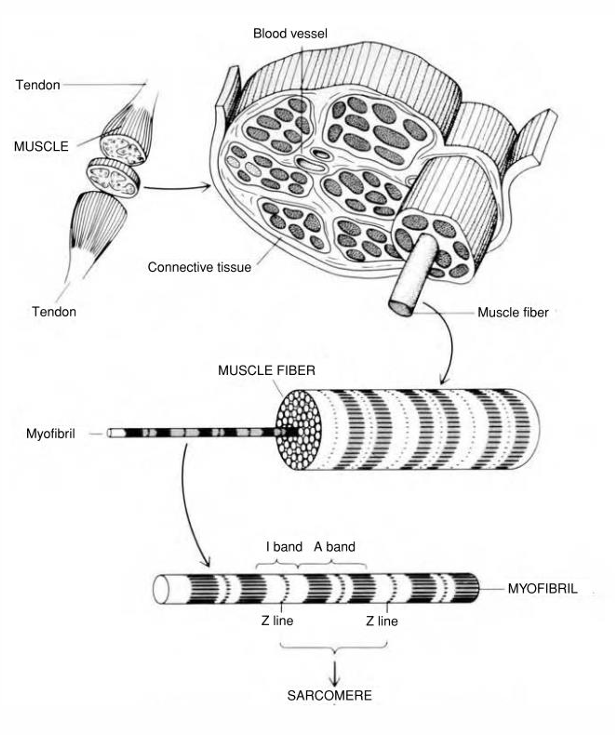
- sarcomere→myofibril→muscle fiber+blood vessel+connective tissue→muscle
- Skeletal muscle is a remarkably efficient and adaptable tissue.
- Skeletal muscles are typically relatively long and thin, often described as spindle shaped
- In cross-section, skeletal muscle consists of
- blood vessels
- connective tissues
- muscle fibers肌纤维
- Individual muscle fibers are long rod-shaped muscle cells
- 10 to 100 μm in diameter
- up to 30 cm in length
- Muscle fibers are typically multinucleated and contain many mitochondria.
- The most prominent constituent of the muscle fiber is the myofibril肌原纤维.
- The myofibril is made up of several sarcomeres肌节.
- Individual muscle fibers are long rod-shaped muscle cells
- sarcomere→myofibril→muscle fiber+blood vessel+connective tissue→muscle
- Sarcomere Filaments
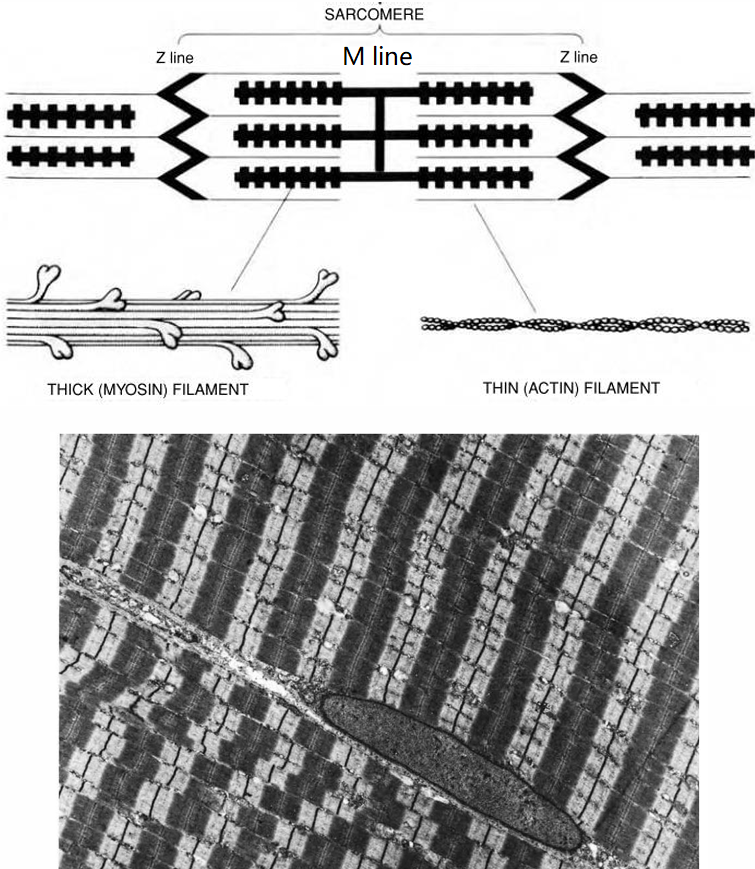
- 黑的粗的myosin连着M, 白的细的actin连着Z
- thick filaments粗肌丝
- about 15 nm in diameter
- composed of myosin肌球蛋白
- located in the central region of the sarcomere
- their orderly, parallel arrangement gives rise to dark bands
- thin filaments细肌丝
- approximately 5 nm in diameter
- composed of actin肌动蛋白
- attached at either end of the sarcomere to the Z line
- The Z line links thin filaments of adjacent sarcomeres and defines the limits of each sarcomere.
- Thin filaments extend from the Z line toward the center of the sarcomere, where they overlap with thick filaments.
- 黑的粗的myosin连着M, 白的细的actin连着Z
- Band Nomenclature
- 收缩时A不变,I变短H变短
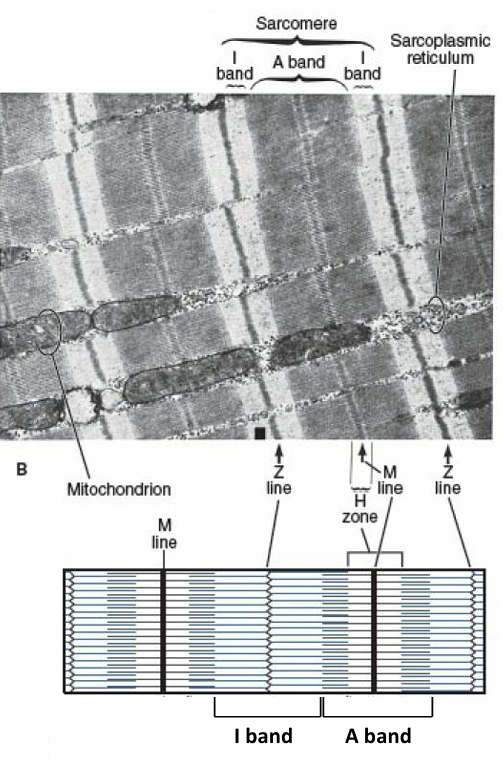
- A band
- A bands are the thick filaments which are strongly anisotropic.
- The width of the A band remains constant during sarcomere shortening.
- I band
- The I band is bisected by the Z lines.
- It contains the portion of the thin filaments that does not overlap with the thick filaments.
- It also contains the elastic part of titin.
- The I band decreases as the Z lines move closer together during shortening.
- H zone
- In the center of the A band, in the gap between the ends of the thin filaments, is the H zone.
- It is a light band containing only thick filaments and the part of titin integrated in the thick filaments.
- M line
- A narrow dark area in the center of the H zone is the M line.
- It is produced by transversely and longitudinally-oriented proteins that link adjacent thick filaments.
- It maintains the parallel arrangement of thick filaments.
- Z line
- Z lines define the boundaries of each sarcomere.
- Adjacent sarcomeres share the Z-line linkage of thin filaments.
- 收缩时A不变,I变短H变短
- Gross Organization
- Molecular Basis of Muscle Contraction
- Sliding Filament Mechanism
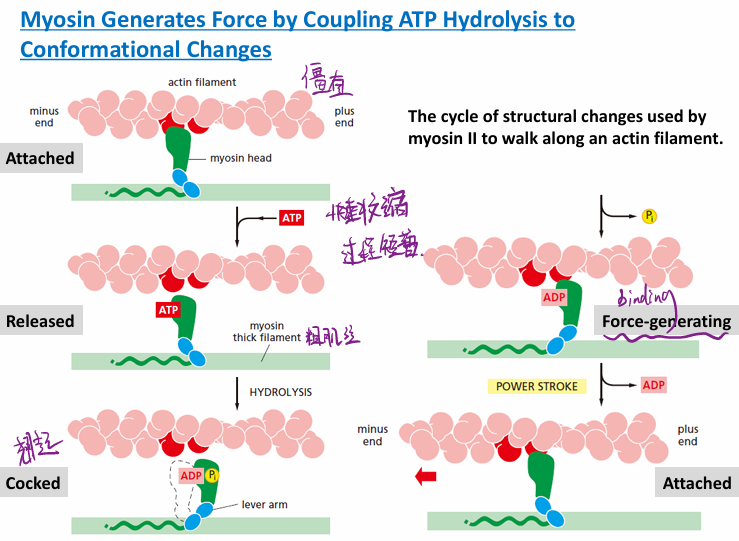
- 本质是myosin head一直扒拉actin
- Active shortening of the sarcomere, and hence of the muscle, results from relative movement of actin and myosin filaments past one another.
- Each filament retains its original length during sliding.
- The force of contraction is developed by the myosin heads, or cross-bridges横桥.
- Cross-bridges act in the region of overlap between actin and myosin.
- A single movement of a cross-bridge produces only a small displacement of the actin filament relative to the myosin filament.
- Each individual cross-bridge detaches from one receptor site on actin and reattaches to another site farther along.
- The process repeats five or six times.
- At any given moment only about half of the cross-bridges actively generate force and displacement.
- When active cross-bridges detach, others take up the task so that shortening is maintained.
- Sarcomere shortening is reflected as a decrease in the I band, the A band remains constant.
- Calcium and Excitation-Contraction Coupling
- 电信号 → 化学信号Ca2+ → 电信号
- calcium ion Ca2+钙离子
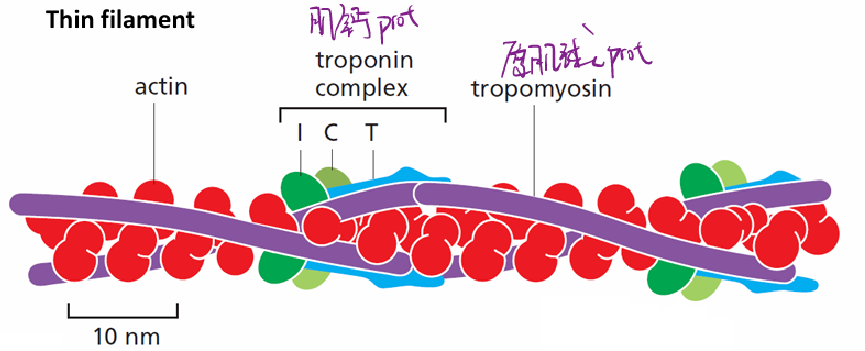
- 原肌球蛋白会挡住thin filament上与myosin的结合位点,当有Ca2+时,肌钙蛋白会拉着原肌球蛋白移动,露出与myosin的结合位点,肌肉收缩
- A key to the sliding mechanism is Ca2+, which turns contractile activity on and off.
- Muscle contraction is initiated when calcium is made available to the contractile elements.
- Contraction ceases when calcium is removed.
- 原肌球蛋白会挡住thin filament上与myosin的结合位点,当有Ca2+时,肌钙蛋白会拉着原肌球蛋白移动,露出与myosin的结合位点,肌肉收缩
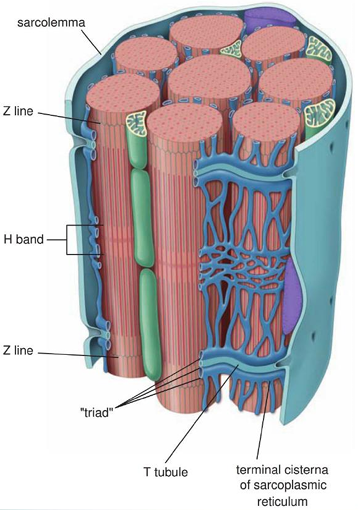
- sarcolemma肌膜
- 肌膜的内质网存着Ca2+
- Mechanisms that regulate calcium availability are coupled to electric events in the muscle membrane.
- An action potential in the sarcolemma provides the electric signal for initiating contractile activity.
- 肌膜的内质网存着Ca2+
- excitation-contraction coupling兴奋-收缩耦联
- The electric signal triggers the chemical events of contraction.
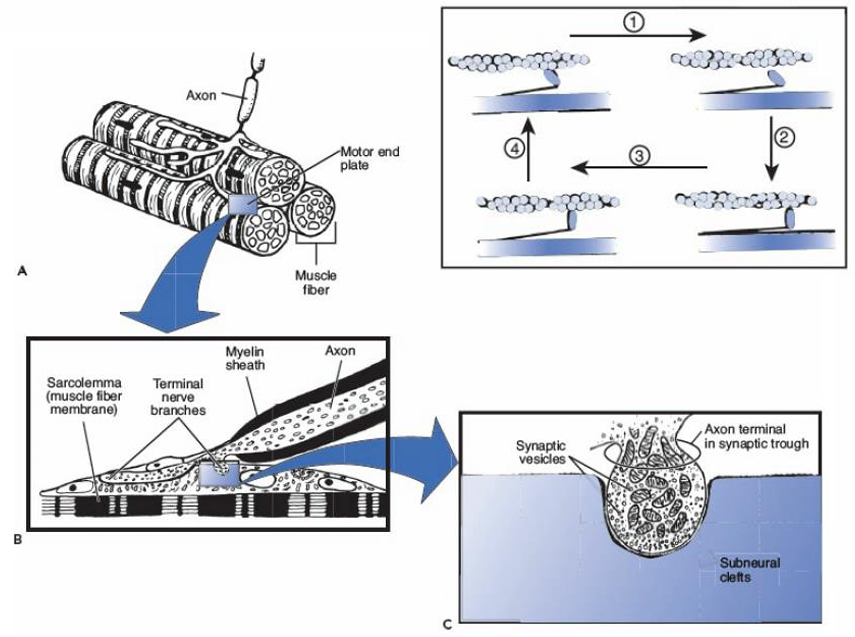
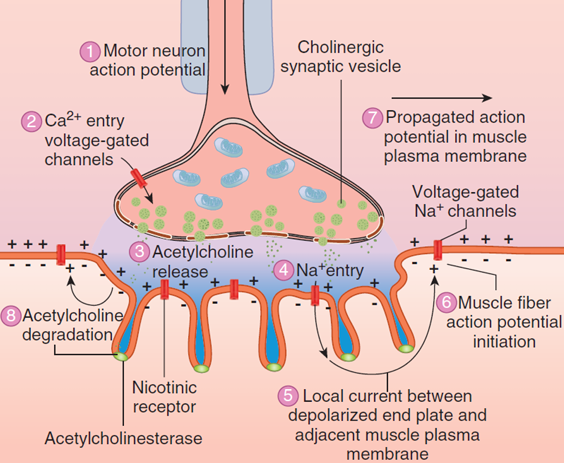
- When the motor neuron stimulates the muscle at the neuromuscular junction, the propagated action potential depolarizes the sarcolemma.
- There is an inward spread of the action potential along the system.
- 电信号 → 化学信号Ca2+ → 电信号
- The Motor Unit
- 一个神经加上所有控制的muscle fiber算一个单位,一个单位要么最大收缩要么不收缩,一个单位的muscle fiber与其他单位的muscle fiber分散在整个肌肉中,而不是一坨
- The functional unit of skeletal muscle is the motor unit运动单位.
- A motor unit includes
- a single motor neuron
- all of the muscle fibers innervated by it
- This unit is the smallest part of the muscle that can be made to contract independently.
- When stimulated, all muscle fibers in the motor unit respond as one.
- The fibers of a motor unit show an all-or-none response全或无反应.
- The number of muscle fibers forming a motor unit is closely related to the degree of control required of the muscle.
- Fibers of each motor unit are not contiguous but dispersed throughout the muscle with fibers of other units.
- If a single motor unit is stimulated, a large portion of the muscle appears to contract.
- If additional motor units are stimulated, the muscle contracts with greater force.
- Sliding Filament Mechanism
- The Musculotendinous Unit肌腱单位 and Hill’s Model
- 总结
- Viscoelastic Structures
- Tendons and connective tissues in and around the muscle belly are viscoelastic structures.
- They help determine the mechanical characteristics of entire muscle during contraction and passive extension.
- 分为收缩成分和弹性成分
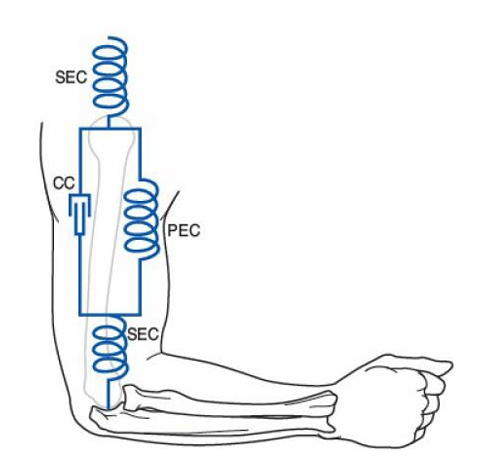
- contractile component
- the contractile proteins of the myofibril, actin, and myosin
- elastic component
- tendons
- represent a spring-like elastic component located in a series with the contractile component
- connective tissues
- epimysium肌外膜
- perimysium肌束膜
- endomysium肌内膜
- sarcolemma肌膜
- represent an elastic component located parallel to the contractile component
- tendons
- contractile component
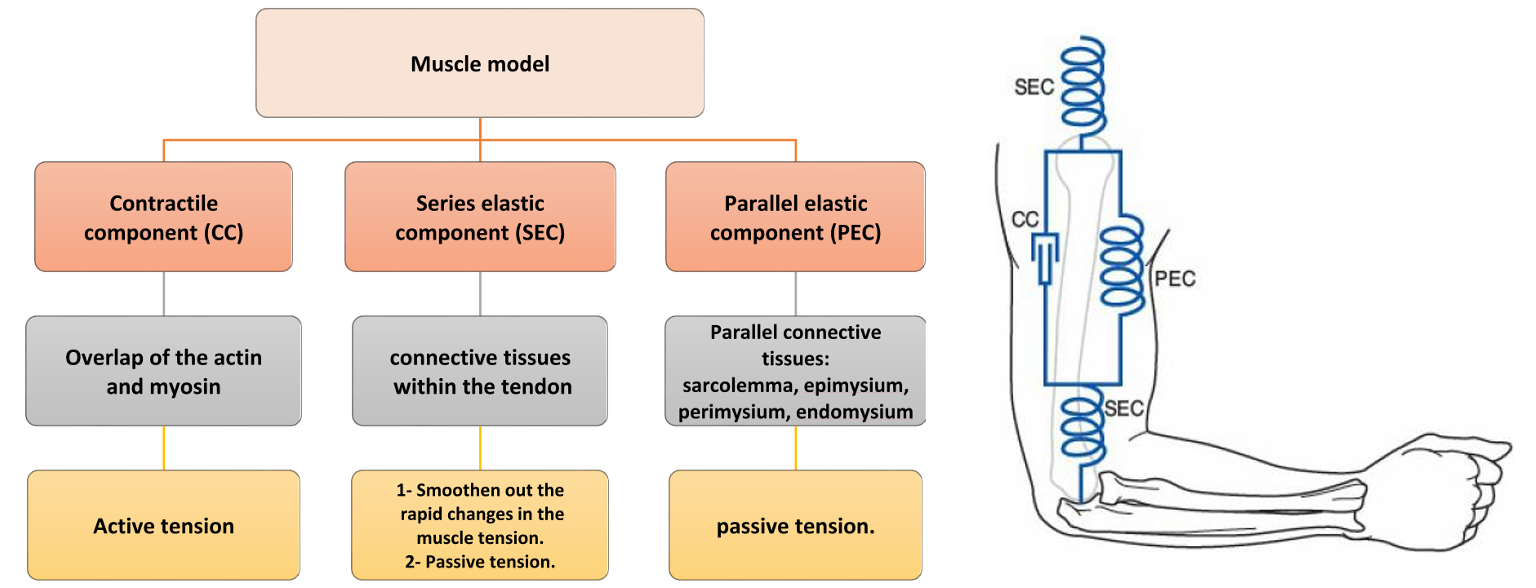
- Hill-Type Muscle Model
- Hill-type muscle model (Hill’s model) is one of the most used models to describe the mechanism of force production.
- It describes the behavior of the muscle and tendon using different elements.
- Hill model tree separates CC, SEC, and PEC
- contractile component CC收缩元件
- represents the fundamental mechanical behavior of the sarcomere
- governed by activation kinetics, force-length properties, and force-velocity properties
- corresponds to overlap of actin and myosin
- produces active tension主动张力
- series elastic component SEC串联弹性元件
- influence force, length, and speed of the entire unit
- connective tissues within the tendon
- smoothen out the rapid changes in muscle tension
- contributes to passive tension被动张力
- parallel elastic component PEC并联弹性元件
- influence force, length, and speed of the entire unit
- parallel connective tissues
- mainly produces passive tension
- Elastic Component Function
- 弹性成分可以储存然后释放能量
- When parallel and series elastic components stretch during active contraction or passive extension, tension is produced and energy is stored.
- When they recoil with muscle relaxation, this energy is released.
- Their distensibility and elasticity are valuable in several ways
- keep the muscle in readiness for contraction
- ensure that muscle tension is produced and transmitted smoothly during contraction
- ensure that contractile elements return to their original (resting) positions when contraction is terminated
- help prevent passive overstretch of relaxed contractile elements
- absorb energy proportional to the rate of force application, dissipate energy in a time-dependent manner
- 总结
- Types and Performance of Muscle Contraction
- Types of Muscle Contraction
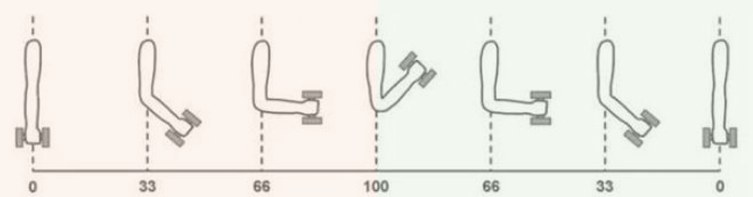
- dynamic work动态做功
- Mechanical work is performed and joint motion is produced.
- concentric contraction向心收缩
- Muscles develop sufficient tension to overcome the resistance of the body segment.
- The muscles shorten and cause joint movement.
- The net moment generated by the muscle is in the same direction as the change in joint angle.
- eccentric contraction离心收缩
- A muscle cannot develop sufficient tension and is overcome by the external load.
- The muscle progressively lengthens instead of shortening.
- The net muscle moment is in the opposite direction from the change in joint angle.
- One purpose of eccentric contraction is to decelerate the motion of a joint.
- Mechanical work is performed and joint motion is produced.
- static work静态维持
- No mechanical work is performed.
- Posture or joint position is maintained.
- isometric contraction等长收缩
- The muscle attempts to shorten, but it does not overcome the load and cause movement.
- Myofibrils shorten and stretch the series elastic component, thereby producing tension.
- No change takes place in the distance between the muscle’s points of attachment.
- The muscle produces a moment that supports the load in a fixed position, for example maintains posture.
- Although no motion and no mechanical work occur during isometric contraction, physiologic work is performed.
- Energy is expended and mostly dissipated as heat, called isometric heat production.
- dynamic work动态做功
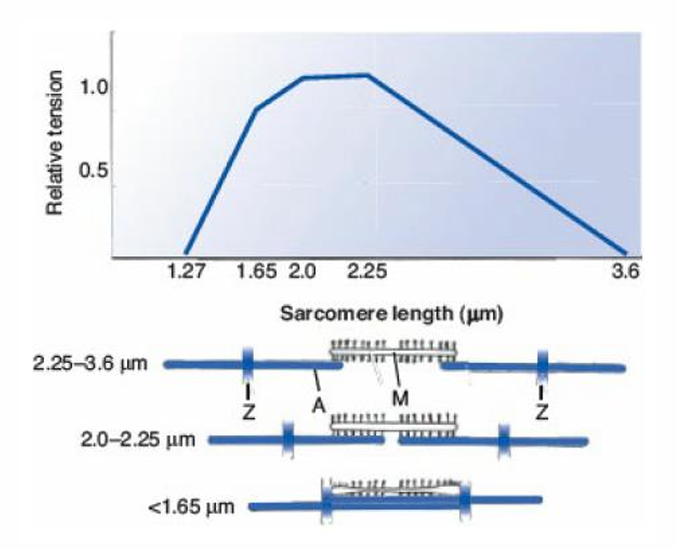
- Length-Tension Relationship
- The force, or tension, that a muscle exerts varies with the length at which it is held when stimulated.
- Maximal tension
- produced when the muscle fiber is approximately at its slack, or resting, length.
- 2.0-2.25 μm sarcomere length
- If the fiber is held at shorter lengths, tension falls off slowly at first and then rapidly.
- If the fiber is lengthened beyond resting length, tension progressively decreases.
- produced when the muscle fiber is approximately at its slack, or resting, length.
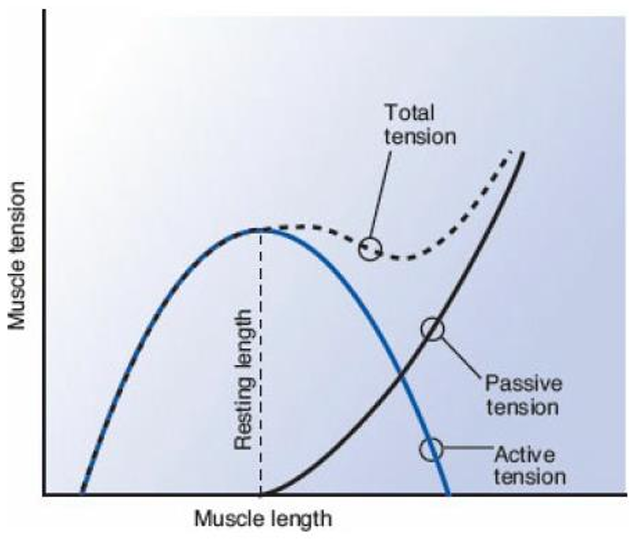
- Whole muscle isometric length-tension
- Tension produced by both active components and passive components must be taken into account.
- active tension主动张力
- developed by the contractile elements of the muscle
- resembles the curve for the individual fiber
- passive tension被动张力
- developed when the muscle surpasses its resting length
- the noncontractile muscle belly is stretched
- mainly developed in the parallel and series elastic components
- total tension总张力
- combined effect of active tension and passive tension
- At longer whole-muscle lengths, passive tension can raise total tension even while active tension declines.
- Tension produced by both active components and passive components must be taken into account.
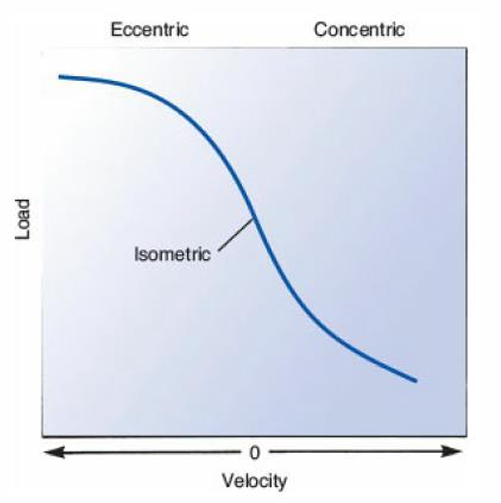
- Load-Velocity Relationship
- 东西从0变重速度减小,到0之后再变重肌肉就离心收缩了
- The velocity of shortening of a muscle contracting concentrically is inversely related to the external load applied.
- When the external load equals the maximal force that the muscle can exert, the velocity of shortening becomes zero.
- At zero shortening velocity, the muscle contracts isometrically.
- When the load is increased still further, the muscle contracts eccentrically, the muscle elongates during contraction.
- The load-velocity relationship is reversed from that of the concentrically contracting muscle.
- The muscle eccentrically lengthens more quickly with increasing load.
- 东西从0变重速度减小,到0之后再变重肌肉就离心收缩了
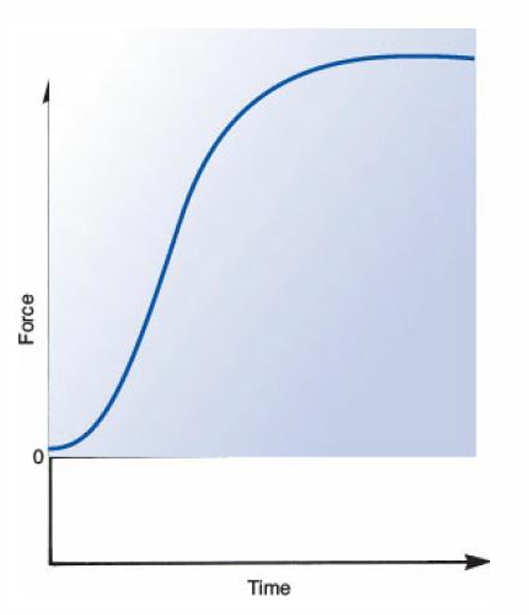
- Force-Time Relationship
- 收缩很快,传递需要时间
- The force, or tension, generated by a muscle is proportional to the contraction time.
- The longer the contraction time, the greater the force developed, up to maximum tension.
- Time is allowed for tension produced by contractile elements to be transmitted through elastic components to the tendon.
- Tension production in the contractile component can reach a maximum in as little as 10 msec.
- Up to 300 msec may be needed for that tension to be transferred to the elastic components.
- The tendon reaches maximum tension only if the active contraction process is of sufficient duration.
- 收缩很快,传递需要时间
- Types of Muscle Contraction
- Factors
- Effect of Skeletal Muscle Architecture
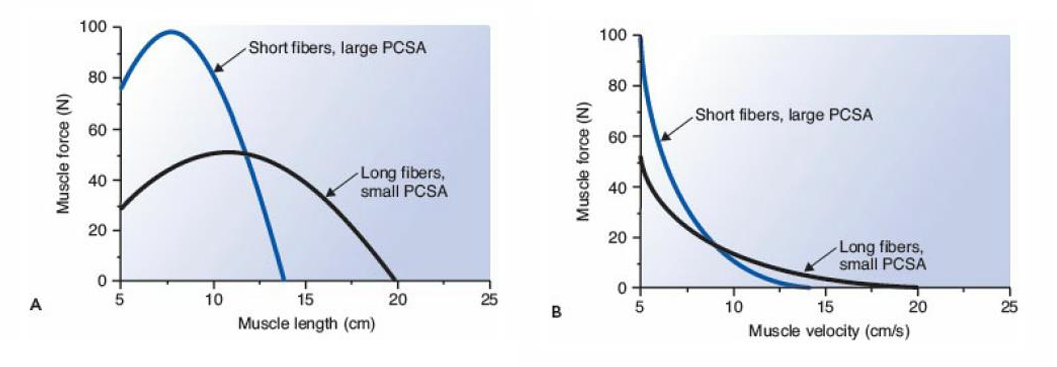
- The more sarcomeres lie in series, the longer the myofibril.
- The more sarcomeres lie parallel, the larger the cross-sectional area of the myofibril.
- Two architectural patterns affect contractile properties
- long myofibrils
- velocity and excursion, or working range, are proportional to myofibril length
- designed for excursion and velocity
- thick myofibrils
- force is proportional to cross-sectional area
- shorter fibers and larger cross-sectional area are designed to produce force
- long myofibrils
- 图 - short fibers with large PCSA show higher force, long fibers with small PCSA show larger range and velocity
- Effect of Temperature
- Changes in temperature affect the contractile properties of skeletal muscles.
- Extreme environmental conditions change the rate of enzymatic activity within the muscle.
- 升温
- A rise in muscle temperature causes an increase in conduction velocity across the sarcolemma.
- Increased conduction velocity increases the frequency of stimulation and hence production of muscle force.
- 降温
- With a decrease in temperature, there is a decrease in production or utilization of ATP.
- Cooling can deplete intracellular glycogen and affect muscle performance power.
- Effect of Fatigue
- ATP availability
- 肌肉收缩和放松依赖ATP,低频刺激下,若氧气和营养充足,肌肉可长时间工作,前提是ATP合成速率能跟上分解速率
- The ability of a muscle to contract and relax depends on the availability of ATP.
- If oxygen and nutrients are adequate, muscle can sustain low-frequency twitch抽搐 responses for a long time.
- The frequency must be low enough for ATP synthesis to keep up with ATP breakdown during contraction.
- oxidative phosphorylation氧化磷酸化
- 中强度活动时主要靠此途径供能,但剧烈运动时ATP分解太快,即使氧气充足,氧化磷酸化速度也可能不足
- At moderate rates of muscle activity, most required ATP can be formed by oxidative phosphorylation.
- During very intense exercise, ATP is broken down very rapidly.
- The ability to replace ATP by oxidative phosphorylation may be limited by inadequate oxygen delivery.
- Even when oxygen delivery is adequate, oxidative phosphorylation may be too slow to sustain very intense exercise.
- anaerobic glycolysis无氧糖酵解
- 剧烈运动时该途径贡献增加,其优点是反应快、无需氧气,缺点是每分子葡萄糖产生的ATP很少,且产生乳酸,会快速消耗糖原,当肌球蛋白ATP酶分解ATP的速度超过糖酵解合成速度时,ATP浓度下降,疲劳迅速发生
- Anaerobic glycolysis contributes an increasing portion of ATP during intense exercise.
- It produces much smaller amounts of ATP from glucose breakdown.
- It operates at a much faster rate.
- It can proceed in the absence of oxygen, with lactic acid as its end product.
- It requires large amounts of glucose for small amounts of ATP.
- Existing glycogen supplies may be depleted quickly when activity is intense.
- Myosin ATPase may break down ATP faster than glycolysis can replace it, and fatigue occurs rapidly as ATP concentrations drop.
- Recovery and efficiency
- 运动后需要重新合成磷酸肌酸和糖原,期间耗氧量仍较高,化学能转化为机械能的效率通常只有20%-25%,大部分能量变成热量,最高状态下也仅约45%的能量用于收缩
- After intense exercise, creatine phosphate磷酸计算 levels drop.
- Much of the muscle glycogen may have been converted to lactic acid乳酸.
- Creatine phosphate must be resynthesized and glycogen stores must be replaced.
- Both processes require energy, so the muscle continues to consume oxygen rapidly even after contraction stops.
- Chemical energy to movement efficiency is usually no more than 20% to 25%.
- Most energy is dissipated as heat.
- Even in its most efficient state, a maximum of only about 45% of energy is used for contraction.
- ATP availability
- Muscle Damage
- mechanical model力学模型
- 强调离心收缩产生更大的力,使每个横桥承受的张力增加,导致收缩蛋白更容易发生结构破坏,该模型主要适用于由离心收缩引起的运动损伤(如冲刺、跳跃、下坡跑等)
- Eccentric contraction produces a greater amount of force.
- This increases force per cross-bridge and predisposes contractile proteins to fail.
- It is primarily true with exercise-induced injuries involving eccentric muscle contraction.
- metabolic model代谢模型
- 关注肌肉在受力状态下的代谢紊乱——钙离子(Ca²⁺)水平升高,引发肌纤维退化,该模型主要解释以向心收缩为主的活动(如长距离自行车、马拉松)所导致的肌肉损伤,认为损伤更多源于代谢产物堆积和钙稳态失衡,而非直接的机械撕裂
- Deficiencies occur within the stressed muscle.
- The presence of Ca2+ increases and may result in muscle fiber degeneration.
- This may explain muscle damage from activities primarily involving concentric contraction.
- Examples include long cycling events or marathons.
- mechanical model力学模型
- Effect of Disuse and Immobilization
- Disuse and immobilization have detrimental effects on muscle fibers.
- Main effects include
- loss of endurance and force production
- muscle atrophy萎缩 at microstructural and macrostructural levels
- These effects depend on
- fiber type
- muscle length during immobilization
- cause of immobilization
- immobilization cause
- Loss of muscle force production due to reduced physical activity and biologic aging.
- loss of strength is greater in the lower limbs than in the upper limbs.
- Reduced postural demand leads to atrophy减少 of slow twitch fibers慢肌纤维. Slow twitch fiber atrophy results in difficulties in postural maintenance. Their cross-sectional area decreases. Their potential for oxidative enzyme activity is reduced.
- Prevention and Recovery
- Physical training increases the cross-sectional area of all muscle fibers.
- The affected fiber type depends on the chosen sport.
- In endurance athletes, slow twitch fibers are mainly affected.
- In explosive activities such as sprinting短跑, intermediate twitch fibers中间型肌纤维 are affected.
- Early motion may prevent this atrophy
- Electric stimulation may also prevent
- the decrease in slow twitch fiber size
- the decline in oxidative enzyme activity caused by immobilization
- Effects of Physical Training
- Physical activity influences muscle architecture and force production.
- Fascicle length肌束长度 differs in highly trained athletes, lesser trained athletes, and untrained controls.
- Unique muscle geometry can be found in athletes from different sports.
- sprinter 短跑运动员
- endurance runner 耐力跑运动员
- weightlifter 举重运动员
- There was no relative or absolute difference of fascicle length between gender.
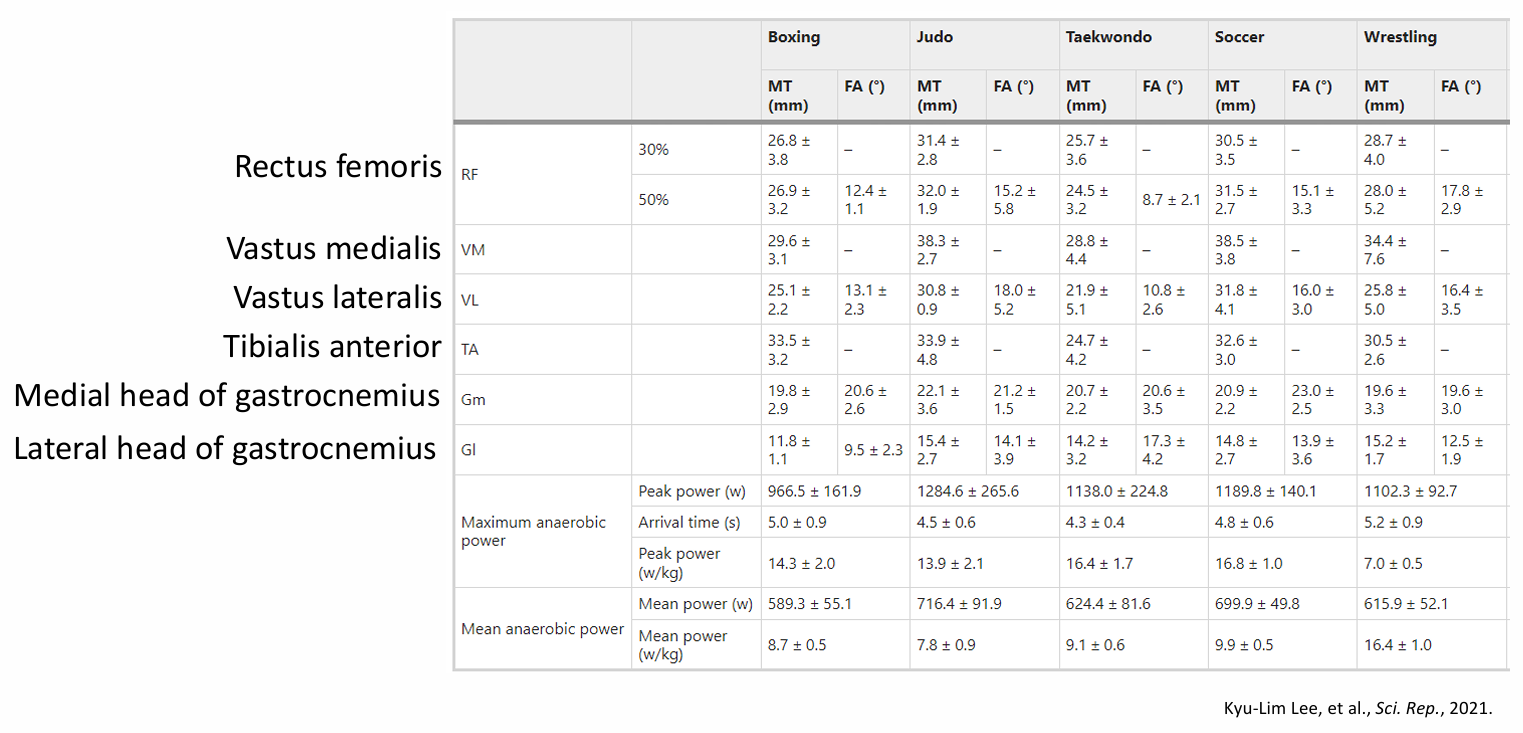
- Athlete comparison table
- 图
- Muscles compared include rectus femoris, vastus medialis, vastus lateralis, tibialis anterior, medial head of gastrocnemius, and lateral head of gastrocnemius.
- Sports compared include boxing, judo, taekwondo, soccer, and wrestling.
- Variables include MT (mm), FA (°), maximum anaerobic power, and mean anaerobic power.
- 图
- Training type and fiber type
- Different exercises have different effects on different types of muscle fiber.
- Intermediate twitch fibers and fast twitch fibers show greater enlargement after eccentric training than after concentric training. This is in line with increased isometric force production.
- Physical activity influences differentiation into slow-twitch and fast-twitch fiber, which may change the biomechanical properties of force production.
- The cross-sectional area of the fibers is affected by one’s principal activity.
- In endurance athletes, the area taken up by slow twitch fibers and intermediate twitch fibers increases. This increase occurs at the expense of the total area of fast twitch fibers.
- Effect of Skeletal Muscle Architecture
- Structure and Organization
- Take-Home Message
- What are the thick filaments and thin filaments, respectively?
- Thick filaments are about 15 nm in diameter and composed of myosin.
- Thin filaments are approximately 5 nm in diameter and composed of actin.
- Thin filaments are attached to Z lines and overlap with thick filaments toward the center of the sarcomere.
- What are Z line, A band, I band, H zone, and M line?
- Z line defines the limits of each sarcomere and links thin filaments of adjacent sarcomeres.
- A band corresponds to thick filaments and remains constant during shortening.
- I band contains non-overlapping thin filaments and elastic titin; it decreases during shortening.
- H zone is the central light region of the A band containing only thick filaments.
- M line is the central dark line that links adjacent thick filaments and maintains parallel arrangement.
- What is the Hill’s model?
- A muscle force-production model composed of CC, SEC, PEC, and tendon-related behavior.
- CC represents sarcomere contractile behavior and active tension.
- SEC represents series elasticity, mainly tendon connective tissues.
- PEC represents parallel connective tissues and passive tension.
- The model links activation kinetics, force-length properties, and force-velocity properties.
- What is the length-tension relationship in muscle fiber?
- Muscle tension varies with the length at which the fiber is held when stimulated.
- Maximal active tension occurs near resting sarcomere length, about 2.0-2.25 μm.
- Shorter or longer sarcomere lengths reduce active tension because actin-myosin overlap becomes less optimal.
- In whole muscle, total tension includes active tension plus passive tension from elastic components.
- How does disuse and immobilization affect muscle force and muscle composition?
- They reduce endurance and force production.
- They cause muscle atrophy at microstructural and macrostructural levels.
- Loss of strength is greater in lower limbs than upper limbs.
- Prolonged bed rest especially causes slow twitch fiber atrophy and reduced oxidative enzyme activity.
- Early motion and electric stimulation may help prevent atrophy.
- What are the thick filaments and thin filaments, respectively?
All articles in this blog are licensed under CC BY-NC-SA 4.0 unless stating additionally.