
生物力学_Elasticity
Elasticity
- pic1
- pic2
- pic3
- pic4
- take home message
- What are stress and strain? / 什么是应力和应变?
- English
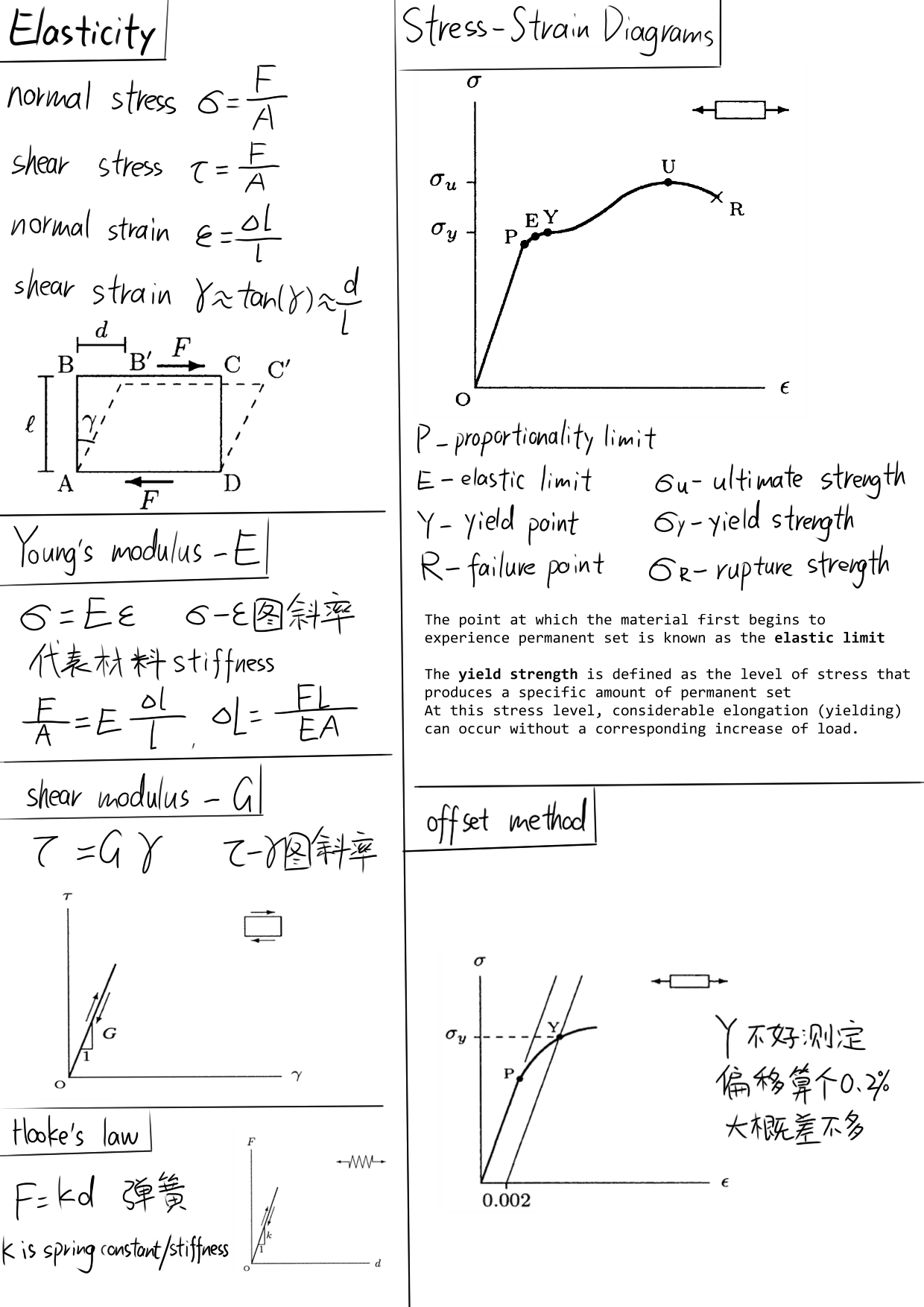
- Stress is the intensity of internal force over a section, or force per unit area.
- Normal stress is produced by a force perpendicular to the section and is denoted by σ. The average normal stress is σ = F / A.
- Tensile loading produces tensile stress, while compressive loading produces compressive stress. Tension is usually positive and compression is negative.
- Shear stress is produced by a force parallel to the section and is denoted by τ. The average shear stress is τ = Fs / A.
- Strain describes deformation normalized by the original dimension, so it is dimensionless.
- Normal or axial strain is ε = Δl / l0, where Δl is the change in length and l0 is the original gauge length.
- In tension, Δl and ε are positive; in compression, Δl and ε are negative. Shear strain is denoted by γ and describes angular distortion.
- 中文
- 应力是截面内部力的强度,也就是单位面积上的内力
- 垂直于截面的力产生正应力 normal stress,常用 σ 表示;平均正应力为 σ = F / A
- 拉伸载荷产生拉应力,压缩载荷产生压应力通常拉伸取正,压缩取负
- 平行于截面的力产生剪应力 shear stress,常用 τ 表示;平均剪应力为 τ = Fs / A
- 应变表示相对于原始尺寸的变形程度,因此没有单位
- 正应变或轴向应变为 ε = Δl / l0,其中 Δl 是长度变化量,l0 是原始标距
- 拉伸时 Δl 和 ε 为正,压缩时 Δl 和 ε 为负剪应变常用 γ 表示,用来描述角度形变
- What do the points in the stress-strain diagram mean? / 应力-应变图中的各点表示什么?
- English
- Point O is the origin and represents the initial state with no load and no deformation.
- Point P is the proportionality limit. Between O and P, stress and strain are linearly proportional.
- Point E is the elastic limit. Below this point, deformation is fully recoverable after unloading; above it, permanent set begins.
- Point Y is the yield point, and its stress is the yield strength σy. After yielding, large deformation can occur with little or no increase in load.
- If the yield point is not obvious, the 0.2% offset method can be used to define an apparent yield strength.
- Point U is the ultimate strength point, the highest point on the engineering stress-strain curve.
- Point R is the rupture or failure point. Because of necking, the rupture strength σR may be lower than the ultimate strength σU.
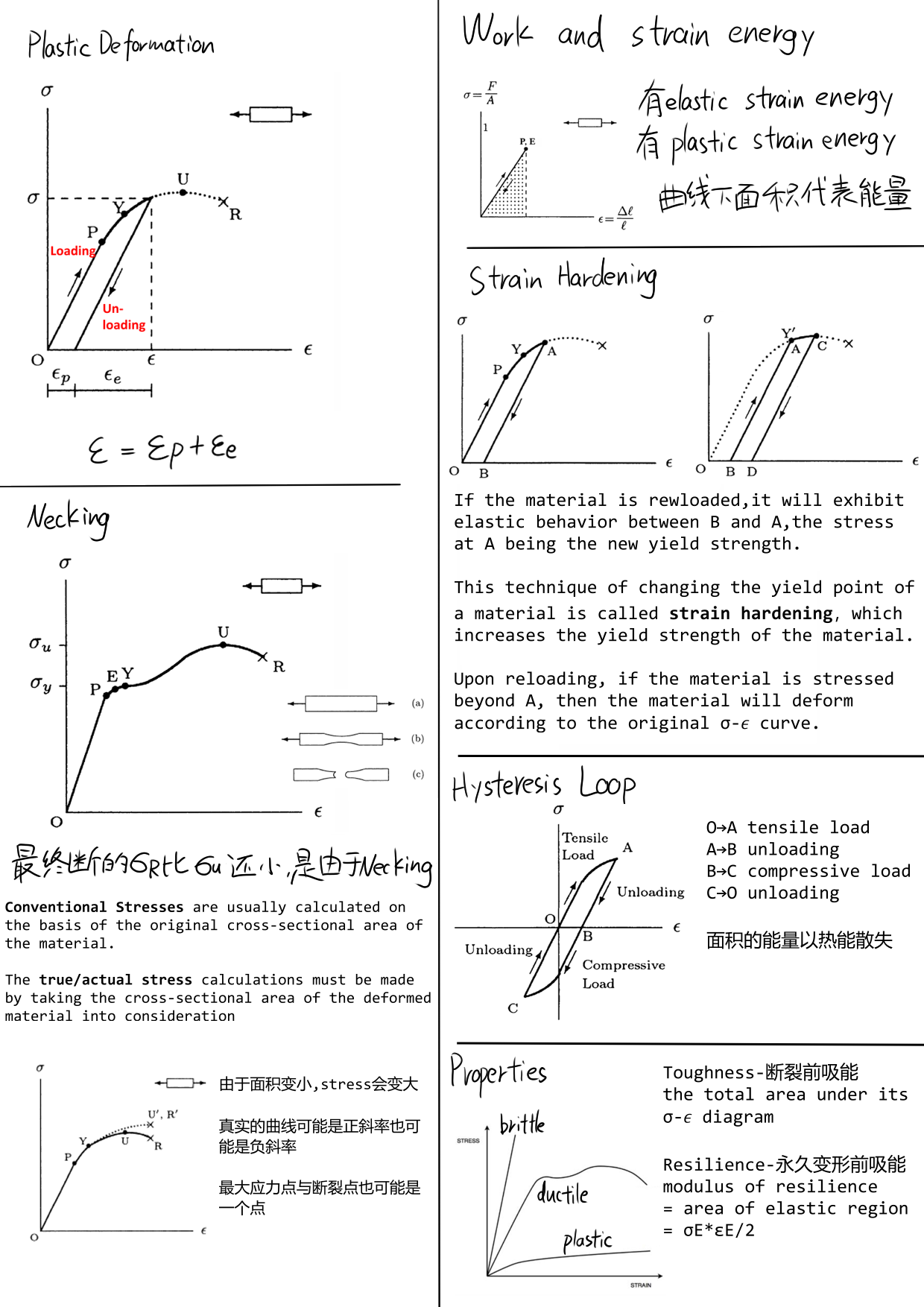
- The curve also shows material properties: a steeper elastic slope means a larger modulus and a stiffer material, a larger area under the curve means higher toughness, and resilience is the ability to store energy without permanent deformation.
- 中文
- O 点是原点,表示无载荷、无变形的初始状态
- P 点是比例极限O 到 P 区间内,应力和应变线性成正比
- E 点是弹性极限低于该点卸载后可完全恢复;超过该点会开始出现永久变形
- Y 点是屈服点,对应屈服强度 σy屈服后材料可发生明显变形,但载荷不一定明显增加
- 如果屈服点不明显,可用 0.2% 偏移法确定表观屈服强度
- U 点是极限强度点,是工程应力-应变曲线上的最高应力点
- R 点是断裂或失效点由于颈缩,断裂强度 σR 可能低于极限强度 σU
- 曲线还可反映材料性质:弹性段斜率越大,弹性模量越大,材料越硬;曲线下面积越大,韧性 toughness 越高;在不产生永久变形的情况下储存能量的能力称为 resilience
- How to measure the Young’s modulus of a material? / 如何测量材料的杨氏模量?
- English
- Young’s modulus is measured from the linear elastic region of a stress-strain curve.
- Perform a uniaxial tension or compression test and record the applied load F and the gauge-length change Δl.
- Calculate engineering stress with the original area: σ = F / A0.
- Calculate engineering strain with the original gauge length: ε = Δl / l0.
- Plot σ against ε. The slope of the linear elastic region gives E = Δσ / Δε.
- For a linearly elastic material, Hooke’s law is σ = Eε. E represents material stiffness: a larger E means smaller strain under the same stress.
- If E is known, the linear elastic load-deformation relation can also be written as Δl = FL / AE.
- 中文
- 杨氏模量从应力-应变曲线的线性弹性段测得
- 进行单轴拉伸或压缩实验,记录载荷 F 和标距段长度变化 Δl
- 用原始截面积 A0 计算工程应力:σ = F / A0
- 用原始标距 l0 计算工程应变:ε = Δl / l0
- 绘制 σ-ε 曲线后,线性弹性段斜率就是 E = Δσ / Δε
- 对线弹性材料,胡克定律为 σ = EεE 表示材料刚度;E 越大,同样应力下应变越小
- 若已知 E,在线弹性范围内也可用载荷-变形关系 Δl = FL / AE
- What is elastic deformation? What is plastic deformation? / 什么是弹性变形和塑性变形?
- English
- Elastic deformation is deformation that can be fully recovered after the load is removed.
- When stress stays below the elastic limit, the material returns to its original size and shape after unloading.
- A linearly elastic material has a straight stress-strain curve in the elastic region, with slope E.
- A nonlinear elastic material can still recover, but its slope is not constant, so it does not have a single elastic modulus.
- Plastic deformation is permanent deformation that remains after unloading and occurs after the material is loaded beyond its elastic limit or yield point.
- Total strain can be viewed as εtotal = εe + εp, where εe is recoverable elastic strain and εp is permanent plastic strain.
- A loading-unloading cycle may form a hysteresis loop, whose area represents energy dissipated as heat.
- 中文
- 弹性变形是卸载后能够完全恢复的变形
- 当应力低于弹性极限时,材料在卸载后能恢复原始尺寸和形状
- 线弹性材料在弹性区的应力-应变曲线为直线,斜率为 E
- 非线性弹性材料也可恢复,但曲线斜率不恒定,因此没有单一弹性模量
- 塑性变形是卸载后仍然保留的永久变形,通常发生在材料加载超过弹性极限或屈服点之后
- 总应变可理解为 εtotal = εe + εp,其中 εe 是可恢复弹性应变,εp 是永久塑性应变
- 加载-卸载循环可能形成滞回环,回线面积表示以热等形式耗散的能量
- What is necking? / 什么是颈缩?
- English
- Necking is the localized reduction of cross-sectional area after a tensile specimen reaches its ultimate strength.
- Once necking begins, deformation concentrates in the narrowed region and the specimen may continue to elongate even while the total load decreases.
- Engineering stress is usually calculated using the original cross-sectional area.
- After necking, the engineering stress may decrease even though the true local stress, calculated using the actual reduced area, may continue to increase.
- This is why the rupture strength σR can be lower than the ultimate strength σU on an engineering stress-strain curve.
- 中文
- 颈缩是拉伸试样达到极限强度后,局部横截面积迅速变小的现象
- 颈缩开始后,变形集中在变窄区域,即使总载荷下降,试样也可能继续伸长
- 工程应力通常用原始截面积计算
- 颈缩后工程应力可能下降;但如果用变形后的实际面积计算真实局部应力,真实应力仍可能继续上升
- 这就是为什么在工程应力-应变曲线上,断裂强度 σR 可能低于极限强度 σU
- What is Poisson’s ratio? / 什么是泊松比?
- English
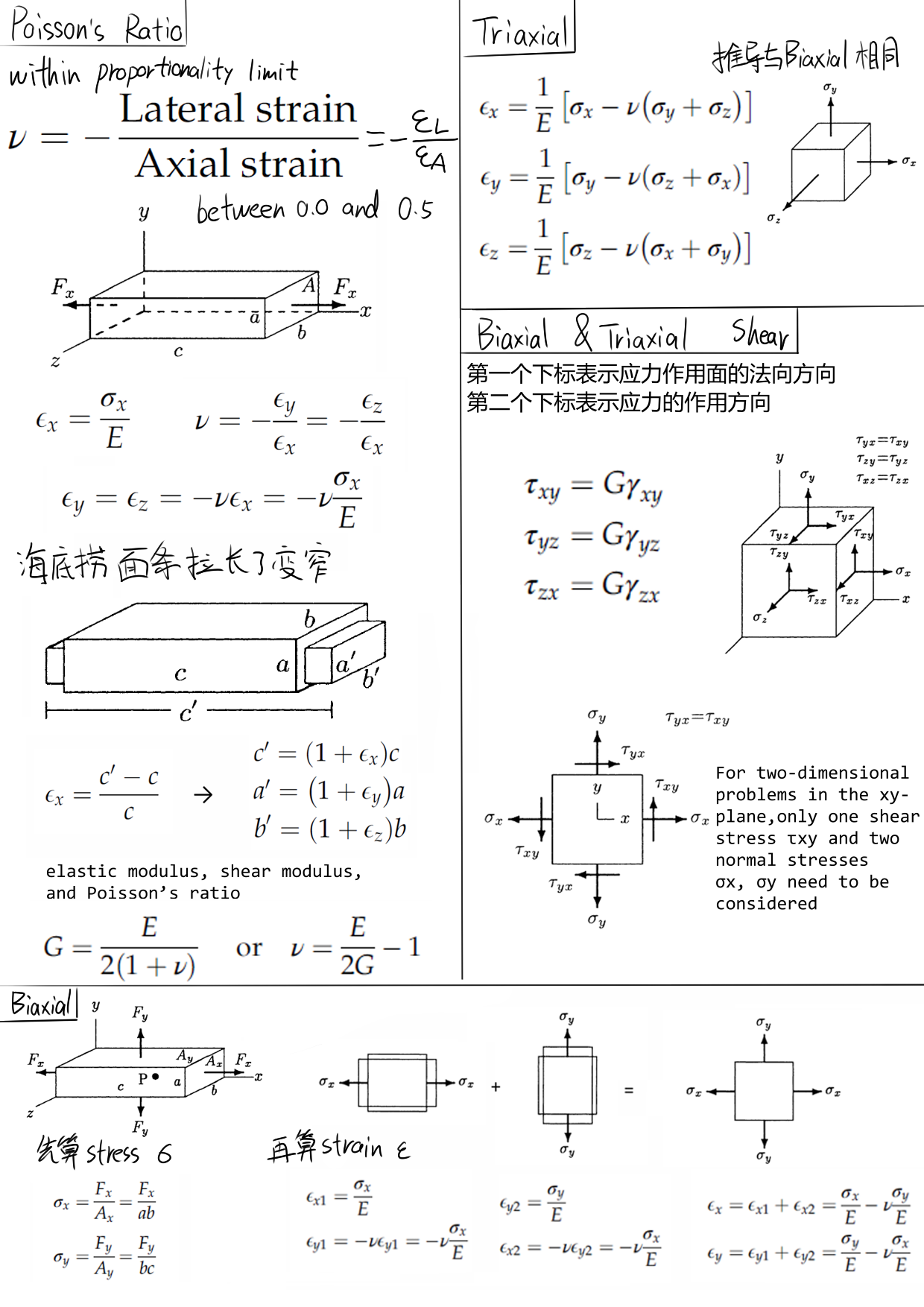
- Poisson’s ratio ν is the negative ratio of lateral strain to axial strain under uniaxial loading: ν = -εlateral / εaxial.
- In tension, the specimen elongates axially and contracts laterally; in compression, it shortens axially and expands laterally.
- The negative sign indicates that lateral and axial strains have opposite signs.
- For uniaxial stress in the x direction, εx = σx / E and εy = εz = -νσx / E.
- For an isotropic linearly elastic material, Young’s modulus E, shear modulus G, and Poisson’s ratio ν are related by E = 2G(1 + ν).
- Most materials have ν between 0 and 0.5. A perfectly incompressible isotropic material has ν = 0.5 at small elastic strains.
- Examples: cork is close to 0, steel is about 0.3, and rubber is close to 0.5.
- 中文
- 泊松比 ν 是单轴加载时横向应变与轴向应变之比的负值,即 ν = -εlateral / εaxial
- 拉伸时试样轴向伸长、横向收缩;压缩时轴向缩短、横向膨胀
- 负号表示横向应变和轴向应变方向相反
- 若 x 方向单轴受力,则 εx = σx / E,εy = εz = -νσx / E
- 对各向同性线弹性材料,杨氏模量 E、剪切模量 G 和泊松比 ν 满足 E = 2G(1 + ν)
- 多数材料的 ν 在 0 到 0.5 之间完全不可压缩的各向同性材料在小应变弹性变形下 ν = 0.5
- 例子:软木接近 0,钢约 0.3,橡胶接近 0.5
- How to solve stress-strain relationships for biaxial and triaxial loading? / 如何求解双轴和三轴加载下的应力-应变关系?
- English
- Use these relations for isotropic, linearly elastic materials under small deformation and within the proportionality limit.
- The method is superposition: each normal stress produces axial strain in its own direction and Poisson strain in the other directions.
- First calculate stresses from loads and corresponding areas: σx = Fx / Ax, σy = Fy / Ay, and σz = Fz / Az. Take tension as positive and compression as negative.
- For triaxial normal stresses: εx = [σx - ν(σy + σz)] / E.
- εy = [σy - ν(σx + σz)] / E.
- εz = [σz - ν(σx + σy)] / E.
- For biaxial loading in the xy-plane, set σz = 0. Then εx = (σx - νσy) / E, εy = (σy - νσx) / E, and εz = -ν(σx + σy) / E.
- Treat shear separately using γxy = τxy / G. Dimension changes are ΔLx = εxLx0, ΔLy = εyLy0, and ΔLz = εzLz0.
- 中文
- 这些关系适用于各向同性、线弹性、小变形且处于比例极限以内的材料
- 方法是叠加原理:每个正应力在本方向产生轴向应变,并通过泊松效应影响另外两个方向
- 先由载荷和对应面积求应力:σx = Fx / Ax,σy = Fy / Ay,σz = Fz / Az拉伸取正,压缩取负
- 三轴正应力下:εx = [σx - ν(σy + σz)] / E
- εy = [σy - ν(σx + σz)] / E
- εz = [σz - ν(σx + σy)] / E
- 对 xy 平面双轴加载,令 σz = 0,可得 εx = (σx - νσy) / E,εy = (σy - νσx) / E,εz = -ν(σx + σy) / E
- 剪切部分单独处理,使用 γxy = τxy / G;尺寸变化由 ΔLx = εxLx0,ΔLy = εyLy0,ΔLz = εzLz0 计算
All articles in this blog are licensed under CC BY-NC-SA 4.0 unless stating additionally.